Your Complete Guide to Building Repeat Guest Loyalty
Learn to build repeat guest loyalty with key strategies that boost direct bookings, lower costs, and enhance customer experiences.

Your Complete Guide to Building Repeat Guest Loyalty
The single highest-impact move you can make this week: pair emotional recognition with a clear direct-booking incentive, and store every guest detail in a centralized profile. That combination lowers your customer acquisition cost, raises customer lifetime value (CLV), and converts OTA-sourced guests into direct repeat bookers faster than any points program alone.
Start here, right now:
- Capture every guest email at check-in or checkout using a Wi-Fi splash page or a simple checkout form.
- Send a checkout thank-you within 24 hours that includes a direct-booking link and one concrete incentive (a waived fee, a priority date, or a small welcome gesture on the next stay).
- Log a guest note in your PMS or CRM immediately after checkout: preferences, special requests, anything that made the stay memorable.
- Schedule your 90-day pilot kickoff for the first Monday of next month, assign one owner, and set a single success metric (repeat booking rate or direct-booking ratio).
These four steps cost almost nothing and produce the data infrastructure every loyalty strategy runs on. Lower acquisition cost and higher CLV follow naturally once the data is in place and the outreach is consistent.
Key Takeaways
Building repeat guest loyalty requires emotional recognition, clean guest data, and a consistent post-stay outreach sequence running together from day one.
| Point | Details |
|---|---|
| Start with data capture | Collect guest emails at every touchpoint (Wi-Fi, checkout form, check-in tablet) before launching any program. |
| Run the three-message sequence | A checkout message, a 3-week follow-up, and a seasonal pre-opening alert convert OTA guests into direct repeat bookers. |
| Track five KPIs | Monitor Repeat Customer Rate, retention rate, CLV, NPS, and direct booking ratio monthly. |
| Choose the right program model | Recognition-first combined with a simple direct-booking incentive delivers the best return for small portfolios. |
| Realtevoos automates the workflow | Realtevoos syncs guest profiles, triggers post-stay campaigns, and tracks loyalty KPIs across your full property portfolio. |
Legal note: U.S. operators must comply with CAN-SPAM for email marketing and TCPA for SMS outreach. Capture explicit written consent at enrollment, document it in your CRM, and include an unsubscribe option in every commercial message.
Table of Contents
- What does guest loyalty actually mean for your business?
- Why guest loyalty is worth the investment
- Which KPIs tell you if your loyalty program is working?
- What loyalty program model fits your property?
- How to design your guest loyalty strategy step by step
- How do you deliver personalization at scale across multiple properties?
- What technology do you need to run a loyalty program efficiently?
- How do you re-engage past guests and convert them to direct bookers?
- How do you test and improve your loyalty program over time?
- Practical examples: what actually drives guests to come back
- Your 90-day loyalty pilot plan
- A practitioner’s perspective on what loyalty programs actually demand
- How Realtevoos helps you run loyalty programs at scale
- Sources
What does guest loyalty actually mean for your business?
Guest loyalty is the measurable tendency of a past guest to return, book directly, and refer others, rather than searching OTA listings again. The business outcome is straightforward: more revenue per guest, less commission paid to third-party platforms, and a more predictable occupancy curve.
The distinction that most programs get wrong is transactional versus emotional loyalty. Understanding both is the foundation of any effective guest loyalty strategy.
| Type | Driver | Guest behavior | Example |
|---|---|---|---|
| Transactional | Points, discounts, cashback | Returns when the deal is good enough | “Book direct and save 10%” |
| Emotional | Recognition, remembered preferences, personal gestures | Returns because the experience felt personal | Remembering a guest’s anniversary and leaving a card |
Transactional loyalty is easy to copy. A competitor can always offer a deeper discount. Emotional loyalty is much harder to replicate because it depends on data, consistency, and genuine human attention, not just a price lever. Guests who feel recognized tend to return even when a cheaper alternative exists, and they refer friends at higher rates.
The most commercially effective programs mix both. A points mechanism gives guests a rational reason to choose you; recognition and personalization give them an emotional reason to stay loyal even when the points balance is zero. Neither alone is as durable as the combination.
Why guest loyalty is worth the investment
The economics of retention are straightforward and compelling. A returning direct guest costs a fraction of that.
Here is what improves when loyalty programs work:
- Lower customer acquisition cost (CAC): Repeat guests book direct, bypassing OTA commissions entirely.
- Higher CLV: A guest who stays multiple times over a period generates more total revenue than separate one-time guests at the same nightly rate.
- Steadier occupancy: Loyal guests often book earlier and fill shoulder-season gaps that OTA demand does not reliably cover.
- More direct bookings: Every direct booking adds margin and gives you the guest’s contact data for future campaigns.
- Referral revenue: Emotionally loyal guests recommend properties to friends and family, producing zero-cost new-guest acquisition.
Industry insight: Loyalty programs can deliver several multiples of revenue compared to their cost when executed with the right engagement model and data infrastructure, according to industry benchmarks cited by Cvent.
The practical consequence for operations is significant. A property manager running a portfolio of multiple units who converts a portion of OTA guests into direct repeat bookers eliminates a significant slice of commission expense while building a contact list that compounds in value every season. That list is an asset no OTA can take away.
Which KPIs tell you if your loyalty program is working?
Measuring loyalty requires five specific metrics. Track all five; relying on occupancy rate alone hides whether your repeat-booking engine is actually functioning.
| KPI | Formula | Cadence | Dashboard field |
|---|---|---|---|
| Repeat Customer Rate (RCR) | (Guests with 2+ stays ÷ total unique guests) × 100 | Monthly | % repeat guests |
| Guest Retention Rate | ((Guests at end of period − new guests) ÷ guests at start) × 100 | Quarterly | Retention % |
| Customer Lifetime Value (CLV) | Avg. booking value × avg. stays per year × avg. guest lifespan (years) | Quarterly | CLV ($) |
| Net Promoter Score (NPS) | % promoters − % detractors | Monthly or post-stay | NPS score |
| Direct Booking Ratio | Direct bookings ÷ total bookings × 100 | Weekly | Direct % |
Repeat Customer Rate is the most actionable of these for vacation rental operators because your PMS already holds the data you need: guest name, email, and booking count. Pull a monthly export, count guests with more than one confirmed stay, divide by total unique guests, and multiply by 100. A rising RCR is the clearest early signal that your loyalty work is producing results.
CLV calculation deserves a concrete example. If your average booking value is $1,200, a loyal guest books 1.5 times per year, and you retain them for three years, their CLV is $5,400. Compare that to a one-time OTA guest at $1,200 and the case for investing $50–$100 in recognition perks per repeat guest becomes obvious.
Pro Tip: Set up a simple Google Sheets dashboard that pulls monthly PMS exports. Track RCR, direct booking ratio, and NPS in three columns. Review it on the first Monday of every month. Consistency in measurement beats sophistication in tooling.
What loyalty program model fits your property?
Four common program types cover most hospitality use cases, and each carries predictable tradeoffs in adoption, perceived value, and operational complexity.
- Points-per-spend: Guests earn points for each dollar spent and redeem them for future stays or perks. High adoption potential, but requires a redemption engine and can feel transactional. Best for hotels with high booking volume and repeat-guest infrastructure.
- Tiered status: Guests unlock Silver, Gold, or Platinum tiers based on nights stayed or spend. Creates aspiration and social signaling. Operationally heavier because each tier needs defined benefits and consistent delivery. Works well for multi-property portfolios.
- Paid membership: Guests pay an annual fee for guaranteed perks (priority booking, waived fees, exclusive rates). Generates upfront revenue and self-selects your most committed guests. Ideal for vacation rentals with a loyal base and a differentiated product.
- Value-based (cause-linked): A portion of each booking goes to a cause the guest cares about. Low operational complexity, strong emotional resonance, and no redemption mechanics to manage. Particularly effective for eco-conscious or community-focused properties.
Beyond these four, recognition-first (“hidden loyalty”) deserves its own mention. This is not a formal program at all. It is a system of internal triggers: a note in the guest profile that fires a welcome-back gesture, a staff prompt to mention a remembered preference, a small upgrade when inventory allows. Emotional gestures like these often produce stronger repeat behavior than generic discounts because they feel personal rather than mechanical.
| Program type | Complexity | Cost to serve | Direct booking impact | Emotional loyalty |
|---|---|---|---|---|
| Points | High | Medium | Medium | Low |
| Tiers | High | Medium–High | High | Medium |
| Paid membership | Medium | Low (after setup) | High | High |
| Value-based | Low | Low | Medium | High |
| Recognition-first | Low | Low | Medium | Very high |
For vacation rental operators managing fewer than 50 units, recognition-first combined with a simple direct-booking incentive (waived cleaning fee on the second stay, priority access to peak dates) delivers the best return for the least operational overhead. Scale the formal program architecture later, once your guest data is clean and your team has the habit of using it.
Pro Tip: Low-cost, high-perceived-value perks outperform discounts in most guest surveys. A handwritten welcome-back card, a local coffee brand in the kitchen, or a pet treat for a returning dog owner costs under $10 and generates the kind of story guests tell friends.
How to design your guest loyalty strategy step by step
A loyalty strategy that actually runs in operations needs six components, built in this order.
- Define goals and KPIs. Pick two or three metrics from the KPI table above. Write them down with a target value and a review date. “Increase repeat customer rate from 8% to 15% by Q4” is a goal. “Improve loyalty” is not.
- Segment your guests. Not all guests are worth the same loyalty investment. Segment by booking frequency, average spend, and channel (OTA vs. direct). Focus your highest-touch recognition on the top 20% by CLV.
- Choose your incentives. Match incentives to segments. High-value repeat guests get priority dates and a personal welcome gesture. First-time guests get a direct-booking offer in the checkout email. Keep the incentive menu small; three clear options beat a confusing points table.
- Model cost and break-even. Estimate the incremental cost per perk (a $15 welcome basket, a waived $75 cleaning fee) and divide it by the margin on an incremental stay. If a waived cleaning fee converts a modest percentage of past guests into repeat direct bookings, the math almost always works.
- Map your enrollment flow. Decide where guests opt in: Wi-Fi splash page, checkout form, post-stay email, or check-in tablet. Capture name, email, stay preferences, and explicit consent for marketing. Keep the form to five fields or fewer.
- Train staff and write SOPs. A loyalty program that lives only in a spreadsheet dies the moment a staff member changes. Document the recognition triggers, the welcome-back gestures, and the data-entry standards. Run a 30-minute training session before launch.
Pro Tip: Build your cost model before you commit to any perk. A waived cleaning fee sounds generous, but if your cleaning cost is $120 and your average nightly rate is $180, you are giving away two-thirds of a night’s margin. Price perks against your actual cost structure, not against what feels nice.
The enrollment flow is where most programs lose data. A standardized check-in workflow that includes a data-capture step at the front desk or on a tablet converts a high percentage of arriving guests into contactable repeat-booking candidates. Build it into the check-in SOP from day one, not as an afterthought.
How do you deliver personalization at scale across multiple properties?
Personalization at scale starts with a centralized guest profile. Without one, every property in your portfolio treats a returning guest as a stranger, which destroys the emotional loyalty you worked to build.
The fields that matter most in a guest profile:
- Contact data: Email, phone, preferred communication channel.
- Stay history: Properties visited, dates, booking channel, average spend.
- Preferences: Room type, floor, dietary needs, pet ownership, occasion (anniversary, work trip).
- Notes: Anything a team member observed that made the stay memorable or difficult.
- Consent status: Marketing opt-in, date captured, channel.
Centralized guest profiles and AI-driven personalization are the architecture that modern loyalty programs run on, particularly for multi-property portfolios where a guest might stay at three different properties in a year. Without a shared profile, each property starts from zero. With one, every team member sees the full picture before the guest arrives.
Statistic: Industry sources note that a large share of consumers expect personalized interactions and express frustration when they do not receive them, which directly undermines repeat booking intent.
Consistency across properties is the single biggest operational risk in multi-property loyalty. A guest who receives a warm welcome-back gesture at your flagship property and is treated as a first-timer at your second property will not return to either. Centralized profiles solve the data problem; SOPs and staff training solve the execution problem.
Pro Tip: The highest-impact low-cost personalization move is a pre-arrival message that references something specific from the last stay: “We remembered you loved the mountain-view room, so we’ve held it for you.” That one sentence, generated from a profile note, costs nothing and creates a memory the guest will describe to others.

Small and independent operators have a genuine advantage here. Tech-enabled independent hosts can outcompete larger brands on emotional recognition because they can implement high-touch gestures faster and with lower overhead than a corporate chain. You do not need a 500-room hotel’s budget to deliver a guest experience that feels genuinely personal.
What technology do you need to run a loyalty program efficiently?
The right tech stack for loyalty does not need to be expensive. It needs to be integrated. A tool that holds guest data but cannot trigger a post-stay email is a dead end. Build your stack around these must-have features:
- Centralized guest profile database (your PMS or a CRM layer on top of it)
- PMS/CRM sync so booking data flows automatically into guest profiles
- Email and SMS automation with trigger-based sequences (checkout, 3-week follow-up, seasonal)
- Wi-Fi captive portal for email capture at the property
- Direct-booking landing page with a loyalty-member rate or incentive clearly displayed
- Segmentation capability to filter guests by stay count, spend, or channel
- Reporting dashboard tracking the five KPIs from the metrics section
Integration priority order matters. Start with what produces data fastest:
- PMS to email platform sync (Mailchimp, ActiveCampaign, or your PMS’s native email tool). This is the foundation.
- Wi-Fi capture at the property, feeding directly into the email list.
- Automated post-stay sequence (three messages: checkout, 3-week, seasonal).
- Direct-booking landing page with a loyalty incentive visible above the fold.
- CRM or profile enrichment layer once you have 200+ guest records worth segmenting.
AI-powered property management tools can automate the data flow between these layers, flagging returning guests, triggering recognition messages, and surfacing profile notes to staff before check-in. The role of automation in guest experience is not to replace the human gesture but to make sure the human gesture happens consistently, even when the team is managing 30 properties at once.
Data governance matters from day one. Store only what you need, document your consent process, and keep your email list clean. A list of 500 engaged past guests outperforms a list of 5,000 cold contacts every time.
How do you re-engage past guests and convert them to direct bookers?
The three-message post-stay sequence is the most proven tactic in vacation rental loyalty. Hosts who run this sequence see significantly higher direct-booking repeat rates than those who do no outreach after checkout.
Campaign timeline and message content:
- Checkout day (within 24 hours): Thank the guest by name, reference one specific detail from the stay, include a direct-booking link with a clear incentive (priority date access, waived fee, or a small welcome-back gift on the next stay). Keep it under 150 words.
- Three-week follow-up: Send a short “we’re thinking of you” message with a seasonal photo of the property and a soft call to book for the next season. Include the same direct-booking link. This message catches guests while the experience is still fresh.
- Seasonal pre-opening (60–90 days before peak season): Alert past guests that peak dates are opening and they get first access. This message has the highest conversion rate of the three because it creates genuine scarcity and exclusivity.
Channel priority:
- Email first. It is the highest-ROI channel for past-guest outreach and the easiest to automate.
- SMS second. Use for time-sensitive offers (peak-date openings, last-minute availability) with guests who have explicitly opted in.
- In-stay messaging. Use your PMS’s automated messaging to plant the seed for a return visit before checkout.
- Social media. Effective for high-intent segments who follow your property pages; use retargeting ads for past guests who have not booked in 12+ months.
Pro Tip: For U.S. operators, the CAN-SPAM Act governs commercial email and the Telephone Consumer Protection Act (TCPA) governs SMS marketing. Always capture explicit opt-in consent at enrollment, include an unsubscribe link in every email, and never send SMS without written consent. Document your consent records in your CRM.
Consistent guest communication across the post-stay sequence is what separates operators who build a loyal direct-booking list from those who rely on OTAs indefinitely. The sequence is simple. The discipline to run it every time, for every guest, is what makes it work.
How do you test and improve your loyalty program over time?
A loyalty program that never changes is a program that slowly stops working. Build a testing habit from the start.
Experiment ideas to run in the first 90 days:
- A/B test your checkout email. Send half your list a discount offer (10% off next stay) and half a non-monetary offer (priority date access). Measure which drives more direct bookings within 60 days.
- Test incentive type. Compare a waived cleaning fee against a welcome-basket gesture for returning guests. Track which produces a higher second-stay conversion rate.
- Test send timing. Try the 3-week follow-up at 14 days versus 21 days. Open rates and click-through rates will tell you which window catches guests at higher intent.
- Tier threshold test. If you run a tiered program, test whether guests respond more to a “2 stays = Silver” threshold or a “3 stays = Silver” threshold by offering each to different cohorts.
Cohort analysis template:
- 30-day cohort: All guests who checked out in the last 30 days. Track email open rate and click-through rate on the checkout message.
- 90-day cohort: Guests from 90 days ago. Track how many have booked a second stay or clicked a direct-booking link.
- 365-day cohort: Guests from 12 months ago. Track total repeat bookings, CLV, and NPS scores for this group versus first-time guests.
Review cohorts on a fixed cadence: 30-day cohorts weekly, 90-day cohorts monthly, and 365-day cohorts quarterly.
ROI calculation steps:
- Calculate the total cost of perks delivered to a cohort (cleaning fee waivers, welcome gestures, email platform cost).
- Calculate the total direct-booking revenue generated by that cohort in the measurement period.
- Subtract cost from revenue. Divide by cost. Multiply by 100 to get ROI percentage.
- If ROI is positive and the cohort is large enough to be statistically meaningful, scale the incentive. If ROI is negative after two full cohort cycles, retire or redesign the incentive.
Practical examples: what actually drives guests to come back
The most effective loyalty gestures are specific, low-cost, and tied to something the guest already told you they valued.
Mini case studies:
- Hotel welcome-back upgrade: A boutique hotel in Asheville, North Carolina, flags returning guests in its PMS and automatically assigns them the best available room in their preferred category at no extra charge. The cost is zero when inventory allows; the perceived value is high. Returning guests mention the upgrade in reviews at a rate that drives new bookings.
- Vacation rental waived cleaning fee: A vacation rental manager in the Florida Keys offers to waive the cleaning fee on a returning guest’s second stay when booked direct. The offer appears in the checkout email and the 3-week follow-up. Second-stay conversion from this cohort runs well above the baseline for cold OTA traffic.
- Priority date access: A mountain cabin operator in Colorado sends past guests a 48-hour early-access window to book peak summer and holiday dates before they go live on Airbnb. The message is short, personal, and creates genuine urgency. Most peak dates fill from this list before OTA inventory opens.
- Remembered preferences: A property manager notes in the guest profile that a couple always requests extra pillows and a late checkout. On their next stay, both are arranged before arrival. The couple leaves a five-star review mentioning that “the property remembered everything.”
- Pet welcome kit: A dog-friendly vacation rental in the Smoky Mountains leaves a small branded bag with treats and a waste bag dispenser for returning guests who traveled with a dog. Cost: under $8. Result: the gesture appears in guest reviews and drives bookings from other pet owners.
Key insight: The highest-ROI loyalty gestures are not the most expensive ones. They are the ones that prove you were paying attention. A $10 gesture tied to a remembered preference outperforms a $50 generic gift card because it signals that the guest is known, not just a booking number.
Which segments respond best to each idea:
- Business travelers: Priority check-in, remembered workspace preferences, reliable Wi-Fi confirmation before arrival.
- Families: Early check-in when available, a welcome note addressed to the kids, a local activity recommendation tailored to their ages.
- Couples: Anniversary or birthday acknowledgment, a bottle of local wine or sparkling water on arrival, a curated local dining recommendation.
Understanding what makes a guest experience genuinely memorable is the foundation of every one of these gestures. The data lives in your guest profiles. The execution lives in your SOPs.
Your 90-day loyalty pilot plan
This plan is designed for a single property or a small portfolio (2–10 units). One person can own it. The milestones are realistic for a team that also manages day-to-day operations.
Week-by-week timeline:
- Weeks 1–2 (Foundation): Audit your current guest data. Export all past-guest emails from your PMS. Clean duplicates. Set up or verify your email platform (Mailchimp, ActiveCampaign, or your PMS’s native tool). Write the three-message post-stay sequence. Install or activate Wi-Fi email capture at the property.
- Weeks 3–4 (Launch): Send the checkout message to all guests who checked out in the last 30 days. Log a profile note for every guest who responds or clicks. Define your first incentive (waived fee, priority date, or welcome gesture). Brief your team on the recognition SOP.
- Weeks 5–8 (Run and measure): Send the 3-week follow-up to the first cohort. Track open rates, click-through rates, and direct bookings. Run your first A/B test (discount vs. non-monetary offer). Review your 30-day cohort data.
- Weeks 9–12 (Iterate and scale): Send the seasonal pre-opening message to all past guests. Review 90-day cohort data. Calculate ROI on your first incentive. Decide whether to scale, adjust, or retire it. Document what worked in a one-page SOP for the next pilot cycle.
Budget estimates:
| Cost item | Estimated monthly cost | Notes |
|---|---|---|
| Email platform (up to 500 contacts) | $0–$20 | Mailchimp free tier covers most small operators |
| Wi-Fi captive portal tool | $15–$50 | Varies by hardware and software provider |
| Welcome gestures and perks | $10–$30 per returning guest | Adjust based on CLV of the segment |
| Staff training time | 2–3 hours one-time | 30-minute briefing plus SOP documentation |
Success criteria at each milestone:
- 30 days: Email list has grown by at least 20 new opted-in contacts. Checkout message open rate exceeds 35%.
- 60 days: At least one direct repeat booking traced to the post-stay sequence. A/B test has enough data to read a directional winner.
- 90 days: Repeat Customer Rate has moved by at least 1–2 percentage points. Direct booking ratio has increased. ROI calculation is positive or break-even on the first incentive.
Automating your guest onboarding process from the first day of the pilot removes the manual friction that kills most loyalty programs before they produce results. The tools exist. The sequence is proven. The only variable is execution consistency.
A practitioner’s perspective on what loyalty programs actually demand
The gap between a loyalty strategy that looks good in a slide deck and one that actually runs in operations is almost always a staffing and consistency problem, not a technology problem.
Property managers who run successful loyalty pilots share a common pattern: they start smaller than they think they should. One message sequence, one incentive, one segment. They measure it for 90 days before adding complexity. The operators who try to launch a full tiered program with points, a referral mechanic, and a paid membership tier in month one almost always abandon it by month three because the operational load exceeds what a small team can sustain.
Seasonality is the other constraint that most guides underestimate. A loyalty program that runs perfectly in summer can collapse in the off-season when staff turnover is high and the team is smaller. Build your SOPs for your leanest staffing period, not your peak. If the recognition trigger requires a full-time front desk, it will not survive a February with a skeleton crew.
The offer-frequency tradeoff is real. Sending past guests too many messages trains them to ignore your emails. Sending too few means they forget you exist and rebook through an OTA. For most vacation rental operators, three messages per year per guest (the post-stay sequence) plus one seasonal pre-opening alert is the right frequency. Add a fifth message only if you have a genuinely time-sensitive offer, not just to stay top of mind.
Customer service quality is the invisible foundation of every loyalty program. No amount of automation or perks recovers a guest who had a poor service experience. The loyalty program amplifies what is already there. If the baseline experience is inconsistent, fix that first.
The AI trends shaping property management in 2026 make the personalization and automation components of loyalty far more accessible than they were even two years ago. But the operators who benefit most are the ones who have clean guest data and clear SOPs before they layer AI on top. Automation of a broken process produces broken results faster.
How Realtevoos helps you run loyalty programs at scale
Running a loyalty program across multiple vacation rental properties without an integrated platform means managing guest profiles in spreadsheets, sending emails manually, and hoping your team remembers to log a preference note after every checkout. That is not a system. It is a liability.
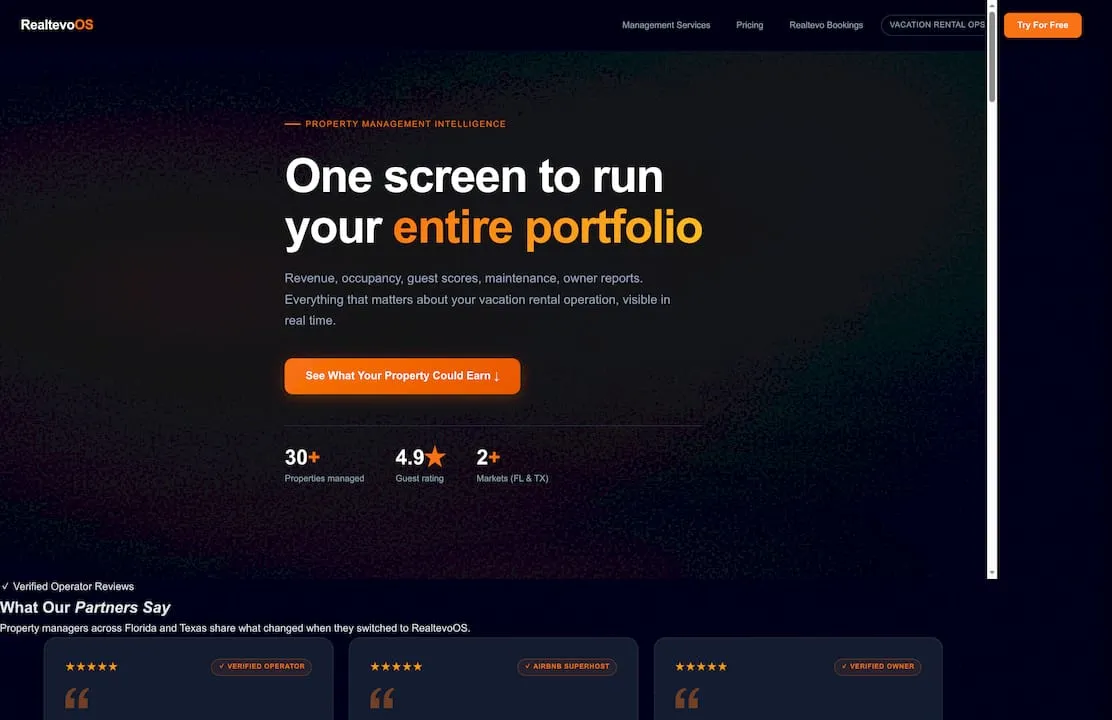
Realtevoos consolidates the operational workflows that loyalty programs depend on: centralized guest profiles that sync across all your properties, automated post-stay messaging sequences triggered by checkout events, Wi-Fi and email capture flows built into the guest onboarding process, and a reporting dashboard that tracks your repeat booking rate and direct booking ratio in real time. The platform integrates with Airbnb, Vrbo, Guesty, Hostaway, and your existing PMS, so guest data flows in automatically rather than requiring manual entry after every stay. Property managers using Realtevoos report saving several hours each week on tasks that previously required manual intervention, which is time that goes directly into guest experience and loyalty execution. Start your pilot with the Realtevoos management deck and see how much of your loyalty workflow you can automate in the first 30 days.
Sources
The following sources informed this guide and are worth bookmarking for deeper study:
- Hotel Loyalty Programs: How to Build One That Actually Brings Guests Back | Cvent Blog
- Hotel customer loyalty: Strategies that drive direct revenue | Revinate
- Vacation Rental Repeat Guest Program: The 2026 Guide | Houfy
- Repeat Customer Rate — Yotpo blog
- Loyalty incentives and program types | Qualtrics