How to Build a Cleaning Fee Strategy That Actually Books Nights
Discover how to create an effective cleaning fee strategy for Airbnb that boosts bookings and optimizes your revenue potential.
How to Build a Cleaning Fee Strategy That Actually Books Nights
Calculate your true cleaning cost first, then set the fee to land between 25% and 50% of your average daily rate (ADR). That range shows up repeatedly in AirROI’s analysis of listings that outperform on both revenue and occupancy. If your calendar leans toward short stays, consider including more of that cost in the nightly rate rather than a separate cleaning fee. Airbnb surfaces total price at checkout, and a fat cleaning fee reads as a tax on short trips.
Here’s your two-minute version:
- Pull your last 10 turnovers and add up cleaner pay, supplies, and laundry cost per clean.
- Divide that total cost by your current ADR to see where you actually sit.
If your ratio is above 50%, you have a pricing problem, not just a cost problem — the fix is usually a nightly rate adjustment, not a fee hike.
Table of Contents
- Cleaning Fee Strategy for Airbnb: What the Fee Actually Covers
- How Do You Calculate Your Actual Cleaning Cost?
- Why the 25 to 50 Percent of ADR Range Works
- Should You Itemize the Cleaning Fee or Roll It Into the Rate?
- How Do You Change Your Cleaning Fee on Airbnb?
- What Should You Track Once You Change the Fee?
- How Realtevoos Lowers Your Cost Floor So You Can Compete on Fees
- Are Cleaning Fees Legal Everywhere, and Do They Need to Be Disclosed?
- Boost Your Margins Without Guesswork
- What Most Hosts Get Wrong About Cleaning Fee Strategy
- Sources
Cleaning Fee Strategy for Airbnb: What the Fee Actually Covers
A cleaning fee is a one-time, host-set charge added once per reservation, not per night. Airbnb’s Help Center confirms hosts can set a standard fee and a separate short-stay cleaning fee, and both get locked in at the time of booking.
Since Airbnb shifted toward showing the total trip price up front, the cleaning fee line item now lives inside the price breakdown guests see before they commit, not buried at final checkout. That single interface change matters more than most hosts realize.
- Guests compare total price, so your cleaning fee gets folded into their mental math against every other listing on the map.
- A visible fee also sets a cleanliness bar. Airbnb’s own resource center warns that a high cleaning fee can discourage bookings while simultaneously raising guest expectations for a spotless arrival.
- Search ranking increasingly treats cleaning fee as part of the price signal, not a separate cost line hosts can hide behind.
That last point is the one most hosts miss. A cleaning fee isn’t bookkeeping anymore. It’s pricing.
How Do You Calculate Your Actual Cleaning Cost?
Before you touch your listing settings, find your real cost floor. Skipping this step is how hosts end up either losing money on every turnover or scaring off short-stay bookers with an inflated fee.
- List every recurring cost per turnover: cleaner labor, linen and towel laundering, restocked supplies (soap, coffee, paper goods), and a few minutes of your own coordination time.
- Get quotes from at least two cleaners or cleaning services and ask them to itemize labor versus supplies. Community reports on the Airbnb forums consistently mention negotiating lower per-clean rates once you commit to volume.
- Time your own labor if you clean in-house. A stopwatch across three cleans gives you a realistic hourly number, not a guess.
- Add a deep-clean buffer, roughly 5 to 10% of the per-clean total, to cover the periodic carpet shampoo or oven scrub that regular turnovers don’t include.
Here’s how that math plays out for two common setups:
Pro Tip: Run this math quarterly, not once. Cleaner rates, linen costs, and even trash pickup fees creep upward, and a cost floor calculated a year ago is already stale.
Once you have that number, everything else in your fee strategy sits on top of it. If a reliable cleaning service quotes you $72 for a 1BR turnover, that’s your non-negotiable minimum, not your target fee.
Why the 25 to 50 Percent of ADR Range Works
Your fee-to-ADR ratio tells you more than your fee-in-isolation ever will. Divide your cleaning fee by your ADR, and you get a number you can actually benchmark against real market data.
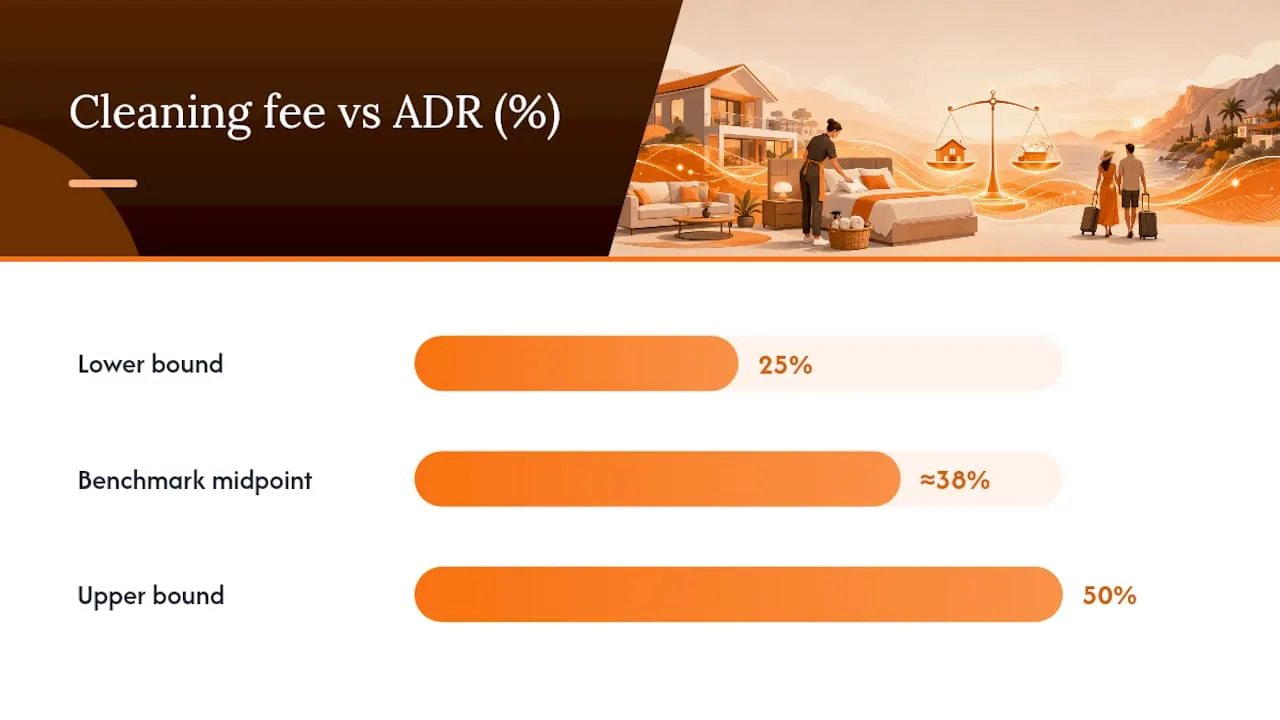
AirROI’s dataset of US listings found a clear pattern: properties with cleaning fees landing at 25% to 50% of ADR posted higher average annual revenue and held competitive occupancy compared to listings with no fee or with fees well outside that band. Fees below 25% often mean hosts are eating cleaning costs out of their margin. Fees above 50% start suppressing bookings, especially for shorter stays.
Pulling your own local benchmark doesn’t require expensive software. You can:
- Search 15 to 20 comparable listings in your market and note their published cleaning fees against their nightly rates.
- Check whether top-performing comps (high review counts, frequent bookings) cluster in that same 25 to 50% zone.
- Cross-reference with a pricing tool if you use one, since guides like PriceLabs recommend anchoring fee decisions to length-of-stay patterns specific to your market rather than a flat industry number.
Skift’s coverage of global cleaning-fee trends shows fee norms vary widely by region and property type, which is exactly why a local comp set beats a generic rule of thumb every time.
Should You Itemize the Cleaning Fee or Roll It Into the Rate?
The math can be identical and still produce wildly different guest behavior, depending on how you split it. A $200 total price shown as $150 nightly plus a $50 cleaning fee reads very differently to a one-night guest than $200 flat, even though they pay the same amount either way.
RentTools’ split-test modeling demonstrates this directly: identical total prices produce different search impressions and conversion rates depending on stay length, because the cleaning fee gets amortized over fewer nights on short trips and effectively disappears on long ones.
Use these rules of thumb to pick your approach:
- Average stay of 1 to 3 nights: bundle most of the cleaning cost into the nightly rate. A visible fee on a one-night stay looks like a penalty, and guests notice.
- Mixed stay lengths: split the difference, keeping a moderate visible fee while pricing nightly rates to absorb the rest.
- Mostly long stays (a week or more): itemize the full fee. It amortizes to almost nothing per night and guests barely register it.
A few tactical levers work alongside these rules:
- Offer a reduced short-stay cleaning fee using Airbnb’s short-stay fee setting, so one and two-night bookings see a lower number than week-long stays.
- Set a minimum-night requirement if your actual cleaning cost makes single-night stays unprofitable regardless of pricing structure.
- Add a small, transparent consumables fee separately from the cleaning fee when it helps guests understand what they’re paying for, rather than folding everything into one opaque line.
How Do You Change Your Cleaning Fee on Airbnb?
Adjusting the fee itself takes minutes once you know your target number.
- Open your listing and go to Calendar → Price settings → Fees.
- Enter your standard cleaning fee, and if your listing takes short stays, set a separate short-stay cleaning fee in the same menu.
- Save your changes. New fees apply to future bookings immediately; they never retroactively touch reservations already confirmed.
- To change the fee on an existing confirmed reservation, you need the guest’s explicit approval first, per Airbnb’s fee policy. Skipping that step invites disputes and bad reviews.
Pro Tip: Time fee changes for slow booking windows, not your peak season, and give your cleaner a heads-up when your fee structure shifts. A pricing change that outpaces what you’re actually paying your cleaner erodes the whole point of recalculating your cost floor.
What Should You Track Once You Change the Fee?
A fee change is a hypothesis, not a decision. Treat it like one.
Watch these metrics before and after any adjustment:
- Impressions and click-through rate on your listing, since search visibility shifts fast when total price moves.
- Conversion rate (inquiries or bookings per view), which tells you if guests balk at checkout.
- Occupancy and ADR together, not separately, because a fee change that boosts occupancy but tanks ADR isn’t a win.
- Average length of stay, which often shifts when fee structure changes guest behavior.
- Revenue per available night, the number that actually matters at the end of the month.
Design the test properly: change one variable, hold everything else steady, and run it for 30 to 60 days to smooth out weekly noise and avoid confusing seasonality with the fee’s real effect. Multiple operator guides converge on that same window as long enough to see a signal without waiting an entire season. Adopt the change permanently only after you see the shift hold across at least one full booking cycle, not just a good week.
Pro Tip: Track these numbers in one place rather than across five tabs. If you’re already using an occupancy monitoring routine, fold the fee experiment into that same dashboard so you’re comparing apples to apples.
How Realtevoos Lowers Your Cost Floor So You Can Compete on Fees
Every dollar you save on coordination is a dollar you can shave off your cleaning fee without touching your margin. Missed cleanings, double-booked cleaners, and manual scheduling calls all add hidden admin cost to every turnover, and that cost gets baked into the fee whether you notice it or not.
Realtevoos automates the coordination layer that normally eats a property manager’s week: turnover scheduling synced to real-time bookings, automated cleaner notifications, and a single dashboard pulling data from Airbnb and Vrbo instead of five separate tabs.
Property managers using Realtevoos report saving several hours each week that used to go into manual scheduling and status-checking, hours that translate directly into a lower per-turnover admin cost and more room to price fees competitively.
- Fewer missed cleanings means fewer emergency same-day cleaner calls, which are almost always priced at a premium.
- A consolidated operations dashboard turns scattered turnover data into a real number you can plug straight into your cost-floor calculation.
- Lower admin overhead gives you room to set a fee inside the 25 to 50% ADR band even in competitive markets where thinner margins would otherwise force a higher fee.
Are Cleaning Fees Legal Everywhere, and Do They Need to Be Disclosed?
Cleaning fees themselves are legal across US markets, but disclosure rules vary by jurisdiction and platform policy. The Federal Trade Commission’s junk-fee rules, which took effect for hotels and short-term rentals, require that the total price, including mandatory fees like cleaning charges, be displayed prominently before checkout rather than added as a surprise at the final step. Airbnb’s total-price display update aligns with that broader regulatory direction, even in markets where it isn’t strictly mandated by local statute.
Some cities and states layer additional rules on top of federal guidance. Short-term rental ordinances in certain municipalities require hosts to itemize cleaning fees separately from lodging tax calculations, since tax authorities sometimes treat mandatory fees differently from optional ones when determining the taxable base. If you operate in a jurisdiction with a local transient occupancy tax, check whether your cleaning fee is taxed as part of the room charge or exempted as a separate service fee. That distinction affects your net revenue more than most hosts realize.
International hosts face a wider spread. Some markets restrict how cleaning fees can be presented relative to the base rate, and others require fee breakdowns in specific formats on booking confirmations. None of this replaces a conversation with a local tax professional or attorney familiar with your specific short-term rental regulations, especially if you operate across multiple jurisdictions with different disclosure standards.
Boost Your Margins Without Guesswork
A cleaning fee set between 25% and 50% of ADR, backed by an accurate cost-floor calculation, produces stronger revenue and occupancy than either underpricing or overpricing the fee.
| Point | Details |
|---|---|
| Calculate cost floor first | Add cleaner labor, supplies, laundry, and a deep-clean buffer before setting any fee. |
| Target 25 to 50% of ADR | This band correlates with higher revenue and occupancy in AirROI’s analysis. |
| Match presentation to stay length | Bundle fees into the rate for short-stay-heavy listings; itemize for long stays. |
| Test one variable at a time | Run fee changes for 30 to 60 days and track occupancy, ADR, and revenue per night together. |
| Cut admin cost to cut fees | Lower coordination overhead through automation to afford a more competitive fee. |
What Most Hosts Get Wrong About Cleaning Fee Strategy
Most cleaning fee advice treats the fee as an accounting problem: figure out your cost, add a margin, done. That framing misses what Airbnb’s own pricing display has made obvious. The fee is a conversion lever now, not a reimbursement line.
The conventional wisdom of “charge whatever covers your costs” ignores that a cost-covering fee and a booking-winning fee are often two different numbers. AirROI’s data makes the case plainly: the hosts winning on both revenue and occupancy aren’t the ones charging the highest fee that guests will tolerate. They’re the ones who found the ratio where the fee stops functioning as a deterrent.
What gets underpriced in most advice is the operational side. A host paying a cleaner $40 in overhead-heavy coordination costs isn’t actually paying $40 for cleaning. Automation that strips out the scheduling friction changes the real cost floor, which changes what fee a host can competitively offer. That’s the piece most pricing guides skip entirely, because they treat operations and pricing as separate departments. They aren’t. The fastest way to a better fee isn’t a smarter formula. It’s a lower cost to begin with.
— Jose Villeda