Data Integration in Rental Management: 2026 Guide
Discover the crucial role of data integration in rental management. Learn how it streamlines operations and boosts efficiency for property managers.

Data Integration in Rental Management: 2026 Guide
Data integration in rental management is defined as the process of unifying property management systems (PMS), CRM, accounting, communications, and pricing tools into a single governed source of truth. The role of data integration in rental management goes far beyond connecting software. It eliminates the fragmented data silos that force property managers to manually reconcile spreadsheets, chase down booking discrepancies, and produce financial reports that are already outdated by the time they land in an owner’s inbox. For vacation rental operators managing multiple properties across Airbnb, Vrbo, and direct booking channels, unified data management is the difference between scaling confidently and drowning in operational noise.
How data integration improves rental management efficiency
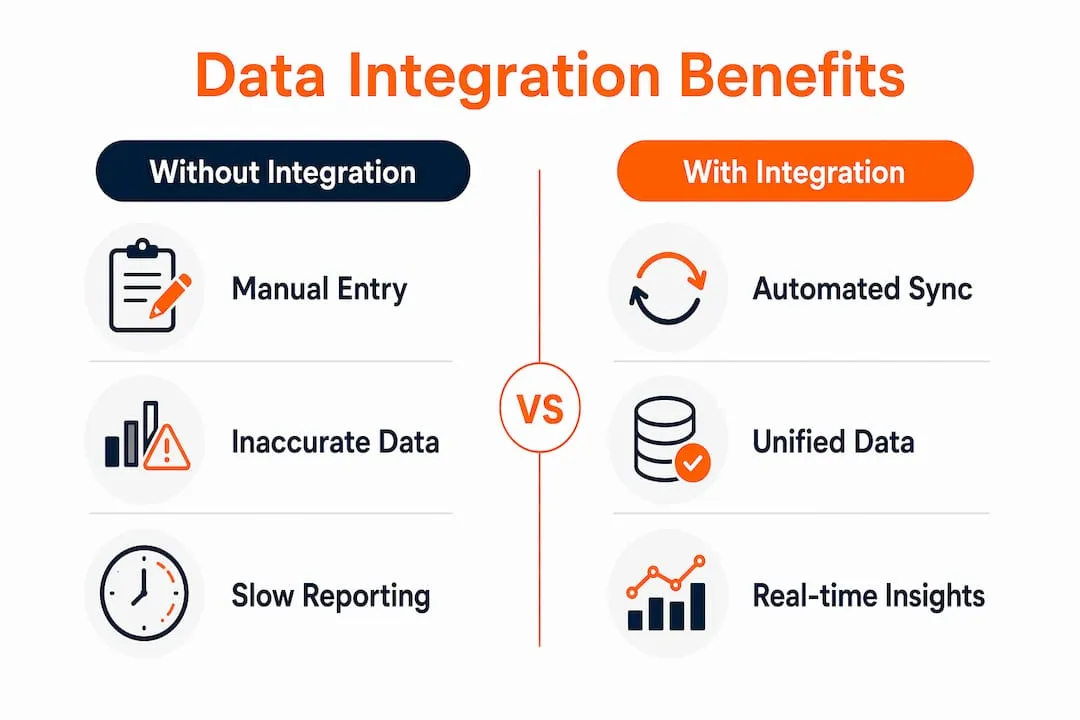
The most direct data integration benefit for rentals is the elimination of manual data entry across disconnected systems. When your PMS, channel manager, accounting software, and guest messaging platform each hold separate versions of the same reservation, errors multiply fast. A rate update that does not sync to your accounting tool creates reconciliation work. A booking confirmed on Airbnb that does not trigger a guest welcome message creates a service gap.
API-driven integrations solve this by connecting systems so that a single reservation event cascades automatically through your entire tech stack. When a booking is created in the PMS, downstream workflows fire: guest messaging sends, financial records update, and channel inventory adjusts. This is not a convenience feature. It is the operational backbone that lets a two-person team manage 40 properties without hiring a data coordinator.

The reporting impact is equally significant. A governed unified data layer can compress quarterly reporting from weeks of manual reconciliation down to a few days. Chart-of-accounts mapping runs automatically, and variance narratives generate against validated source data. For property owners who expect clean monthly performance reports, this speed matters enormously.
Pro Tip: Map every data field at the point of integration setup, not after. Inconsistent field mappings between your PMS and accounting tool are the single most common cause of reconciliation errors six months into a deployment.
Key operational improvements you can expect from well-executed data integration:
- Reservation syncing across all channels with no manual intervention
- Automated guest communications triggered by booking status changes
- Real-time financial updates tied directly to confirmed reservations
- Portfolio-level occupancy and revenue dashboards updated continuously
- Reduced double-booking risk through synchronized inventory management
What makes data integration effective: models, normalization, and governance
Connectivity alone does not make integration effective. The structural foundation underneath your connected systems determines whether you get reliable data or a more sophisticated version of the same fragmentation problem.
A strong real estate data model ensures that core entities like units, guests, and reservations exist once and are referenced consistently across every system. Without this, the same guest appears as three separate records across your CRM, PMS, and email platform. Reconciling those records manually is exactly the kind of work integration is supposed to eliminate.
Normalization is the process of standardizing how data is structured before it flows into your reporting layer. In vacation rental operations, this means aligning date formats, currency fields, booking source labels, and fee categories so that a reservation from Airbnb and a direct booking look identical to your analytics tools. Without normalization, your revenue reports will show different totals depending on which system you pull from. That is the “multiple versions of financial truth” problem that manual reconciliation creates and that a governed data layer eliminates.
Governance adds the accountability layer. Data lineage tracking records where each data point originated, how it was transformed, and which systems consumed it. When a number in your owner report looks wrong, lineage lets you trace it back to the source in minutes rather than hours. It also protects you when systems change. If your PMS updates its API schema, governance tools flag where downstream data definitions break before they corrupt your reports.
The table below contrasts what you get with a raw data layer versus a unified normalized layer:
| Dimension | Raw data layer | Unified normalized layer |
|---|---|---|
| Data consistency | Each system holds its own version | Single governed record across all systems |
| Reporting speed | Days of manual reconciliation | Near real-time with automated pipelines |
| Error traceability | Difficult to identify source of discrepancy | Full lineage from source to report |
| Scalability | Degrades as portfolio grows | Designed to scale with new properties and tools |
| AI and analytics readiness | Limited without clean, structured data | Supports anomaly detection and forecasting |
The bottom row matters more than most operators realize. Effective data integration enables a shift from reactive to predictive management. Clean, structured, lineage-tracked data is the prerequisite for AI-powered anomaly detection, dynamic pricing optimization, and demand forecasting. You cannot build those capabilities on a fragmented data foundation.
What integration technologies work best for vacation rentals?
The technology choice behind your integration directly determines its reliability and speed. Not all connection methods are equal, and the wrong choice creates problems that compound over time.
iCal and feed-based integrations are the most common starting point for small operators because they are easy to set up. They are also the most limited. Calendar syncs update on a delay, sometimes hours behind real bookings. In a fast-moving vacation rental market, that lag creates double-booking exposure and stale pricing data. They are a starting point, not a strategy.
Native API and webhook integrations are the standard for serious operators. API integrations with real-time event capture fire the moment a booking event occurs, pushing updates to every connected system within seconds. Webhooks are particularly valuable because they push data proactively rather than waiting for a scheduled pull. The result is a tech stack that reacts to reality in real time.
Middleware platforms like Zapier or custom workflow tools sit between your systems and handle transformation logic. They are useful for connecting tools that do not share a native integration, but they introduce a dependency that requires monitoring. If a Zapier workflow breaks silently, you may not notice until a guest complaint surfaces.
Key criteria for evaluating any integration technology:
- Update frequency: Does it sync in real time or on a schedule? Scheduled syncs introduce lag.
- Error handling: Does the integration log failures and alert you, or fail silently?
- Rollback capability: Can you reverse a bad data push without corrupting your records?
- API documentation quality: Poor documentation signals a vendor that does not prioritize integration reliability.
- Webhook support: Webhooks indicate a mature, event-driven architecture.
Pro Tip: Before committing to any PMS or channel management platform, test its API documentation directly. Sparse or outdated API docs are a reliable signal that the vendor treats integration as an afterthought.
Vacation rental PMS APIs form the backbone of integrated tech stacks, feeding real-time updates to all connected platforms. Choosing a PMS with a well-documented, event-driven API is one of the highest-leverage decisions you will make when building your operational infrastructure.
How to implement data integration across your rental portfolio
Implementation works best when it starts with a clear audit rather than a technology purchase. Before you connect anything, you need to know what data you currently have, where it lives, and where the gaps and conflicts are.
Follow these steps to build a reliable integration foundation:
- Audit your current data landscape. List every system you use: PMS, channel manager, accounting tool, CRM, pricing software, and guest communication platform. Document what data each system holds and how it currently moves between them.
- Identify integration gaps and conflicts. Where are you manually copying data between systems? Where do you see discrepancies between what your PMS shows and what your accounting tool records? These gaps are your integration priorities.
- Run a pilot on one property or one workflow. Integrate your PMS with your accounting tool for a single property before rolling out portfolio-wide. Validate that data flows correctly, that field mappings are accurate, and that reports match expected outputs.
- Train your team on integrated workflows. Integration changes how your team works. Staff who previously exported and emailed spreadsheets need to understand the new data flow and trust the integrated system as the authoritative source.
- Set up monitoring and alerting. Every integration needs a health check. Configure alerts for sync failures, data mismatches, or unusual gaps in update frequency. Silent failures are the most dangerous kind.
- Audit and recalibrate quarterly. Systems change. APIs update. New tools get added to your stack. A quarterly review of your integration health catches mapping drift before it corrupts your reporting.
The ROI from this process is measurable. Consistent data syncing across PMS, channels, accounting, and communications reduces manual workload significantly as your portfolio grows. Property managers gain portfolio-level visibility that was previously impossible without a dedicated analyst. For multi-property reporting, the time savings alone justify the implementation investment within the first quarter.
Key takeaways
Data integration in rental management succeeds when it combines API-driven connectivity, normalized data models, and governance practices into a single owned data layer that scales with your portfolio.
| Point | Details |
|---|---|
| Define your data layer first | Build a governed, normalized data model before connecting systems to avoid fragmentation. |
| Prioritize API over calendar sync | Native API and webhook integrations eliminate the lag and double-booking risk of iCal feeds. |
| Governance enables scale | Data lineage tracking makes reports trustworthy and supports AI-powered analytics as you grow. |
| Pilot before full rollout | Test integrations on one property or workflow to validate mappings and catch errors early. |
| Monitor continuously | Silent integration failures corrupt data; configure health checks and alerts from day one. |
Why most operators are solving the wrong integration problem
I have worked with enough vacation rental operators to recognize a pattern. They invest in connecting their systems, watch the data start flowing, and conclude the problem is solved. Six months later, they are back to reconciling discrepancies manually. The integration is working. The data strategy is not.
The uncomfortable truth is that integration without governance is just faster fragmentation. You are moving bad data more efficiently. The operators who actually solve the problem treat data integration as an architectural decision, not a technical task. They define what a “unit” means across every system before they connect anything. They decide which system is authoritative for each data type. They build lineage tracking from the start, not as an afterthought when something breaks.
The other thing I would push back on is the idea that this is only relevant at scale. I have seen operators with 10 properties waste more time on manual reconciliation than operators with 100 properties who built their integration foundation correctly from the beginning. The size of your portfolio does not determine your data maturity. Your decisions do.
The operators who will benefit most from AI-powered pricing, anomaly detection, and predictive maintenance are the ones building clean, governed data pipelines right now. That is not a future consideration. It is a present competitive advantage.
— Jose
How Realtevoos puts these integration principles into practice
If the integration architecture described in this article sounds like what your operation needs, Realtevoos is built specifically to deliver it for vacation rental operators.

Realtevoos connects your PMS, accounting tools, and guest communication platforms into a single command center, pulling real-time data from Airbnb, Vrbo, and direct booking channels into one governed dashboard. Property managers using Realtevoos report saving several hours each week by eliminating manual report generation and cross-system reconciliation. The platform’s AI-driven automation handles guest communications, financial updates, and performance reporting automatically, so your team focuses on decisions rather than data cleanup. Whether you manage 5 properties or 50, Realtevoos scales with your portfolio without adding operational complexity. Request a demo to see how integrated data management translates directly into faster reporting and higher guest satisfaction.
FAQ
What is data integration in rental management?
Data integration in rental management is the process of connecting systems like PMS, accounting, CRM, and channel managers into a single unified data source. It eliminates manual reconciliation by automating data flow between platforms so that every system reflects the same accurate information.
Why is data integration important for vacation rental operators?
Operational ROI from data integration includes reduced manual workload, faster financial reporting, and portfolio-level visibility that scales as your property count grows. Without it, teams spend significant time correcting data discrepancies rather than managing properties.
What is the difference between API integration and calendar sync?
API integrations capture booking events in real time and trigger immediate updates across connected systems, while calendar syncs update on a delay that can range from minutes to hours. For vacation rentals, that delay creates double-booking risk and stale pricing data.
How do I know if my current data integration is working correctly?
Monitor sync health logs, compare reservation counts between your PMS and channel manager daily, and run a monthly reconciliation between your PMS revenue totals and your accounting records. Discrepancies signal mapping drift or silent sync failures that need immediate attention.
What is data governance and why does it matter for rental management?
Data governance is the practice of tracking where data originates, how it is transformed, and which systems use it. For rental operators, governance makes financial reports auditable and enables confident troubleshooting when a number in an owner report does not match expectations.