How integrated PMS solutions streamline vacation rentals
Discover why integrated property management systems can transform your vacation rental operations, streamline tasks, and boost efficiency today!

How integrated PMS solutions streamline vacation rentals
Running a vacation rental portfolio without a unified system is like trying to manage a hotel with sticky notes and a whiteboard. You’re constantly catching up, fixing avoidable mistakes, and losing time to tasks that software should handle automatically. Property management companies juggling Airbnb, Vrbo, and direct bookings across dozens of properties know this friction well. This guide breaks down why fragmented tools hold operations back, how integrated property management systems (PMS) solve those problems at scale, and how to evaluate whether the switch makes sense for your business right now.
Table of Contents
- The fragmented reality: Why relying on multiple tools harms growth
- How integrated property management systems transform operations
- Scaling made simple: Supporting growth from 50 to 200+ properties
- Who actually needs an integrated PMS? Key considerations
- Evaluating and transitioning to an integrated PMS
- The real problem with ‘integration’: Most property management stacks stay fragmented anyway
- Take control: Move to a unified, integrated rental operations platform
- Frequently asked questions
Key Takeaways
| Point | Details |
|---|---|
| Integration replaces silos | A unified PMS prevents data loss and miscommunication caused by fragmented software tools. |
| Centralized automation boosts efficiency | Automating routine tasks in one platform frees up staff for higher-value work and cuts down on errors. |
| Scaling is easier without extra hires | Integrated systems allow you to expand from dozens to hundreds of properties without larger teams. |
| Fit matters | A full PMS is ideal for growth-focused portfolios, but small operations may prefer leaner setups. |
| Careful onboarding pays off | A phased, thoughtful approach to PMS adoption ensures smoother transitions and better results. |
The fragmented reality: Why relying on multiple tools harms growth
Most property management companies don’t start with a messy tech stack by choice. They add tools one at a time: a channel manager here, a cleaning scheduler there, a separate inbox for guest messages, maybe a spreadsheet for owner reports. Each tool solves one problem and creates three more. Before long, your team is spending hours every week on manual data transfers, and mistakes are inevitable.
The most damaging consequences show up in the moments that matter most. Double bookings surface when a calendar update doesn’t sync fast enough between platforms. A cleaning crew shows up at the wrong time because the schedule lives in a different system than the reservation. A guest waits hours for a reply because messages are scattered across three inboxes. These aren’t rare edge cases. They’re the daily reality of running a fragmented operation.
The hidden cost of fragmented workflows isn’t just wasted time. It’s compounding errors, guest complaints, and staff burnout that quietly erode your margins and reputation month after month.
Standalone tools and channel managers create data silos, manual handoffs, and errors that a full PMS eliminates through unified workflow. The key word is unified. When data lives in one place, your team makes decisions based on accurate, real-time information instead of guessing which system has the most current version.
Here’s what operational risk actually looks like when your stack is fragmented:
- Miscommunication between teams: Housekeeping, maintenance, and front-desk staff each rely on different data sources, leading to conflicting schedules and missed tasks.
- Delayed guest responses: Without a unified inbox, messages fall through the cracks, damaging review scores and repeat booking rates.
- Inconsistent guest experiences: Automated check-in instructions, welcome messages, and follow-ups require manual effort to customize per property.
- Staff overload: Your best people spend their time on data entry instead of guest relations, owner communications, and growth.
Exploring the integrated PMS benefits that matter most to your operation is the first step toward breaking this cycle.
How integrated property management systems transform operations
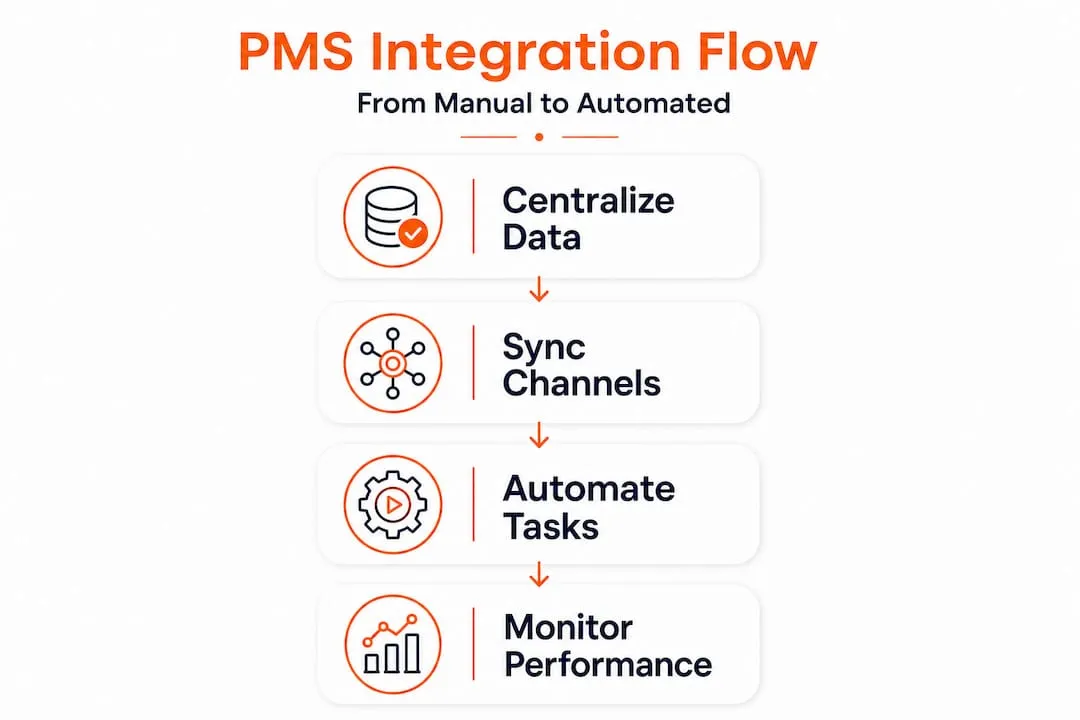
The shift from fragmented tools to an integrated PMS isn’t just a productivity upgrade. It’s a structural change in how your operation functions. Instead of connecting systems through workarounds, everything runs through one platform: reservations, guest messaging, housekeeping assignments, maintenance tickets, and financial reporting.
Integrated PMS platforms centralize reservations, channel management, guest communication, housekeeping, and reporting into one system, directly reducing manual updates and the errors that come with them. When a new booking comes in from any channel, the calendar updates instantly, the guest receives an automated confirmation, the cleaning schedule adjusts, and the owner report reflects the new revenue. No one has to trigger any of those steps manually.
Automation is what makes this possible at scale. Rules-based systems can handle check-in instructions, review requests, mid-stay messages, and maintenance escalations without any staff intervention. This is where you start recovering real hours.
Pro Tip: Start by mapping your five most repetitive weekly tasks, whether that’s sending check-in instructions, updating availability across channels, or generating owner statements. Build automation rules for each one before you tackle anything else. You’ll see ROI from day one.
Here’s a before-and-after look at how task handling changes once you move to an integrated system:
| Task | Before integration | After integration |
|---|---|---|
| Updating channel availability | Manual update across 3+ platforms | Automatic real-time sync |
| Sending guest check-in info | Staff emails each guest manually | Triggered automatically at booking |
| Assigning cleaning jobs | Coordinator calls or texts cleaners | Auto-assigned based on checkout schedule |
| Generating owner reports | Built manually from multiple data sources | Auto-generated with live revenue data |
| Escalating maintenance issues | Spotted by luck, reported via text | Triggered by guest flag or scheduled inspection |
| Responding to inquiries | Staff monitors multiple inboxes | Unified inbox with AI-assisted draft responses |
The efficiency gains compound quickly. When you add dynamic pricing for vacation rentals into this ecosystem, your rates adjust automatically based on demand signals, competitor data, and seasonal trends, all without a single manual update. Think of the platform as a true command center for vacation rental operators where every moving part connects to every other.
Scaling made simple: Supporting growth from 50 to 200+ properties
Here’s where integrated systems prove their real value. Growing from 50 to 100 properties with a fragmented stack means hiring more coordinators, more cleaners supervisors, more people manually reconciling data. Growing the same distance with an integrated PMS means adding properties, not people.
Integrated systems enable scaling from 50 to 200 or more properties without proportional headcount increases, because automation absorbs the complexity that would otherwise require additional staff. That’s not a feature list promise. It’s a documented operational reality for companies that have made the transition.
Consider a practical scenario. A property management company managing 60 units decides to acquire a portfolio of 40 additional properties in a new market. Without an integrated PMS, onboarding those properties means:
- Manually creating listings on every channel separately.
- Setting up cleaning schedules in a separate tool and cross-referencing with reservations.
- Training staff on a new market’s quirks while they’re still juggling the old portfolio.
- Building owner reports from scratch for new clients using spreadsheets.
- Monitoring a separate inbox for the new market’s guest communications.
- Hoping no double booking slips through while systems catch up.
With an integrated PMS, steps 1 through 6 are either automated or centralized. Listings sync through a single interface. Cleaning schedules generate from the same reservation data. Owner reports run automatically. Guest messages arrive in one inbox. The new market looks exactly like the old one from a workflow standpoint. Understanding vacation rental management insights confirms that this operational clarity is one of the most important factors separating growing companies from stagnating ones.
Pro Tip: When adding new properties or markets to your portfolio, resist the temptation to create custom workflows for each one. Build standardized templates in your PMS for listings, cleaning schedules, and owner reports, then replicate them. Consistency is what makes scale sustainable.
Here’s how the numbers look when comparing operations with and without integration at different portfolio sizes:
| Portfolio size | Staff needed (fragmented) | Staff needed (integrated) | Time spent on admin weekly |
|---|---|---|---|
| 20 properties | 3 coordinators | 1 coordinator | Fragmented: 25+ hours |
| 60 properties | 6 coordinators | 2 coordinators | Fragmented: 60+ hours |
| 150 properties | 12+ coordinators | 3 to 4 coordinators | Integrated: 15 to 20 hours |
The scalable PMS platform approach doesn’t just save money on headcount. It protects quality as you grow, because standardized, automated workflows don’t degrade under volume the way manual ones do.

Who actually needs an integrated PMS? Key considerations
Not every operator needs the full weight of an enterprise PMS. Choosing the right level of tooling for your actual situation is just as important as choosing the right platform.
For portfolios with fewer than 5 properties, a full-featured PMS can be excessive, with a steep learning curve that outweighs the efficiency gains. A lean stack of simpler tools may be easier to manage and faster to set up. However, once you cross the 10 to 15 property threshold and start dealing with multiple channels, owner relationships, and staff coordination, the calculus changes dramatically.
The goal isn’t to have the most integrations. It’s to eliminate the friction between the tools you rely on. A well-structured lean stack can outperform a bloated enterprise system that nobody uses correctly.
Use these criteria to assess where you stand:
- Portfolio size: Are you managing 10 or more properties actively? Integration starts to pay off quickly at this scale.
- Growth trajectory: Are you planning to add 20 or more units in the next 12 months? Build for where you’re going, not where you are.
- Channel complexity: Do you list on three or more booking platforms? Manual sync becomes a liability fast.
- Team size: Do more than two people touch operational workflows? Coordination costs multiply without a shared system.
- Owner reporting: Are you spending more than two hours a week building reports? Automation is overdue.
There’s also a real risk on the other end: resources for vacation rental owners often highlight over-buying, where managers invest in a platform with features they’ll never use, then struggle with adoption. A system your team ignores is worse than a simple one they actually use.
Review the key PMS system decision factors for your specific market and portfolio before committing to any vendor. The right fit depends on your current complexity and your growth ambitions, not on feature lists alone.
Evaluating and transitioning to an integrated PMS
Once you’ve determined that an integrated PMS makes sense for your operation, the evaluation and transition process deserves as much attention as the selection itself. A rushed migration can create more chaos than the fragmented system it replaces.
Follow these steps to evaluate and transition effectively:
- Audit your current workflows. List every tool you use, every manual step your team takes weekly, and every recurring error or complaint. This becomes your baseline and your shopping list.
- Shortlist platforms based on your core needs. Focus on the functions that cause you the most pain today: channel management, guest communication, reporting, or maintenance.
- Verify API and integration support. Ask every vendor specifically how their platform connects to your existing channels, cleaning software, and accounting tools. “We integrate with everything” is not an answer.
- Plan your migration with a timeline. Move properties in batches rather than all at once. Test with a smaller subset before committing your full portfolio.
- Involve your team in the decision. The coordinators, cleaners, and guest experience staff who use the system daily will surface practical objections that management often misses.
- Set a 90-day review checkpoint. After launch, measure actual time savings, error rates, and guest response times against your pre-migration baseline.
Pro Tip: Assign a dedicated internal champion for the PMS migration. This person owns the onboarding timeline, fields questions from the team, and escalates issues to the vendor. Without a single point of accountability, implementation projects drift.
Centralizing reservations and communication in one platform doesn’t just reduce errors. It creates a data foundation that improves every business decision going forward, from pricing strategy to staffing levels to owner retention. Consider the onboarding integrated PMS process as a strategic investment, not just a software switch.
The real problem with ‘integration’: Most property management stacks stay fragmented anyway
Here’s an opinion that most PMS vendors won’t share with you: most operators who buy an integrated system still end up running a fragmented operation. Why? Because they purchase the platform but keep their old habits. They use the channel sync feature but still manually update pricing in a separate tool. They run the unified inbox but let staff respond through personal phones. They generate automated reports but build a shadow spreadsheet anyway because “it’s just easier.”
The technology is rarely the bottleneck. The real fragmentation lives in the processes people refuse to change, the workarounds they’ve grown comfortable with, and the fear of trusting a system they don’t fully understand.
Most vendor “integrations” also stop at surface-level sync. They move a booking from one platform to another. They send a notification. But they don’t close the loop on what happens next. A maintenance issue gets flagged, but there’s no escalation rule. A guest leaves a bad review, but there’s no automated owner alert. The data exists in the system but never becomes a decision.
What you actually need isn’t a longer list of integrations. You need solving data silos at the workflow level, meaning every piece of information triggers the right action for the right person at the right time, without anyone manually connecting the dots. That’s a fundamentally different standard than “our platform integrates with 50+ tools.”
Insist on seeing how a vendor handles error states, not just successful syncs. Ask what happens when a cleaning assignment fails. Ask what the system does when a guest inquiry sits unanswered for more than two hours. The answers reveal whether you’re buying real automation or just a more expensive version of the fragmented stack you already have.
Take control: Move to a unified, integrated rental operations platform
Everything covered in this article points toward the same conclusion: fragmentation is expensive, growth requires automation, and the right integrated PMS becomes the operational backbone of a scalable rental business. Centralizing your reservations, guest communications, housekeeping, reporting, and owner relations in one platform isn’t a luxury for large operators. It’s the foundation that makes growth manageable for companies at every stage past that initial handful of properties.

The RealtevoOS PMS platform is built specifically for property management companies that are serious about scaling without sacrificing service quality. From AI-driven guest communication and automated owner reporting to real-time occupancy and revenue dashboards across multiple markets, it consolidates everything your team needs into one intelligent system. If you’re ready to stop patching a fragmented stack and start building on a solid operational foundation, explore what RealtevoOS can do for your portfolio.
Frequently asked questions
What makes an integrated PMS different from separate management tools?
An integrated PMS centralizes all key functions including reservations, communication, housekeeping, and reporting within a single platform, eliminating the manual data transfers and errors that come from using disconnected tools.
Is an integrated PMS necessary for small portfolios?
For fewer than 5 properties, a full-featured PMS is often excessive, since the learning curve and setup time outweigh the efficiency gains. A simpler lean stack is usually the smarter starting point.
How does an integrated PMS help with scaling a vacation rental business?
Integrated systems enable scaling from 50 to 200 or more properties by automating repetitive workflows and centralizing data, so your team can absorb new properties without proportional increases in headcount.
Can switching to an integrated PMS reduce manual errors?
Yes, because reducing manual updates eliminates the double-entry and cross-system syncing that create most common errors. When data flows automatically between functions, mistakes caused by outdated or mismatched information drop significantly.