How to Centralize Rental Data for Multi-Property Managers
Discover how to centralize rental data effectively for multi-property managers. Learn strategies to streamline operations and boost efficiency.

How to Centralize Rental Data for Multi-Property Managers
Centralizing rental data means creating one consistent, reliable repository where all your property, guest, booking, financial, and document information connects across your entire portfolio. In the vacation rental industry, this practice is formally called building a single source of truth, and it is the foundation that separates operators who scale confidently from those who spend their days reconciling spreadsheets. Property management systems (PMS) like Guesty, Hostaway, and Lodgify serve as the primary anchors for this structure, but the real work lies in how you model, ingest, and maintain the data flowing through them. This guide covers exactly how to centralize rental data using proven data architecture principles, the right integration strategies, and a phased implementation roadmap built for 2026.
How to centralize rental data: the foundational data model
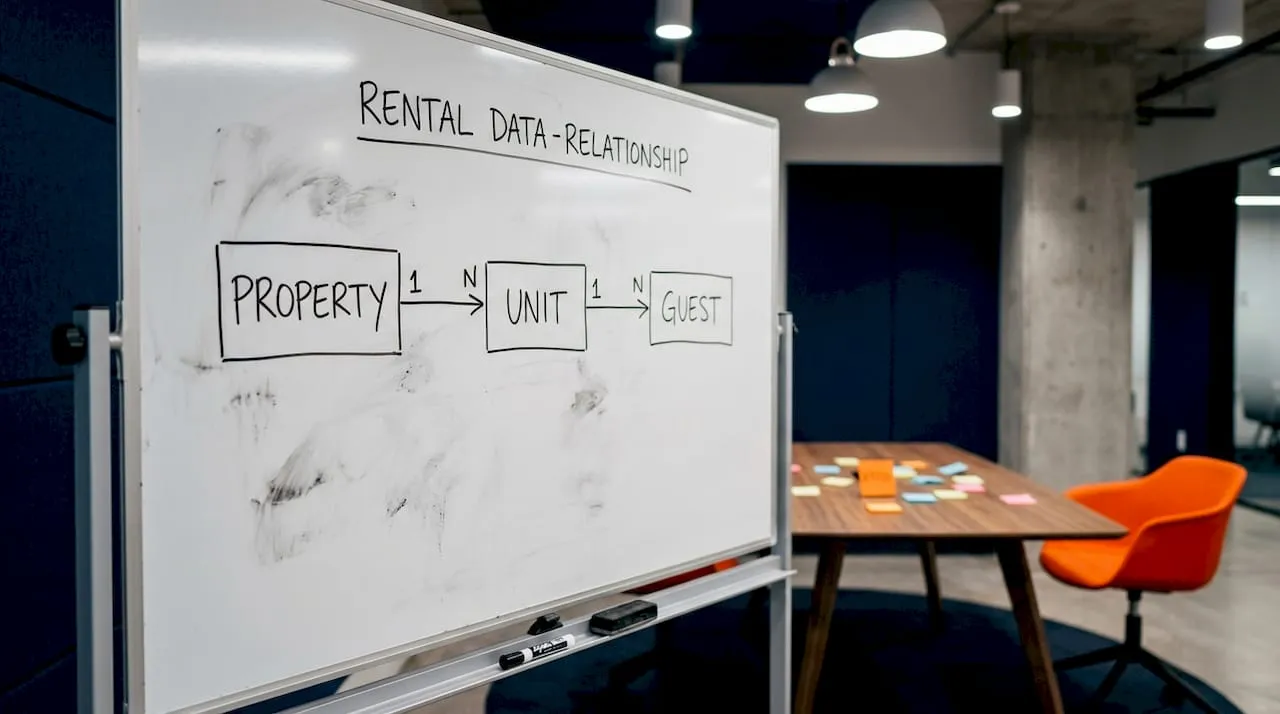
The backbone of any centralized rental data system is a well-defined entity model. Designing a strong data model in 2026 means assigning unique stable identifiers to every core entity and mapping explicit relationships between them. Without this structure, you are not centralizing data. You are just moving fragmented information into a new location.
The six core entities every vacation rental portfolio must define are:
- Properties — the physical address or building, with a unique property ID
- Units — individual rentable spaces within a property, each with their own unit ID
- Parties — guests, owners, and staff, each with a deduplicated party record
- Bookings or leases — the contractual link between a party and a unit for a defined period
- Financial transactions — payments, refunds, fees, and payouts tied to specific bookings
- Documents — contracts, ID scans, and inspection reports linked to the relevant entity
The relationships between these entities matter as much as the entities themselves. One property contains many units. One unit can have many sequential bookings. Each booking links one guest party to one unit and generates multiple financial transactions. When you make these relationships explicit in your data model, your reports and dashboards become trustworthy because every number traces back to a verified source.
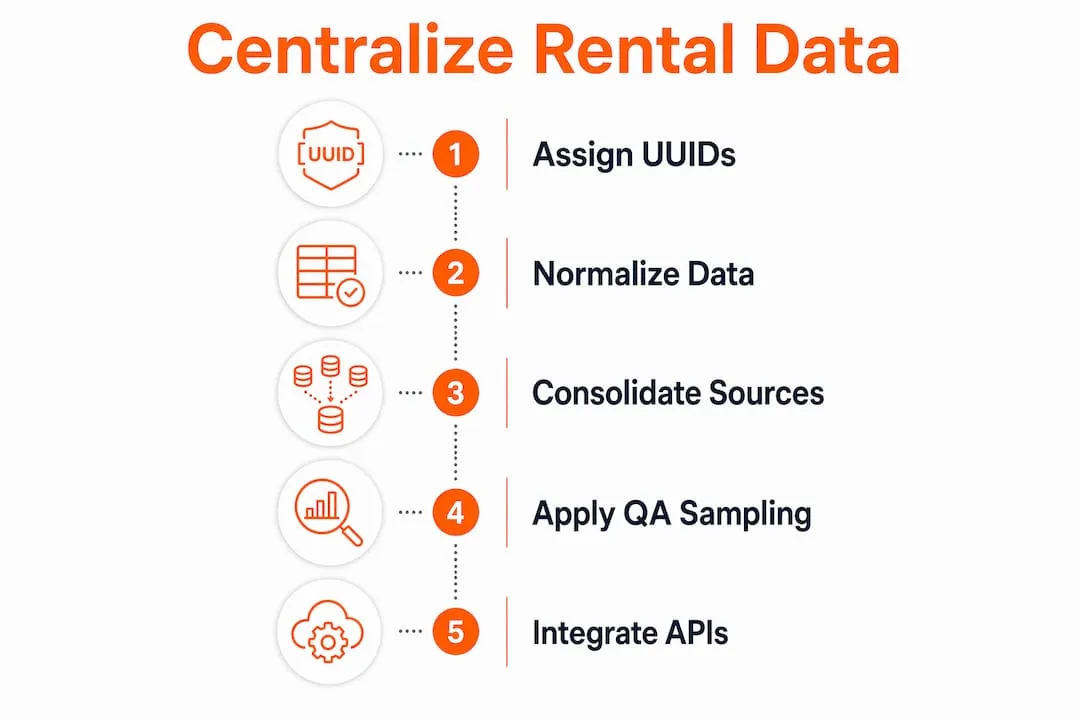
Pro Tip: Assign UUIDs (universally unique identifiers) to every entity at the point of creation, not after the fact. Retrofitting IDs onto existing records is the single most time-consuming part of any centralization project.
Normalization is the process of structuring data to eliminate redundancy. For rental data, this means storing a guest’s name and contact details once in the party record, then referencing that party ID in every booking rather than re-entering the name. Denormalization, by contrast, copies data into reporting tables for speed. Both have their place, but your canonical records must always be normalized. Temporal data, meaning records that change over time such as booking status or unit pricing, requires versioning so you can answer questions like “What was the nightly rate on March 15th?” without guessing.
| Entity | Relationship | Example |
|---|---|---|
| Property to Unit | One-to-many | Beachfront Villa contains 3 rentable units |
| Unit to Booking | One-to-many | Unit 2B has 47 bookings in 2025 |
| Booking to Transaction | One-to-many | Booking #1042 has a deposit, balance, and cleaning fee |
| Party to Booking | One-to-many | Guest Maria Chen has 4 lifetime bookings |
How do you consolidate and cleanse data from multiple sources?
Data from Airbnb, Vrbo, direct booking sites, and your PMS arrives in different formats, with different field names, and sometimes with conflicting values for the same record. The industry-standard approach is an ELT pipeline. ELT ingestion means you Extract raw data, Load it into a staging area without modification, and then Transform it into your canonical model. This preserves the original evidence so you can always audit where a value came from.
Here is a practical consolidation workflow for vacation rental managers:
- Land raw extracts. Pull data from each source as immutable snapshots. Store the raw JSON or CSV with a timestamp and source label. Never overwrite these files.
- Assign confidence scores. When extracting field values, score how reliable each source is. A confirmed Airbnb booking carries higher confidence than a manually entered spreadsheet row.
- Apply deterministic matching first. Match records by exact fields: email address, phone number, or booking reference. Deterministic and probabilistic matching together catch duplicates that exact matching alone misses.
- Apply fuzzy matching for remaining records. Use algorithms like Levenshtein distance to catch near-matches: “Jon Smith” versus “John Smith” at the same address. Flag these for manual review rather than auto-merging.
- Run manual exception review. Any record where confidence falls below your threshold goes to a human reviewer. This step is non-negotiable for data you will use in financial reporting.
- Track field-level lineage. For every canonical field, record which source provided the current value and when it was last updated. Field-level lineage prevents silent data corruption when a source changes its format.
Pro Tip: Schedule weekly QA sampling where a team member manually reviews a random selection of merged records. Weekly human QA samples of even 50 to 100 records per week catch identity drift before it corrupts your entire dataset.
Regional format differences add another layer of complexity. Addresses in Europe follow different conventions than US addresses. Currency symbols and decimal separators vary by locale. Build format normalization into your transformation layer so that all addresses, dates, and currency values conform to a single standard before they reach your canonical tables. Monitor for data drift, meaning gradual changes in how a source formats its output, by setting alerts when field patterns deviate from historical norms.
Which tools best support centralized rental operations?
Your PMS is the authoritative system of record for bookings and property data. Platforms like Guesty, Hostaway, and Lodgify each offer API access that lets you pull structured booking data in real time. The role of the PMS as the operational hub means every other tool in your stack should write back to it or read from it, not maintain its own parallel copy of booking records.
On top of your PMS, an operations layer consolidates guest verification, smart lock management, housekeeping scheduling, and automated communications into a single interface. This is where centralizing operational workflows pays off most visibly. Instead of logging into five separate tools to check a guest’s ID, confirm a door code, and verify a cleaning assignment, your team works from one screen.
The integration method matters enormously. Native API integrations outperform workarounds like iCal feeds or Zapier automations for one critical reason: they are bidirectional, real-time, and structured. An iCal feed only syncs availability blocks. A Zapier workflow breaks when either connected app updates its interface. A native API integration pushes and pulls structured data on a defined schedule with error handling built in.
| Tool category | Best use | Integration method |
|---|---|---|
| PMS (Guesty, Hostaway) | Booking and property records | Native API |
| Accounting (QuickBooks Online, Xero) | Financial reporting | Native API or direct connector |
| Operations layer | Guest ops, housekeeping, locks | Native API to PMS |
| Channel manager | Airbnb, Vrbo sync | Native API |
| Analytics (Realtevoos) | Unified reporting and AI insights | Native API to PMS and channels |
Reducing subscription sprawl is a real financial benefit of centralization. Consolidating operations into fewer, better-integrated tools cuts both monthly costs and the cognitive load of context-switching. Property managers who move from eight disconnected tools to three well-integrated ones consistently report reclaiming several hours per week. That time compounds across a growing portfolio.
What are the best practices for implementing centralized rental data systems?
A phased roadmap prevents the most common failure mode: attempting to centralize everything at once and abandoning the project when complexity overwhelms the team. Centralizing with clear purpose and incremental steps is the approach that actually reaches completion.
Follow this sequence:
- Define your business goals and KPIs first. Are you centralizing to reduce reconciliation time, improve occupancy reporting accuracy, or scale to 50 properties? Your goal determines which entities to prioritize.
- Catalog every current data source. List each tool, spreadsheet, and manual process. Document how often each source updates and what quirks it has, such as fields that are sometimes blank or dates in inconsistent formats.
- Implement unique IDs incrementally. Start with properties and units. Once those are stable, add parties, then bookings, then transactions. Rushing all entities at once creates a messy migration.
- Build ingestion pipelines with SLAs. Define how fresh your data must be. Booking data may need a 15-minute SLA. Owner financial statements may tolerate a 24-hour lag. Set alerts when pipelines miss their SLA.
- Integrate systems one at a time. Connect your PMS first, validate the data, then add your channel manager, then your accounting tool. Each integration should be tested and signed off before the next begins.
- Collect user feedback at each stage. Your housekeeping staff, front-line property managers, and owners all interact with this data differently. Their feedback reveals gaps that no technical audit will catch.
- Run ongoing QA and monitor confidence dashboards. Centralization is not a one-time project. Data quality degrades without active maintenance.
The pitfalls that derail most centralization projects share a common thread: centralizing without user feedback or a phased plan creates a system that is technically complete but practically ignored. If your team does not trust the data, they will revert to their old spreadsheets. Trust is built through transparency, which means showing where each number comes from, and through accuracy, which means catching and correcting errors visibly.
Pro Tip: Build a centralized property data confidence dashboard that shows, at a glance, which sources are healthy and which have drifted. A red indicator on a source is far less damaging than a corrupted report that nobody catches for three months.
Fragmented tools cause teams to waste time aligning on data instead of acting on it. When your team spends Monday morning reconciling last week’s numbers instead of reviewing this week’s occupancy forecast, centralization has failed its core purpose. The goal is a system where the data is trusted enough that decisions happen faster, not slower.
Key takeaways
Centralizing rental data succeeds when you build a structured entity model with unique IDs, apply ELT ingestion with field-level lineage, choose native API integrations over workarounds, and roll out incrementally with active user feedback.
| Point | Details |
|---|---|
| Build a structured entity model | Assign unique IDs to properties, units, parties, bookings, and transactions before centralizing. |
| Use ELT ingestion with lineage | Store raw extracts immutably and track which source provided each canonical field value. |
| Prioritize native API integrations | iCal and Zapier workarounds break under scale; native APIs deliver reliable, real-time data sync. |
| Roll out incrementally | Centralize one entity type at a time and validate with user feedback before expanding scope. |
| Maintain ongoing QA | Weekly manual sampling of merged records prevents identity drift from corrupting your dataset. |
What I’ve learned from watching rental data projects succeed and fail
I have seen property managers with 10 properties and managers with 150 properties attempt centralization. The technical complexity scales with portfolio size, but the failure mode is almost always the same regardless of scale: someone skips the identity management step because it feels tedious, and six months later the guest records are a mess of duplicates that nobody trusts.
The operators who get this right treat their data model as a living document, not a one-time setup task. They assign someone ownership of data quality, the same way they assign ownership of guest communications or maintenance requests. That person reviews the confidence dashboard weekly, investigates anomalies, and communicates data health to the rest of the team.
The cost-versus-time trade-off is also worth naming directly. Centralization requires upfront investment in setup, migration, and training. The payoff is not always immediate cost reduction. Often the first measurable return is time: hours saved per week on reconciliation, reporting, and cross-checking. For a manager running 20 properties, recovering five hours per week is worth more than any subscription savings in the first year.
My honest advice: resist the temptation to over-engineer the data model before you have real usage patterns. Start with the entities that cause the most daily friction, usually bookings and guest records, and build from there. A simple model that your team actually uses beats a perfect model that sits unused.
— Jose
See how Realtevoos centralizes your rental operations

Realtevoos is built specifically for vacation rental property managers who need one place to see everything. The platform pulls real-time data from Airbnb, Vrbo, and your PMS into a unified operations dashboard that gives you accurate occupancy, revenue, and guest data without manual reconciliation. AI-driven automation handles routine reporting and guest communications, so your team focuses on decisions rather than data entry. Property managers using Realtevoos report saving several hours per week while maintaining higher guest satisfaction scores as their portfolios grow. If you are ready to move from fragmented tools to a scalable rental operations system, Realtevoos is the place to start.
FAQ
What does it mean to centralize rental data?
Centralizing rental data means creating a single source of truth where all property, guest, booking, financial, and document records are stored with unique identifiers and explicit relationships. Every team member and every tool references the same canonical records rather than maintaining separate copies.
Why do native API integrations matter for rental data centralization?
Native API integrations deliver real-time, bidirectional, structured data exchange between your PMS and connected tools. iCal feeds and Zapier workflows only sync partial data and break when either connected app updates, making them unreliable for critical rental records.
How often should you run quality assurance on centralized rental data?
Weekly manual QA sampling of 50 to 100 merged records is the minimum recommended practice. This frequency catches identity drift and format changes from data sources before they corrupt your canonical dataset.
What is the biggest risk when centralizing rental data too quickly?
Rushing centralization without a phased rollout and user feedback creates a system the team does not trust. When staff revert to spreadsheets because the centralized data feels unreliable, the project fails regardless of its technical quality.
Which entities should you centralize first in a vacation rental portfolio?
Start with properties, units, and bookings because these generate the most daily operational friction. Once those records are stable and trusted, add guest party records, financial transactions, and documents in subsequent phases.