Multi-Market Management Guide for Vacation Rental Pros
Unlock growth with our effective multi-market management guide. Learn to coordinate operations, finances, and guest experiences across regions.

Multi-Market Management Guide for Vacation Rental Pros
Effective multi-market management is the coordinated practice of running vacation rental properties across multiple regions while keeping operations consistent, finances healthy, and guest experience strong. Property managers who treat each market as a standalone effort burn capital fast and miss the compounding advantages that come from a connected portfolio. This effective multi-market management guide covers the four pillars that separate operators who scale from those who stall: sequenced expansion, standardized metrics, brand coherence, and governance systems. Master these, and you can grow across markets without losing control of the ones you already run well.
What does an effective multi-market management guide cover?
Multi-market management in vacation rentals is not simply owning properties in different cities. It is a deliberate operating model that coordinates cash flow, data, brand standards, and local knowledge across every market simultaneously. The industry term for this discipline is portfolio operations management, and the best practitioners treat their entire property collection as one interconnected system rather than a set of separate businesses.
The stakes are real. Treating each market as isolated ignores compounding costs and learning opportunities that a portfolio view would capture. That means a manager running properties in Miami, Nashville, and Scottsdale who reports on each city separately is almost certainly misallocating resources. The data from one market should inform decisions in the others.

A multi-market strategy guide built for vacation rentals must address four questions: When do you enter a new market? How do you measure performance fairly across markets with different price points? What stays the same everywhere, and what changes locally? Who makes which decisions, and how does information flow between markets?
How should you sequence market expansion sustainably?
The most reliable expansion framework follows a 90-day market entry plan that splits the launch into three distinct phases.
- Days 1–30: Research and landing. Identify local demand patterns, seasonal peaks, regulatory requirements, and competitor pricing ranges. Secure your first properties and establish local vendor relationships for cleaning and maintenance.
- Days 31–60: Localization. Set up market-specific pricing rules, tax compliance, local payment preferences, and any required permits. Adapt your listing copy and photography to match what guests in that region respond to.
- Days 61–90: Scale. Replicate what worked in the first properties. Add inventory only after your occupancy rate and review scores confirm the model is working in that market.
The sequencing of markets matters as much as the sequencing within each launch. Sequential funding outperforms simultaneous launches because the first market generates positive cash flow within 12–18 months, and that cash flow funds the next entry. Launching three markets at once ties up capital before any of them prove profitable, and it splits your management attention at the worst possible time.
Choose your next market by cost of capital and time-to-revenue, not by how attractive the destination looks on paper. A market with lower acquisition costs and faster booking velocity beats a glamorous market that takes two years to break even. Sequencing by cost of capital reduces financial risk and accelerates sustainable growth across the portfolio.
Pro Tip: Target 3–5 diverse markets to balance risk and opportunity. Geographic and seasonal diversity means a slow winter in one market gets offset by peak bookings in another.
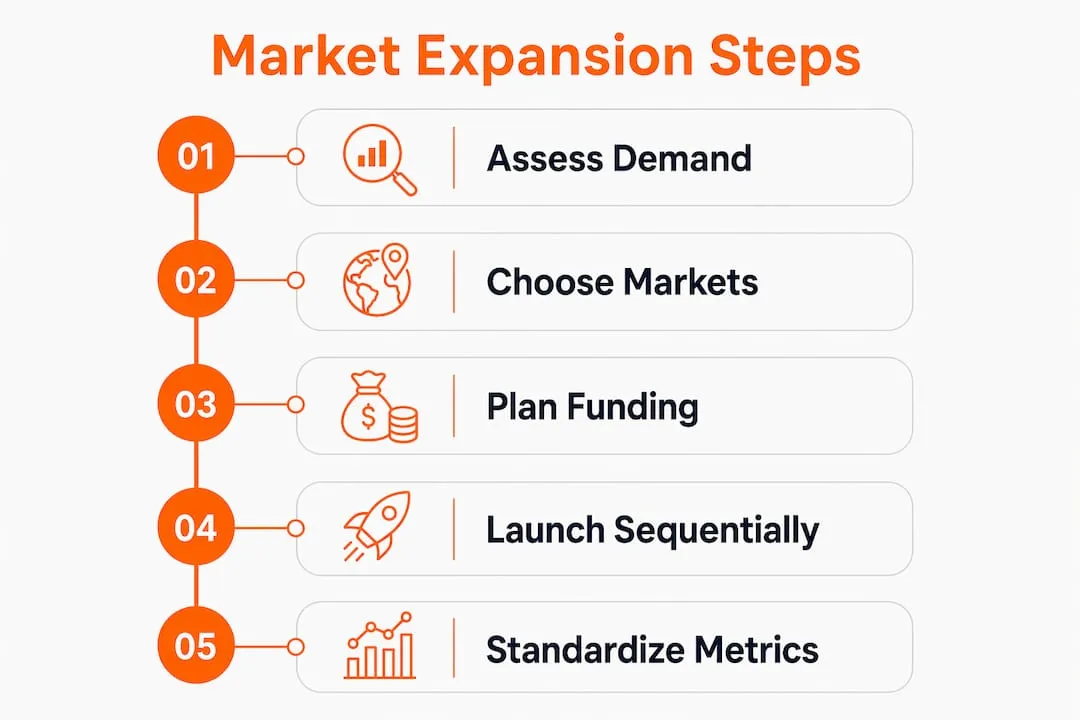
How do you standardize metrics across vacation rental markets?
Consistent measurement is the foundation of cross-market management. Without it, you cannot tell whether a property in Denver is underperforming or simply operating in a lower-revenue market than your Maui listings.
The core metrics every multi-market operator should track include:
- Customer acquisition cost (CAC): What you spend on marketing and listing fees to generate one confirmed booking
- Lifetime value (LTV): Total revenue generated per guest relationship, including repeat stays
- Retention rate: Percentage of guests who book again within 12 months
- Occupancy rate: Percentage of available nights booked, measured monthly and seasonally
- Revenue per available night (RevPAN): Total revenue divided by total available nights, the vacation rental equivalent of RevPAR in hotels
Normalizing metrics like CAC, LTV, and retention for purchasing power and regulatory complexity is what makes cross-market comparison meaningful. A $120 CAC in a high-cost coastal market may be excellent, while the same number in a budget mountain market signals a problem.
Structured metric discipline and normalized KPIs allow leadership teams to make objective decisions about where to invest more and where to pull back. Without this structure, decisions default to gut feel, which favors markets the manager knows best rather than markets that perform best.
Pro Tip: Use a unified operational reporting platform that pulls data from all markets into one dashboard. Manual spreadsheets across five markets create errors and delay the decisions that protect your margins.
| Metric | What it measures | Why it matters across markets |
|---|---|---|
| CAC | Cost to acquire one booking | Reveals marketing efficiency per market |
| LTV | Total revenue per guest | Shows long-term value of each market’s guest base |
| Occupancy rate | Nights booked vs. available | Tracks demand health and pricing accuracy |
| RevPAN | Revenue per available night | Enables fair revenue comparison across price tiers |
| Retention rate | Repeat guest percentage | Indicates guest satisfaction and brand loyalty |
How do you balance brand consistency with local adaptation?
The most common mistake in multi-market expansion is letting local teams reinvent everything. The second most common mistake is giving them no room to adapt at all. The answer is a modular approach that combines centralized core systems with decentralized local execution.
Start by defining your non-negotiables. These are the standards that apply in every market without exception:
- Brand identity: logo, photography style, tone of voice in listings and guest communications
- Pricing philosophy: how you set rates relative to market benchmarks and how you handle discounts
- Guest experience standards: response time targets, check-in process, cleanliness benchmarks
- Safety and legal compliance: minimum insurance coverage, required permits, platform policy adherence
Successful multi-market operators define these non-negotiables before any local adaptation begins. Without this anchor, local teams diverge in ways that weaken the brand and create operational inconsistencies that are expensive to fix later.
Everything outside the non-negotiables is fair game for local customization. Listing language should reflect regional vocabulary. Payment methods should match local guest preferences. Amenity packages should reflect what guests in that market actually want, whether that is a ski gear storage room in a mountain market or a beach gear locker in a coastal one. Understanding your local guest segments shapes which amenities and communication styles land best in each market.
“Modern multi-market firms transcend the global vs. local debate by building systems that enable both centralized control and local autonomy simultaneously. The goal is not to choose between the two. It is to architect operations so both are possible at once.”
Local leadership significantly improves market responsiveness and cultural competence. Hiring a local operations lead who understands the market’s seasonal rhythms, vendor relationships, and guest expectations is one of the highest-return investments a multi-market operator can make.
What governance systems keep multi-market operations from fragmenting?
Governance is the operating system of a multi-market portfolio. Without it, each market drifts toward its own processes, tools, and standards, and the portfolio loses the efficiency gains that justified expansion in the first place.
Governance protocols and technology-enabled integration prevent fragmentation by creating shared knowledge networks across markets. The key components of a working governance system include:
- Clear decision rights: Define which decisions local managers make independently, which require regional approval, and which stay with the portfolio owner. Ambiguity here creates delays and conflict.
- Harmonized reporting cadence: All markets report on the same metrics, on the same schedule, using the same format. Weekly occupancy and revenue reports, monthly P&L reviews, and quarterly strategy sessions keep everyone aligned.
- Learning loops: When one market solves a problem well, that solution gets documented and shared across the portfolio. Institutionalizing learning loops and regular performance reviews creates a competitive advantage through faster adaptation.
- Platform governance: Avoid letting each market adopt different software tools. Fragmented tech stacks multiply training costs and make unified reporting impossible. A single platform with market-level configuration is far more manageable than five different tools stitched together.
A portfolio performance tracking workflow that connects all markets gives leadership the visibility to catch problems early and allocate resources where they create the most value.
Key Takeaways
Effective multi-market management requires sequenced expansion, normalized metrics, defined non-negotiables, and governance systems that connect markets without controlling them into rigidity.
| Point | Details |
|---|---|
| Sequence market entry | Use a 90-day phased launch and fund each new market from the previous market’s cash flow. |
| Normalize your metrics | Adjust CAC, LTV, and occupancy for local market conditions before comparing performance across regions. |
| Define non-negotiables first | Lock in brand, pricing philosophy, and experience standards before allowing any local adaptation. |
| Hire local leadership | Local operations leads improve responsiveness and cultural fit in ways remote management cannot replicate. |
| Build governance early | Clear decision rights and shared reporting prevent fragmentation before it becomes expensive to fix. |
What I’ve learned from watching multi-market portfolios succeed and fail
The operators I’ve seen scale past five markets without losing quality share one habit: they treat the portfolio as the strategy, not as a collection of individual bets. Every market decision gets evaluated against what it does for the whole, not just for that one city.
The managers who struggle almost always made the same error early on. They launched two or three markets at once because the opportunity looked good in all of them. Capital got stretched, attention got divided, and none of the markets got the focused effort needed to prove the model. By the time the first market was profitable, the others had already accumulated problems that required expensive fixes.
Sequencing is not a conservative choice. It is the aggressive choice if you want to build something that lasts. Getting one market to strong positive cash flow before entering the next one means you enter the second market with real data, real cash, and real confidence. That compounds fast.
The other lesson I’d push hard on: standardized metrics are not bureaucracy. They are the only way to know the truth about your portfolio. Managers who rely on intuition about which markets are performing well almost always have a blind spot. The market they feel good about is often the one they visit most, not the one that actually generates the best returns.
Build the measurement system before you need it. By the time you realize your reporting is broken, you are already making bad decisions based on bad data.
— Jose Villeda
Realtevoos: built for operators managing multiple markets
Managing five markets with five separate spreadsheets is not a system. It is a liability.

Realtevoos gives vacation rental operators a single Command Center that consolidates performance data from every market, automates guest communications, and delivers real-time reporting across your entire portfolio. Property managers using Realtevoos report saving several hours each week by replacing manual reporting with AI-driven dashboards that pull live data from Airbnb, Vrbo, and other platforms. Whether you are managing three properties or thirty, Realtevoos scales with your portfolio without adding operational complexity. See what centralized portfolio control looks like for your operation.
FAQ
What is multi-market management in vacation rentals?
Multi-market management is the practice of operating vacation rental properties across multiple geographic markets under a unified operational and financial framework. It requires standardized metrics, consistent brand standards, and governance systems that connect all markets.
How many markets should a vacation rental operator target first?
Target 3–5 diverse markets to balance risk and opportunity. Launching fewer markets reduces learning, while launching more than five simultaneously strains capital and management attention.
What metrics matter most when managing multiple rental markets?
The most critical metrics are CAC, LTV, occupancy rate, RevPAN, and guest retention rate. Normalizing these metrics for local purchasing power makes cross-market comparison accurate and useful.
How do you maintain brand consistency across different vacation rental markets?
Define non-negotiables such as brand identity, pricing philosophy, and guest experience standards before entering any new market. Everything outside those standards can adapt to local preferences without diluting the brand.
What is the biggest mistake in multi-market vacation rental expansion?
Treating each market as an isolated investment rather than part of a portfolio is the most expensive mistake. A portfolio view enables better capital allocation, risk management, and reuse of systems across markets.