At 8–10 Listings: Multi Market Pricing Automation for Rental Managers
Actionable guide for scaling rental managers: when to automate, set guardrails, and prove ROI using academic research and RealtevoOS evidence.

At 8–10 Listings: Multi Market Pricing Automation for Rental Managers
Multi-market pricing automation is AI-driven, channel-aware rate management that adjusts nightly pricing across every listing and market in your portfolio, daily, using booking pace, local events, and competitor rates as inputs. It’s the right move once you’re running multiple properties or markets with real seasonal or event volatility, because that’s where manual spreadsheets stop scaling. The payoff: captured demand windows, hours back in your week, and RevPAR that actually reflects what guests will pay today.
TL;DR:
- Automation provides the greatest benefits in markets with high volatility caused by seasonality or local events, where manual pricing lags demand shifts.
- Effective deployment requires robust integration, portfolio segmentation, guardrails, and an initial tuning period of 30 to 90 days with manual oversight.
- Key performance indicators include RevPAR, ADR, occupancy, booking pace, and gap-night fill rate, all compared against relevant property-specific benchmarks.
- Common pitfalls like missing event data, poor comp sets, and wide price ranges can be fixed through careful tuning, regular reviews, and clear escalation rules.
- RealtevoOS offers a unified platform that automates multi-market pricing with two-way integrations, dashboards, guardrails, and owner reports, saving hours and reducing manual work.
Table of Contents
- What Multi-Market Pricing Automation Actually Does
- When Does Automation Actually Pay Off?
- How to Deploy Multi-Market Pricing Automation Safely
- Which KPIs Prove the Automation Is Working?
- Common Pitfalls (and How to Fix Them Fast)
- What I’ve Learned Watching This Play Out Across Portfolios
- How RealtevoOS Handles Pricing Automation Across Your Portfolio
- Sources
What Multi-Market Pricing Automation Actually Does
Manual pricing means someone opens a spreadsheet, checks a few comp listings, and nudges rates every week or two. Multi-market pricing automation replaces that with software that recalculates rates every day, across every property, using signals no human can track in real time.
The inputs matter more than the algorithm’s name. A capable system pulls in booking pace (how fast nights are filling relative to historical norms), lead time, comp-set rates, local events, seasonality curves, and length-of-stay patterns. It then adjusts rates nightly rather than waiting for a manual review cycle, which is where most of the operational value actually comes from. Orphan nights (the single unbooked night wedged between two reservations) get repriced automatically instead of sitting stale for weeks.
None of this works without a two-way connection between your channel manager and your property management system. If rate pushes are one-directional or delayed, your Airbnb calendar and your Vrbo calendar drift apart, and you end up managing discrepancies instead of revenue.
What separates a well-run automated setup from a chaotic one comes down to a few structural pieces:
- Portfolio segmentation that groups properties by market type and lead-time behavior, so a ski cabin isn’t priced with the same logic as a downtown studio
- Two-way PMS and channel-manager sync so rate and availability changes push instantly across every platform
- Guardrails like minimum and maximum price floors that keep the algorithm from underpricing during slow weeks or overreacting to a single data point
- Custom season windows that reflect your actual demand calendar, not a generic template
Guardrails are what let you hand pricing decisions to software without handing over control. You set the boundaries; the system operates inside them.
When Does Automation Actually Pay Off?
Not every market rewards the same level of automation, and pretending otherwise wastes setup time. Four broad profiles determine where you’ll see the biggest lift.
Extreme seasonal markets (beach towns, ski destinations) see the largest gains because demand swings hard between peak and shoulder periods, and manual pricing almost always lags the curve. Event-driven markets (convention cities, festival towns, college towns during game weekends) reward automation because a human reviewing rates weekly will miss a three-day spike that the algorithm catches the moment demand signals shift. Resort-squeeze markets with tight inventory and short booking windows benefit from daily recalculation because pricing mistakes compound fast when supply is limited. Year-round urban markets with flatter demand curves see smaller, though still real, incremental lifts, and a simpler rules-based approach can sometimes cover most of the gap.
Mixed portfolios complicate the calculus. Pairing a ski cabin with a handful of urban apartments means one automation profile won’t fit both, which is exactly why segmentation isn’t optional once you’re managing more than one market type.
Scale is the other trigger. Somewhere around eight to ten active listings, or two or more distinct markets, manual pricing stops being a Tuesday-afternoon task and starts eating a full workday. That’s also roughly the threshold where automation is required to sustain gap-night pricing at all.
Before adopting, run this checklist:
- Volatility: Does your market see meaningful seasonal or event-driven swings, or is demand mostly flat?
- Scale: Are you managing enough properties or markets that manual review has become a bottleneck?
- Integration readiness: Does your PMS support two-way sync with a pricing engine, or will you be stitching things together manually?
If you answer yes to two of three, automation is worth piloting.
How to Deploy Multi-Market Pricing Automation Safely
Rolling out automation across a portfolio without a plan is how managers end up with underpriced weekends and confused owners. Here’s the sequence that keeps risk low while you learn what the system actually does.
- Establish your baseline. Pull ADR, occupancy, and RevPAR for each property over the trailing 12 months, along with a defined comp set for each market. You can’t measure a lift you didn’t first measure a starting point for.
- Confirm technical integrations. Verify two-way sync between your PMS and channel manager, enable event calendars for each market, and set up currency handling if you operate across regions. A reliable cloud-based connection here prevents the rate-drift problems that undermine trust in automation early.
- Build portfolio dashboards that show pricing activity, occupancy pace, and revenue by property and by market, in one view.
- Set segmentation rules. Group properties by market profile and booking lead time, then define season windows specific to each market rather than importing a generic calendar.
- Set guardrails. Establish minimum and maximum price floors, minimum-stay rules, and an owner-approval workflow for any rate change beyond a set threshold.
- Run a 30 to 90 day tuning window with weekly manual review of the algorithm’s suggestions before shifting to a lighter cadence.
- Assign review ownership. Decide who checks algorithm suggestions, documents manual overrides, and reports outcomes to owners.
Pro Tip: Keep an owner-visible log of every automated rate change during the first 90 days. It turns “the algorithm did something weird” into a two-minute conversation with a clear answer, and it builds the trust you’ll need before owners let automation run unsupervised.
Which KPIs Prove the Automation Is Working?
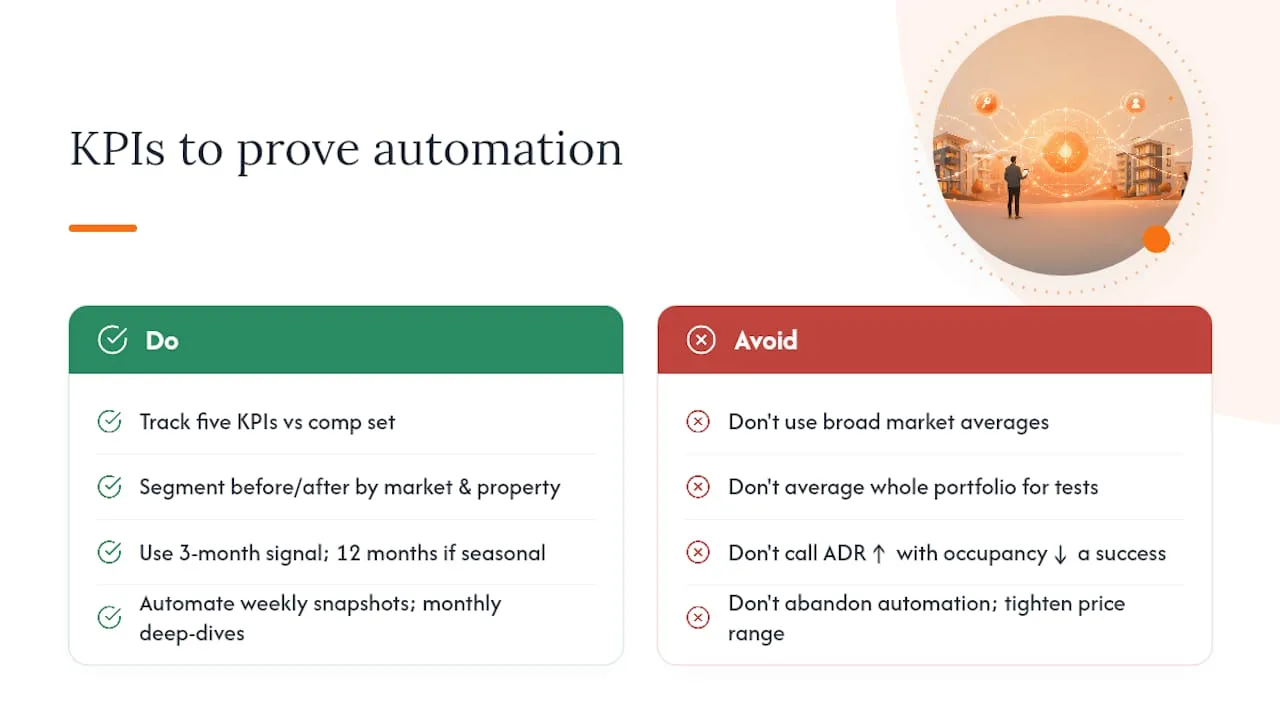
Five numbers tell you whether multi-market pricing automation is earning its keep: RevPAR, ADR, occupancy, booking pace, and gap-night fill rate. Track them together, not in isolation, and always against your comp set rather than a broad market average, since market averages hide the stale pricing you’re trying to fix.
For before/after comparisons, segment by market profile and property type rather than averaging your entire portfolio into one number. A three-month window gives you early directional signal; seasonally sensitive markets need a full 12 months before you can trust the comparison, since a single strong summer can mask a weak shoulder season.
Academic research applying dynamic pricing models to short-term rentals has shown measurable revenue lifts in controlled tests, though the size of the gain depends heavily on market and configuration, according to research on hedonic pricing models applied to Airbnb listings.
Set up automated weekly snapshots for a quick pulse check, and reserve monthly deep-dives for the segmented before/after analysis. When you see rising ADR paired with falling occupancy, that’s usually a floor set too high for current demand, not a sign the system is broken. The fix is almost always tightening the price range, not abandoning the approach.
Common Pitfalls (and How to Fix Them Fast)
Most automation failures trace back to the same handful of causes, and all of them are fixable without ripping out the system.
- Missing local event data: If your algorithm doesn’t know about a festival or convention, it prices that weekend like any other, and you leave revenue on the table.
- Poor comp sets: Comparing your properties against the wrong tier of listings skews every recommendation downstream.
- Overly wide price ranges: Loose floors and ceilings let the algorithm swing further than owners are comfortable with.
- Weak owner communication: Silence about automated changes is what turns a minor pricing dip into a trust problem.
Tuning fixes most of this. Tighten your floors, add missing event windows, correct comp sets, and review suggestions weekly for eight to twelve weeks before easing off to a lighter cadence.
Pro Tip: If a property’s occupancy drops two consecutive weeks below your baseline, pause automation on that listing and run a manual review before touching the guardrails. Fixing the wrong variable wastes a tuning cycle you don’t get back.
Keep a rollback procedure ready and clear escalation rules for when a manager needs to override the algorithm outright.
What I’ve Learned Watching This Play Out Across Portfolios
The biggest misconception I run into is that automation replaces judgment. It doesn’t. It replaces the repetitive part of judgment, the daily rate check across forty listings that no manager has time to do well by hand. What it doesn’t replace is knowing that a marathon is happening three blocks from your downtown unit next month. Event awareness is still where humans add the most value, because an algorithm without a local event feed will price that weekend like any other Tuesday.
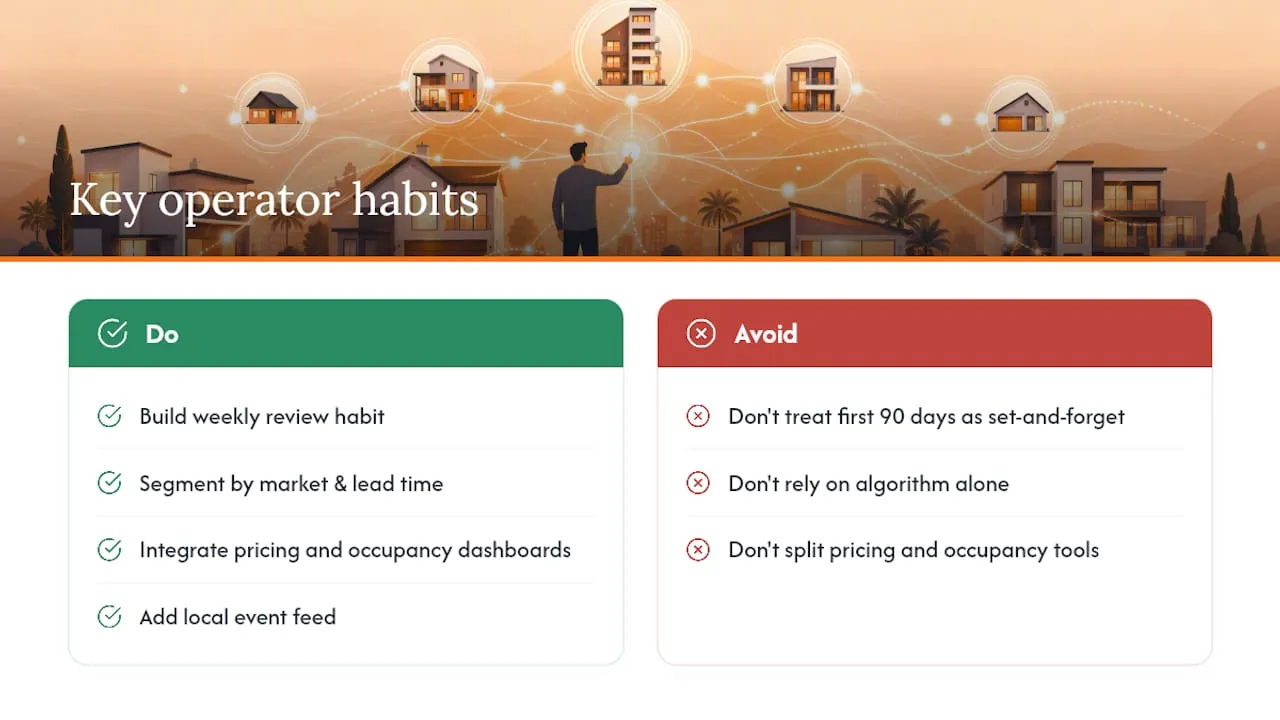
The second thing I’d push back on: managers who treat their first 90 days as a “set it and forget it” trial are the ones who end up disappointed. The value isn’t in the algorithm being smart on day one. It’s in the weekly review habit you build during that window, where you catch a bad comp set or a floor set too low before it costs you a full season. Portfolios that segment properly by market profile and lead time, rather than treating every listing the same, consistently see cleaner results faster.
If there’s one thing scaled operators underestimate, it’s how much cleaner reporting gets once pricing logic and occupancy data live in the same dashboard instead of three disconnected tools.
— Jose Villeda
How RealtevoOS Handles Pricing Automation Across Your Portfolio
RealtevoOS is built specifically for the scaling problem this article walks through: managing rate strategy across properties and markets without hiring a full-time revenue team. It runs two-way integrations with Airbnb, Vrbo, and common PMS platforms, so rate changes push instantly instead of drifting between calendars.

The platform surfaces AI-driven pricing recommendations alongside portfolio dashboards that show occupancy, ADR, and RevPAR by property and by market, so you’re not stitching together five spreadsheets to see the full picture. Guardrails and owner-visible reporting come built in, which means the 90-day tuning window described above happens inside one system rather than across disconnected tools. Property managers using RealtevoOS report saving several hours a week that used to go into manual rate checks and owner updates.
Onboarding starts with a trial, moves through guided setup with optional paid onboarding support, then continues as a monthly subscription priced by property count. If you’re managing multiple markets and ready to stop pricing them by hand, request a demo of the RealtevoOS command center and see how it fits your portfolio.
Sources
- Dynamic vs Manual Pricing for Vacation Rentals
- Pricing in the sharing economy: a hedonic pricing model applied to Airbnb listings (and related academic work on dynamic pricing models)
- Staystra
- What Is Dynamic Pricing in Short-Term Rentals?