Two Page Owner Proposal Property Managers Can Send in 48 Hours
Copy a two page owner proposal managers can send in 48 hours, with sample wording, payout math, and an onboarding timeline.

Two Page Owner Proposal Property Managers Can Send in 48 Hours
An owner proposal template exists to do one job: prove you understand the property, show the owner the actual math on their payout, and give them a date to say yes. The format that works is two pages, sent within 48 hours of your first conversation, with a live walk-through call booked at the moment you hit send. RealtevoOS handles the reporting and onboarding side of that promise once the ink dries, which is exactly why the template should mention it.
TL;DR:
- Presenting clear fee structures with visible math and scenario projections greatly increases owner trust and reduces expectations gaps during onboarding.
- Including explicit exclusions, legal entity details, and termination terms early in the proposal minimizes surprises and speeds legal approval.
- Sending proposals within 48 hours and scheduling walk-through calls with specific dates significantly improves sign rates.
- Using automated reporting tools like RealtevoOS ensures transparency, saves time, and provides real-time data owners can verify post-signature.
- Customizing proposal tone and emphasis based on owner type—first-time investor, remote owner, or portfolio owner—boosts relevance and likelihood of closing.
Table of Contents
- What Goes Into an Owner Proposal Template?
- How Should You Present Fees to a New Owner?
- What Contract Terms Should the Proposal Preview?
- What Does the First 30 Days Look Like for a New Owner?
- Why Sending Within 48 Hours Increases Your Sign Rate
- How Does RealtevoOS Support the Promises in Your Proposal?
- How Do You Customize the Same Template for Different Owners?
- What Mistakes Sink an Otherwise Good Proposal?
- How Do You Make the Proposal Look as Good as It Reads?
- What Legal Details Belong in the Proposal Itself?
- How Should You Follow Up Without Sounding Desperate?
- A Note on Honesty in Owner Proposals
- Send Owners a Proposal That Proves the Reporting Promise
- Sources
What Goes Into an Owner Proposal Template?
Every winning proposal has the same five bones, no matter how you dress them up. Skip one and owners notice the gap immediately.
Start with a cover letter, two to three lines, no more. It should prove you listened and state your value proposition in plain terms:
- “You mentioned the pool deck needs attention before summer bookings. Here’s how we’d handle that alongside a pricing strategy built for your beachfront location.”
Next comes the property snapshot: bedrooms, sleep capacity, standout features, and honest constraints (a shared driveway, an HOA quiet policy, limited parking). Owners trust proposals that admit limitations up front.
Then list services as short, concrete bullets, not marketing fluff:
- Listing creation and management across Airbnb, Vrbo, and direct booking channels
- Professional photography and copywriting
- Dynamic pricing adjusted weekly against local demand
- Guest messaging with a stated response-time standard
- Cleaning and turnover coordination
- Maintenance triage and vendor dispatch
Close with exclusions and separately billed items. According to research on proposal templates, owners respond better to concrete metrics than vague adjectives, and the same logic applies to what you won’t do. Spell out that deep cleans after long-term rental damage, major appliance replacement, and landscaping are billed separately. A property management proposal that names its exclusions clearly tends to close faster than one that buries them, because it kills the surprise later.
How Should You Present Fees to a New Owner?
Owners don’t want to decode a percentage. They want to see dollars landing in their account, so the fee section needs to do arithmetic in front of them, not around them.
- Percentage-based fee: “We charge 20% of gross booking revenue, deducted before your payout.” One sentence, no footnote.
- Flat monthly fee: “A flat $350 per month covers full-service management regardless of occupancy.” Useful for owners who dislike variable costs.
- Hybrid fee: “A $150 monthly base plus 12% of bookings once occupancy exceeds 60%.” This works well for seasonal properties with inconsistent demand.
Follow the fee line with a short projection table showing two scenarios, since presenting a conservative and a realistic revenue scenario side-by-side with visible math protects both sides from unrealistic expectations:
State plainly who pays cleaning fees (usually the guest, passed through), who covers consumables (typically the owner), and when the first payout lands. Never push fee terms into an appendix. If it decides whether the owner signs, it belongs on page one.
What Contract Terms Should the Proposal Preview?
The proposal isn’t the contract, but it should preview the terms clearly enough that legal review feels like a formality, not a surprise. Owners who see contract essentials early sign faster because there’s nothing left to negotiate blind.
- Legal identity: List the owner’s exact legal entity. If the property sits inside an LLC or trust, the agreement needs that entity named to preserve liability protection, per legal guidance on management agreements.
- Term and renewal: “This agreement runs for a year, renewing automatically unless either party gives advance written notice within a specified period.” Watch for auto-extension language that traps owners who miss the notice window.
- Termination: State the exit path plainly, including what happens to bookings already on the calendar.
- Maintenance spend threshold: “Repairs under $250 are authorized automatically. Anything above that requires your approval within 24 hours.” Our maintenance automation guide covers how to route these approvals without slowing down urgent fixes.
- Listing and data ownership: Clarify who owns the Airbnb and Vrbo listing accounts, and what happens to guest data and reviews if the relationship ends.
Pro Tip: Send the proposal’s contract preview to your own lawyer once, build a reusable clause library from it, and you’ll never redraft this section from scratch again.
What Does the First 30 Days Look Like for a New Owner?
Owners sign faster when they can see the actual calendar, not a vague promise that “onboarding takes a few weeks.”
- Week 0: Countersigned agreement, banking details collected, license numbers verified, and initial condition photos taken. Store these alongside the signed contract, since documented photo inventories protect both sides in later damage disputes.
- Week 1: Professional photography scheduled and delivered, listing copy written, pricing strategy set, and the booking calendar goes live across channels.
- Week 2: Linen inventory counted, full property condition photos logged, vendor team briefed on the property’s quirks, and a sample owner statement built so the owner sees the reporting format before their first real one arrives.
- Week 4: Property fully live with a direct-booking page, and the first performance check-in call happens, comparing actual bookings against the proposal’s projection.
Assign a name and date to every milestone in the proposal itself. “We handle onboarding” means nothing. “Sarah confirms your banking details by Thursday” means everything.
Why Sending Within 48 Hours Increases Your Sign Rate
Momentum decays fast after a good conversation. Send your proposal within 48 hours of meeting the owner, and book the walk-through call in the same message, because a named next step with a date and time converts far better than “let me know what you think.”
Bring two things to that call: a conservative revenue projection and a sample owner statement that traces one booking from guest payment to owner payout. Owners who see that single transparent example tend to trust the rest of the proposal faster.
- First follow-up: two business days after sending, if no response.
- Weekly touches: three total, spaced a week apart.
- Close-the-file message: a polite note after touch three, leaving the door open without chasing.
Pro Tip: Use language like, “I’ll call you Thursday at 2 PM to walk through this, and if you’re comfortable, I’ll send the agreement that same day.” It removes the ambiguity that kills momentum.
How Does RealtevoOS Support the Promises in Your Proposal?
Every proposal promises transparency and fast onboarding. RealtevoOS is the system that actually delivers both once the owner signs. It consolidates guest messaging, dynamic pricing, and maintenance workflows into one dashboard, pulling real-time data from Airbnb and Vrbo instead of forcing your team to reconcile spreadsheets manually. Owners increasingly expect to see a reporting portal or live demo before they sign, and property managers using automated reporting report saving several hours a week that used to go into building owner statements by hand.

Two lines you can drop straight into your template:
“Your monthly owner statement is generated automatically through RealtevoOS, showing every booking, fee, and payout in real time.”
“We use RealtevoOS to track guest response times and maintenance requests, so you always know the status of your property without asking.”
Our owner reporting checklist breaks down exactly what belongs in that statement.
How Do You Customize the Same Template for Different Owners?
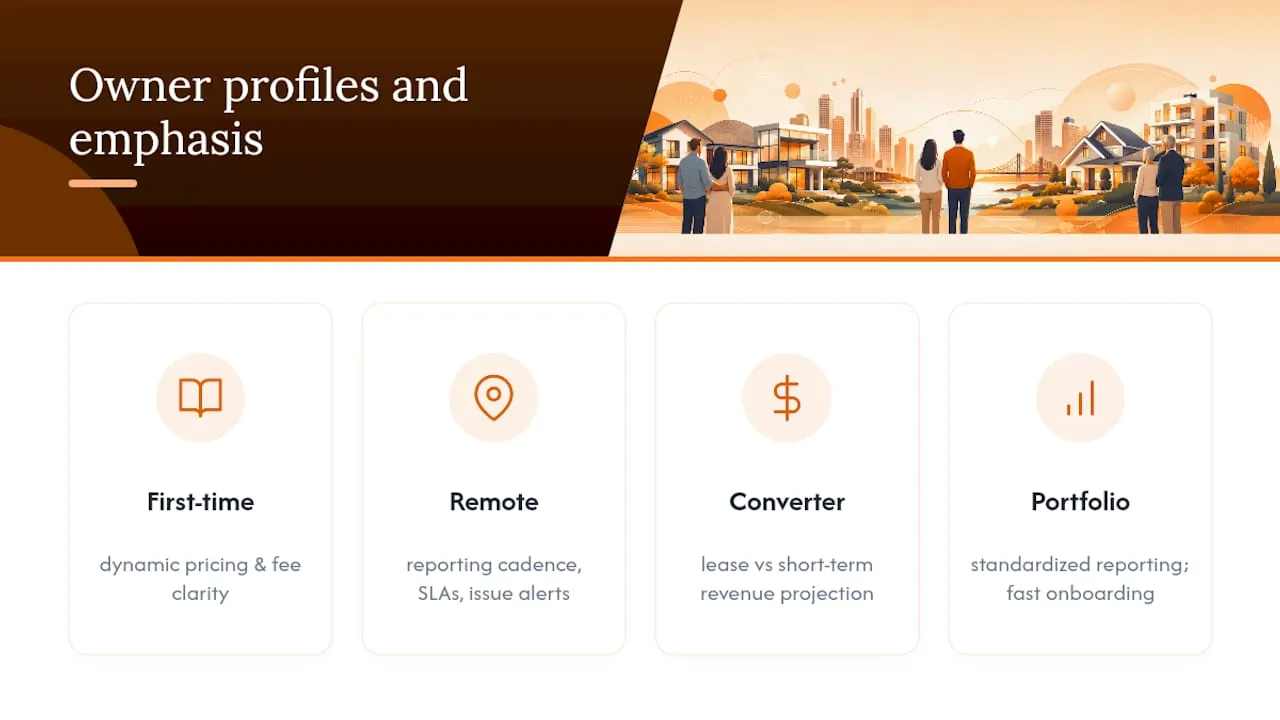
A single template rarely fits every owner, and forcing it to is the fastest way to lose a deal. The bones stay the same, but the emphasis shifts.
The first-time investor wants education more than efficiency. Add a short paragraph explaining how dynamic pricing works and why occupancy fluctuates seasonally. They’re nervous about the unknown, so slow down the fee section and explain the arithmetic twice if needed.
The remote or out-of-state owner cares most about visibility. Lean harder on the reporting cadence, the maintenance approval workflow, and how they’ll be notified of issues without being on-site. Mention response-time SLAs prominently, since distance breeds anxiety about being kept in the dark.
The owner converting from a long-term rental needs the revenue comparison spelled out. Show what they earned under a lease versus a realistic short-term projection, since that contrast is usually the reason they’re talking to you at all. Our guide to converting long-term rentals has projection language worth adapting here.
The portfolio owner with multiple properties wants consistency and scale, not hand-holding. Skip the basics and lead with your systems: how you standardize reporting across their properties and how quickly you can onboard the next one.
Match the proposal’s tone to the owner’s actual worry, not to a generic template.
What Mistakes Sink an Otherwise Good Proposal?
The most common failure is burying the fee structure in an attachment or footnote. Owners read the first page closely and skim the rest, so if the fee sentence isn’t visible early, they’ll assume you’re hiding something even when you’re not.
A close second: promising vague outcomes instead of specific numbers. “We’ll maximize your revenue” says nothing. A conservative and realistic projection with visible math says everything, and it’s the difference between sounding like every other manager and sounding like the one who did the work.
Skipping the exclusions list is another quiet deal killer. Owners who don’t know what’s not included end up surprised by a bill three months in, and that surprise damages trust far more than the actual dollar amount.
Sending a ten-page proposal is also a mistake, even when the extra content is good. Owners forward the short version to a spouse or business partner for a quick read. A dense packet gets set aside “for later,” and later rarely comes.
Finally, don’t skip the legal identity question. Proposing to “the owner” instead of naming their LLC or trust creates confusion once the contract stage arrives, and it signals you haven’t done the basic homework a serious management relationship requires.
How Do You Make the Proposal Look as Good as It Reads?
Content wins the deal, but design decides whether the content gets read at all. A proposal that looks like a Word document from 2015 undercuts even the strongest fee math.
Use a single consistent header with your company name and logo on both pages, not just the cover. White space matters more than most managers think. Cramming five sections onto two pages with no breathing room makes owners feel like they’re being sold to rather than informed.
Pick one accent color and use it for section headers and the fee table, nothing else. A proposal with six different colors reads as unpolished, while one clean accent color reads as intentional.
Tables beat paragraphs for the fee projection and onboarding timeline specifically, because owners scan those two sections for numbers and dates rather than reading them line by line. Everything else, including the cover letter and property snapshot, reads better as short prose.
Export to PDF before sending, always. A Word document that reflows differently on the owner’s screen than on yours is a small thing that quietly signals carelessness.
What Legal Details Belong in the Proposal Itself?
The proposal previews the contract, so what it implies matters just as much as what the formal agreement states later. Getting this wrong doesn’t just cost you a signature. It can cost you a defensible position if the relationship sours.
The proposal should name the owner’s legal entity, since a management agreement written against the wrong party can pierce the liability protection an LLC or trust was set up to provide. If you’re not sure whether the owner holds title personally or through an entity, ask before you draft the contract.
Cancellation handling deserves a plain sentence, too. Who absorbs a refund when a guest cancels under a flexible policy: the owner, the platform, or you? Owners assume this is obvious. It usually isn’t, and silence here creates disputes later.
Insurance expectations belong in the proposal as well, even briefly. State whether the owner needs a specific short-term rental policy or rider, since many standard homeowner policies exclude short-term rental activity entirely.
None of this replaces a lawyer’s review of the final agreement. But a proposal that gets these points right the first time moves through legal review faster, because there’s nothing to renegotiate that should have been settled up front.
How Should You Follow Up Without Sounding Desperate?
The follow-up cadence matters almost as much as the proposal itself, and most managers either follow up too aggressively or not at all.
Send the first nudge two business days after the proposal lands, timed to the walk-through call you already scheduled. This isn’t really a follow-up. It’s a scheduled touchpoint the owner already agreed to, which removes any awkwardness.
If the owner goes quiet after the call, follow up weekly for three touches total. Each message should add something small: a market data point, a quick answer to something they raised on the call, a note about a comparable property’s occupancy. Repeating “just checking in” three times in a row reads as pressure, not persistence.
After the third touch with no response, send a polite close-the-file message: “I don’t want to keep filling your inbox, so I’ll close this out on our end. If your plans change, the proposal and projection still stand; just reach out.” This does two things well. It removes the awkwardness of unanswered messages, and it often prompts a response from owners who were simply busy, not uninterested.
Track every touch in whatever system you use for lead management, because a proposal that gets no response in month one sometimes gets signed in month four when the owner’s circumstances change.
A Note on Honesty in Owner Proposals
Owners will eventually ask about your worst-case experience with a property, and dodging the question costs you more than answering it honestly. Describe a specific, team-based resolution process, not a denial that problems ever happen. Candor here speeds negotiation, because owners who trust your disclosure stop probing for hidden risk and move toward signing.
— Jose Villeda
Send Owners a Proposal That Proves the Reporting Promise
Most of what makes an owner proposal credible, the visible projection, the sample statement, the onboarding dates, only works if you can actually deliver it after signing, following property owner onboarding tips for short-term rentals. That’s the gap between managers who promise transparency and managers who automate it. RealtevoOS turns the reporting and onboarding commitments in your proposal into something real: automated owner statements, real-time data pulled directly from Airbnb and Vrbo, and maintenance workflows that don’t depend on someone remembering to update a spreadsheet.
That matters most in the first 30 days, when a new owner is watching closely for proof they made the right call. Managers using RealtevoOS report saving several hours a week that used to go into manual reporting, time that goes straight back into finding and onboarding the next owner. If you want to see how the platform’s reporting dashboard and onboarding tools work before your next proposal goes out, view the management deck and walk through it the same way you’d walk an owner through their first statement.
Sources
- Sample vacation rental property management agreement template
- Short-term rental management proposal template
- How to Get Property Management Clients: First Contact to Signed Agreement