Owner Relations Workflow: Build It Right in 2026
Discover how to create an effective owner relations workflow in 2026. Keep property owners engaged and boost contract renewals with proven strategies.

Owner Relations Workflow: Build It Right in 2026
An owner relations workflow is a structured communication and management process that keeps property owners informed, engaged, and confident in their investment. For vacation rental managers, this process is the difference between owners who renew contracts and owners who walk. Proactive communication with monthly statements, quarterly calls, and annual reviews keeps owner churn below 10%. That single statistic should shape every decision you make about how you communicate with the people who trust you with their properties.
What are the key components of an owner relations workflow?
A strong owner relations workflow is built on five repeatable elements: financial reporting, scheduled calls, issue escalation, relationship tracking, and documented authority limits. Each component serves a specific function. Together, they create a system owners can rely on.
Monthly financial and performance statements are the foundation. Owners want to know what their property earned, what it cost, and how it compared to the market. The format matters as much as the frequency. Owners prioritize narrative-driven insights over raw data blocks. A statement that explains why occupancy dropped in February beats a spreadsheet that just shows the number.

Quarterly check-in calls keep the relationship human. A 10-minute call every three months is enough to surface concerns before they become complaints. Use a consistent agenda: review the last quarter, preview the next, and ask one open question about the owner’s goals.
Annual performance reviews give owners the bigger picture. Cover year-over-year revenue, property condition, market positioning, and goals for the coming year. This meeting signals that you manage their asset strategically, not just operationally.
Proactive issue reporting is where most managers fail. Calling owners about issues before they discover them builds trust faster than perfect statements alone. Set a rule: any issue above a defined cost threshold gets a call within 24 hours.
Maintenance authority documentation prevents the most common trust-breaking events. Clear maintenance authority limits documented from day one prevent friction around spending. Define the dollar amount you can approve without owner sign-off, and put it in writing during onboarding.
- Monthly statements with narrative context, not just numbers
- Quarterly 10-minute calls with a consistent agenda
- Annual reviews covering revenue, condition, and strategy
- 24-hour issue notification for anything above the spending threshold
- Written maintenance authority limits signed at onboarding
- CRM log of every owner interaction, call, and decision
Pro Tip: Use a CRM like HubSpot or a property management platform to log every owner touchpoint. When a dispute arises six months later, you will have a timestamped record of every conversation.
Which tools best support a scalable owner relations workflow?
The right technology turns a good workflow into a consistent one. Without tools, your process depends entirely on individual memory and effort. That does not scale.
AI-powered communication tools can deflect up to 80% of routine owner inquiries, freeing your team for high-value interactions. That means owners get answers at 11 p.m. on a Saturday without you lifting a finger. The remaining 20% of inquiries, the ones that require judgment, get your full attention.
| Tool Category | Primary Function | Best For |
|---|---|---|
| Property Management Software (e.g., Realtevoos) | Centralized dashboard, automated reporting, AI-driven alerts | Full workflow automation across multiple properties |
| Owner Portals | 24/7 statement and maintenance access for owners | Self-service transparency and reducing inbound calls |
| CRM Systems (e.g., HubSpot, Salesforce) | Tracking interactions, scheduling follow-ups, logging decisions | Relationship health tracking and communication history |
| AI Communication Tools | Handling routine inquiries automatically | After-hours coverage and high-volume portfolios |
| Analytics Platforms (e.g., PriceLabs Owner Analytics) | Market benchmarking and performance context | Narrative-driven reporting and pricing strategy |
Standardized communication rhythms with monthly checklists and scheduled calls prevent owners from being forgotten as portfolios scale. A platform like Realtevoos consolidates data from Airbnb and Vrbo into one dashboard, so your monthly statements pull from a single source of truth rather than three separate exports.
Data consolidation is the hidden advantage of integrated platforms. When your booking data, maintenance logs, and financial records live in one place, your reports are accurate and your owner conversations are grounded in real numbers.
Pro Tip: Set up automated owner notifications for maintenance received, maintenance completed, and monthly statement delivery. Configuring these automations takes a few hours but eliminates the largest controllable cause of owner churn.
How to implement an owner relations workflow step by step
Building the workflow is a 60-day project. Maintaining it is a permanent commitment. Here is the sequence that works.
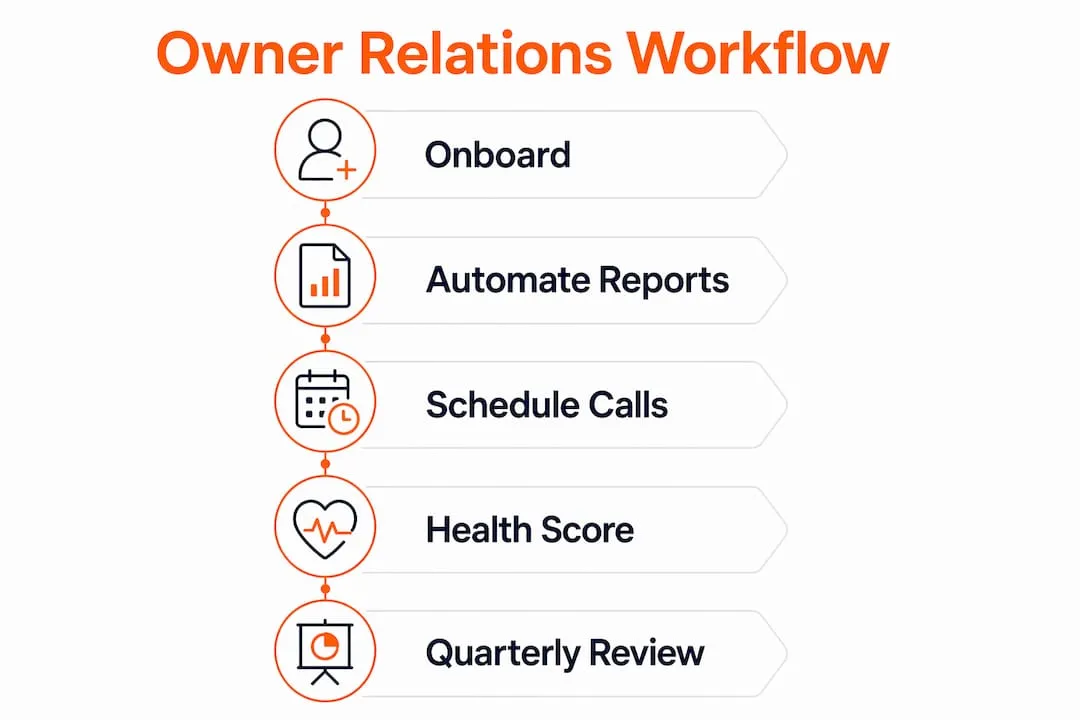
Step 1: Onboard with documented expectations (Days 1–30)
The first 30 days set the tone for the entire relationship. Documenting specific owner expectations during onboarding prevents early relationship decline. Cover statement timing, maintenance authority limits, preferred communication channels, and how you define success. Give the owner a one-page summary they can reference later.
Step 2: Configure automated reporting and notifications (Days 15–45)
Set up automated monthly statement delivery before you need it. Build notification triggers for maintenance events, booking milestones, and any financial threshold you defined in onboarding. Test every automation before the first statement goes out.
Step 3: Schedule the full year of touchpoints (Days 30–60)
Block quarterly calls and the annual review on both calendars before Day 60. Owners who see a scheduled call six months out feel managed, not forgotten. Use calendar tools like Google Calendar or Calendly to send automatic reminders.
Step 4: Build a relationship health scorecard
Track three to five KPIs per owner: response time to your communications, satisfaction score from quarterly calls, statement open rate, number of escalated issues, and contract renewal likelihood. Review the scorecard monthly. Any owner trending negative gets a personal outreach within the week.
| KPI | Healthy Range | Warning Signal |
|---|---|---|
| Statement open rate | Above 80% | Below 60% for two consecutive months |
| Response time to your messages | Under 48 hours | Over 5 days consistently |
| Escalated issues per quarter | 0–1 | 3 or more |
| Quarterly call satisfaction | 4–5 out of 5 | Below 3.5 |
Step 5: Update the workflow quarterly
A workflow that never changes stops fitting the reality it was built for. After each quarterly call cycle, review what owners asked about most, what caused friction, and what automations misfired. Update your templates, thresholds, and call agendas accordingly.
Pro Tip: Ask one structured feedback question at the end of every quarterly call: “Is there anything about our communication or reporting you would change?” The answers will improve your workflow faster than any internal audit.
What challenges in owner relations does a structured workflow prevent?
Owner churn is rarely caused by one catastrophic event. It builds from small, repeated failures: a statement that arrives late, a maintenance issue the owner heard about from a guest, a call that never happened. A structured workflow closes each of those gaps before they compound.
The most common causes of owner dissatisfaction are communication lapses and unclear financial reporting. Both are entirely preventable with the right process. A proactive workflow must define actions, timings, and follow-ups precisely. Vague intentions like “we communicate regularly” are not a workflow. A workflow names the exact day statements go out, who sends them, and what happens if an owner does not open the email within 72 hours.
- Communication lapses: Owners who go weeks without contact assume the worst. Monthly statements and quarterly calls eliminate this gap entirely.
- Financial discrepancies: Unexplained variances in statements destroy trust. Narrative context in every report prevents the confusion before it starts.
- Maintenance surprises: Owners who learn about a $2,000 repair from a guest invoice feel blindsided. A 24-hour notification rule fixes this.
- Unclear authority: Spending decisions made without owner input feel like violations. Documented authority limits make every decision defensible.
“Reactive communication is a major pitfall. Proactive identification of issues shifts the dynamic from defensive to consultative. Owners stop seeing you as someone who manages problems and start seeing you as someone who prevents them.” — PriceLabs Owner Communication Guide
Offering owners flexible usage options such as exchange programs or expanded rental participation adds perceived value beyond communication frequency. Owners who feel educated about their options stay longer than owners who only receive statements. Pair this with strong owner reporting practices and you create a relationship that is hard to walk away from.
Key takeaways
A structured owner relations workflow is the single most effective way to reduce churn, build trust, and scale a vacation rental portfolio without losing the personal connection owners expect.
| Point | Details |
|---|---|
| Proactive communication prevents churn | Monthly statements, quarterly calls, and annual reviews keep annual churn below 10%. |
| Narrative reporting outperforms raw data | Owners retain confidence when reports explain the “why” behind performance numbers. |
| Automation handles volume, humans handle trust | AI tools deflect up to 80% of routine inquiries, freeing staff for relationship-critical conversations. |
| Document everything at onboarding | Maintenance authority limits and communication expectations set in the first 30 days prevent most future disputes. |
| Workflows require regular updates | Review and revise your process quarterly to stay aligned with owner needs and portfolio growth. |
The part most managers get wrong about owner relations
I have reviewed workflows at dozens of vacation rental operations, and the pattern is consistent. Managers build a solid process for the first 90 days and then let it drift. The quarterly call gets skipped once because the calendar was full. The statement goes out two days late in December. A maintenance issue gets resolved before the owner is notified because it seemed minor. None of these feel significant in the moment. Collectively, they signal to the owner that the structure they were promised does not actually exist.
The fix is not more automation. Automation is a tool for consistency, not a substitute for judgment. The managers who retain owners year after year are the ones who treat the workflow as a living document. They ask owners directly what is working. They adjust statement formats when owners stop opening them. They add a personal note to the annual review when a property had a rough year.
The human element is what separates a workflow from a system. A system processes inputs and produces outputs. A workflow is a relationship with structure around it. The structure makes the relationship scalable. The relationship makes the structure worth having. If you are managing more than five properties and relying on memory and good intentions to keep owners informed, you are one bad quarter away from losing someone you cannot afford to lose. Build the workflow now, while things are going well. It is much harder to rebuild trust after it breaks than to maintain it from the start.
— Jose
How Realtevoos supports your owner relations workflow
Managing owner communications across multiple properties without a centralized platform means constant manual work and inconsistent output. Realtevoos changes that.
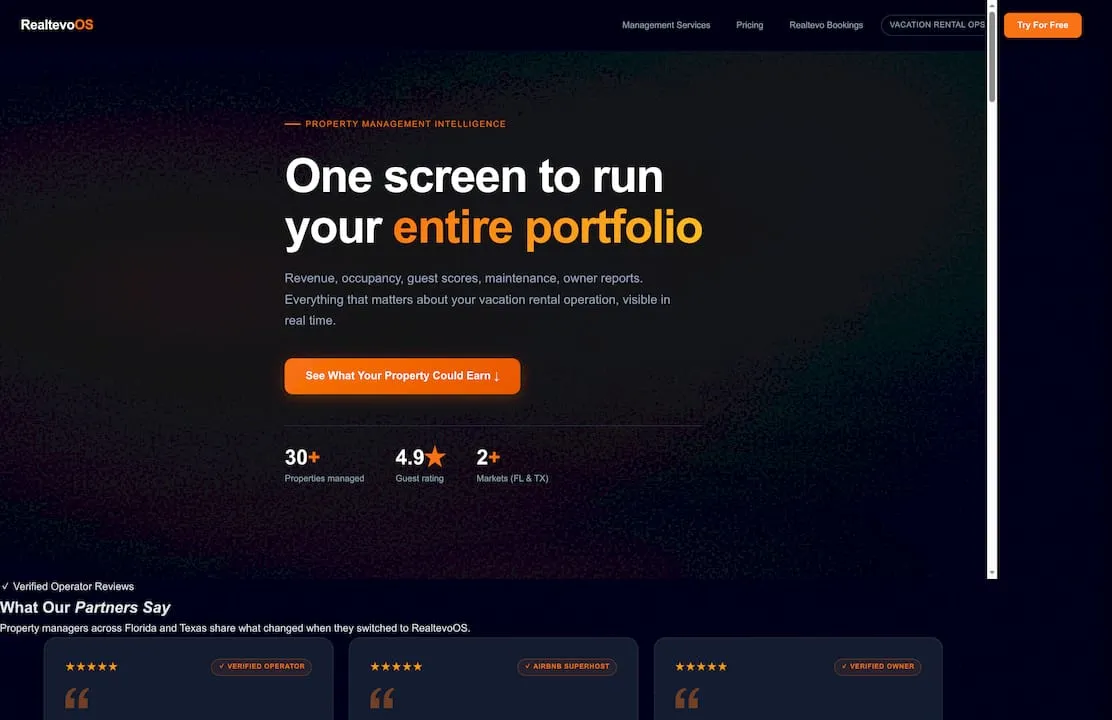
Realtevoos pulls real-time data from Airbnb and Vrbo into one dashboard, so your monthly statements are accurate without manual exports. Automated notifications handle maintenance updates and statement delivery on schedule. AI-driven tools manage routine owner inquiries around the clock. Property managers using Realtevoos report saving several hours each week on reporting alone. If you are ready to build a scalable owner relations system that runs consistently whether you manage 5 properties or 50, Realtevoos is built for exactly that.
FAQ
What is an owner relations workflow in vacation rentals?
An owner relations workflow is a structured process for communicating with and managing property owners, covering financial reporting, scheduled calls, issue notifications, and relationship tracking. It replaces ad hoc communication with a repeatable system that keeps owners informed and satisfied.
How often should you communicate with vacation rental property owners?
The proven cadence is monthly financial statements, quarterly check-in calls, and an annual performance review. This communication rhythm keeps annual owner churn below 10% and prevents the communication lapses that drive most departures.
What tools support an owner relations workflow?
Property management platforms like Realtevoos, CRM systems like HubSpot, owner portals for 24/7 statement access, and AI communication tools each play a role. The most effective setups integrate these tools so data flows automatically from booking platforms into owner-facing reports.
How do you prevent owner churn with a structured workflow?
Churn is driven mainly by poor issue responses and unclear financial reporting. A workflow that includes proactive issue notification within 24 hours, narrative-driven monthly statements, and documented maintenance authority limits removes the three most common causes of owner dissatisfaction.
When should maintenance authority limits be documented?
Maintenance authority limits should be documented and signed during the onboarding process, ideally within the first 30 days. Setting these limits upfront gives owners confidence that spending decisions will not be made without their knowledge or consent.