Owner Satisfaction Reporting Process for Property Managers
Streamline your owner satisfaction reporting process with automated monthly statements, ensuring quick reads and insights. Reduce churn today!

Owner Satisfaction Reporting Process for Property Managers
The owner satisfaction reporting process is an automated monthly workflow that produces reconciled, itemized statements owners can read in under three minutes, paired with a short performance summary and satisfaction score. Success looks like three things: statements delivered within five business days of month-end, a net payout that matches the bank deposit dollar-for-dollar, and a one-line satisfaction summary showing the owner’s top feedback items or score. Get those three right, and owner churn drops. Miss any one of them consistently, and you will field audit requests.
Every statement your owners scan should confirm these at a glance:
- ✅ Bookings listed by channel (Airbnb, Vrbo, direct)
- ✅ Platform fees deducted, line by line
- ✅ Net payout (the amount that hit the bank)
- ✅ Itemized property expenses with invoice references
- ✅ Management fee shown as both a percentage and a dollar amount
- ✅ Occupancy rate, ADR, and booked nights for the period
- ✅ Delivery date stamped on the statement
Realtevoos automates every step of this workflow, from PMS data ingestion through owner portal delivery. For year-end statements, coordinate 1099 reporting so owners see gross income figures that match what the IRS receives, eliminating tax-season surprises.
Table of Contents
- What does the owner satisfaction reporting process require in every statement?
- When should you run, reconcile, and deliver monthly statements?
- How do you build an accurate, automated owner statement step by step?
- Which performance metrics belong in every monthly owner statement?
- What quality controls prevent owner audits and protect satisfaction?
- How does Realtevoos automate the owner satisfaction reporting process?
- 30/60/90 day rollout checklist and owner communication templates
- Key Takeaways
- Why owner statements are the most underestimated retention tool you have
- Realtevoos puts your owner reporting on autopilot
- Useful sources and further reading
What does the owner satisfaction reporting process require in every statement?
A professional owner statement is a mini P&L for one property, for one calendar month. The line items every statement must include are non-negotiable if you want owners to stop asking follow-up questions.

| Line Item | Notes |
|---|---|
| Gross booking revenue by channel | List each OTA separately; include stay dates |
| OTA/platform payout received | The amount the platform actually transferred |
| Platform fees deducted | Airbnb host fee, Vrbo service fee, etc. |
| Management fee | Show percentage AND dollar amount |
| Cleaning fee (itemized) | Reference the cleaning invoice number |
| Maintenance expenses | Each charge with invoice number and photo |
| Supplies | Receipt reference; flag recurring vs. one-time |
| Tourist/local taxes remitted | Amount and jurisdiction |
| Owner net payout | Must equal the bank deposit |
| Opening/closing reserve balance | Carry-forward and ending balance |
Optional rows that owners consistently appreciate: pending damage claims with claim reference numbers, security deposit holds with expected resolution dates, and owner-authorized capital expenditures with the approval reference.
Pro Tip: Always lead with the net payout (the bank deposit figure), not the headline booking value. Owners who see a gross booking number first will subtract fees in their head and rarely get the same answer you do. Show the payout first, then the calculation that produced it.
For layout, use a three-tier structure: top-line summary (net payout + delivery date), second-tier performance snapshot (occupancy, ADR, booked nights), then the full transaction list with attachments. Attach receipts and photos for every maintenance charge. See property management reporting examples for ready-to-use layouts.
When should you run, reconcile, and deliver monthly statements?
Monthly is the industry standard. Statements generated and sent within five business days of month-end give owners the cash-flow visibility they need for their own planning, and predictable timing is one of the strongest retention levers you have.
A practical six-day calendar:
- Days 1–3: Close all reservations for the month; post all invoices and expenses
- Day 4: Reconcile OTA payouts to reservations and bank deposits
- Day 5: Generate statements for the full portfolio; run peer review on a sample set
- Day 6: Deliver via owner portal and email; archive with version stamps
For high-volume owners managing multiple properties, consider a mid-month preview showing bookings confirmed so far. It reduces inbound questions and signals transparency.
On accounting basis: cash-basis reporting (record income when the payout clears, expenses when paid) is the most common choice for short-term rental managers and the easiest for owners to verify against their bank statements. If you use accrual, document that choice in the owner agreement and repeat it in the statement header. Payouts that clear after month-end belong in the following period under cash-basis; never pull them back to inflate the current month.
How do you build an accurate, automated owner statement step by step?
This is the operational sequence your team follows or automates end-to-end. Operational reporting guidance covers the full technical setup.
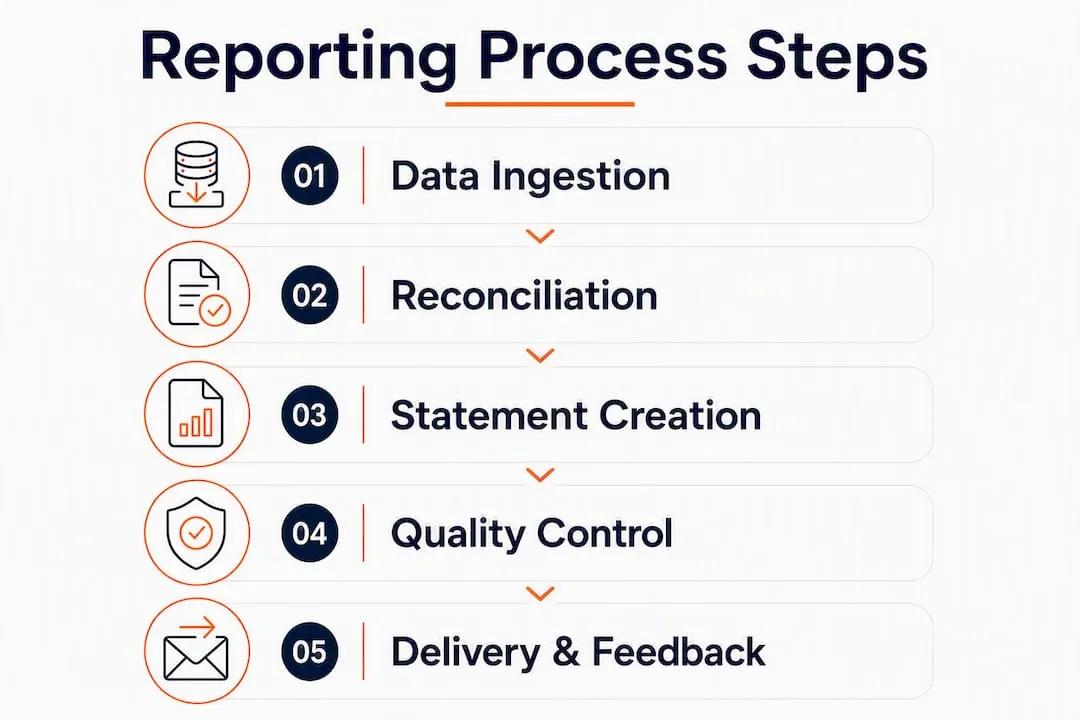
- Ingest reservations and payouts from your PMS, channel managers, and bank feeds into a single data layer.
- Lock the month. Close all reservations; no edits after the cutoff without a documented adjustment.
- Code and post all invoices. Every expense needs an invoice number, a property code, and a category tag.
- Reconcile OTA payouts to reservations and bank deposits. Match by payout ID or bank reference; flag exceptions immediately.
- Calculate management fees and owner splits using pre-coded formulas, not manual math.
- Attach supporting documents. Invoices, photos, and claim numbers go directly to the relevant line item.
- Generate statements for the full portfolio simultaneously. Running all owners at once surfaces anomalies faster than one-at-a-time processing.
- Peer-review a sample set. Check five to ten statements for math accuracy, missing attachments, and formatting consistency.
- Deliver and archive. Send via owner portal and email; save a versioned copy with a timestamp.
Pro Tip: Run automated reconciliation rules that match payouts by ID or bank reference across the entire portfolio in one pass. Anomalies that would take hours to find manually surface in minutes when the system flags unmatched transactions automatically.
Which performance metrics belong in every monthly owner statement?
Three metrics are required in every statement. Tracking occupancy, ADR, and booked nights gives owners the data they need to evaluate asset performance, not just cash flow.
- Occupancy rate (period): Booked nights ÷ available nights. Tells the owner how hard the property worked.
- ADR (average daily rate): Total room revenue ÷ booked nights. The single best indicator of pricing performance.
- Booked nights (period total): Raw count. Owners use this to spot gaps and plan personal-use blocks.
Secondary metrics worth adding when your PMS supports them:
- RevPAR (revenue per available room night)
- Revenue split by channel
- Nights blocked for maintenance or owner holds
- Average length of stay
- Guest satisfaction summary (top three feedback items or a composite score)
Present these as a one-line KPI row at the top of the performance section, followed by a simple bar chart showing occupancy trend for the past three months. Always label the exact period and include a month-over-month comparison.
Pro Tip: Add one sentence of plain-language interpretation below the KPI row. Something like “Occupancy was 78% vs. 71% last month, driven by a long weekend in the first week.” Owners read that sentence. They often skip the numbers.
What quality controls prevent owner audits and protect satisfaction?
Inconsistent formatting, missing invoice references, unreconciled bank deposits, and bundled line items are the four most common triggers for owner audits. Each is preventable.
Essential controls to build into your process:
- Bank-deposit reconciliation: Net payout on the statement must equal the bank deposit. No exceptions.
- Transaction-level audit trail: Every statement line links to a source document (payout ID, invoice number, photo).
- Consistent formatting and versioning: Same template, same order, every month. Version-stamp every statement.
- Variance explanations: Any adjustment, refund, or unusual charge gets a one-line explanation on the statement.
Operational checks to run each cycle:
- Automated matching rules flag unmatched payouts before statements generate
- Mandatory invoice and photo attachments for every maintenance charge above your threshold
- Sample peer review of five to ten statements each month
- Exceptions workflow with a defined SLA for resolution (48 hours is a reasonable target)
Pro Tip: Never net damage costs and recoveries on the same line. Post the repair expense in the month it occurs. Post the reimbursement in the month it arrives. Owners and their accountants need clean, auditable flows, and a single netted line makes both impossible to verify.
Owners can request the full document set at any time: invoice numbers, payout IDs, receipts, and photos are all stored and searchable. That transparency, more than any individual statement, is what builds long-term trust. For a broader look at how feedback patterns inform satisfaction, a review management playbook offers useful frameworks for structuring owner feedback summaries.
How does Realtevoos automate the owner satisfaction reporting process?
Realtevoos connects directly to your PMS, Airbnb, Vrbo, Guesty, Hostaway, and bank feeds, pulling reservation and payout data into a single workspace. From there, the platform runs automated fee formulas, allocates expenses by property, and matches payouts to bank deposits using rule-based reconciliation.
The automated workflow maps directly to the nine-step process above:
- Data ingestion: PMS and channel integrations pull reservations and payouts automatically
- Auto-allocation: Fee formulas and expense coding run without manual input
- Reconciliation: Automated rules match payout IDs to bank references and flag exceptions
- Statement generation: Branded statements generate for the full portfolio simultaneously
- Owner portal delivery: Statements and attachments deliver directly to each owner’s portal
- Archival: Every statement is versioned, timestamped, and searchable
Property managers using Realtevoos report saving several hours each week on manual reporting tasks. The platform’s AI-driven automation handles the reconciliation and generation steps that typically consume the most time, freeing your team to focus on owner relationships rather than spreadsheet cleanup.
30/60/90 day rollout checklist and owner communication templates
Days 0–30: Data mapping and integrations
- Map all payout IDs from each OTA to property records
- Configure management-fee formulas and expense coding categories
- Connect PMS, channel managers, and bank feeds
- Set statement template, branding, and delivery preferences
- Define review and approval roles for the peer-review step
Days 31–60: Parallel reporting and reconciliation automation
- Run automated reconciliation rules alongside your existing process
- Generate statements in the new system and compare to current output
- Resolve discrepancies and refine exception workflows
- Train the team on the approval and delivery steps
Days 61–90: Full cutover and owner portal launch
- Switch to portal-only delivery; archive all statements with version stamps
- Notify owners of the new delivery method and portal access
- Run the first full cycle end-to-end; peer-review ten statements
- Document the reporting basis (cash vs. accrual) in owner agreements
Monthly statement email template:
Subject: [Property Name] — [Month] Statement Ready
Your [Month] statement is available in your owner portal. Net payout: $[X], deposited [date]. Occupancy was [X]%, ADR $[X], [X] nights booked. [One-line insight.] Reply to this email with any questions.
Discrepancy response template:
Thank you for flagging this. We reviewed [specific line item] and found [brief explanation]. We expect to resolve this by [date] and will send a corrected statement at that time. The supporting invoice is attached.
Set expectations with owners at contract start: state the reporting basis, explain how pending damage claims appear until resolved, and confirm the delivery timeline in writing.
Key Takeaways
A reliable owner satisfaction reporting process delivers reconciled, itemized statements within five business days of month-end, with net payout matching the bank deposit every single time.
| Point | Details |
|---|---|
| Predictable timing matters | Deliver within five business days of month-end; consistent timing reduces owner anxiety and ad-hoc questions. |
| Payout must equal deposit | Net payout on the statement must match the bank deposit exactly; this is the primary trust signal owners verify. |
| Itemize every expense | List cleaning, maintenance, and supplies with invoice references; bundled lines trigger audits. |
| Attach proof for every charge | Photos, invoices, and payout IDs stored and searchable protect you when owners request documentation. |
| Realtevoos automates the full cycle | From PMS ingestion through owner portal delivery, Realtevoos handles reconciliation, generation, and archiving in one workflow. |
Why owner statements are the most underestimated retention tool you have
Most property managers think owner retention comes down to revenue performance. It does not. Owners tolerate a slow month. What they do not tolerate is a statement that makes them feel like they are being managed rather than informed.
A single recurring error, say a maintenance charge that appears without an invoice reference for three consecutive months, creates a pattern of distrust that is very hard to reverse. The owner starts checking every line. They ask for backup documentation. They call their accountant. By the time they formally raise the issue, they are already looking at other management options.
The operators who retain owners through difficult stretches are the ones whose statements are so clean and consistent that owners have nothing to question. Reconciliation is not a back-office task. It is the most visible proof of competence you produce every month.
Document your reporting basis in the owner agreement. Repeat it in the statement header. And when a negative payout occurs (it happens), report it honestly with a clear explanation. That conversation, handled professionally, builds more trust than six months of clean statements.
Realtevoos puts your owner reporting on autopilot
Manual reporting costs your team hours every month and leaves room for the kind of small errors that erode owner confidence over time. Realtevoos eliminates that exposure by connecting your PMS, channel data, and bank feeds into a single automated workflow that generates, reconciles, and delivers branded owner statements without manual assembly.

Every feature maps directly to the process: integrations pull the data, automated formulas handle fee allocation, reconciliation rules match payouts to deposits, and the owner portal delivers statements with attachments already attached. Your team reviews and approves; the platform does the rest.
Property managers report saving several hours each week after switching from manual spreadsheets to Realtevoos. See the full workflow in action and explore how the management deck fits your portfolio. Book a demo today and run your first automated statement cycle within 30 days.
Useful sources and further reading
- Owner Reporting Checklist for Vacation Rental Managers — Realtevoos’s practical checklist covering cadence, required line items, and communication templates
- Property Management Reporting Examples — Example statement layouts and formatting guidance
- Operational Reporting for Vacation Rentals: 2026 Guide — Broad operational reporting guidance and timing recommendations
- Key Metrics for Property Managers: 2026 Guide — Definitions and formulas for occupancy, ADR, and RevPAR
- Review Management Playbook — Frameworks for structuring feedback summaries and satisfaction-response workflows, applicable to owner feedback analysis