Vacation Rental Portfolio Acquisition Due Diligence Guide
Master the process with our portfolio acquisition due diligence guide. Learn essential steps to secure financial documents and permits.

Vacation Rental Portfolio Acquisition Due Diligence Guide
Proceed to formal due diligence if the seller can produce trailing 12-month P&Ls, platform payout CSVs from Airbnb and Vrbo, and written confirmation of permit status within 72 hours. If any of those three are missing or vague, pause. Your first three moves: (1) request T12 financials and OTA payout exports via a structured document request, ideally executed through DocuSign to preserve chain-of-custody; (2) contact the municipal or county licensing office in writing to confirm permit existence and transferability; (3) schedule licensed property inspections and request a photo inventory for every unit. Realtevoos can pull PMS exports and reconcile OTA data the moment you have access, cutting days off your verification timeline.
Table of Contents
- What documents should you request first in portfolio due diligence?
- How do you verify revenue and reconcile OTA booking history?
- What should your on-site inspection protocol cover?
- What title and contract issues can kill an STR portfolio deal?
- How do you confirm STR permits and TOT compliance before closing?
- Is the portfolio operationally ready to hand off at close?
- What insurance and tax items must you verify before closing?
- What red flags should stop or delay a purchase?
- Your due-diligence checklist and seller email template
- How do occupancy, ADR, RevPAR, and channel mix affect your valuation?
- How do you verify operating expenses and P&L accuracy?
- What legal and regulatory risks go beyond the permit itself?
- What environmental and neighborhood risks should you assess?
- How do guest reviews reveal operational and asset quality?
- How do you assess the quality of the existing management team?
- What are the tax implications of acquiring an STR portfolio?
- Key Takeaways
- What most buyers get wrong about STR portfolio acquisitions
- Realtevoos gets you from closing to steady-state operations faster
- Where to find primary sources and public records for STR due diligence
What documents should you request first in portfolio due diligence?
Get these in writing before you spend a dollar on inspections or legal review. Structure your request as a single email with a numbered attachment list so nothing slips through.
Financial records:
- Trailing 12-month P&L per property (T12), plus the prior year for context — request at least 24 months of profit and loss statements
- Platform payout CSVs from Airbnb, Vrbo, and any other OTA, with reservation-level detail
- Bank statements for the operating account (12 months minimum)
- Federal tax returns and any state lodging/sales tax filings
Operational records:
- PMS export with all reservations (reservation ID, check-in/out dates, payout, cleaning fees, cancellations, guest-paid taxes)
- Vendor contracts: cleaning, maintenance, landscaping, pool service
- Current management agreement, including assignment and termination clauses
- HOA CC&Rs and two years of board meeting minutes
- Title commitment with Schedule B exceptions for each property
Permits and compliance:
- Current STR permit number and holder name for each unit
- Transient occupancy tax (TOT) remittance receipts or platform tax remittance records
- Any active code enforcement notices or violation history
Pro Tip: Ask for direct read-only access to the seller’s PMS rather than seller-exported files when possible. Seller-generated exports can omit cancellations, owner stays, or refund adjustments. Direct access removes that variable entirely.
Use DocuSign to collect signed document-transfer authorizations and NDAs. It creates a timestamped audit trail that protects both parties and keeps your acquisition due diligence checklist defensible.
How do you verify revenue and reconcile OTA booking history?
Verification requires matching OTA payout CSVs to PMS reservations and bank deposits. Start at the reservation level, not the monthly summary. Monthly summaries hide refunds, duplicate listings, and split payouts.
| Reservation ID | Platform | Check-In | Gross Payout | Platform Fee | Cleaning Fee | Refunds | Net Payout | Bank Deposit Ref |
|---|---|---|---|---|---|---|---|---|
| ABC123 | Airbnb | — | — | — | $85 | $0 | — | — |
| — | Vrbo | — | — | $27 | — | — | — | — |
Common discrepancies to flag: host service fees that vary by listing, platform-collected taxes that inflate gross payout figures, refunds processed in a different month than the stay, and duplicate listings running parallel calendars. Once you have a clean reservation-level match, normalize for owner stays (zero-revenue nights), one-time promotional credits, and partner payouts. What remains is your verified trailing gross revenue. From there, calculate occupancy, ADR, and RevPAR by property and by month to expose seasonality patterns. AirROI’s 7-metric framework recommends an occupancy coefficient of variation (CV) below 0.35 as a reliability threshold — higher CV signals income that swings too hard to underwrite confidently.
What should your on-site inspection protocol cover?
Inspect every unit with the same checklist and photo inventory so you can compare deferred maintenance across the portfolio on equal terms. One property with a failing HVAC and another with a new roof look identical on a spreadsheet until you standardize the inspection format.
Inspection categories:
- Structural: foundation, walls, roof age and condition
- Systems: HVAC, plumbing, electrical panel, water heater age
- Safety devices: smoke detectors, CO detectors, fire extinguishers, pool fencing
- Appliances and FF&E: age, condition, replacement cost estimates
- Pest evidence: rodent droppings, termite damage, moisture intrusion
- Unauthorized occupants: mail, personal belongings, or lease agreements suggesting long-term tenants
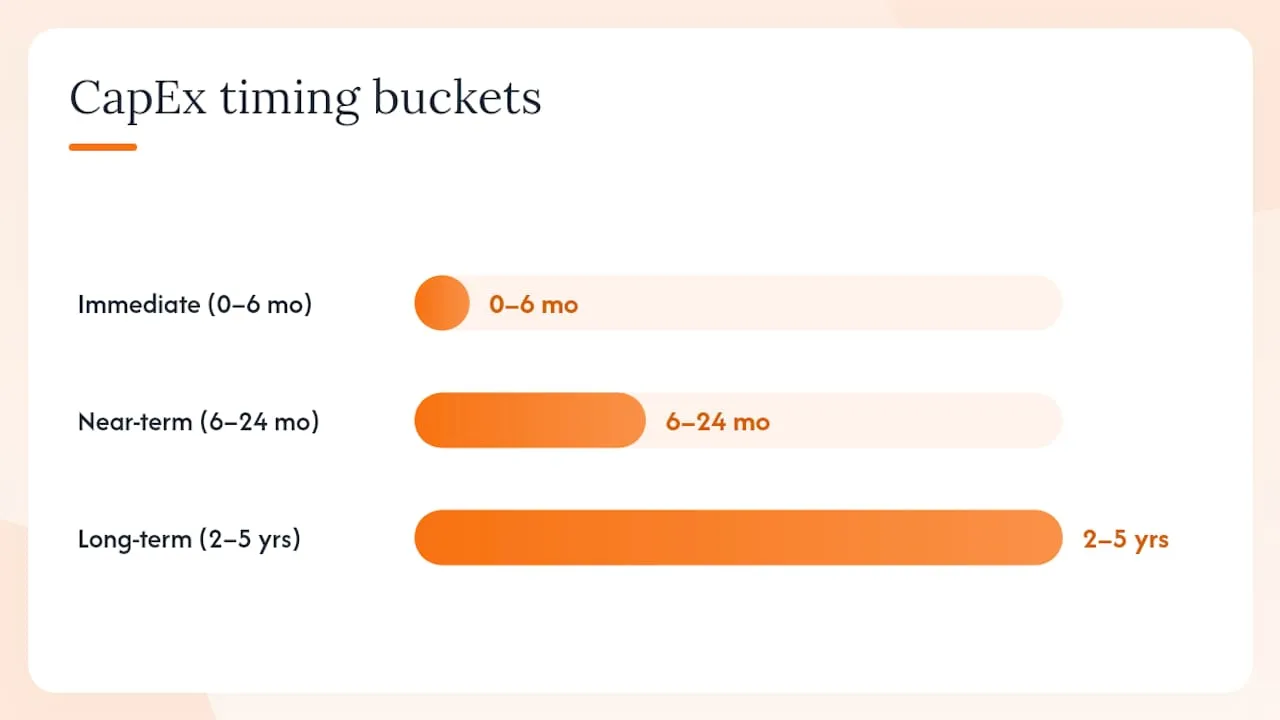
CapEx buckets to assign each finding:
- Immediate (0–6 months): Safety hazards, non-operational systems, code violations
- Near-term (6–24 months): Cosmetic upgrades, aging appliances, moderate system wear
- Long-term (2–5 years): Roof replacement, HVAC full replacement, major structural work
Request contractor cost estimates for immediate and near-term items before closing. Those figures feed directly into your pro forma and your price negotiation. A standardized photo inventory tagged to each checklist item — labeled by property address, room, and system — makes it possible to compare capex exposure across 10 or 30 units without losing track of which photo belongs where.
Pro Tip: Tag every photo with the property address and checklist category in the filename (e.g., “123MainSt_HVAC_unit1.jpg”). A shared folder organized this way takes 20 minutes to set up and saves hours of confusion during legal review.
What title and contract issues can kill an STR portfolio deal?
A clean title plus transferable operating rights are required to buy an income-producing STR portfolio as a business. Without both, you are buying bare real estate at an income-property price.
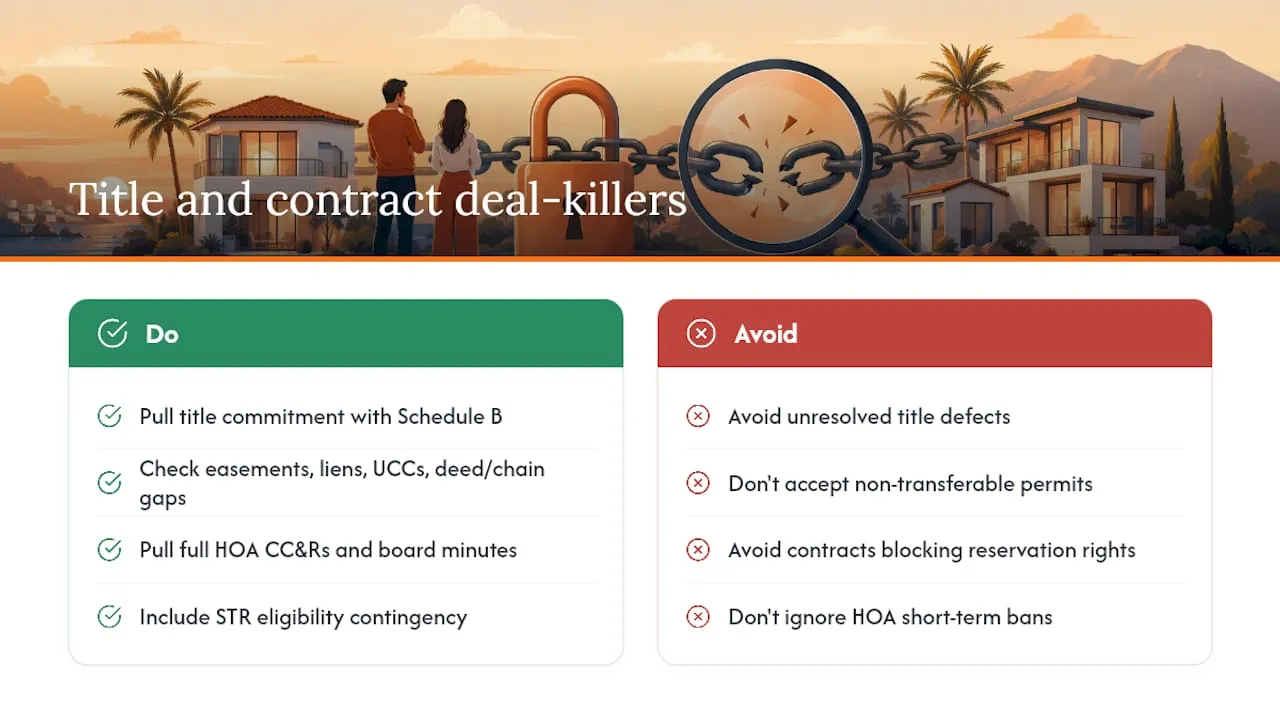
Pull the current title commitment with Schedule B exceptions for every property. Look for recorded easements that restrict access or use, open mortgages or mechanic’s liens, UCC filings against personal property (furniture, equipment), and any chain-of-title gaps. Verify that the deed owner matches the STR permit holder — a mismatch often means the permit is non-transferable.
In management and owner contracts, watch four clauses specifically: assignment language (does the contract transfer automatically or require consent?), reservation ownership (who legally owns future bookings and deposits?), vendor and cleaning contract termination rights, and owner occupancy exceptions that could block revenue during a transition period.
HOA CC&Rs are the most underestimated deal-killer in STR portfolio acquisitions. A single clause requiring a minimum 30-day lease term, a cap on the percentage of units rented short-term, or an explicit STR ban can eliminate operating rights entirely — and CC&Rs are not always reflected in listing descriptions or seller disclosures. Pull the full CC&R package and two years of board minutes from the HOA manager before you spend money on inspections.
Including an STR eligibility contingency in the purchase agreement — one that requires written confirmation of zoning compliance, absence of HOA prohibitions, and permit transferability — gives you a full earnest-money refund if any of those conditions fail.
How do you confirm STR permits and TOT compliance before closing?
Confirm permit existence and transferability in writing from the municipal or county licensing office. Verbal assurances from sellers or listing agents are not sufficient and have led to post-close revenue loss in regulated markets.
- Contact the city or county licensing office directly; do not rely on the seller’s permit copy alone
- Request the current permit number, holder name, expiration date, and transfer rules in writing or via portal screenshot
- Ask specifically whether the jurisdiction is under a permit moratorium or cap
- Request TOT remittance history or platform tax remittance receipts for the past 24 months
Markets including Nashville, San Antonio, Bend (OR), and Encinitas (CA) tie permits to the individual owner and require new buyers to reapply, sometimes into a capped or frozen permit pool. If a permit is non-transferable, your options are: include an STR eligibility contingency with a defined cure period, negotiate a seller-cooperation clause for the permit application, or adjust the purchase price to reflect the operating gap during reapplication.
Pro Tip: Always request a written confirmation email or portal screenshot from the licensing office — not a phone call summary. Save it to your DocuSign document folder with a date stamp. That record protects you if a permit dispute arises post-close.
Is the portfolio operationally ready to hand off at close?
Operational continuity depends on clean calendar control, documented SOPs, vendor contracts, and clear ownership of upcoming reservations and guest deposits. Without those four elements, the first 30 days post-close are chaotic.
Pre-close onboarding checklist:
- PMS access or full export in a compatible format
- Calendar freeze protocol for existing bookings during the transition window
- Written plan for platform account ownership transfer or re-listing on Airbnb and Vrbo.
- Vendor agreements (cleaning, maintenance) with assignment or novation clauses confirmed
- Keycode and lock transfer plan for every unit
- Owner communication templates and portal access
Negotiate a calendar hold for confirmed reservations so guests are not disrupted. Establish a written guest-communication takeover plan that specifies exactly when your team takes over messaging. Verify whether the seller uses a proprietary dynamic-pricing tool — if so, confirm whether historical pricing data exports or stays locked in that system, since it affects how you interpret trailing ADR.
For multi-market portfolios, confirm that each property’s channel manager integrations are documented and that API connections to Airbnb and Vrbo can be migrated or rebuilt without a calendar blackout period.
What insurance and tax items must you verify before closing?
Confirm current insurance coverage, claims history, and evidence of proper TOT and tax remittances before you sign anything.
Insurance checklist:
- Current declarations page for each property (property damage and general liability)
- Proof of host-protection coverage or equivalent (Airbnb AirCover for Hosts does not replace a standalone policy)
- Loss runs for the past five years — look for frequency of claims, not just severity
- Confirm coverage does not lapse at close; arrange new policies to activate on the closing date
Tax checklist:
- TOT remittance receipts or platform tax remittance records (Airbnb and Vrbo collect and remit TOT in many jurisdictions, but not all)
- Local business registration certificates for each property’s jurisdiction
- Sales tax or tourism tax filings where applicable
- Any open audits, assessments, or notices from state or local tax authorities
Consider escrow retention for unresolved claims or for evidence of TOT remediation if remittance history is incomplete.
What red flags should stop or delay a purchase?
A DSCR below 1.0 or a non-transferable permit in a moratorium market are immediate walk signals. Multiple accounting inconsistencies or missing documentation are pause signals that require cure before you proceed.
Walk signals:
- Non-transferable permits in a jurisdiction under a permit cap or moratorium
- DSCR below 1.0 under base-case assumptions
- Active HOA prohibition on STR use confirmed in CC&Rs
- Ongoing code enforcement actions with no resolution timeline
- Undisclosed long-term tenants with lease agreements
Pause and demand cure:
- Unverifiable OTA payouts (seller cannot produce reservation-level CSVs)
- Significant undisclosed capex discovered during inspection
- Missing TOT remittance history for more than two quarters
- Management contract with no assignment clause
Remediation options that can salvage a deal: escrowed repair funds tied to a contractor scope, seller-funded permit application cooperation with a defined timeline, or a price reduction sized to the capex gap and permit-gap revenue loss.
Your due-diligence checklist and seller email template
A complete checklist covers five tabs: financial documents, reservation-level data, inspection findings, legal/title items, and permit/compliance records. Use one tab per property for portfolios over five units, plus a master summary tab that flags outstanding items by category.
What the checklist includes:
- Document request tracker with status (requested / received / verified)
- Reconciliation table schema (reservation ID through bank deposit reference)
- Inspection photo inventory template with filename convention
- Pro forma template with normalization and sensitivity rows
- Permit verification log with licensing office contact and written confirmation field
Sample seller request email structure:
Subject: Document Request — [Portfolio Name] Acquisition Due Diligence
Dear [Seller Name], Thank you for moving forward. Please provide the following by [date], executed via DocuSign where signatures are required:
- T12 P&L per property (attached template)
- Airbnb and Vrbo payout CSVs, reservation-level, trailing 24 months
- PMS export (all reservations, cancellations, owner stays)
- Bank statements, 12 months
- Current STR permits and TOT remittance receipts
- Vendor contracts and management agreement
- Title commitment with Schedule B for each property Please confirm read-only PMS access if available. All documents should be uploaded to the shared DocuSign envelope linked below.
Realtevoos integrates with common PMS platforms and can ingest OTA exports directly, so once documents arrive, reconciliation starts immediately rather than waiting for manual data entry.
How do occupancy, ADR, RevPAR, and channel mix affect your valuation?
These four metrics tell you whether the portfolio’s revenue is real, repeatable, and defensible. Occupancy alone is misleading — a property running 85% occupancy at a deeply discounted ADR can underperform a property at 65% occupancy with strong pricing discipline.
RevPAR (Revenue Per Available Room/Night) combines both into one number. Use it as your primary market-support test: if RevPAR covers your break-even daily cost with margin, the market supports the asset. High supply growth rates signal RevPAR compression risk within about a year or two, while lower supply growth is generally healthy for underwriting purposes.
Cancellation rate by property reveals operational or pricing problems. A property with a cancellation rate significantly above the platform average often has a pricing, availability, or guest-expectation issue that suppresses effective occupancy. Channel mix matters because Airbnb and Vrbo carry different fee structures and guest demographics — a portfolio heavily weighted toward one platform carries concentration risk if that platform changes its algorithm or fee model.
How do you verify operating expenses and P&L accuracy?
Request itemized expense records, not just summary P&Ls. Sellers sometimes net expenses against revenue or omit owner-paid costs that will become your costs post-close.
Verify utilities (electric, water, gas, internet) by pulling actual bills for 12 months — utility costs for STR properties vary significantly by occupancy and guest behavior. Maintenance expenses should be cross-referenced against vendor invoices; a P&L showing $500/year in maintenance for a 10-unit portfolio is a red flag, not a selling point. Management fees should reflect the actual contract rate; if the seller self-manages, normalize for a market-rate management fee (typically 20–30% of gross revenue for full-service STR management in most U.S. markets) to get a true NOI picture.
Property taxes are public record — pull the current assessed value and tax bill from the county assessor’s portal and confirm they match the P&L. Insurance premiums should match the declarations pages you requested. Any expense line that cannot be verified against a third-party document (invoice, bill, tax record) should be treated as unverified until proven.
What legal and regulatory risks go beyond the permit itself?
Zoning is the layer beneath the permit. A property can hold a valid STR permit today and still sit in a zone where STR use is legally contested or subject to a pending ordinance change. Check the current zoning designation against the municipality’s STR overlay map, and ask the planning department directly whether any zoning amendments affecting STR use are in process.
State-level restrictions add another layer. Several states have preemption laws that limit how aggressively municipalities can restrict STRs, while others give cities broad authority to ban them outright. Confirm the state-level framework for each market in your portfolio before assuming local permits are stable.
Nuisance ordinances, noise regulations, and occupancy caps (maximum guests per unit) are enforced separately from STR permits and can generate fines or operating restrictions that never appear on a permit record. Pull any code enforcement history from the city’s public records portal for each address.
What environmental and neighborhood risks should you assess?
Flood zone designation affects both insurability and operating costs. Pull the FEMA flood map designation for each property — properties in Zone AE or VE carry mandatory flood insurance requirements that can add materially to annual costs. Wildfire risk zones in Western markets carry similar insurance implications.
Crime rate data by neighborhood is publicly available through local police department crime mapping tools and the FBI’s Uniform Crime Reporting database. A property in a high-crime micro-neighborhood will show up in guest reviews before it shows up in your underwriting. Check both.
Upcoming developments — new hotels, large STR complexes, or infrastructure projects — can shift supply and demand dynamics within 12–24 months of close. Search the local planning department’s permit database for major projects within a half-mile radius of each property. A 200-unit hotel breaking ground two blocks away is not a reason to walk, but it belongs in your RevPAR sensitivity scenario.
How do guest reviews reveal operational and asset quality?
Guest reviews are a real-time condition report that predates your inspection. Read the trailing 12 months of reviews on Airbnb and Vrbo for every property, not just the star rating. Recurring complaints about cleanliness, maintenance response, or check-in problems signal either a vendor quality issue or a deferred maintenance pattern that your inspection should confirm.
A property with a 4.2 average rating on Airbnb in a market where the median is 4.7 carries a real ADR and occupancy penalty. Guests filter by rating, and Airbnb’s search algorithm deprioritizes listings below platform thresholds. That gap is quantifiable: model the ADR and occupancy at the market median versus the current rating to size the upside if you fix the underlying issues.
Review sentiment also reveals owner-dependency. If multiple reviews mention the owner by name as the reason for a great stay, that goodwill does not transfer with the deed.
How do you assess the quality of the existing management team?
The management team’s quality determines whether the portfolio runs itself or requires your full attention from day one. Ask for staff org charts, role descriptions, and tenure records. High turnover in cleaning or guest-communication roles is a leading indicator of operational instability.
Request SOPs for guest check-in, cleaning standards, maintenance escalation, and owner reporting. If none exist in writing, the operation runs on institutional knowledge that leaves with the current team. That is an owner-dependency problem at the staff level, not just the owner level, and it justifies a price adjustment or an escrow holdback tied to a 90-day transition period.
Meet the key vendors — primary cleaner, maintenance contractor — before close. Confirm they are willing to continue under new ownership and at what terms. A cleaning team that walks at close because their relationship was personal rather than contractual can disrupt operations for weeks.
What are the tax implications of acquiring an STR portfolio?
At the federal level, STR properties held for investment are generally treated as rental real estate under IRC Section 469, with passive activity loss rules applying unless you qualify as a real estate professional. Depreciation on the structures (27.5-year residential schedule) and on FF&E (5-year schedule under MACRS) generates paper losses that offset rental income. A cost segregation study on a larger portfolio can accelerate those deductions significantly in year one.
At the state level, income tax treatment varies by state. Some states conform to federal depreciation schedules; others do not. Confirm the state income tax treatment for each market in the portfolio with a CPA familiar with multi-state rental operations.
At the local level, TOT (transient occupancy tax) obligations attach to the property and the operator. If the prior owner has unremitted TOT, that liability can follow the property in some jurisdictions. Confirm clean remittance history and consider a tax indemnification clause in the purchase agreement.
This article provides general information, not legal, tax, or financial advice. Confirm current rules and tax treatment with a qualified CPA and real estate attorney before closing.
Key Takeaways
A vacation rental portfolio acquisition succeeds or fails on document quality, permit transferability, and verified NOI — get all three confirmed in writing before releasing earnest money.
| Point | Details |
|---|---|
| Documents come first | Request T12 P&Ls, OTA payout CSVs, and bank statements before spending on inspections or legal review. |
| Permits are gatekeepers | Confirm transferability in writing from the licensing office; a verbal assurance is not sufficient in regulated markets. |
| Reconcile to bank deposits | Match OTA payout CSVs to PMS exports and bank deposits at the reservation level to catch refunds, owner stays, and duplicate listings. |
| DSCR below 1.0 is a walk signal | Run sensitivity scenarios at RevPAR down 10% and confirm DSCR clears 1.25x for lender qualification. |
| Realtevoos accelerates onboarding | Realtevoos centralizes OTA reconciliations, automates owner reporting, and handles DocuSign document workflows from day one post-close. |
What most buyers get wrong about STR portfolio acquisitions
The biggest preventable value loss in STR portfolio acquisitions is not a bad inspection finding or a permit problem. It is buying an operation that runs on the seller’s relationships rather than documented systems. When the seller is the operation, you are not buying a business — you are buying a job with a mortgage attached.
Sellers who cannot produce written vendor contracts, cleaning SOPs, and a guest-communication playbook are telling you something important: the portfolio’s performance is not reproducible without them. That owner-dependency discount is real and material. Price it into your offer, or require an escrow holdback tied to a 90-day operational transition where the seller actively supports the handoff.
Permit surprises are the second most common avoidable loss. A buyer who discovers post-close that a permit is non-transferable in a capped market faces weeks or months of zero legal STR revenue while a new application processes. The fix is simple: make permit transferability a written contingency, not a verbal assumption. The licensing office will answer the question in writing if you ask directly.
Start your changeover plan 30 days before close, not the day after. Schedule vendor meet-and-greets, document every SOP you can extract from the current operator, and freeze the calendar for the first two weeks post-close to give your team time to get oriented. That 30-day head start is the difference between a smooth transition and a guest-review disaster in month one.
Realtevoos gets you from closing to steady-state operations faster
Closing on a portfolio is the starting line, not the finish. The first 30 days post-close determine whether your new properties perform at their verified trailing numbers or bleed occupancy while you sort out calendar conflicts, owner statements, and vendor handoffs.

Realtevoos centralizes every reconciliation, calendar, and owner report across your entire portfolio in one command center. OTA payout data from Airbnb and Vrbo flows in automatically, expense items extract without manual entry, and DocuSign handles every document signature from vendor contracts to owner agreements. The management deck gives you a live view of every property’s performance from day one, so you are not flying blind during the most critical window of your acquisition. Optional paid onboarding services mean your team can be fully configured before the ink dries on the purchase agreement. Request a demo and see how fast a portfolio can go from closed to controlled.
Where to find primary sources and public records for STR due diligence
These are the authoritative sources to consult during your diligence process. When title exceptions are complex, CC&Rs are ambiguous, or permits span multiple jurisdictions, involve a local real estate attorney and a title company.
- Investing in Airbnb Portfolios: Complete Guide
- How to Sell a Vacation Rental Business: A Complete Guide — Truvi
- Evaluate an Airbnb Before You Buy: The 7-Metric Due Diligence Checklist | AirROI
- How to Value Your Short-Term Rental Business: What Sellers Discover That Their Spreadsheets Missed | StaySTRA.com
- STR Purchase Due Diligence. What Every Buyer Needs to Check Before Closing on a Short-Term Rental | StaySTRA.com
- RealtevoOS - The Command Center for Vacation Rental Operators
Store every written confirmation — licensing office emails, portal screenshots, title commitments — in a DocuSign secure folder with date stamps. That documentation package is your legal protection if a dispute arises post-close and your portfolio performance tracking baseline for the first year of operations.