Predictive Maintenance for Vacation Rentals Explained
Discover what is predictive maintenance for vacation rentals and learn how it can save you up to 40% on costs while enhancing guest satisfaction.

Predictive Maintenance for Vacation Rentals Explained
Most vacation rental owners discover a maintenance problem the same way: a guest texts at 11 p.m. about a broken HVAC unit during a July heat wave. That single emergency call costs more than it should, tanks the review, and blocks the next booking while repairs happen. Understanding what is predictive maintenance for vacation rentals flips that script entirely. Instead of waiting for failure, you monitor asset health continuously and act before anything breaks. This guide explains the technology, the real-world application, and exactly how to start.
Table of Contents
- Key Takeaways
- What is predictive maintenance for vacation rentals
- Challenges unique to vacation rental maintenance
- Benefits and ROI of predictive maintenance
- How to get started with predictive maintenance
- My honest take on where most operators go wrong
- Take maintenance control with Realtevoos
- FAQ
Key Takeaways
| Point | Details |
|---|---|
| Predictive vs. reactive maintenance | Predictive maintenance monitors assets in real time and triggers repairs before failure, not after a guest complaint. |
| Cost savings are substantial | Properties using predictive systems cut total maintenance costs by 25 to 40% and reduce unplanned downtime by up to 50%. |
| Seasonal timing is critical | Automated scheduling aligns maintenance tasks with low-occupancy windows, preventing disruptions during peak revenue periods. |
| You can start with what you have | Existing smart thermostats and leak detectors provide sufficient data to begin a predictive maintenance program. |
| ROI arrives fast | Maintenance automation payback can occur in as few as 38 to 41 days, with Year 1 returns that far exceed initial investment. |
What is predictive maintenance for vacation rentals
Predictive maintenance is a data-driven approach that uses sensors, software, and analytics to monitor the health of physical assets in real time. The goal is to detect early warning signs of deterioration and schedule repairs before equipment fails. To understand it properly, you need to see how it differs from the two alternatives most owners rely on.
Reactive maintenance is exactly what it sounds like. Something breaks, you fix it. It is the default for most rental operators and it is the most expensive mode to operate in. Preventive maintenance is an improvement. You schedule inspections and servicing on a calendar, say quarterly HVAC filters or annual appliance checks, regardless of actual condition. That is better, but it still generates unnecessary work and misses problems that develop between scheduled visits.
Predictive maintenance optimizes where preventive maintenance leaves off. It only triggers a repair when sensor data signals that an asset’s condition has actually degraded. No unnecessary labor, no missed failures.
Here is how the technology stack typically works in a vacation rental context:
- IoT sensors attach to or integrate with HVAC units, water heaters, plumbing lines, and kitchen appliances. They capture data points like temperature, vibration, pressure, and moisture continuously.
- AI and machine learning algorithms analyze those data streams against baseline performance. When readings drift outside normal ranges, the system flags the anomaly.
- Automated alerts notify managers or trigger work orders before the guest ever notices a problem.
The assets that benefit most in vacation rentals are HVAC systems, water heaters, washing machines, refrigerators, and plumbing. IoT sensors on HVAC and plumbing can detect early failure signs 4 to 8 weeks before an actual breakdown, giving you a wide window to act on your schedule rather than a guest’s emergency.
Pro Tip: If you manage more than five properties, start by deploying sensors on HVAC units and water heaters first. These two asset types account for the highest-cost emergency calls in short-term rentals.
Challenges unique to vacation rental maintenance
Running maintenance on a vacation rental portfolio is meaningfully different from maintaining a long-term rental or a commercial building. Three dynamics create pressure that most property managers underestimate until they have felt the consequences.
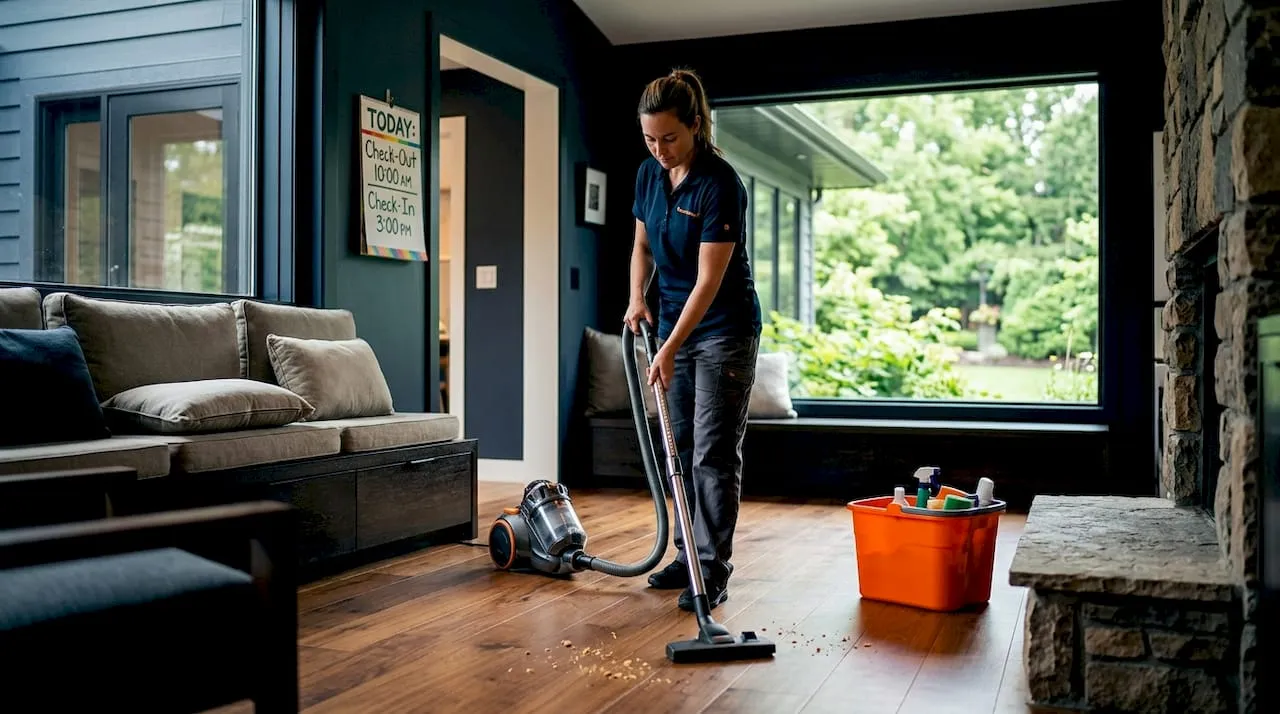
High guest turnover with no buffer. A property might check out at 11 a.m. and check in at 4 p.m. That five-hour window is consumed by cleaning, restocking, and inspection. There is almost no room for even minor repairs. Any maintenance issue that was not identified before the checkout is likely to become the incoming guest’s problem.
The seasonal trap. During peak booking seasons, operators consistently defer non-urgent maintenance because there is no convenient vacancy window. Seasonal occupancy swings cause maintenance deferral that builds up silently until a mid-season failure hits the worst possible moment. A predictive system automates task scheduling to align with low-occupancy windows, removing the human tendency to kick the can down the road.
Guest satisfaction is directly tied to platform ranking. A single 3-star review citing a broken dishwasher or a leaking faucet damages your Airbnb or Vrbo standing in ways that take months to repair. Maintenance is a direct revenue driver, not just a cost center, because your ranking determines your visibility, and your visibility determines your bookings.
Here is a practical sequence for managing maintenance within the vacation rental calendar:
- Pre-season sweep. Four to six weeks before your peak season, run full inspections on all high-use assets. Use sensor data to prioritize units showing early stress signals.
- Turnover checks. Build a standardized digital checklist into every turnover workflow. Flag anything that warrants follow-up but does not block the check-in.
- Mid-season monitoring. Let your sensors do continuous observation. Set alert thresholds to catch gradual degradation rather than relying solely on turnover checks.
- Offseason deep maintenance. Schedule any deferred work during your lowest-occupancy weeks. This is the time for HVAC servicing, appliance deep-cleaning, and plumbing inspections.
Pro Tip: Tie your sensor alert thresholds to your booking calendar. A warning-level alert during a 90% occupancy stretch should trigger a pre-scheduled response, not an ad hoc fix during a guest stay.
Benefits and ROI of predictive maintenance
The financial case for predictive maintenance is not theoretical. The numbers from actual deployments are specific enough to build a business model around.
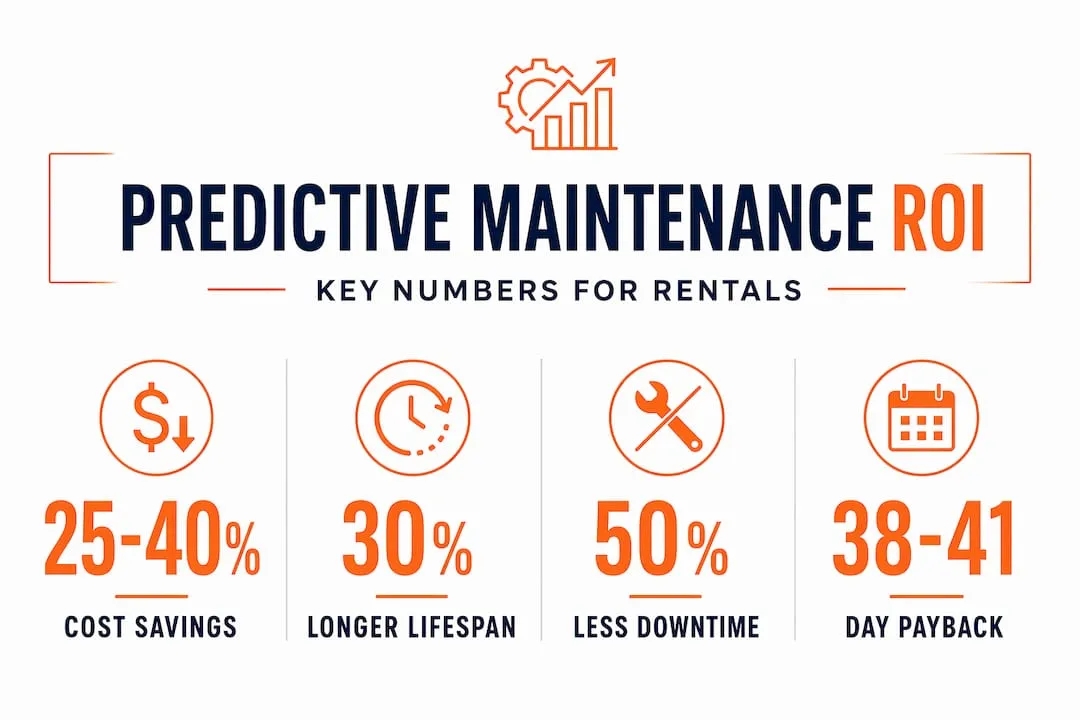
Properties using AI-driven predictive maintenance cut total maintenance costs by 25 to 40%, extend asset lifespans by roughly 20%, and reduce unplanned downtime by up to 50%. Those three outcomes compound. Fewer emergency repairs mean lower per-incident costs. Longer asset life means deferred capital expenditure. Less downtime means more nights available to book.
The administrative side is equally significant. Automating maintenance coordination reduces management overhead from approximately $180 per unit per year down to $68, a 62% reduction. For a portfolio of 30 properties, that is over $3,300 in administrative savings annually before counting a single repair.
| Metric | Traditional Maintenance | Predictive Maintenance |
|---|---|---|
| Annual admin cost per unit | $180 | $68 |
| Maintenance cost reduction | Baseline | 25 to 40% |
| Unplanned downtime | Baseline | Up to 50% less |
| Asset lifespan | Baseline | Up to 20% longer |
| Emergency repair premium | 3 to 7x standard cost | Largely avoided |
“The true ROI of predictive maintenance lies not only in cost savings but in maintaining 5-star guest experiences that directly impact occupancy and platform ranking.” (Source)
The speed of return is what surprises most operators. Maintenance automation payback can happen in as few as 38 to 41 days, with a Year 1 ROI reported at 790%. Emergency repairs cost 3 to 7 times more than planned repairs, so even avoiding two or three critical failures in the first year pays for the system many times over.
How to get started with predictive maintenance
The biggest reason operators delay implementation is assuming they need to rip out existing infrastructure and start fresh. That is not the case. Smart home devices you already own like smart thermostats, leak sensors, and connected appliances can serve as data sources immediately. You build software intelligence on top of hardware you already have.
Here is a practical framework for phased deployment:
- Phase 1: Prioritize high-risk assets. Start with HVAC and water systems. These generate the most costly emergencies and are the most sensor-ready. Phased deployment starting with highest-risk assets lets AI establish baselines within weeks, so you get useful alerts fast.
- Phase 2: Integrate with your operations software. Choose a platform that converts sensor alerts directly into work orders, assigns them to vendors, and tracks completion. Manual handoffs between your monitoring tool and your task manager will kill the program’s efficiency.
- Phase 3: Automate your scheduling calendar. Build turnover checklists, monthly inspections, and seasonal tasks into automated reminders. Remove the dependency on any single person’s memory or initiative.
- Phase 4: Use data for financial forecasting. This is where predictive maintenance changes how you budget. AI maintenance budget forecasting reduces budget variance from 35 to 50% down to 8 to 12%, meaning you can present owners with accurate monthly cost projections rather than surprise invoices.
| Approach | Reactive | Preventive | Predictive |
|---|---|---|---|
| Trigger | Asset failure | Fixed calendar | Real-time condition data |
| Cost profile | High and unpredictable | Moderate | Low and controlled |
| Guest impact | High | Low to moderate | Minimal |
| Budgeting accuracy | Poor | Moderate | High |
| Best for | Single property owners | Small portfolios | Growing and large portfolios |
Avoid two common mistakes when launching a predictive maintenance program. First, do not deploy sensors without assigning clear ownership. Every alert must have a named person or vendor responsible for response. Second, do not skip verification. Confirm that work was completed and documented, not just dispatched. A work order sent is not a problem solved.
Pro Tip: Connect your vacation rental management workflows to your maintenance calendar from day one. Operators who keep these systems separate end up doing double work and missing coordination windows.
My honest take on where most operators go wrong
I have watched property managers implement predictive maintenance programs and then underuse them completely. They install the sensors, see the dashboard, and then still respond to problems the same way they always did because the alert system was not wired into their operations workflow. The technology works. The culture change is harder.
What I have found consistently is that predictive maintenance does not become valuable when you install it. It becomes valuable when it changes the decision your team makes on a Tuesday morning. When an alert fires at 7 a.m. about HVAC performance trending downward at a property with a check-in at 3 p.m., the system is only useful if someone acts on that information before noon.
The operators I have seen get the most out of these programs treat maintenance as a revenue function, not just an operations function. They track the relationship between well-maintained properties and 5-star reviews and use that data to justify the investment to property owners. That reframe changes everything. Maintenance stops being the line item you try to shrink and becomes the system that protects your ratings, your occupancy, and your income.
The future of this space is full integration. Maintenance alerts, booking calendars, vendor dispatch, owner reporting, and guest communication all talking to each other automatically. We are not far from that reality.
— Jose
Take maintenance control with Realtevoos
If the case for predictive maintenance makes sense but the implementation feels like one more system to manage, that is exactly the gap Realtevoos was built to close.

Realtevoos is a centralized command center for vacation rental operators managing multiple properties. The platform connects maintenance workflows directly to your booking calendar, automates work order creation and vendor assignment, and tracks inspection completion without manual follow-up. Real-time maintenance data feeds into the same dashboard as your revenue, occupancy, and guest satisfaction metrics, giving you the complete picture your owners want to see. If you are ready to move from reactive fixes to system-driven operations, Realtevoos gives you the infrastructure to do it at scale.
FAQ
What is predictive maintenance for vacation rentals?
Predictive maintenance uses IoT sensors, data analytics, and AI to monitor asset health continuously and trigger repairs before equipment fails. Unlike reactive maintenance, it prevents guest disruptions and emergency repair costs.
How does predictive maintenance differ from preventive maintenance?
Preventive maintenance follows a fixed calendar regardless of asset condition. Predictive maintenance only acts when sensor data shows actual degradation, reducing unnecessary labor and catching issues that scheduled inspections would miss.
What are the main benefits of predictive maintenance?
Properties using predictive maintenance cut costs by 25 to 40%, reduce unplanned downtime by up to 50%, and can achieve payback in as few as 38 to 41 days through avoided emergency repairs and reduced administrative overhead.
Do I need new hardware to get started?
No. Existing smart home devices like connected thermostats and leak detectors provide enough data to start. You add software intelligence on top of devices you already own and expand sensor coverage as you prove results.
How does predictive maintenance affect guest reviews?
Fewer equipment failures during guest stays means fewer negative reviews. Consistent property performance protects your Airbnb or Vrbo ranking, which directly drives visibility and bookings over time.