Property Management Reporting Examples for Vacation Rentals
Discover effective property management reporting examples for vacation rentals. Learn how to enhance owner trust with informative, actionable reports.

Property Management Reporting Examples for Vacation Rentals
Most vacation rental managers can generate a report. Far fewer generate one that actually tells the owner something useful. If your monthly statements are just a PDF of numbers with no context, no reconciliation, and no forward-looking information, you are leaving owner trust on the table. This article walks through practical property management reporting examples built specifically for vacation rental operations, covering what makes a report effective, three distinct formats you can implement today, and how to choose the right approach for your portfolio.
Table of Contents
- Key takeaways
- What makes property management reporting examples actually useful
- 1. Monthly owner financial statement with transaction-level detail
- 2. Dashboard-style owner report with narrative and forward-looking insights
- 3. Compliance-focused trust accounting report for vacation rental management
- 4. Comparison and selection guide for report formats
- My honest take on reporting that actually matters
- How Realtevoos makes this reporting reality, not a weekend project
- FAQ
Key takeaways
| Point | Details |
|---|---|
| Transaction-level detail builds trust | Owners need date, description, category, and amount for every line item, not just totals. |
| Narrative context changes decisions | A number without explanation is just data. Pair financials with a short event summary every month. |
| Compliance requires reconciliation first | Reports built on unreconciled records create audit exposure and erode owner confidence. |
| Forward-looking info builds confidence | Include upcoming expenses, market rent trends, and lease expirations to give owners real control. |
| Report format should match portfolio size | A single property owner needs something different from a manager running 50 vacation rentals. |
What makes property management reporting examples actually useful
Most owners do not struggle to get reports. They struggle to get reports that mean something. The role of analytics in property management is not just to display numbers. It is to answer three questions: How did we perform? Why did it happen? What comes next?
Strong property management reports check several boxes at once.
- Financial clarity: The report shows income and expenses including rent collected, late fees, maintenance, utilities, inspections, and management fees, plus owner disbursements and reserve balances.
- Transaction-level detail: Every line item carries a date, description, category, and dollar amount. Summaries alone leave owners guessing.
- Expense categorization: Separating routine costs from one-time expenses helps owners spot trends and unusual charges instead of burying them in a single “miscellaneous” category.
- Reconciliation: Reports must be built on reconciled financial records. Failure to reconcile leads to unverifiable numbers and potentially non-compliant reports.
- Forward-looking information: A good report covers what just happened and what is coming. Upcoming maintenance, market rent comparisons, and occupancy forecasts belong here.
- Customization: Some owners want a one-page summary. Others want a full general ledger. Knowing which format each owner prefers and delivering it consistently is part of the service.
Pro Tip: Separate your monthly reporting cadence from your event notification cadence. Operationally, sending a monthly financial statement is different from alerting an owner the day a $2,000 HVAC repair gets approved. Both matter. Mixing them into one delayed monthly document is a common mistake.
1. Monthly owner financial statement with transaction-level detail
This is the most common format in vacation rental management, and also the most frequently done wrong. A monthly owner financial statement should function like a mini income statement for a single property or portfolio, with enough detail that an owner can verify every number independently.
Here is what a complete statement includes:
- Gross rental income collected for the period
- Platform fees and channel commissions (Airbnb, Vrbo, and others listed separately)
- Cleaning fees and associated labor costs
- Maintenance and repair expenses with vendor names and dates
- Management fees with the calculation basis shown
- Owner disbursement amount
- Opening and closing reserve balance
The table below shows what a single-property monthly statement might look like at the transaction level.
| Category | Description | Date | Amount |
|---|---|---|---|
| Income | Airbnb booking, Guest A | June 3 | $1,240.00 |
| Income | Vrbo booking, Guest B | June 14 | $980.00 |
| Expense | Airbnb host fee (3%) | June 3 | ($37.20) |
| Expense | Cleaning service, June 4 | June 4 | ($120.00) |
| Expense | HVAC filter replacement | June 11 | ($45.00) |
| Management Fee | 10% of gross income | June 30 | ($222.00) |
| Reserve Contribution | Monthly reserve deposit | June 30 | ($100.00) |
| Net Owner Disbursement | $1,695.80 |
A strong owner statement should also include transaction-level detail covering date, description, category, and amount. For managers running multi-unit vacation rental portfolios, this format can be generated in batch at month-end, with each property getting its own statement. Owners with negative balances receive invoices while those with positive balances receive payouts, all handled within the same reporting cycle.

2. Dashboard-style owner report with narrative and forward-looking insights
The transaction-level statement handles the “what.” The dashboard-style report handles the “so what.” This format combines a visual summary with a brief written narrative, and it works especially well for owners who are not deeply engaged in the day-to-day operations of their properties.
Effective owner reports combine a headline summary with the most important recent events and upcoming items to build clarity and trust. The structure breaks down into three layers:
- Top section: Net income for the month, occupancy rate, and average daily rate compared to the prior period
- Middle section: Three to five significant events from the month. Think major repairs, guest complaints resolved, or a policy change that affected a booking
- Bottom section: A 30 to 60 day forecast covering upcoming reservations, scheduled maintenance, lease expirations, and any market rent data
The narrative piece is where most managers underinvest. Owners see a $400 maintenance charge and assume something went wrong unless you explain it. A single sentence next to the line item (“Water heater pilot light relighted by plumber, no parts needed”) changes the entire perception of that expense.
Automated reporting reduces manual work by aggregating data from multiple systems, generating narratives, and delivering personalized reports on schedule. For a manager running 20 or more properties, that automation is not a luxury. It is the only way to produce this level of quality at scale without burning hours every month.
Pro Tip: Good reports not only present past numbers but also clearly explain what happened and what to expect next. Owners who feel informed are far less likely to call you with anxious questions or second-guess your decisions.
3. Compliance-focused trust accounting report for vacation rental management
This format is less glamorous than a dashboard but critically important, especially in states with strict property management licensing laws. A trust accounting report is not about impressing owners with visuals. It is about regulatory protection for both the manager and the owner.
Compliant monthly reports in regulated markets include beneficiary trust ledgers, trust cash records, bank statements, and reconciliations. Missing any single component prevents audit verification. That is not a technicality. It creates direct liability.
Here is how a trust accounting report differs from a standard summary report:
| Feature | Summary-only report | Trust accounting report |
|---|---|---|
| Transaction detail | Totals only | Every transaction with date, payee, and ledger code |
| Bank reconciliation | Not included | Included and tied to trust ledger |
| Beneficiary ledgers | Not included | Separate ledger per owner/property |
| Audit readiness | Low | High; producible immediately |
| Regulatory compliance | Often insufficient | Meets licensing board standards |
| Owner risk exposure | Higher | Lower |
Financial transparency and supporting documentation in reports create trust and enable owners to make informed decisions. For vacation rental managers scaling into new markets, producing a trust accounting report from day one protects your license and signals professionalism to property owners evaluating management companies.
4. Comparison and selection guide for report formats
You do not need to pick one format and stick with it forever. Most successful vacation rental operators use a combination depending on the owner, the portfolio size, and the regulatory environment.
| Report type | Best for | Compliance value | Owner-friendliness | Automation potential |
|---|---|---|---|---|
| Monthly owner statement | All portfolio sizes | Medium | High | High |
| Dashboard with narrative | Owners with 1 to 5 properties | Low | Very high | High |
| Trust accounting report | Licensed PM companies, multi-market operators | Very high | Medium | Medium |
For a single-property owner renting out a lake house, a clean one-page dashboard with a short narrative is usually enough. For a property management company overseeing 50 vacation rentals across three states, the trust accounting report is non-negotiable and the dashboard becomes a supplement on top of it.
The role of advanced analytics in property management comes in when you start connecting these reports to predictive data. What is predictive analytics in property management? It is using historical occupancy, seasonal demand, and local event data to forecast revenue and flag underperforming periods before they happen. When you fold that kind of data into the forward-looking section of any report format, you shift from reactive to proactive management.
The property management analytics list for a well-run vacation rental operation should include occupancy rate, average daily rate, revenue per available night, maintenance cost per property, guest satisfaction score, and platform review trend. Reports that surface these metrics regularly give owners the information they need to make smart decisions about pricing, reinvestment, and market positioning.
My honest take on reporting that actually matters
I have reviewed a lot of property management reports over the years, and the honest truth is that most of them are built to satisfy a contractual obligation, not to inform an owner. A PDF with totals and a management fee calculation technically counts as a report. It does not count as good communication.
The managers I have seen retain the most owners long-term share one common habit: they write reports as if the owner were sitting across the table from them. Every unusual expense gets a brief explanation. Every slow month gets context. Upcoming costs get flagged before they happen, not buried in next month’s statement.
The trust accounting piece is where I see the most risk tolerance, and I think that is backwards. Managers skip the full reconciliation because it takes more time, but audit-ready reporting relies on reconciliation-first logic, making sure all underlying financial records tie out before reports are shared. One audit request from a state licensing board will cost you more time recovering records than six months of clean monthly reconciliations would have taken.
My suggestion: start with the trust accounting framework as your base. Build the narrative dashboard layer on top of it. The compliance foundation protects you. The narrative layer retains your owners.
— Jose
How Realtevoos makes this reporting reality, not a weekend project
If you manage more than five vacation rental properties, the reporting formats described in this article are genuinely difficult to produce manually every month without errors or gaps. That is the problem Realtevoos was built to solve.
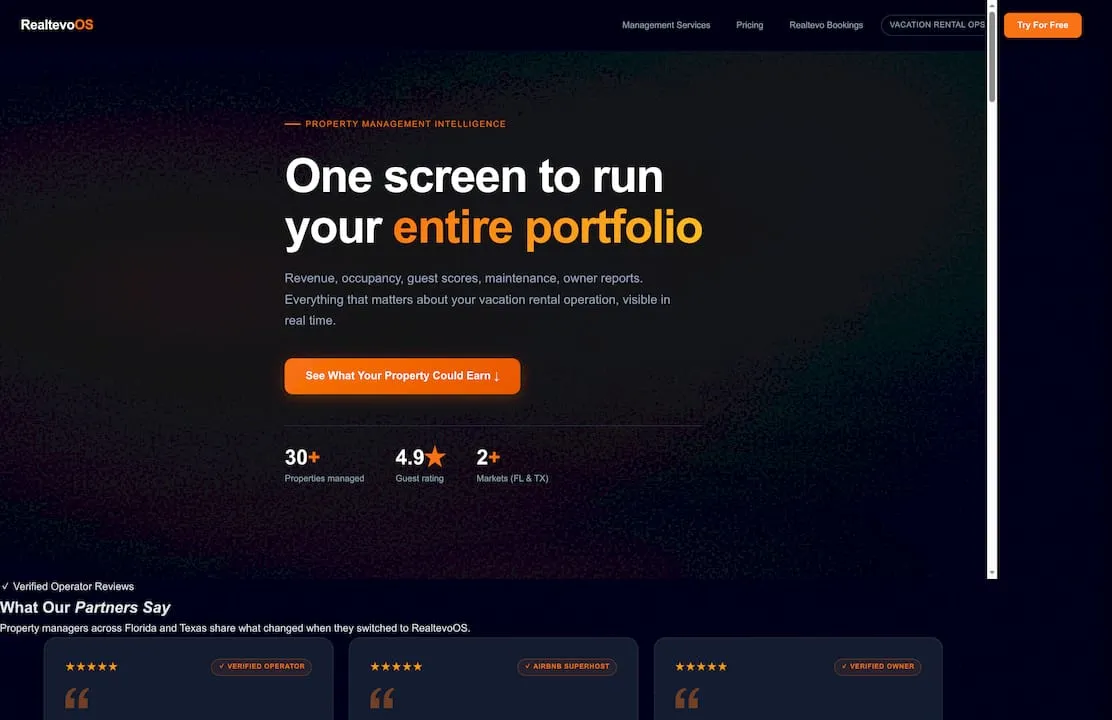
Realtevoos consolidates income, expenses, occupancy data, and channel performance from Airbnb, Vrbo, and other platforms into one place, then generates customized owner reports automatically. The platform supports transaction-level detail, narrative generation, and forward-looking dashboards without requiring you to rebuild the report from scratch each month. If you are ready to replace manual reporting with a system that actually scales with your portfolio, Realtevoos is worth a close look.
FAQ
What should a monthly property management report include?
A monthly report should cover rent collected, all expense categories, management fees, owner disbursements, and reserve balances, with transaction-level detail for every line item to support transparency and owner trust.
What is the difference between a summary report and a trust accounting report?
A summary report shows financial totals, while a trust accounting report includes individual beneficiary ledgers, bank reconciliations, and cash records that meet regulatory standards and can survive an audit.
How often should vacation rental owners receive reports?
Monthly financial statements are standard, but major events like large repairs or guest disputes should trigger immediate notifications rather than waiting for the monthly cycle.
What is predictive analytics in property management?
Predictive analytics in property management uses historical occupancy, seasonal demand, and local market data to forecast future revenue and flag potential underperformance before it affects the bottom line.
How can automation improve property management reports?
Automated reporting aggregates data across multiple channels, generates consistent narratives, and delivers personalized reports on schedule, reducing manual effort and improving accuracy across large vacation rental portfolios.