Rental compliance monitoring: the complete guide for managers
Discover what rental compliance monitoring is and how it safeguards your vacation rental business from costly fines and regulatory changes.

Rental compliance monitoring: the complete guide for managers
Compliance isn’t just about paying your occupancy taxes on time. Many vacation rental property managers think they’ve checked every box once they’ve set up a business license and connected to a booking channel, only to discover that local regulators have quietly changed the rules, a permit lapsed, or a new safety inspection requirement took effect months ago. Those oversights carry real consequences: fines, forced delistings, and angry guests who arrive at a property that can’t legally host them. This guide breaks down exactly what rental compliance monitoring is, what it covers, and how to build a system that protects your portfolio as your business grows.
Table of Contents
- Understanding rental compliance monitoring
- Key components of rental compliance
- Common compliance challenges and risks
- Tools and strategies for effective compliance monitoring
- Why efficient compliance monitoring is a competitive edge
- Take control of rental compliance with the right platform
- Frequently asked questions
Key Takeaways
| Point | Details |
|---|---|
| Compliance is ongoing | Successful managers treat compliance monitoring as a routine, not a one-time task. |
| Multiple risk factors | Licenses, taxes, safety, and guest screening all require close attention for full legal compliance. |
| Digital tools help | Modern platforms automate monitoring and reduce manual errors significantly. |
| Competitive advantage | Operators who prioritize proactive compliance often outperform the market. |
Understanding rental compliance monitoring
Rental compliance monitoring is the ongoing practice of tracking every regulatory obligation that applies to each property you manage, verifying that those obligations are met, and catching any changes before they create a violation. The word “ongoing” is the part most operators underestimate. Regulations don’t stand still. Cities regularly update short-term rental ordinances, zoning rules shift, and state-level tax laws get amended without much fanfare.
For vacation rental managers, compliance monitoring covers at least four broad categories:
- Licenses and permits: Business licenses, short-term rental permits, and any property-specific authorizations required by local authorities
- Tax obligations: Transient occupancy tax (TOT) collection, remittance schedules, and any new taxes added at the city, county, or state level
- Health and safety standards: Smoke detectors, carbon monoxide alarms, pool safety fencing, fire extinguisher placement, and any inspection requirements tied to those items
- Occupancy and zoning rules: Maximum guest counts, minimum night stay requirements, owner-occupancy clauses, and any HOA overlay rules that restrict rentals
Vacation rental operators need ongoing monitoring to ensure compliance with evolving local regulations, which means a one-and-done setup is simply not enough.
Pro Tip: Set a recurring monthly calendar task to check your top five markets for any new ordinance changes. Many municipalities post updates on their planning or city clerk websites weeks before enforcement begins. Ten minutes a month can save you a five-figure fine.
“Operators who treat compliance as a living process rather than a setup task are the ones who avoid the surprises that can shut a property down overnight.”
The value of compliance tools becomes obvious the moment you’re managing more than a handful of properties across multiple jurisdictions. At that scale, keeping track of every renewal date and regulatory update by memory or spreadsheet is a liability.
Key components of rental compliance
With a clear definition in mind, it’s essential to recognize the specific areas that require close attention. Compliance isn’t a single checkbox. It’s a web of interconnected requirements, and failing any single thread can unravel the entire operation.

| Compliance category | What it includes | Typical renewal frequency |
|---|---|---|
| Licenses and permits | City business license, short-term rental permit, state registration | Annual or biennial |
| Tax collection and remittance | TOT, state sales tax, county tourism levies | Monthly or quarterly |
| Safety requirements | Smoke detectors, CO alarms, pool barriers, fire safety inspections | Annual inspections; check after every turnover |
| Guest vetting | ID verification, signed rental agreements, occupancy acknowledgments | Per booking |
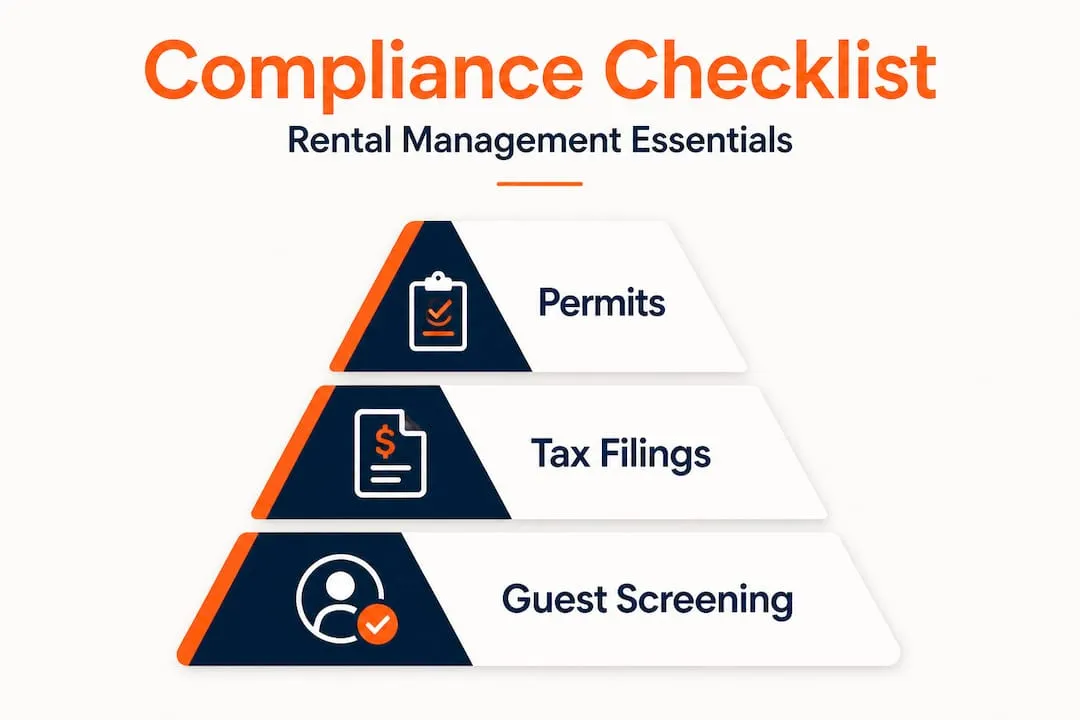
Rental compliance requires managers to oversee several components, including permits, tax filings, and guest screening, all simultaneously and across properties that may have very different local rules.
Breaking this down further by category helps clarify the real workload:
Licenses and permits:
- Tracking expiration dates across dozens of properties in different cities
- Submitting renewal applications before deadlines, often 30 to 60 days in advance
- Maintaining physical or digital copies of all active permits on file
Tax obligations:
- Calculating and collecting the correct tax rate for each booking depending on the property’s location
- Remitting collected taxes on schedule, even during low-occupancy months
- Reconciling platform-remitted taxes (which Airbnb handles for certain jurisdictions) against what you owe directly
Safety requirements:
- Logging inspection dates and scheduling follow-up visits
- Replacing equipment like detectors and extinguishers on time, not just when a guest flags a problem
- Keeping records of every safety check in case a municipality audits your operations
Guest vetting:
- Verifying guest identities per platform requirements and local law
- Ensuring signed rental agreements acknowledge house rules, occupancy limits, and noise policies
- Keeping those agreements accessible in case of a dispute or regulatory inspection
Failing even one of these components can create cascading problems. A lapsed permit in one jurisdiction can trigger a platform delisting that affects booking momentum for months, even after you resolve the underlying issue. The reputational cost often outlasts the fine.
Common compliance challenges and risks
Understanding the required elements is only half the battle. Next comes facing the real-world stumbling blocks that trip up even seasoned property managers.
Here are the most common compliance mistakes operators make:
- Missing permit renewal deadlines. Renewal dates are spread across different months for different properties, and without a centralized system, it’s easy to lose track. A missed renewal often results in an automatic violation notice, not just a late fee.
- Failing to track regulation changes. Local governments rarely send direct notifications to rental operators. A city can lower its maximum occupancy cap or introduce a new registration fee, and you won’t know until an inspector shows up or a guest complains.
- Confusing short-term and long-term rental rules. Some markets apply completely different legal frameworks depending on whether a stay is under 30 nights or over. Mixing those rules up creates real liability, especially around habitability standards and tenant rights.
- Inconsistent tax collection. Even when platforms remit some taxes on your behalf, gaps exist. Some counties levy local taxes that no platform collects automatically, leaving the manager on the hook for amounts they never collected from guests.
- Inadequate record-keeping. Many regulatory audits don’t result in fines because of a missing detector. They result in fines because the manager can’t prove they had one. Documentation is compliance.
Mistakes in compliance monitoring can lead to hefty fines and business disruption for vacation rental owners, and those fines are climbing. Several major U.S. markets now levy daily fines exceeding $1,000 per property for operating without a valid permit, with some cities pursuing fines retroactively for every night of non-compliant operation. That math adds up brutally fast across a portfolio of ten or twenty properties.
Pro Tip: Build a shared compliance calendar with your team and integrate it with your property management system. Assign a specific person as the owner of each renewal date. When ownership is clear, things don’t slip through the cracks.
The risk isn’t only financial. Guests who arrive at a property that loses its rental authorization mid-stay face enormous disruption. That experience destroys your review score, likely triggers a full refund, and puts your relationship with the booking platforms at risk. Operational continuity is inseparable from compliance.
Tools and strategies for effective compliance monitoring
To overcome these challenges, you need more than good intentions. You need the right systems and tools running consistently behind your operations.
Manual tracking vs. digital compliance tools:
| Feature | Manual tracking | Digital compliance tools |
|---|---|---|
| Renewal deadline alerts | Relies on memory or calendar entries | Automated alerts sent in advance |
| Regulation change tracking | Requires manual research | Platform monitors and flags changes |
| Cross-property visibility | One spreadsheet per property | Unified dashboard across all markets |
| Audit-ready record-keeping | Documents stored in scattered folders | Centralized, searchable records |
| Time investment | High, ongoing staff hours | Low, system handles routine checks |
| Error rate | High, especially at scale | Low, automated verification |
The comparison is stark at scale. A portfolio manager handling five properties in one city can manage manually, though it’s still risky. A manager handling 30 properties across five cities cannot. The cognitive load alone makes errors inevitable.
Practical strategies that work:
- Centralized compliance checklists: Create a master checklist for every property that includes each compliance category, the responsible team member, the renewal date, and the documentation location. Update it monthly.
- Automated alerts: Set alerts at 90, 60, and 30 days before any permit expiration or tax filing deadline. Multiple touchpoints reduce the risk of a single missed notification causing a violation.
- Regular auditing: Conduct a quarterly compliance audit for every property. Verify that all documentation is current, all safety equipment is in place, and all tax filings are reconciled.
- Jurisdiction-specific guides: Document the specific rules for each market where you operate. When you add a new property in a city you already serve, this guide becomes your onboarding baseline.
Digital platforms can centralize regulation tracking and automate notifications, reducing manual errors across your entire portfolio. Modern compliance management software integrates with your existing property management stack, pulling booking data, renewal schedules, and regulatory updates into a single view so your team never has to chase information across disconnected systems.
Platforms like RealtevoOS are built specifically for this kind of operational complexity, giving multi-market property managers the automation, visibility, and audit-ready documentation that manual processes simply can’t deliver reliably.
Why efficient compliance monitoring is a competitive edge
Having covered the tactical side, let’s step back and ask what true leaders in rental management do differently.
Most property managers treat compliance the same way people treat dental appointments: something to do when you absolutely have to, not something to build a strategy around. That mindset is a missed opportunity hiding behind a good excuse.
Here’s the uncomfortable truth: compliance isn’t a burden if you’ve built the right systems. It’s a moat. Operators who have clean, documented, audit-ready portfolios can move faster when new markets open up, take on owner clients that demand regulatory certainty, and avoid the cash flow shocks that come from surprise fines or emergency delistings. The competition that’s scrambling to catch up with a compliance crisis can’t undercut you on service quality or take the clients you already have.
The guest trust angle is equally underappreciated. Guests increasingly research the properties they book. A property with a verified permit badge on a listing platform signals legitimacy. In markets where short-term rental backlash has made neighbors and local media more vigilant, operators who run clean programs face far less friction with community complaints and local enforcement. That’s brand protection you can’t buy through marketing.
Those who systematize compliance monitoring tend to outperform competitors due to fewer disruptions and better guest experiences, and that performance compounds over time. Fewer disruptions mean higher review scores. Higher review scores mean better search placement on booking platforms. Better placement means more bookings and more owner clients who want their properties associated with a well-run operation.
We’ve seen operators in competitive urban markets grow their managed portfolio specifically because a competitor was delisted for permit violations. When that happens, the property owners affected need a new manager fast, and they choose the one with a reputation for reliability. Your compliance record is a growth asset.
When you streamline your operations around compliance from day one, you’re not just avoiding problems. You’re building the operational infrastructure that makes scaling to 50, 100, or 200 properties possible without proportional increases in risk or staff.
Take control of rental compliance with the right platform
If this guide has made one thing clear, it’s that compliance monitoring at scale requires systems, not effort alone. You can hire more staff, build more spreadsheets, and create more calendar reminders, but none of that scales cleanly as your portfolio grows across multiple markets with different rules, timelines, and documentation standards.

RealtevoOS is built to solve exactly this problem. The RealtevoOS compliance platform centralizes your regulatory tracking, automates renewal alerts, consolidates documentation, and gives your team a unified view of every property’s compliance status across all markets. Whether you’re managing 10 properties or 200, the platform gives you the infrastructure to stay ahead of regulations, satisfy owner reporting requirements, and protect your business from the costly surprises that come from operating manually in an increasingly regulated industry. Request a demo and see how operators are turning compliance into a genuine competitive advantage.
Frequently asked questions
What does a rental compliance monitoring system do?
It automatically tracks all relevant rental regulations, alerts managers to changes, and ensures every property stays compliant. Digital platforms can centralize regulation tracking and automate notifications so your team spends less time chasing deadlines and more time growing the portfolio.
What are the most common compliance violations for vacation rentals?
The most common issues are lacking proper permits, missing tax filings, and failing to meet occupancy or safety standards. Rental compliance requires managers to oversee several components simultaneously, and the intersection of those components is where most violations occur.
How often should I monitor my rental properties for compliance?
At minimum, conduct a formal compliance check monthly and immediately whenever a regulation change is announced in any of your markets. Vacation rental operators need ongoing monitoring because local rules evolve faster than most annual review cycles can catch.
Can compliance monitoring actually improve business performance?
Absolutely. Proactive monitoring reduces costly disruptions, strengthens guest trust, and protects your review scores and platform rankings. Those who systematize compliance monitoring tend to outperform competitors because fewer operational crises means more consistent revenue and a stronger reputation with both guests and property owners.