Rental Maintenance Escalation Process for Vacation Rentals
Master the rental maintenance escalation process to ensure swift resolutions, protect your properties, and keep guests happy. Discover how now!

Rental Maintenance Escalation Process for Vacation Rentals
A broken HVAC in the middle of summer. A guest flooding your inbox at 2 a.m. about a leaking pipe. No clear path for who handles what, or when. These scenarios cost vacation rental managers real money and real guests. A well-designed rental maintenance escalation process eliminates the guesswork, protects your properties from compounding damage, and keeps guests feeling taken care of instead of ignored. This guide walks you through exactly how to build and run that process, from the first tenant repair request all the way through resolution and follow-up.
Table of Contents
- Key takeaways
- Preparation steps for a rental maintenance escalation process
- Step-by-step guide to escalating maintenance requests
- Common mistakes in escalation handling
- Measuring the success of your process
- My take on proactive maintenance escalation
- How Realtevoos handles escalation at scale
- FAQ
Key takeaways
| Point | Details |
|---|---|
| Prepare before issues arise | Set up communication channels, documentation standards, and urgency tiers before the first request comes in. |
| Categorize every request | Classifying issues as emergency or routine prevents costly misrouting and after-hours labor overruns. |
| Document every step | Timestamped logs of all communications create a defensible audit trail and reduce liability exposure. |
| Track KPIs consistently | Measuring response times and repeat issues turns escalation from a reaction into a managed process. |
| Automate where possible | Technology flags unresolved requests and prevents items from falling through the cracks across multiple properties. |
Preparation steps for a rental maintenance escalation process
No escalation system works without the right foundation. Before you handle a single repair request, you need to put four things in place: communication channels, documentation standards, urgency categories, and tenant expectations.
Communication channels should be centralized. If requests arrive by text, email, phone call, and Airbnb message all at once, items get lost. Pick one primary intake method, whether that is a dedicated maintenance portal, a property management platform, or a shared inbox, and direct every guest toward it. Secondary channels are fine for emergencies, but everything should funnel back to one record.
Documentation standards are non-negotiable. Every request should log the date received, the nature of the issue, any photos the guest provides, and timestamps for every action taken. Documenting all repair communications with timestamps creates an audit trail that protects you in disputes, insurance claims, and potential legal situations. Make this the default behavior for your team, not an afterthought.
Urgency categorization needs to happen at intake, not after the fact. The clearest way to do this is by defining exactly what counts as an emergency in your lease agreement or guest welcome materials. Explicit emergency definitions such as burst pipes, total loss of heat, and electrical hazards reduce misclassification and protect you from unnecessary after-hours callouts.
Here is a practical urgency framework to start from:
- Emergency (respond within 1-2 hours): No running water, flooding, gas smell, electrical failure, no heat in freezing temperatures, security breach
- Urgent (respond within 24 hours): Hot water outage, appliance failure affecting guest comfort, AC failure in summer
- Routine (respond within 48-72 hours): Minor plumbing drips, cosmetic damage, non-functional amenities like a TV remote
Tenant and guest expectations should be set before arrival. Your lease agreement or rental agreement should specify response timeframes for each urgency tier. Research supports a 3 to 5 day response window for non-emergency repair requests as a reasonable baseline that creates clear escalation timelines.
Pro Tip: Add a one-page maintenance guide to your digital welcome packet. It should show guests exactly how to submit a request, what counts as an emergency, and what they can expect in terms of response time. This single document reduces panicked messages and repeat contacts significantly.
Step-by-step guide to escalating maintenance requests
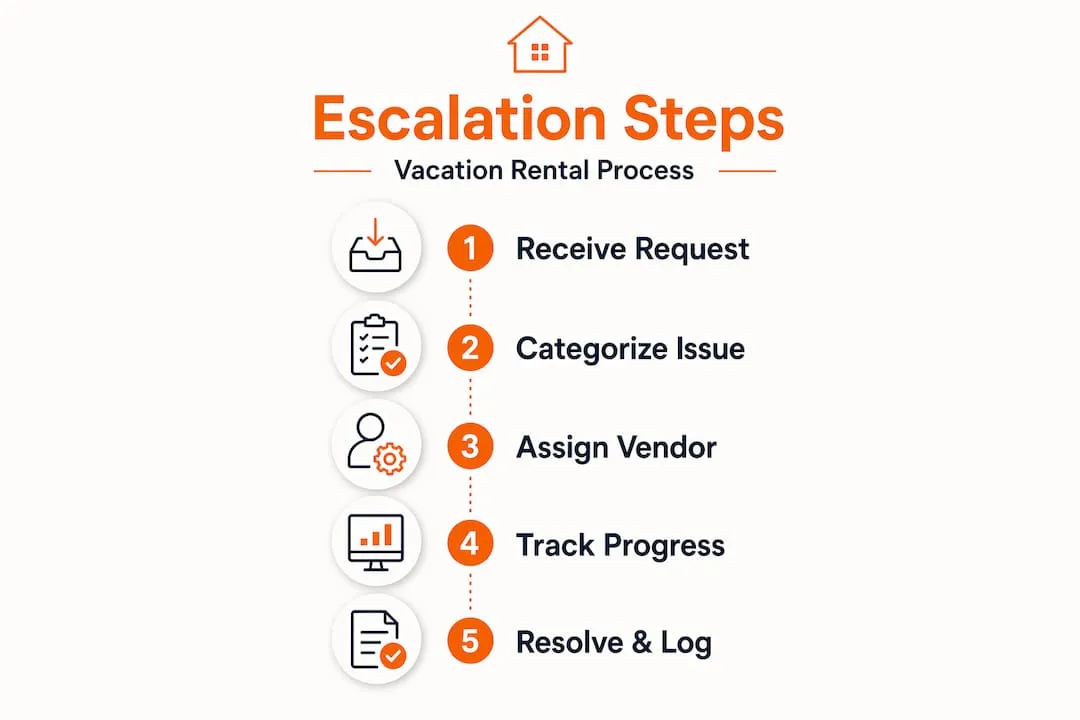
Once your foundation is in place, the tenant repair request process follows a clear path. Here is how each stage should work.
-
Receive and validate the request. Log the incoming request immediately, including the time, the property, and the reported issue. Ask for photos if none were provided. Confirm receipt to the guest within 30 minutes for emergencies and within a few hours for routine items. This acknowledgment alone defuses a significant amount of guest frustration.
-
Classify the urgency. Use your predefined tiers to categorize the issue. Do not let a guest’s emotional language override your classification criteria. A guest saying something is “urgent” does not automatically make it an emergency. Stick to your definitions.
-
Assign to the right resource. Emergency issues go to your on-call vendor or internal technician immediately. Routine issues get scheduled with your preferred vendor during normal hours. Your property maintenance procedure should specify primary and backup vendors for each issue type so you are never scrambling.
-
Communicate the plan to the guest. Before the technician even shows up, tell the guest what is happening and when they can expect resolution. This step is where most managers fall short. Quick repairs build tenant trust and reduce turnover, but the communication around those repairs matters just as much as the speed.
-
Escalate when the first response does not resolve the issue. If your initial vendor cannot fix the problem within the agreed timeframe, escalate to a specialist or a backup vendor. This is the core of any rental repair escalation steps framework. Set a clear trigger: if an issue is not resolved within X hours, it automatically moves up the chain. Do not leave this to judgment calls in the moment.
-
Log the resolution. Once the repair is complete, document the resolution date, what was done, and the cost. Send the guest a brief confirmation. If the issue required multiple visits or escalation, note all of that in the maintenance log.
-
Follow up with the guest. A short message asking whether everything is working properly does two things: it catches any lingering issues before they become complaints, and it signals to the guest that you care about their experience beyond just closing the ticket.
Pro Tip: Automated systems can flag events and maintenance items well in advance, dramatically improving escalation accuracy across a multi-property portfolio. If you are managing more than five properties, manual tracking will eventually fail you.
Common mistakes in escalation handling
Even managers with good intentions make predictable errors. Knowing these patterns in advance is the fastest way to avoid them.
The most expensive mistake is misclassifying urgency. When a routine issue gets treated as an emergency, you pay after-hours rates for standard work. When an emergency is dismissed as routine, you risk property damage, guest harm, and serious legal exposure. In some jurisdictions, landlords must pay double monthly rent if a rental becomes uninhabitable due to maintenance failures. That is not a hypothetical risk.
- Skipping documentation. Verbal promises and informal text threads are not sufficient. Every contact, repair attempt, and update needs to be logged with a timestamp. Without this, you have no defense against a guest claiming a problem was ignored.
- Poor guest communication. Silence is perceived as negligence. Even if you are actively working on a repair, a guest who hears nothing will assume nothing is happening. A 30-second update message prevents a two-star review.
- Ignoring recurring patterns. If the same issue reappears at the same property three times, that is not bad luck. That is a systemic problem requiring a deeper fix. Managers who only address surface repairs without tracking patterns end up in a permanent reactive cycle.
- No backup vendor protocol. If your primary plumber is unavailable and you have no backup, you are stuck. Every vendor category in your property maintenance procedure should have at least one fallback contact.
The most damaging maintenance mistakes are not the ones you make during a repair. They are the ones you make before the request even comes in, specifically failing to define clear processes and set guest expectations in advance.
Ignoring legal obligations is the risk that catches managers off guard most often. Repair timelines are not just operational preferences. They are frequently governed by local housing law. Know your jurisdiction’s requirements and build them into your escalation thresholds, not as targets but as hard limits.
Measuring the success of your process
A process you cannot measure is a process you cannot improve. Once your rental maintenance escalation process is running, these are the metrics worth tracking consistently.
| Metric | What it measures | Target benchmark |
|---|---|---|
| First response time | Speed of initial acknowledgment to guest | Under 30 minutes for emergencies |
| Time to resolution | Total time from request to confirmed fix | Under 4 hours for emergencies, 72 hours for routine |
| Repeat issue rate | Same issue reported more than once at same unit | Under 10% of total requests |
| Guest satisfaction score | Post-stay ratings related to maintenance | 4.5 stars or above |
| Escalation rate | Percentage of requests requiring escalation | Track trend, aim for consistent reduction |
Centralized maintenance dashboards convert this from a reactive task into a strategic one. When you can see all open requests, resolution statuses, and repeat issue patterns in one place, you stop guessing and start managing.

Guest feedback is underused data. After each maintenance event, a brief survey or a simple follow-up question gives you signal on whether the process felt responsive from the guest’s perspective. Operational efficiency metrics tell you what happened internally. Guest feedback tells you what it felt like to be on the receiving end.
Pro Tip: Review your escalation data quarterly. Look for any vendor category with consistently high escalation rates. That pattern usually means either your primary vendor is underperforming, or your urgency thresholds for that category need to be recalibrated.
My take on proactive maintenance escalation
I have seen what happens when property managers treat maintenance purely as a cost to minimize. The pattern is always the same. Small issues get ignored because they seem manageable. Then they compound. A slow leak becomes a mold problem. A guest with a broken air conditioner leaves a one-star review that takes months to overcome. The financial case for proactive maintenance as a profit driver is strong, but most managers do not feel it until they have already paid the cost of ignoring it.
What I have found actually works is treating every maintenance request as a trust transaction. The guest is not just reporting a problem. They are testing whether you are the kind of operator who shows up. How you respond shapes whether they rebook, whether they recommend you, and whether your reviews reflect the quality you are actually trying to deliver.
The technology piece matters more than people expect. Managing escalation for even a handful of properties manually is genuinely difficult to do consistently. Automated flagging, centralized logs, and real-time status updates are not luxury features. They are the infrastructure that makes a reliable process possible at any real scale.
My honest observation after watching operations across many property portfolios: the managers who handle escalation well are not necessarily the ones with the fastest vendors. They are the ones with the clearest processes, the best communication habits, and the discipline to document everything.
— Jose
How Realtevoos handles escalation at scale

Managing a rental maintenance escalation process across dozens of properties is where manual systems break down fast. Realtevoos was built specifically for this challenge. The platform captures maintenance requests from all channels into a single dashboard, auto-classifies urgency based on your defined criteria, and triggers escalation workflows without anyone needing to remember to follow up. Every communication is logged with a timestamp, every vendor assignment is tracked, and every unresolved item gets flagged before it becomes a guest complaint.
For vacation rental operators who want to stop reacting and start managing, Realtevoos consolidates the entire escalation workflow into one place. Explore how the platform can reduce your response times and protect your guest satisfaction scores.
FAQ
What is a rental maintenance escalation process?
A rental maintenance escalation process is a structured system for receiving, categorizing, assigning, and resolving tenant repair requests, with defined steps for escalating unresolved issues to higher-priority resources.
How should I categorize maintenance requests?
Divide requests into emergencies, urgent issues, and routine repairs based on impact to guest safety and habitability. Define specific examples for each tier in your lease agreement to prevent misclassification.
How quickly should I respond to maintenance requests?
Emergencies should receive an initial response within 30 to 60 minutes. Non-emergency requests should have a 3 to 5 day response window as a reasonable outer limit, with same-day acknowledgment as the operational standard.
Why is documentation so critical in maintenance escalation?
Complete documentation with timestamps creates an audit trail that protects you against liability claims, disputes, and legal challenges related to repair timelines or habitability standards.
How do I know if my escalation process is working?
Track first response time, time to resolution, repeat issue rate, and guest satisfaction scores. A well-functioning process shows declining escalation rates over time and consistent improvement in guest feedback related to maintenance responsiveness.