Rental Occupancy Optimization: Your 2026 Strategy Guide
Discover what is rental occupancy optimization and how it can maximize your income. Learn strategies for effective pricing and vacancy management.

Rental Occupancy Optimization: Your 2026 Strategy Guide
Rental occupancy optimization is the systematic practice of managing occupancy rates and rental pricing together to maximize net operating income and reduce costly vacancy. The industry term for this discipline is revenue management, and it applies directly to vacation rental portfolios where a single empty week can erase a month of profit. The national vacancy index hit 7.4% in february 2026, the highest level since 2017. That number signals that most property owners are leaving real money on the table. The good news is that dynamic pricing, professional photography, and data analytics give you the tools to close that gap fast.
What is rental occupancy optimization and why does it matter?
Rental occupancy optimization is defined as the coordinated management of occupancy rates, rental pricing, and leasing activity to produce the highest possible net operating income (NOI) from a property or portfolio. It treats occupancy and revenue as two sides of the same equation, not separate problems. A property sitting empty costs you money. A property priced too low costs you money in a different way.
The math is straightforward. Your occupancy rate is the percentage of available rental days that are actually booked or leased. Your vacancy rate is the inverse. If your vacation rental is occupied 270 out of 365 days, your occupancy rate is 74% and your vacancy rate is 26%. Every point of vacancy you recover translates directly into revenue.
Revenue intelligence combines occupancy data, rental rates, and leasing activity into one unified framework. That framework is what separates reactive landlords from operators who consistently outperform their market. Without it, you are guessing.
How do occupancy and vacancy rates impact rental revenue?
Occupancy and vacancy rates have a direct, inverse relationship with your NOI. Higher occupancy at the right price produces more income. But chasing 100% occupancy at any price is a trap. 100% occupancy often signals underpriced inventory, meaning you could charge more and still fill the property. A slight vacancy rate in a strong market is actually a sign of healthy pricing discipline.
Here is a simple comparison that shows how occupancy level and nightly rate interact to produce very different revenue outcomes:
| Scenario | Occupancy rate | Avg. nightly rate | Annual revenue |
|---|---|---|---|
| Underpriced, full | 100% | $150 | $54,750 |
| Optimized pricing | 88% | $185 | $59,458 |
| Overpriced, vacant | 65% | $210 | $49,868 |
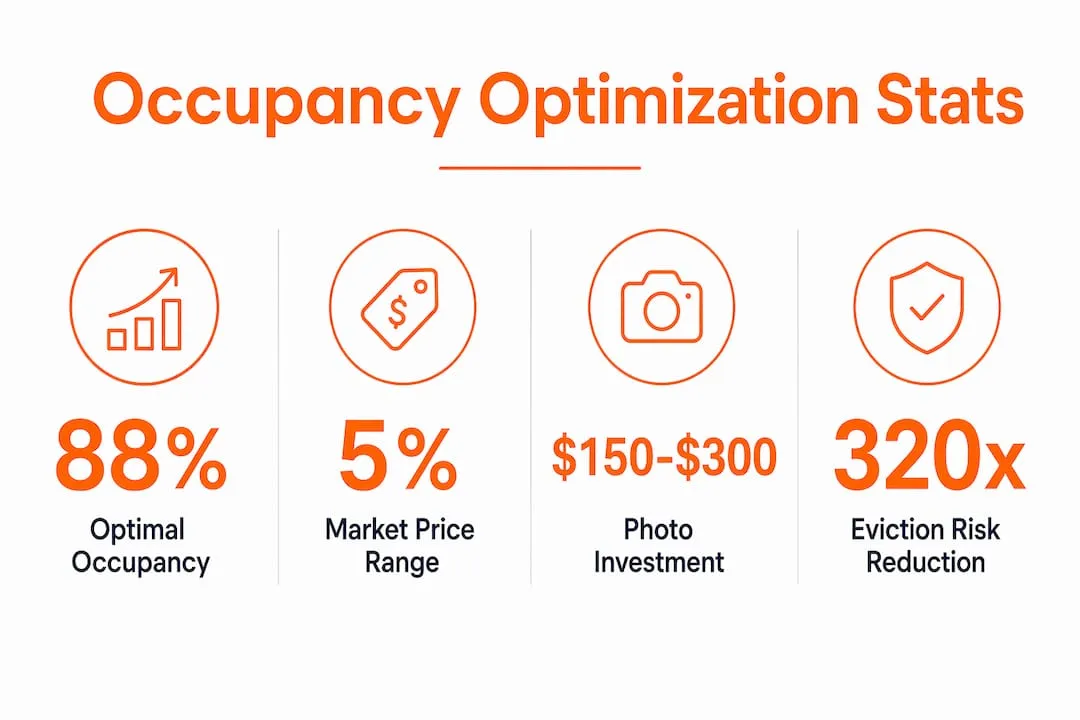
The middle scenario wins. An 88% occupancy rate at a higher nightly rate beats both extremes. This is the core logic behind rental property optimization: you are not trying to fill every night. You are trying to maximize total revenue across the year.
NOI calculations must also account for operating expenses. Excluding CapEx reserves and management fees overstates returns by 2–4 percentage points. That gap matters when you are comparing properties or deciding whether to adjust pricing.
What are the fastest and most effective strategies to improve rental occupancy?
The fastest wins in occupancy improvement come from three areas: presentation, pricing, and platform reach. Most property owners underinvest in all three.
Presentation: professional photography
Professional photography reduces days on market by 30–50% with an investment of just $150–$300. That is one of the highest return-on-investment moves available to any vacation rental owner. Guests make booking decisions in seconds based on photos. A dark, cluttered listing photo is a vacancy waiting to happen.

Pricing: stay within 5% of market comps
Competitive pricing adjustments fill units faster when rents exceed comparable properties by more than 5%. Check your local market comps on Airbnb and Vrbo at least monthly. If your nightly rate is running more than 5% above similar listings in your area, expect slower booking velocity.
Platform reach and marketing
Listing on multiple platforms multiplies your exposure without multiplying your workload, especially when you use a property management system that syncs calendars automatically. Airbnb, Vrbo, and direct booking sites each attract different guest segments. Relying on one channel is a single point of failure.
Tenant retention and lease renewal outreach
For longer-term rentals, proactive lease renewal outreach prevents the vacancy spikes that come from last-minute turnover. Contact tenants 90 days before lease end. Offer a renewal incentive before they start shopping alternatives.
- Use professional photography for every listing update, not just the initial post
- Price within 5% of market comps and review monthly
- List on at least two major platforms with synced calendars
- Begin lease renewal conversations 90 days before expiration
- Run comprehensive tenant screening to reduce eviction risk and improve renewal rates
Pro Tip: Combine a pricing adjustment with a fresh photo set when relisting a slow property. The two changes together produce faster results than either one alone.
Tenant screening reduces eviction risk by up to 320 times at high ResidentScore bands. Better tenants renew more often, pay on time, and cause fewer turnovers. Screening is not just a risk management tool. It is an occupancy tool.
How does dynamic pricing and revenue management drive occupancy optimization?
Dynamic pricing is the practice of adjusting rental rates in real time based on occupancy levels, demand signals, and seasonal patterns. It differs from static pricing in one critical way: it responds to the market instead of ignoring it. Dynamic pricing increases revenue by 7–15% compared to static pricing models. That range represents real dollars across a portfolio.
The key to making dynamic pricing work is structure. Effective dynamic pricing depends on clear, documented rules rather than ad hoc discounting. Random price cuts erode revenue and confuse guests. Rule-based systems protect both.
Here is how to build a basic dynamic pricing framework:
- Set your base rate. Calculate your target nightly rate based on annual revenue goals and expected occupancy. This is your anchor.
- Define occupancy thresholds. Decide at what occupancy level you will adjust pricing. For example, if a property sits vacant for more than 7 days, trigger a 10% rate reduction.
- Build seasonal bands. Identify your peak, shoulder, and slow seasons. Set rate multipliers for each. Peak season might run 140% of base rate. Slow season might run 80%.
- Add demand signals. Monitor local events, competitor availability, and platform search trends. Raise rates when demand spikes. Lower them when it drops.
- Set floor and ceiling prices. Never go below your cost floor. Never price so high that you price yourself out of the market entirely. Document both limits.
- Review and adjust monthly. Rules are not set-and-forget. Review performance data monthly and refine thresholds based on actual booking patterns.
Pro Tip: Treat your pricing rules as a living document. Review them every 30 days against actual occupancy and revenue data. Rules that made sense in January may need adjustment by April.
Dynamic pricing, when treated as a rule-based system, aligns occupancy, demand, and yield without requiring you to be a data scientist. The system does the heavy lifting. You set the guardrails. You can explore vacation rental revenue tips that work alongside dynamic pricing to build a complete revenue strategy.
What nuances affect occupancy optimization and how to apply best practices?
Occupancy optimization gets more complex at the portfolio level. Several factors that look minor on a single property become significant when multiplied across 10 or 20 units.
Lease timing and the renewal cliff
Neglecting lease-end management causes vacancy spikes known as renewal cliffs. A renewal cliff happens when multiple leases expire at the same time, flooding your portfolio with simultaneous vacancies. Staggering lease ends into peak booking seasons can save thousands per year per property. Vacancy durations vary seasonally, with slow-season vacancies lasting nearly twice as long as peak-season ones. Engineering lease lengths to push turnover into favorable periods is one of the highest-value, lowest-risk moves available to a portfolio manager.
Retention economics vs. acquisition cost
Keeping a good tenant costs far less than finding a new one. Turnover costs include cleaning, repairs, marketing, and lost revenue during the vacancy period. For vacation rentals, a single unbooked week in peak season can cost more than a month of off-season revenue.
- Stagger lease ends to avoid simultaneous vacancies across your portfolio
- Target lease renewals that push turnover into peak booking windows
- Calculate your true turnover cost, including lost revenue, before deciding not to offer a renewal incentive
- Use ResidentScore or equivalent screening tools to identify high-renewal-probability tenants
- Track NOI per unit, not just gross revenue, to catch expense creep early
The table below shows how retention economics compare to new tenant acquisition at the property level:
| Cost category | Tenant retention | New tenant acquisition |
|---|---|---|
| Marketing spend | $0–$50 | $150–$400 |
| Vacancy loss (days) | 0 | 14–30 days |
| Cleaning and repairs | Minimal | Full turnover cost |
| Screening fees | $0 | $30–$75 |
| Total estimated cost | Under $100 | $500–$1,500+ |
The numbers make the case clearly. Retention is the most cost-effective occupancy strategy available. Pair it with data integration across your rental management tools to track which tenants are renewal risks before they become vacancies.
Key takeaways
Rental occupancy optimization works because it treats occupancy and pricing as one system, not two separate problems, and uses data to find the balance that maximizes NOI.
| Point | Details |
|---|---|
| Optimize rate, not just occupancy | 88% occupancy at a higher rate outperforms 100% occupancy at a discounted rate. |
| Use rule-based dynamic pricing | Documented pricing rules tied to occupancy thresholds produce 7–15% more revenue than static pricing. |
| Invest in professional photography | A $150–$300 photo investment reduces days on market by 30–50%. |
| Manage lease-end timing actively | Staggering lease renewals into peak seasons prevents costly renewal cliffs. |
| Screen tenants to protect occupancy | High-quality tenants renew more often, reducing turnover and compounding occupancy gains over time. |
Why most property managers get occupancy optimization backwards
I have reviewed the operations of dozens of vacation rental portfolios, and the same mistake shows up repeatedly. Owners focus on filling every available night and treat pricing as secondary. They discount aggressively when bookings slow, then wonder why their annual revenue is flat even when occupancy looks healthy.
The uncomfortable truth is that 100% occupancy is often a warning sign, not a success metric. It tells you that your price is too low for the demand you are seeing. The goal is not to fill every night. The goal is to maximize what each night earns you across the full year.
The second mistake I see constantly is ignoring lease-end timing. A property manager who lets three leases expire in January, in a market where slow-season vacancies last twice as long as peak-season ones, has created a self-inflicted revenue problem. This is entirely preventable with basic calendar management and proactive renewal outreach.
The operators who consistently outperform their markets share one habit: they treat occupancy and pricing as a single, data-driven system. They review performance monthly, adjust pricing rules based on actual booking data, and invest in tools that give them real-time visibility across their portfolio. They also understand that operational efficiency is not separate from occupancy strategy. The two are connected at every level.
Start with your pricing rules. Document them. Review them monthly. Then build your retention strategy around them. That sequence produces compounding results.
— Jose
How Realtevoos helps you maximize vacation rental occupancy
Realtevoos is built specifically for vacation rental property managers who need real-time occupancy and revenue data across multiple properties in one place.

The platform pulls live data from Airbnb and Vrbo, giving you a single dashboard to track occupancy rates, booking velocity, and revenue performance without switching between tabs or building manual reports. Realtevoos supports dynamic pricing workflows, automated guest communications, and portfolio-level reporting that shows you exactly where vacancy risk is building before it becomes a problem. Property managers using Realtevoos report saving several hours each week on reporting alone. Explore what Realtevoos can do for your occupancy and revenue strategy today.
FAQ
What is rental occupancy optimization?
Rental occupancy optimization is the practice of managing occupancy rates and rental pricing together to maximize net operating income. It uses dynamic pricing, marketing, and lease management to reduce vacancy and increase revenue.
What is a good occupancy rate for a vacation rental?
A healthy vacation rental occupancy rate typically falls between 75% and 90%, depending on the market and season. Rates at 100% often indicate underpriced inventory rather than peak performance.
How does dynamic pricing improve occupancy?
Dynamic pricing adjusts nightly rates based on demand, seasonality, and current occupancy levels. Rule-based dynamic pricing produces 7–15% more revenue than static pricing models by capturing demand peaks and reducing slow-period vacancies.
How does tenant screening affect occupancy rates?
High-quality tenants renew leases more often and cause fewer turnovers. Professional screening reduces eviction risk by up to 320 times at high ResidentScore bands, which compounds into significantly better long-term occupancy.
What causes rental vacancy spikes?
Vacancy spikes most often result from poor lease-end timing, overpricing relative to market comps, or weak marketing. Renewal cliffs, where multiple leases expire simultaneously, are a leading cause of sudden vacancy increases in multi-unit portfolios.