Scaling rental operations guide for property managers
Unlock growth with our scaling rental operations guide for property managers. Learn key systems to automate and streamline your portfolio today!

Scaling rental operations guide for property managers
Managing multiple vacation rentals starts feeling manageable at two properties, gets complicated at five, and becomes genuinely dangerous at ten without the right systems in place. This scaling rental operations guide exists because most property managers hit a wall somewhere between their eighth and fifteenth unit, not from lack of hustle but from lack of structure. Automation, standardized processes, and data-driven decision making are what separate operators who grow sustainably from those who spiral into burnout and guest complaints. Work through each section and you will have a clear, actionable framework for scaling your portfolio without sacrificing quality.
Table of Contents
- Preparing your operations for growth: systems and staffing essentials
- Automating guest communication to boost efficiency and guest satisfaction
- Implementing data-driven pricing strategies for revenue maximization
- Streamlining cleaning and maintenance workflows at scale
- Verifying success: tracking KPIs and avoiding common scaling pitfalls
- Why most vacation rental scaling strategies fail and how to win
- How RealtevoOS powers scalable vacation rental management
- Frequently asked questions
Key Takeaways
| Point | Details |
|---|---|
| Standardize operations | Create repeatable systems and SOPs before expanding to maintain consistency and quality. |
| Leverage AI automation | Use AI to automate guest messaging and upsells to scale without proportionally increasing staff. |
| Employ dynamic pricing | Implement data-driven pricing tools to optimize revenue based on market signals. |
| Optimize cleaning workflows | Automate cleaning schedules with photo verifications and backups to prevent operational failures. |
| Track relevant KPIs | Continuously monitor occupancy, turnover costs, and rebooking metrics to guide informed scaling decisions. |
Preparing your operations for growth: systems and staffing essentials
Before you add a single property, your existing operations need to be repeatable. That means written SOPs (standard operating procedures) for every recurring task: pre-arrival cleaning, guest check-in messaging, mid-stay check-ins, and maintenance response. If your process lives in someone’s head, it cannot be delegated, and delegation is the entire point of scaling.
Start with three core SOPs that every growing portfolio needs:
- Cleaning and turnover protocol: Step-by-step room-by-room checklist with photo verification requirements
- Guest communication cadence: Message templates for booking confirmation, arrival instructions, day-two check-in, and post-stay review request
- Maintenance response ladder: Who gets called for what, in what order, with what response time expectation
Quality control matters more as you grow, not less. Photo-verified cleaning checklists are non-negotiable at scale. When a cleaner submits a photo log before payment is released, you catch problems before the guest arrives rather than after they leave a two-star review.
Staffing needs change dramatically as your portfolio grows. MiniStays outlines a clear progression: owner plus one cleaner handles 1-5 units, a part-time operations coordinator enters around 6-10 units, and a dedicated head of operations becomes essential at 15 or more units. Skipping that middle layer is where most operators get crushed.
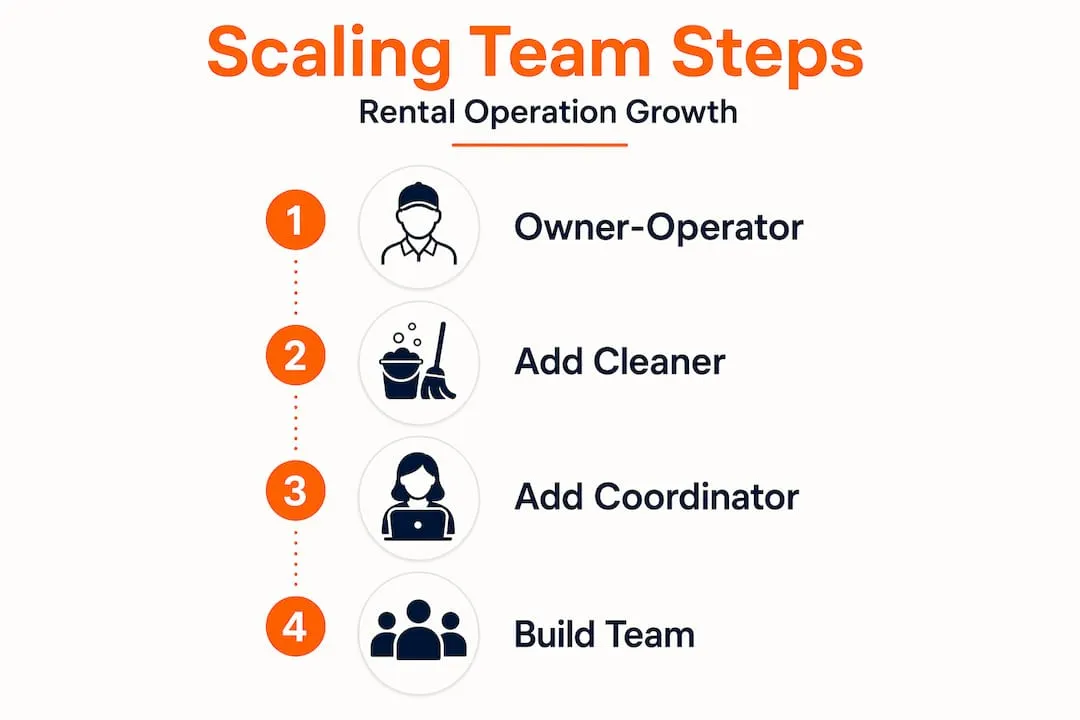
| Portfolio size | Core staffing model | Key addition |
|---|---|---|
| 1-5 units | Owner-operator + cleaner | Basic task tracking |
| 6-14 units | Owner + ops coordinator + cleaner team | Scheduling software |
| 15+ units | Head of ops + tiered team + dedicated vendors | Full ops platform |
Pro Tip: Start using a vacation rental operations platform from your fifth unit, not your fifteenth. The earlier your team learns the system, the less painful the transition when volume spikes.
With operations prepared and the right team in place, you can now focus on automating workflows and enhancing efficiency.
Automating guest communication to boost efficiency and guest satisfaction
Guest messaging is the most time-consuming daily task for most property managers, and it is almost entirely predictable. Seventy percent of the messages you receive follow the same patterns: check-in questions, Wi-Fi passwords, early check-out requests, and parking instructions. That predictability is exactly what makes it automatable.

AI-powered messaging tools handle 80-90% of routine guest messages, which means a team managing 20 properties can realistically scale to 60-100 units without adding staff. Response times drop below two minutes around the clock, which directly improves booking conversion rates since guests on booking platforms make fast decisions.
The practical implementation approach is straightforward:
- Build a message library covering the 30 most common guest questions at each property
- Set automated triggers tied to booking stages: confirmation, 48-hour pre-arrival, day of check-in, and post-checkout
- Layer in digital guidebooks that answer property-specific questions guests would otherwise message you about
- Add upsell workflows (late checkout, mid-stay cleaning, local experiences) triggered automatically based on stay length
Real-world results validate the investment. Seacoast Vacation Rentals implemented an AI communication system that automatically answered 62% of FAQ-style guest inquiries and generated automated upsell conversions at 13.5%, delivering three times return on investment within months.
One frequently overlooked resource for improving guest satisfaction at scale is providing digital guest resources that reduce dependency on direct staff contact for routine information.
Pro Tip: Pilot AI messaging on a group of five to eight properties before rolling it out portfolio-wide. This lets you identify gaps in your message library and fine-tune tone before guests at your flagship properties experience any rough edges.
Connecting automated guest communication tools to your property management system ensures messages trigger correctly even when booking data changes last minute.
With guest communication optimized, the next step is smart revenue management through dynamic pricing.
Implementing data-driven pricing strategies for revenue maximization
Static pricing is the silent killer of vacation rental revenue. Setting a flat rate and adjusting it twice a year means you are leaving money on the table during peak demand and sitting empty during shoulder seasons when a modest discount would fill the calendar.
Dynamic pricing tools pull in demand signals: local event calendars, competitor occupancy rates, historical booking windows, and seasonal patterns, and adjust your rates daily or even hourly. PriceLabs dynamic pricing increased revenue by 22% after 90 days by analyzing market demand and seasonality across properties. That is not a marginal improvement; it materially changes the economics of each unit in your portfolio.
| Pricing approach | Revenue ceiling | Occupancy control | Effort required |
|---|---|---|---|
| Static flat rate | Low | None | Minimal |
| Manual seasonal adjustments | Medium | Limited | High |
| Dynamic pricing tool | High | Automated | Low after setup |
At scale, pricing strategy also becomes an owner relations issue. Homeowners see their rates fluctuate and sometimes panic. Build trust by providing monthly reports that show how dynamic pricing decisions tracked against local market performance. Transparency converts skeptics into advocates. VTrips’ use of Wheelhouse across multiple markets demonstrated that operators who commit fully to dynamic pricing tools sustain both occupancy and average daily rate (ADR) even in tougher market conditions.
The key safeguard is pricing floors. Never let automation drop your rate below the point where the rental is actually profitable after cleaning costs, channel fees, and management time. Set hard minimums in your pricing tool and review them quarterly.
For full revenue optimization, connect your dynamic pricing integration directly to your property management system so rate changes publish instantly across all channels without manual intervention.
Having automated communication and dynamic pricing in place, it’s important to ensure your operational workflows are equally optimized for scale.
Streamlining cleaning and maintenance workflows at scale
Cleaning is the most common point of failure when scaling rental portfolios. It touches every guest stay, happens under time pressure, and involves third-party vendors you do not fully control. Get this wrong and five-star ratings become three-star ratings within a quarter.
Here is a practical framework for managing cleaning at volume:
- Automate task assignment. Connect your booking calendar to your cleaning scheduling system so every checkout automatically generates a cleaning task with the correct time window assigned to the right vendor.
- Require photo verification before payment releases. Cleaners submit timestamped photos of completed rooms. Payment is conditional. This single requirement reduces quality failures dramatically.
- Build a backup cleaner network. For every primary cleaner, maintain at least one vetted backup available on short notice. Last-minute call-outs at scale happen every week.
- Enforce SLA targets with real consequences. A 98% on-time SLA is the standard, enforced through a penalty and bonus structure. Late completions or failed photo submissions trigger penalties; consistent performance earns bonuses.
- Automate consumable restocking. Connect inventory tracking to your supply ordering system so toiletries, paper goods, and cleaning supplies reorder automatically before they run out.
The math of scale makes this non-negotiable. A 50-property portfolio at 70% occupancy generates roughly 350 cleans per month. At that volume you can negotiate per-clean rates down, but only if you provide the scheduling consistency and volume that makes your business worth prioritizing for vendors.
Maintenance follows a similar logic. Digital maintenance reporting, where guests or cleaners log issues through a structured form with photos, creates a documented repair queue that your maintenance coordinator works through systematically. Unlogged verbal complaints become missed repairs become negative reviews.
Pro Tip: Use cleaning workflow automation that flags a cleaning task as incomplete if no photo upload is received within two hours of the checkout window. This catches issues in time to dispatch a backup before the next guest arrives.
With operational workflows stabilized, it’s vital to verify and measure performance regularly to sustain growth momentum.
Verifying success: tracking KPIs and avoiding common scaling pitfalls
Growth feels good until the metrics tell you otherwise. Most operators who scale too fast find out through their inbox: complaints pile up, cleaners start missing windows, reviews slip. The operators who scale well find out through their dashboards before the problems reach guests.
Track these KPIs weekly:
- Occupancy rate per property and across the portfolio
- ADR and revenue per available night (RevPAN)
- Turnover cost per booking
- Net operating income per unit
- Average days to rebook after checkout
- Guest review score trends by property
Key KPIs include occupancy rate, turnover cost per booking, net operating income, and days to rebook, tracked on a consistent schedule in a consolidated dashboard rather than scattered across spreadsheets.
The single most common scaling mistake is adding properties faster than operations can absorb them. Add five to ten properties at a time, stabilize before expanding, and measure whether your core metrics held. Without SOPs and automation, operators drown at 20 properties. It is not a headcount problem; it is a systems problem.
| Growth phase | Properties added | Stabilization focus | Risk if skipped |
|---|---|---|---|
| Early scaling | 5-10 | SOP documentation | Inconsistent guest experience |
| Mid scaling | 10-25 | Automation rollout | Staff burnout and errors |
| Portfolio maturity | 25+ | KPI monitoring | Profitability erosion |
Use a performance tracking dashboard that consolidates data from all your booking channels into one view so you are not manually pulling reports to see how the portfolio is performing.
With your data-driven verification in place, reflect on practical lessons and strategic insights that differentiate successful scaling in vacation rental operations.
Why most vacation rental scaling strategies fail and how to win
Here is what most scaling guides will not tell you: hiring more people before fixing your systems is the most expensive mistake you can make. Every new hire inherits your chaos, works around your broken processes, and creates workarounds that make the next hire even harder to onboard. Standardize first. Hire second. The sequence matters more than the timeline.
The operators who consistently scale well share one behavior: they treat automation not as a nice-to-have efficiency but as a structural requirement for growth. AI and automation are what decouple headcount from property count. Without that decoupling, you are not really scaling; you are just hiring.
Guest engagement is another underappreciated lever. High-performing landlords engage early using centralized technology to prevent bottlenecks and late payments, which are direct inputs to scaling success. Early communication, proactive problem resolution, and consistent touchpoints build the kind of guest experience that generates repeat bookings and reduces the constant pressure to fill new demand.
The uncomfortable truth about growing rental business strategies is that most of the work happens before you add the next property, not after. Systems, SOPs, and automation need to be in place before scale, not retrofitted during it. If your scaling operations insights are telling you that things got messy somewhere around property ten, the fix is not to slow down growth; it is to go back and build what should have been there at property five.
How RealtevoOS powers scalable vacation rental management
Scaling rental operations without a centralized command center means your team is constantly context-switching between booking platforms, spreadsheets, and messaging apps.

RealtevoOS consolidates your entire operation: guest communication automation, cleaning task coordination, dynamic pricing integration, owner reporting, and KPI dashboards in one platform built specifically for multi-property managers. It connects directly to Airbnb, Vrbo, and other channels, so data flows in automatically and your team acts on insights rather than hunting for information. Whether you are managing 15 units or 150, vacation rental management software at this level of integration is what turns the strategies in this guide from theory into daily practice.
Frequently asked questions
What is the first step to scaling vacation rental operations?
The first step is building repeatable SOPs for cleaning, guest communication, and maintenance so every process can be delegated without losing quality. Growth without systems is chaos that compounds as your property count increases.
How can AI improve guest communication when managing many properties?
AI automates 80-90% of routine guest messages, cutting response times to under two minutes and freeing your team to handle complex issues rather than answering the same questions repeatedly.
What are critical KPIs to track when scaling vacation rental operations?
Focus on occupancy rate, turnover cost per booking, net operating income per unit, and average days to rebook after checkout. Track these weekly in a consolidated dashboard to catch problems before they compound.
Why is dynamic pricing important for vacation rental scaling?
Dynamic pricing adjusts your rates daily based on local demand, events, and seasonality, and delivers an average 22% revenue increase after 90 days compared to static rate strategies.
How do cleaning operations impact scaling vacation rental portfolios?
Cleaning is the largest operational bottleneck at scale. A 50-property portfolio at 70% occupancy generates over 350 cleans monthly, requiring automated scheduling, photo-verified quality control, and backup vendor networks to avoid guest-facing failures.