Short-Term Rental Local Law Guide for Investors
Navigate short-term rental laws with our comprehensive short-term rental local law guide. Stay compliant, protect your income, and succeed in 2026!

Short-Term Rental Local Law Guide for Investors
Short-term rental local laws define where, how, and under what conditions you can legally rent your property for short stays. This short-term rental local law guide covers every regulatory category that matters in 2026: zoning, licensing, transient occupancy taxes, occupancy limits, and safety standards. California’s SB 346 now requires booking platforms to share host data with local governments quarterly, signaling that enforcement is tightening nationwide. Property owners who treat compliance as a core discipline protect their income and their investment. Those who ignore it risk fines, delisting, and permanent loss of operating rights.
What are the main categories of local short-term rental laws?
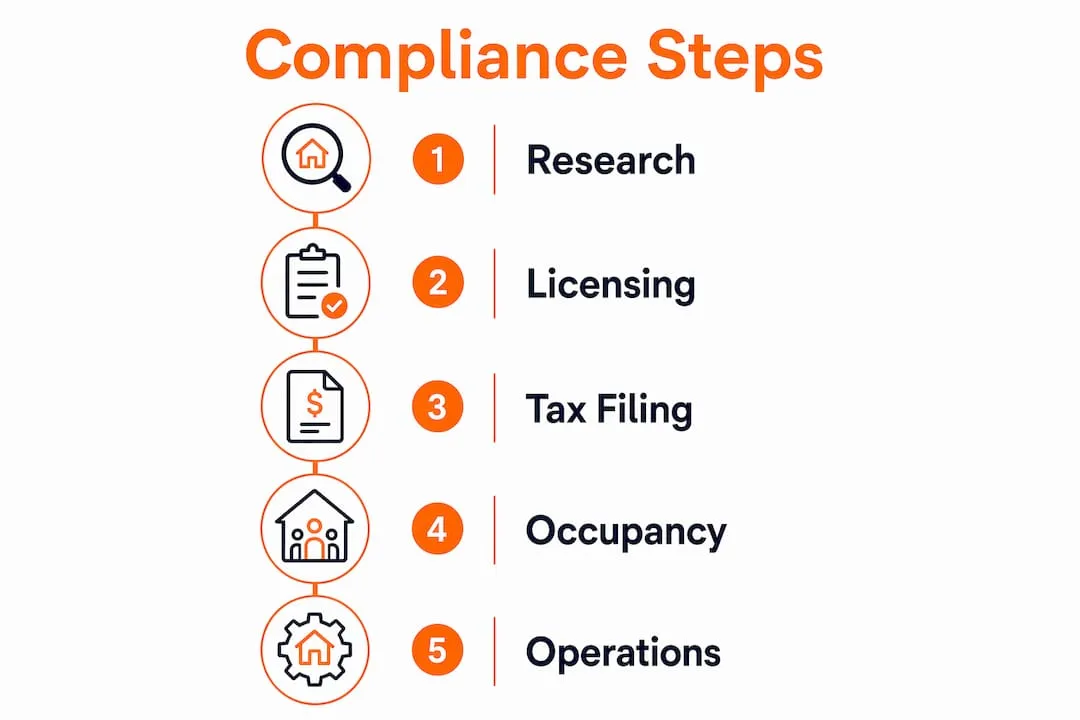
Local short-term rental regulations fall into five distinct legal categories. Each one carries real consequences if you miss it.
Licensing and permits are the entry point. Most cities require a dedicated short-term rental license, separate from a general business license. Madison, Wisconsin, for example, requires a Tourist Rooming House license and a zoning permit, with fees, annual renewals, and mandatory safety inspections. Some jurisdictions also require parking plans and trash management documentation before approving your application.
Zoning and land-use rules determine whether your property can legally operate as a short-term rental at all. Many cities restrict STRs to primary residences only, ban them in certain zoning districts, or impose density caps per block. A property that qualifies today can become illegal overnight if the city council rezones the area.

Lodging and transient occupancy taxes require you to collect tax from guests and remit it to the city or county. California’s SB 346 mandates that platforms share booking data with local governments, enabling cities to cross-check tax filings and remove unlicensed listings. Some platforms remit taxes automatically; others leave that responsibility entirely to the host.
Occupancy limits and safety standards cap the number of guests per night and require physical safety features. Los Angeles limits unhosted rentals to 120 nights per year, while San Francisco charges a $250 registration fee and enforces strict residency requirements. Smoke detectors, carbon monoxide alarms, fire extinguishers, and posted emergency exit plans are standard requirements across most markets.
Operational requirements include nuisance controls, noise restrictions, and local contact mandates. Many municipalities now require a local contact who can respond to complaints within one to four hours. Noise monitoring devices are increasingly mandatory in urban markets.
Pro Tip: Check whether your city uses a permit cap system. Some markets, like Santa Monica, have so few available licenses that the waitlist effectively closes the market to new investors.
How do you research local laws before buying or listing?
Verifying local short-term rental legal requirements before you purchase or list a property is non-negotiable. The research process has a clear sequence.
- Search the city and county permit portal. Look up the property address directly. Confirm whether the zoning district allows short-term rentals and whether any prior licenses were issued or revoked at that address.
- Review the HOA’s CC&Rs. HOA rules often ban STRs independently of city law, and they are harder to contest than municipal regulations. Read the Covenants, Conditions, and Restrictions before signing a purchase agreement.
- Identify night caps and primary residence tests. Some cities allow unlimited nights for hosted stays but cap unhosted rentals at 90 or 120 nights per year. Confirm which rule applies to your intended operating model.
- Confirm safety inspection and insurance requirements. Many jurisdictions require a pre-license safety inspection and proof of a commercial insurance policy before issuing a permit.
- Consult a local land-use attorney. Zoning is hyper-local, and address-specific enforcement history matters. An attorney can pull zoning maps, variance records, and pending ordinance changes that a portal search will miss.
Pro Tip: Ask the city planning department directly whether any STR ordinance amendments are scheduled for the next 12 months. A pending ban discovered before closing saves you from a stranded investment.
The table below summarizes what to verify at each research level.
| Research level | What to check | Why it matters |
|---|---|---|
| City permit portal | Zoning district, license history | Confirms legal eligibility |
| County records | Tax remittance requirements | Identifies who collects and remits |
| HOA documents | CC&Rs, rental restrictions | Private bans override city approval |
| State legislation | Data-sharing mandates, night caps | Sets enforcement framework |
| Attorney review | Pending ordinances, variance risk | Catches changes not yet on portals |
How do you register, license, and stay compliant?
Registration is a process, not a one-time event. Getting licensed is step one. Staying licensed requires ongoing attention.
The application process varies by city but follows a common structure. You submit proof of ownership or a lease agreement, a floor plan, proof of insurance, and payment of the license fee. Los Angeles charges $89 for registration. San Francisco charges $250. Madison requires both a zoning permit and a Tourist Rooming House license, with separate fees for each. Once approved, local short-term rental regulations require you to display your registration number on every listing. Platforms increasingly delist properties that cannot provide a government-verified permit number.
Tax compliance runs parallel to licensing. You must collect transient occupancy tax from guests on every booking. The rate varies by jurisdiction, but underwriting your investment at a 15% transient occupancy tax rate covers most U.S. markets. Some platforms remit taxes on your behalf in certain jurisdictions; in others, you file and pay directly to the city or county. Confirm which model applies to each market where you operate.
Safety standards require physical upgrades before your inspection. The standard checklist includes:
- Functioning smoke detectors in every bedroom and hallway
- Carbon monoxide detectors on every floor
- A fire extinguisher in the kitchen
- Posted emergency exit diagrams
- A local emergency contact number displayed inside the unit
Renewal cycles are annual in most cities. Missing a renewal deadline can trigger a license suspension, which forces you to cancel bookings and halt income. Set calendar reminders 60 days before each renewal date and keep digital copies of every permit, inspection report, and tax filing.
What are the biggest compliance risks and how do you manage them?
The most dangerous risks in short-term rental compliance are the ones that arrive without warning.
Zoning changes are the most permanent threat. A city council vote can reclassify your property’s zoning district and make your STR illegal with 30 days’ notice or less. Zoning changes can instantly end STR viability, which is why legal vetting before purchase is non-negotiable. Investors who skip this step have lost operating rights on properties they paid a premium for.
Primary residence restrictions eliminate the investment model for non-owner-occupied properties in many cities. If a city requires the host to live on-site, a pure investment property cannot legally operate as a short-term rental. Verify this requirement before you model your returns.
Nuisance complaints trigger enforcement actions faster than any other issue. A single noise complaint logged with the city can initiate a license review. Installing noise monitoring devices and setting clear guest rules reduces complaint frequency and demonstrates good-faith compliance to regulators.
Insurance gaps create catastrophic liability exposure. Standard homeowner’s insurance excludes STR activity. A commercial STR policy with $500,000 to $1,000,000 in liability coverage is the minimum standard. These policies cost more than standard coverage, but the alternative is personal liability for guest injuries or property damage.
Regulation filters out less prepared hosts. Compliant operators who invest in proper licensing, insurance, and safety infrastructure build a defensible business that survives market shifts. The hosts who cut corners are the ones who disappear when enforcement tightens.
Pivot planning protects your income if regulations change. Underwrite every investment assuming a 15% transient occupancy tax and model a fallback scenario using 30-plus-day medium-term rentals. A property that works as a furnished monthly rental survives a short-term ban without becoming a total loss.
How does technology help you scale short-term rental compliance?
Compliance is a core operational discipline, not a background task. At scale, manual tracking fails. Technology fills the gap.
Rental management platforms centralize license tracking, tax remittance schedules, and permit renewal dates across multiple properties and markets. Instead of managing spreadsheets for each city, you get a single dashboard that flags upcoming deadlines and missing documentation. Realtevoos, for example, consolidates operational workflows across multiple properties using AI-driven automation, giving property managers real-time visibility into compliance status without manual reporting.
Automated noise and occupancy monitoring devices reduce nuisance violations before they become complaints. Devices that measure decibel levels without recording audio are now accepted in most jurisdictions and satisfy local contact and rapid-response requirements. Connecting these devices to your management platform creates an auditable record of compliance.
Key technology practices for compliant scaling include:
- Using a centralized dashboard to track permit status, renewal dates, and tax filing deadlines across all markets
- Integrating AI-driven automation to generate compliance reports and flag regulatory changes
- Connecting noise monitoring devices to your operations platform for real-time alerts
- Maintaining digital records of every inspection, license, and tax payment for audit readiness
- Joining local STR alliances to receive early notice of pending ordinance changes
Pro Tip: Treat your compliance calendar the same way you treat your booking calendar. Every renewal date, tax filing deadline, and inspection appointment belongs in your operations platform, not a personal email reminder.
Engaging property managers with multi-market compliance expertise adds another layer of protection. A manager who knows the specific enforcement patterns in your city catches issues before they escalate. For multi-property operators, centralized data management is the difference between scaling confidently and losing licenses one market at a time.
Key Takeaways
Mastering local short-term rental laws requires verifying zoning, securing licenses, remitting taxes accurately, and maintaining safety standards before and after every listing goes live.
| Point | Details |
|---|---|
| Verify zoning first | Confirm STR eligibility at the address level before purchasing or listing any property. |
| Display your permit number | All major platforms now delist listings that lack a government-verified registration number. |
| Underwrite for taxes | Model every investment assuming a 15% transient occupancy tax to avoid cash flow surprises. |
| Carry commercial insurance | Standard homeowner policies exclude STR activity; a $500k–$1M liability policy is the minimum. |
| Build a pivot plan | Model a 30-plus-day rental fallback so a zoning change does not strand your investment. |
Why zoning deserves more respect than most investors give it
Most investors focus on occupancy rates and nightly prices when evaluating a short-term rental. I understand why. Those numbers are visible and exciting. Zoning is invisible until it destroys your business plan.
I have seen investors purchase properties in markets with strong short-term rental demand, only to discover that the specific zoning district excluded rentals under 30 days. The city portal showed the right neighborhood. The address-level zoning told a different story. A land-use attorney would have caught it in 48 hours. The investor found out after closing.
Regulation is not the enemy of short-term rental investing. It is a filter. The hosts who cannot meet licensing, safety, and tax requirements exit the market. The ones who do the work build a real business with defensible income. I have watched compliant operators in heavily regulated markets like San Francisco and New York outperform investors in “easy” markets because they understood the rules and their competitors did not.
The operators I respect most treat their compliance calendar as seriously as their revenue calendar. They hire local attorneys before they buy. They model worst-case tax scenarios. They have a medium-term rental pivot ready before they need it. That discipline is not a burden. It is the competitive advantage that keeps their properties earning when others get shut down.
— Jose Villeda
How Realtevoos supports your compliance across every market
Managing compliance across multiple properties and jurisdictions requires more than a spreadsheet. Realtevoos gives property managers a centralized command center that tracks licensing status, tax deadlines, and permit renewals across every market in one dashboard.

The platform uses AI-driven automation to flag upcoming renewal dates, generate compliance reports, and reduce the manual labor that causes costly oversights. Property managers using Realtevoos report saving several hours each week on reporting alone. With integrations that pull real-time data from booking platforms, you always know where each property stands on registration and tax remittance. Visit the Realtevoos Command Center to see how centralized compliance management protects your portfolio and scales with your business.
FAQ
What is a short-term rental local law guide?
A short-term rental local law guide is a reference covering the licensing, zoning, tax, occupancy, and safety rules that govern short-term rentals in a specific city or region. These rules vary by jurisdiction and change frequently, so property owners must verify requirements at the local level before operating.
Do I need a separate license for each city where I operate?
Yes. Most cities issue their own short-term rental permits, and a license in one jurisdiction does not transfer to another. Madison, Wisconsin, for example, requires both a Tourist Rooming House license and a zoning permit, each with separate fees and renewal cycles.
What happens if I operate without a permit?
Operating without a permit exposes you to fines, forced listing removal, and permanent license denial. Platforms increasingly delist properties that cannot provide a government-verified registration number, cutting off your booking income immediately.
Does my homeowner’s insurance cover short-term rental guests?
Standard homeowner’s insurance excludes STR activity. A commercial STR policy with $500,000 to $1,000,000 in liability coverage is the required minimum to protect against guest injuries and property damage claims.
How do I stay current when local short-term rental regulations change?
Monitor your city’s planning department website, join a local STR alliance, and use a property management platform that tracks regulatory updates. California’s SB 346 is one example of state-level legislation that changed enforcement rules for all hosts operating in that state.