Switching Property Management Companies: Your 2026 Guide
Navigate your transition smoothly with our switching property management companies guide. Protect your revenue and guest relationships effectively.

Switching Property Management Companies: Your 2026 Guide
Switching property management companies is one of the most operationally complex moves a vacation rental manager can make. Done right, it protects your revenue, your reviews, and your guest relationships. Done wrong, it can cost you weeks of bookings, your Airbnb listing history, and thousands in unexpected fees. Here is what a clean, risk-minimized switch actually requires:
- Confirm listing ownership first. Verify you can log into each OTA as the host before serving any notice.
- Read your contract in full. Know your notice period, termination fees, and commission tail clauses before you act.
- Line up your replacement before you exit. The transition should overlap, never gap.
- Plan your technology migration at the API level. Calendar sync errors and booking gaps happen when API credentials are not switched in the right order.
- Coordinate every operational detail. Guest communications, cleaning schedules, smart lock codes, and security deposit reconciliations all need a clear handoff plan.
- Time the switch for slow season. January through March is the window most STR operators use before summer peak demand arrives.
Table of Contents
- What you must know about contracts when switching property managers
- How to protect your OTA listings and digital assets before you leave
- Technology migration: the step most managers underestimate
- Operational steps and timeline for a clean transition
- How Realtevoos helps you manage transitions and scale what comes next
- How to evaluate and select your next property management company
- Monitoring performance after the switch is complete
- Key Takeaways
What you must know about contracts when switching property managers
Your management agreement is a legal document, and most operators treat it like a formality. That mistake gets expensive fast. Pull the contract and focus on four specific clauses before you do anything else.
- Termination notice requirements: Most U.S. vacation rental contracts require a written notice period, sometimes by certified mail to a specific address. Missing the exact method can trigger fees for the full notice period even after you have stopped working together.
- Early termination fees: Some agreements allow immediate exit for documented performance failures. If your manager has dropped occupancy or gone dark on communications, this clause may apply.
- Commission tails (“procuring cause” clauses): Many contracts require fees on bookings made before termination, even after your exit date. Failure to negotiate this upfront leads to withheld payments and disputes.
- Data ownership and portability: Your contract should explicitly state that guest data, booking history, and listing content belong to you. If it does not, negotiate that language before signing anything new.
- Acquisition risk: The vacation rental management market has seen significant consolidation. A merger or acquisition can shift your manager’s service quality and platform stability overnight, making exit-readiness critical.
- Bookings spanning the transition date: Negotiate explicitly how legacy bookings are handled when they straddle the management change date to avoid commission disputes.
Pro Tip: Ask any new management company to show you their cancellation terms in writing before you sign. A company confident in its performance does not need a 12-month lock-in to keep your business.
How to protect your OTA listings and digital assets before you leave
Listing ownership is the single most consequential factor in any property management company switch. On Airbnb, ownership is tied to the host account, not the property address. If your manager created your listing under their account, they own the review history, the Superhost status, and the booking authority. You do not.
- Verify host account access now. Confirm you can log in as the host on Airbnb and that your property is registered to your email on Vrbo before giving notice.
- Use co-host permissions, not manager accounts. Co-host access lets a manager operate your listing without taking ownership of it. If your manager holds sole control, you risk losing all historical reviews when they exit.
- Understand platform transfer policies. Airbnb evaluates listing transfer requests case by case and does not guarantee approval. Vrbo supports review transfers between listings through its owner support team, which is worth pursuing if you have meaningful review history.
- Maintain direct booking channels. Diversifying beyond OTA dependence protects you from sudden platform disruptions or management company failures.
- Secure access before serving notice. Attempting to recover listing control after termination is far harder than confirming it beforehand. Do this step first, every time.
Technology migration: the step most managers underestimate
PMS migration is not a data export. It is an API-level integration project, and the operators who treat it like a simple file transfer are the ones who end up with double bookings, blocked calendars, and suppressed OTA search rankings for weeks after the switch.
- API credential sequencing matters. Calendar gap issues occur when old API credentials are not fully disconnected before new ones activate. The result: double bookings and blocked listings.
- New system must be “ready-state” before cutover. Your new PMS should have listings, photos, pricing rules, and channel connections fully configured before the old manager’s termination date.
- Demand hands-on migration support. Technological friction in switching platforms is consistently underestimated. Choose a new provider that offers API-native migration assistance, not just documentation and a help desk ticket.
- Ranking suppression is a real risk. Poorly managed PMS migrations can cause OTA search ranking drops that take weeks to recover. Staging the migration carefully minimizes this exposure.
- Verify API vs. iCal connections. iCal sync is calendar synchronization, not channel management. If you are paying for a channel manager, confirm that your key OTAs are connected via API, not iCal.
Pro Tip: Stage your migration by running the new PMS in parallel for 7–10 days before full cutover. This lets you catch sync errors before they affect live bookings.
For a deeper look at how data management in property transitions affects your operational continuity, the technical details matter more than most guides acknowledge.

Operational steps and timeline for a clean transition
A well-executed property management change follows a sequenced timeline. Compress it carelessly and you create gaps. Here is the operational framework that protects bookings and guest experience throughout.
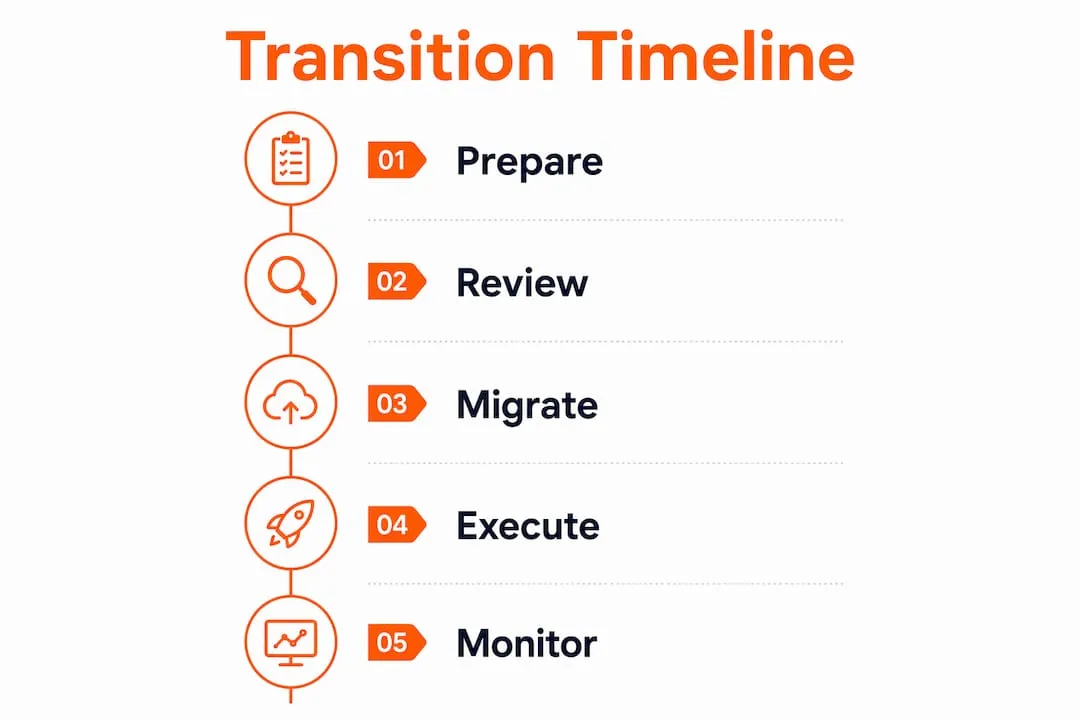
| Phase | Timeframe | Key Tasks |
|---|---|---|
| Contract audit | Days −30 to −25 | Review termination clause, notice method, commission tails |
| Account preparation | Days −25 to −15 | Confirm OTA ownership, secure co-host access, notify new manager |
| New system ready-state | Days −15 to −5 | Full PMS setup, listings live, pricing configured |
| Cutover | Day −5 to +7 | API switch, smart lock codes changed, cleaning team briefed |
| Stabilize | Days +7 to +30 | Monitor bookings, guest communications, financial reconciliation |
Beyond the timeline, these operational details require direct attention:
- Give written notice exactly as the contract specifies and keep a copy. Professional, factual, and documented.
- Coordinate confirmed bookings with both managers. The outgoing manager typically handles reservations with check-in dates before the transition; the incoming manager takes everything after.
- Change smart lock codes on transition day and send updated access instructions to the cleaning team immediately.
- Reconcile security deposits and financial accounts before the final handoff. Unresolved balances become disputes quickly.
- Switch during slow season. January through March gives your new manager months to optimize before peak revenue periods. A mid-summer switch means rebuilding during your highest-value weeks.
Reviewing operational workflow best practices before your cutover date helps you catch coordination gaps that generic checklists miss.
How Realtevoos helps you manage transitions and scale what comes next
Switching managers is the hard part. What you do with the operational clarity on the other side determines whether the switch actually pays off. Realtevoos is built for exactly this moment.
The platform consolidates your entire vacation rental operation into a single AI-powered command center, pulling real-time data from Airbnb, Vrbo, and other OTAs into one unified dashboard. During a management transition, that visibility is not a convenience. It is a control mechanism.
- Unified operations across properties: No more fragmented data spread across disconnected tools. Realtevoos tracks performance, bookings, and guest communications in one place.
- AI-driven automation: Property managers using Realtevoos report saving several hours per week through automated reporting and guest communication workflows.
- Transition visibility: Real-time OTA integration means you can monitor booking continuity and calendar accuracy during and after the cutover, not days later when damage is already done.
- Scalability built in: Traditional PMS platforms require significant manual overhead to manage portfolio growth. Realtevoos’s AI handles that overhead, letting you add properties without adding proportional labor.
The Realtevoos Command Center gives you the infrastructure to not just survive a management switch, but to perform better on the other side of it.
How to evaluate and select your next property management company
The most common mistake in a property management change is evaluating the new company the same way you evaluated the last one. A website and a pitch call are not due diligence. Ask these questions directly, and get answers in writing.
- Who owns the OTA listings? This is non-negotiable. Your listings must live on your host accounts with the manager as a co-host.
- What is the contract term and exit process? Monthly agreements with no lock-in are the standard to hold new managers to. If they require 12 months upfront, ask why.
- Which OTA channels are API-connected vs. iCal? Full API integration on Airbnb, Vrbo, and Booking.com is the baseline for any serious operator.
- How do they handle dynamic pricing? Static pricing leaves revenue on the table. Ask specifically what pricing tool they use and how frequently rates update.
- What does their local presence look like? For markets like Gulf Shores, understanding local compliance and vendor networks is as important as platform expertise.
- What are the full fee structures? Commission rates, maintenance markups, booking fees, and any onboarding charges should all be disclosed before you sign.
Monitoring performance after the switch is complete
The transition is not finished on cutover day. The first 30–60 days post-switch are when performance gaps surface, and catching them early is the difference between a successful change and a lateral move.
Track these metrics from day one with your new manager:
- Occupancy rate vs. prior period: Compare week-over-week and month-over-month against the same period under the previous manager.
- Average daily rate (ADR) and revenue per available night (RevPAN): These tell you whether pricing is working, not just whether the calendar is filling.
- Guest review scores and response times: A drop in review quality within the first 30 days signals a guest communication problem, not a seasonal anomaly.
- OTA search ranking position: Monitor your listing’s visibility on Airbnb and Vrbo. Post-migration ranking suppression should recover within 2–4 weeks if the API transition was clean.
- Booking lead time: If guests are booking closer to arrival than before, your new manager’s pricing or listing optimization may need adjustment.
Set a formal 30-day and 60-day performance review with your new manager. Define the metrics in advance, share them in writing, and hold the conversation regardless of whether results are positive or negative. Good managers welcome the structure.

Ready to take control of your vacation rental operation? Realtevoos gives you the AI-powered command center to monitor performance, automate communications, and scale your portfolio, whether you are mid-transition or building from a clean slate. Explore the platform and see what unified operations actually look like.
Key Takeaways
Switching property management companies successfully requires securing listing ownership, negotiating clean exit terms, and executing a staged technology migration before the cutover date.
| Point | Details |
|---|---|
| Confirm OTA ownership first | Verify you can log in as host on Airbnb and Vrbo before serving any termination notice. |
| Negotiate commission tails | Address legacy booking fees explicitly in your contract to avoid unexpected charges post-exit. |
| Stage your PMS migration | Run the new system in ready-state for 7–10 days before cutover to catch API sync errors early. |
| Time the switch for slow season | January through March gives your new manager months to optimize before peak revenue periods. |
| Monitor 30- and 60-day performance | Track occupancy, ADR, and review scores against prior-period benchmarks to catch gaps fast. |