The Role of Data in Property Management in 2026
Discover the role of data in property management by 2026. Learn how to unify data to enhance decision-making and boost operational efficiency.

The Role of Data in Property Management in 2026
You have dashboards, reports, channel data, and maintenance logs. Yet when a guest disputes a charge or a booking window looks off, you’re still digging through three separate systems to find the answer. That’s the disconnect the role of data in property management keeps exposing. 70% of commercial property managers say technology dashboards improved their business, yet only 7% report faster decisions and 6% report better outcomes. Having data is not the same as using it well. This article explains why that gap exists and how to close it.
Table of Contents
- Key takeaways
- The role of data in property management starts with one problem
- What centralized data actually changes
- Overcoming the real barriers to data integration
- Using data analytics to drive revenue and guest experience
- My honest take on why most property managers are still struggling
- See your entire portfolio from one place with Realtevoos
- FAQ
Key takeaways
| Point | Details |
|---|---|
| Fragmented data costs more than you think | Disconnected systems create blind spots that slow decisions and fuel lease disputes and guest conflicts. |
| Centralization multiplies data value | Unifying data into one platform can boost operational efficiency by 28% and speed up decisions by 35%. |
| Clean data comes before AI | Feeding AI tools dirty or fragmented data produces unreliable outputs that reduce trust across your team. |
| Predictive analytics changes the revenue game | With consolidated data, vacancy forecasting and lease renewal predictions reach up to 90% accuracy. |
| Integration barriers are mostly organizational | Technology exists to connect systems. The harder work is changing how teams share and own data. |
The role of data in property management starts with one problem
The real problem is not a lack of data. It’s that the data lives in too many places, maintained by too many people, in formats that refuse to talk to each other. A typical multi-property operator pulls reservation data from Airbnb, financial records from a spreadsheet, maintenance tickets from a separate work order system, and guest reviews from three different channels. None of these systems were designed to communicate with each other.
The operational consequences are significant. Manual reconciliation of records across these systems doesn’t just waste time. It introduces errors, and those errors compound fast. 62% of property managers identified inconsistent tenant data as a primary driver of lease disputes, which means the consequences of fragmented information show up directly in your owner relationships and guest experience.
Consider what happens when occupancy data doesn’t sync with your pricing tool in real time. You might hold a property at a rate that no longer reflects market demand, losing revenue for days before anyone catches it. Or worse, you double-book because availability wasn’t updated across channels fast enough. Manual duplicated efforts waste time and quietly drain portfolio value while your team handles problems that should never have occurred.
The core issues with fragmented data include:
- Blind spots in portfolio performance: No single view means important signals get missed until they become expensive problems.
- Slower response times: Maintenance escalations, guest complaints, and pricing adjustments all require pulling from multiple sources before acting.
- Forecasting errors: Incomplete data produces inaccurate projections, making revenue planning unreliable.
- Staff burnout: Teams spend hours reconciling records instead of managing relationships and improving guest experience.
What centralized data actually changes
When you consolidate your data into a single platform, the first thing that changes is speed. Organizations that centralize tenant data see a 28% increase in operational efficiency and make decisions 35% faster. That’s not a marginal improvement. That’s a structural shift in how your operation runs.
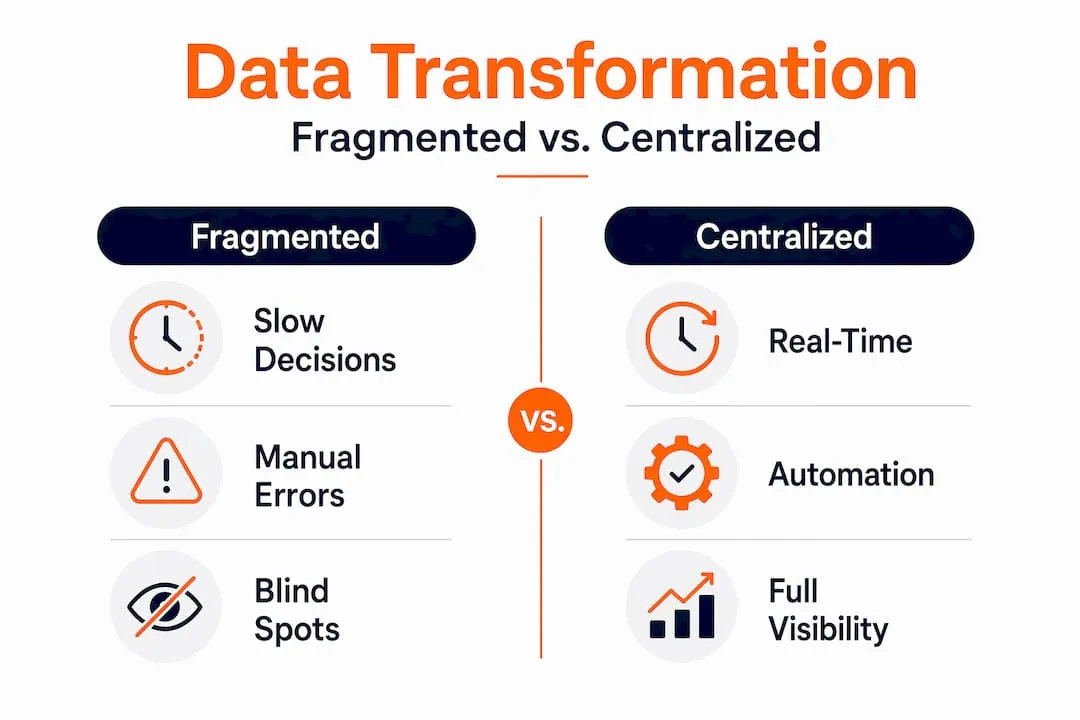
Here’s what changes when your data lives in one place versus several disconnected systems:
| Area | Fragmented data | Centralized data |
|---|---|---|
| Decision speed | Hours of manual lookups | Real-time dashboard access |
| Reporting accuracy | Reconciliation errors common | Single source of truth |
| Revenue forecasting | Based on incomplete signals | Full portfolio visibility |
| Maintenance tracking | Siloed work order systems | Unified escalation workflows |
| Owner reporting | Manual compilation, delayed | Automated, on-demand reports |
The role of data consolidation in property operations becomes clear when you look at owner reporting alone. Instead of spending two hours building a monthly report from five sources, your team generates it in minutes, with numbers that are accurate and current. Owners trust the data. Conversations shift from “why is this wrong?” to “what do we do next?”
Data consolidation also unlocks automation. When your data is clean and unified, you can set rules that trigger automatically. Guest check-in messages go out based on confirmed booking data. Maintenance tickets escalate based on response time thresholds. Pricing adjusts based on real-time occupancy signals. None of this is possible if your data is spread across systems that don’t communicate.

Pro Tip: Before you build any automation, map your current data sources and identify which system holds the most accurate version of each record. That system becomes your source of truth, and every integration flows from it.
Overcoming the real barriers to data integration
Most property management teams assume the hard part of data integration is technical. It usually isn’t. Cultural resistance and departmental data silos remain the biggest blockers, requiring change management alongside technology adoption. Teams that hoard their data because it gives them control over their domain, or because they distrust other departments’ records, actively slow down integration projects before the first API call is made.
Establishing your Property Management System as an immutable source of truth is not a technology decision. It’s an organizational commitment. Everyone from the leasing team to the maintenance crew has to agree that one system holds the authoritative record and that duplicating records elsewhere creates risk, not security.
Here’s a practical sequence for teams preparing to consolidate their data:
- Audit your current systems: List every platform, spreadsheet, and manual process that holds property, tenant, or financial data. Include informal ones like shared email inboxes and personal spreadsheets.
- Identify your authoritative records: For each data category, decide which system holds the cleanest, most reliable version. That’s your anchor.
- Clean before you migrate: Data cleaning and master data management is the critical first step before any migration or AI implementation. Garbage in, garbage out is not a cliché. It’s a daily operational reality for teams that skip this step.
- Choose your integration approach: Modern options include iPaaS platforms, low-code connectors, and no-code workflow tools. You do not need a developer for every connection.
- Establish governance rules: Define who owns each data type, who can edit it, and how conflicts get resolved. Without governance, a unified system slowly becomes as fragmented as what it replaced.
The AI readiness piece matters more than most teams realize. Many firms rush to deploy AI-driven pricing, guest communication, or predictive maintenance tools without cleaning legacy data first. The result is AI outputs that contradict reality, eroding your team’s trust in the technology before it ever had a fair chance.
Pro Tip: Run a 30-day data accuracy audit on your top five data fields, such as unit availability, nightly rate, and maintenance status, before connecting any AI tool to your stack. Fix what you find before you automate it.
Using data analytics to drive revenue and guest experience
Once your data foundation is solid, data analytics in property management shifts from reactive to predictive. And that shift changes your revenue ceiling. Knowing a property is underperforming after the fact is useful. Knowing it will underperform in three weeks, with enough time to adjust pricing, run a promotion, or reallocate resources, is transformational.
Predictive analytics can forecast lease renewals and vacancies with up to 90% accuracy. For a portfolio manager overseeing 50 or 100 units, that accuracy means you never get blindsided by a vacancy wave. You know it’s coming, and you fill it before it hits. That’s the role of data-driven decision making in property management at its most practical.
The specific areas where consolidated data creates measurable gains include:
- Dynamic pricing: Real-time market and occupancy data powers pricing models that adjust rates based on demand signals, local events, and competitor movement. Static rate cards are a significant revenue liability by comparison.
- Tenant and guest screening: Centralized history across your portfolio lets you identify patterns in guest behavior, flag high-risk bookings earlier, and personalize communication based on past interactions.
- Asset performance monitoring: Real-time dashboards surface properties that are lagging on occupancy, generating disproportionate maintenance costs, or underpriced relative to their market.
- Retention modeling: Using guest satisfaction scores, repeat booking rates, and complaint history together gives you a clear picture of which guests are worth targeting for direct booking incentives.
Legacy monthly financial consolidation cycles create data lags of nearly a month, which makes decisions in volatile environments dangerously slow. Real-time integrated data removes that lag entirely. You see the revenue picture today, not 28 days later.
For operators managing properties across multiple channels and markets, this visibility is the difference between scaling confidently and scaling blindly. Accuracy in your operational data also reduces waste and rework across vendor relationships and supply management, which compounds the financial benefit over time.
My honest take on why most property managers are still struggling
I’ve spoken with dozens of property management teams over the years, and the pattern is almost always the same. They invested in a shiny new tool, maybe a pricing engine or an AI assistant, and then wondered why the outputs felt unreliable. When you dig in, the answer is always the same: the data underneath was a mess.
What I’ve learned is that the technology is almost never the problem. The problem is trusting tools you haven’t earned the right to trust yet. You earn that trust by doing the unglamorous work first. Cleaning records. Deciding who owns what data. Getting your team aligned on a single source of truth. It’s not exciting work. But it’s the work that determines whether your analytics actually tell you something real.
Here’s what I think gets missed in most articles on this topic. Data consolidation is not a technology project. It’s a trust project. When your team trusts the numbers, they use them. When they don’t, they work around them, creating the exact shadow spreadsheets and informal workarounds that fragment your data all over again. Independent operators can compete directly with larger firms through transparency and data-driven operations, not by out-spending them on tools.
The firms I’ve seen get this right share one trait. They started simple. One source of truth. Clean records. Then they added complexity. That sequencing is not optional. It’s the whole game.
— Jose
See your entire portfolio from one place with Realtevoos

If this article surfaces a gap between the data you have and the decisions you need to make, Realtevoos was built specifically to close it. The Realtevoos platform pulls data from Airbnb, Vrbo, and your other channels into a single dashboard, giving you real-time visibility into revenue, occupancy, maintenance, and guest satisfaction across every property you manage. Automated owner reporting, AI-driven guest communication, and maintenance escalation workflows all run from the same unified data layer. There’s no replacing your existing systems. Realtevoos connects to them. If you’re ready to stop reconciling and start deciding, explore what the platform can do for your operation.
FAQ
What is the role of data in property management?
Data in property management supports faster decisions, accurate revenue forecasting, and better guest experiences. Its value depends entirely on the quality and accessibility of that data across your operation.
Why does centralized data matter for property managers?
Centralized data eliminates the blind spots created by disconnected systems, reducing errors and giving your team a single reliable source to work from. Organizations that centralize see up to 28% better operational efficiency and 35% faster decision-making.
How does data analytics improve revenue management?
Data analytics enables dynamic pricing based on real-time occupancy and market signals, and predictive models can forecast vacancies with up to 90% accuracy, allowing proactive adjustments before revenue is lost.
What are the biggest barriers to data integration in property management?
Cultural resistance and departmental silos are typically harder to address than the technical challenges. Without organizational alignment on data ownership, even the best integration tools will underperform.
Should property managers adopt AI before fixing their data?
No. AI tools applied to fragmented or unclean data produce unreliable outputs that damage team trust in the technology. Clean, consolidated data must come first for AI to deliver real value.