The Role of Owner Reporting in Property Management
Discover the vital role of owner reporting in property management. Unlock strategic insights and enhance your investment decisions today!

The Role of Owner Reporting in Property Management
Owner reporting is not a formality. For property owners and investors, it represents the primary lens through which you assess the health of your asset, verify your manager’s fiduciary performance, and make forward-looking investment decisions. Yet the role of owner reporting in property management is routinely misunderstood as a simple monthly PDF or a brief income summary. That framing leaves real money, compliance protection, and strategic clarity on the table. This article breaks down what effective owner reporting actually entails and why getting it right is one of the highest-leverage things you can do as a property owner.
Table of Contents
- Key Takeaways
- The role of owner reporting in property management
- Common pitfalls in traditional owner reporting
- Reporting as a strategic and fiduciary tool
- How automation changes owner reporting
- Practical steps to improve your owner reporting
- My take on why most owners are underserved by reporting
- How Realtevoos makes owner reporting work at scale
- FAQ
Key Takeaways
| Point | Details |
|---|---|
| Reporting is a fiduciary tool | Audit-ready reports with trust ledgers protect owners from regulatory and valuation risk. |
| Most reports are underpowered | Only a fraction of managers provide market rent comparisons that owners actually want. |
| Narrative context matters | Explanatory commentary in reports significantly reduces owner anxiety and unnecessary calls. |
| Automation changes the equation | Technology eliminates manual report creation hours while improving accuracy and timeliness. |
| Reporting drives retention | Proactive, transparent reporting is one of the strongest retention tools in owner relations. |
The role of owner reporting in property management
At its core, owner reporting is the structured delivery of financial, operational, and compliance data about a managed property to its owner. But that definition undersells what quality reporting actually contains and what it should accomplish.
A complete owner report covers several layers of detail:
- Income and expense statements showing gross rents collected, management fees, maintenance charges, and net income
- Beneficiary trust ledgers that document how owner funds are held, disbursed, and reconciled
- Trust account reconciliation reports confirming that the manager’s bank records match property-level accounting
- Occupancy and leasing status updates including vacancies, renewals, and upcoming lease expirations
- Reserve fund balances so you can track cash set aside for major repairs
- Maintenance logs with line-item detail and vendor invoices attached
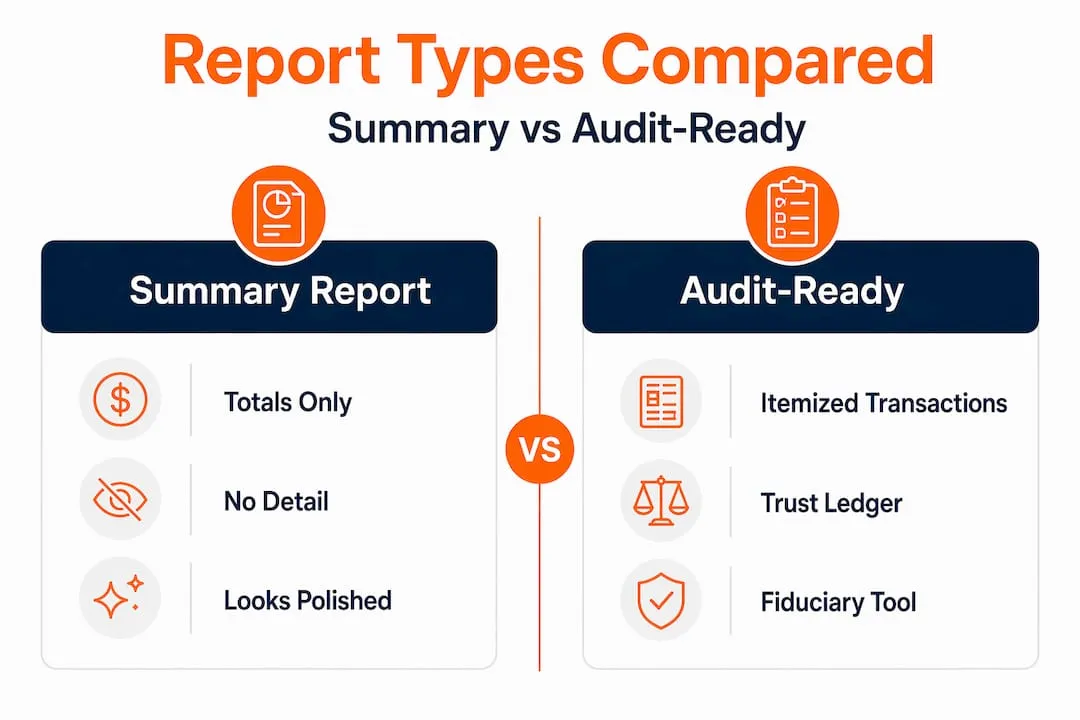
There is an important distinction between a summary report and an audit-ready report. A summary gives you a clean top-line view. An audit-ready report means beneficiary ledgers and reconciliations are producible the same business day without manual reconstruction. That distinction matters enormously if you are ever audited, seeking financing, or selling the asset.
What owner reporting is not: a polished PDF that shows total income and total expenses without transaction-level support. That type of presentation-only document is common but leaves you unable to verify the underlying math or challenge a discrepancy. Incomplete or cosmetic reporting exposes owners to regulatory and valuation risks tied to unverifiable income and trust accounting failures.
Pro Tip: Ask your property manager for a sample trust ledger before signing a management agreement. If they cannot produce one quickly, that is a signal about how they run their books.
Common pitfalls in traditional owner reporting
The gap between what owners need and what they typically receive is significant. Understanding why helps you push for better.
Manual report creation is the first problem. For a portfolio of 200 units, building reports by hand consumes 8 to 15 hours per month. That time cost pressures managers to simplify or abbreviate, and the shortcuts land squarely on your statement. You get less detail, less context, and more chances for transcription errors.

The content gap is equally telling. 62% of property owners want market rent comparisons included in their monthly reports. Only 18% of managers using manual processes actually provide them. That means most owners have no way to know whether their property is priced competitively without doing their own research outside the report.
Timing is another chronic problem. Owners typically receive distributions 20 to 25 days after rent is due, after rent collection, reconciliation, and statement generation cycles complete. When reports arrive late or without explanation, that silence fuels anxiety. You do not know if a maintenance charge is routine or a sign of a larger issue. You do not know if your occupancy is trending down or just seasonally soft.
The absence of forward-looking information is perhaps the most costly gap. Most reports look backward. They tell you what happened last month. They do not tell you about the lease expiring in 60 days, the reserve fund dropping below target, or how your vacancy rate compares to the local market. Without that forward view, you are always reacting rather than planning.
Reporting as a strategic and fiduciary tool
Most owners think of reporting as a record-keeping function. In reality, monthly reports serve as both communication tools and compliance verification instruments. That dual role has serious consequences when reports are delayed or incomplete.
From a compliance standpoint, trust accounting is regulated in nearly every U.S. state. Your property manager holds your funds in a trust account, and they are legally obligated to account for every dollar. Reports that include running trust ledgers and reconciled balances are not just good practice. They are how you verify that your manager is meeting their fiduciary obligation to you.
“Owners want reporting as a tool to decide where to deploy capital, protect value, and when to exit an asset — not just historical data.” This framing, drawn from investment-grade reporting standards, should be the benchmark every property owner applies to their own statements.
The retention dimension is equally real. Owner reporting is a primary retention and fiduciary tool for property management firms. Owners who receive detailed, narrative-rich reports ask fewer questions, file fewer complaints, and renew management contracts at higher rates. That dynamic benefits you too. A manager who invests in quality reporting is signaling a long-term relationship orientation, not a transactional one.
The industry is also shifting toward an owner-centric model where property managers act as performance advisors, using reporting as the primary vehicle for demonstrating ROI. That shift is good for owners who demand it. For owners who accept whatever they are sent, the old transactional model persists.
Pro Tip: Request that your manager include a written variance explanation for any line item that differs by more than 10% from the prior month. That single requirement will transform your reporting from a data dump into a decision-making tool.
How automation changes owner reporting
Technology is reshaping what owner reporting can deliver without adding hours of manual labor. The key shift is automated data aggregation: pulling financials directly from accounting software, bank feeds, and property management systems into a single report without human transcription. That eliminates the errors that come from copying numbers between spreadsheets.
Here is how automated reporting compares to manual approaches:
| Feature | Manual reporting | Automated reporting |
|---|---|---|
| Time to generate | 8-15 hours/month per 200 units | Minutes per portfolio |
| Error rate | Higher due to manual entry | Significantly lower |
| Market rent comparisons | Rarely included | Can be generated automatically |
| Narrative context | Inconsistent or absent | Generated from data patterns |
| Report delivery timing | Often delayed | Scheduled, on-demand |
| Trust ledger availability | Requires manual reconstruction | Available same business day |
Beyond speed and accuracy, automation enables narrative generation. Narrative context that explains variances and upcoming needs in owner reports significantly reduces owner anxiety and repetitive phone calls. Instead of seeing a $2,400 HVAC charge with no explanation, you receive a note that the unit required compressor replacement ahead of summer, with a comparison to the average cost for that repair type in your market.
Automation also makes customization viable. Owners have different preferences: some want weekly summaries, others want quarterly deep dives. Some want PDF statements, others want dashboard access. A manual process cannot serve those preferences at scale. Automated platforms can deliver custom report templates and owner preferences without adding management overhead.
The impact on owner churn is measurable. Automated, contextual owner reporting leads to significantly reduced owner churn by improving transparency and proactive communication. That is a direct financial benefit for property management firms, and a direct signal to you as an owner about which managers are investing in the relationship.
Practical steps to improve your owner reporting
Whether you manage your own properties or work with a third-party manager, these steps will sharpen the quality of reporting you rely on.
-
Audit your current reports. Pull the last three months of statements. Check whether they include a trust ledger, a reconciliation report, and a reserve fund balance. If any of those are missing, that is your starting conversation.
-
Set reporting standards in writing. Your management agreement should specify report contents, delivery dates, and the format of trust account reconciliations. Verbal expectations get lost. Written standards create accountability.
-
Request a running reserve balance. Including a running reserve balance alongside monthly statements helps clarify cash flow and prevents confusion during high maintenance expense months. If your manager does not include this, ask them to add it.
-
Ask for market rent comparisons. This single addition gives you context for pricing decisions and vacancy risk. If your manager cannot provide it, that is a gap worth solving with technology.
-
Establish a communication cadence. Monthly reports are the baseline, but proactive communication should not wait for a report cycle. Ask your manager to notify you immediately when a maintenance expense exceeds a threshold you define.
-
Evaluate technology-enabled managers. If your current manager relies entirely on manual reporting processes, ask what tools they use and whether they plan to upgrade. The quality of your reporting is a direct reflection of their operational investment.
Pro Tip: When evaluating a new property manager, ask specifically whether their reports are audit-ready the same business day. That question alone separates managers with real accounting infrastructure from those who are winging it.
My take on why most owners are underserved by reporting
I’ve spent years watching the gap between what owners need from reporting and what they actually receive. The uncomfortable truth is that most property managers treat reporting as an obligation rather than an opportunity. They produce the minimum required, call it a statement, and move on. What I’ve seen is that owners who accept that standard pay for it in ways they cannot always trace directly: missed rent increases, undetected trust account mismanagement, and a generalized sense of being out of control with their own asset.
The risk that worries me most is trust accounting failure. Owners rarely catch it until the damage is done, and by then the recovery is expensive and sometimes impossible. Audit-ready reports with same-day ledger availability are the only real defense against that exposure. Most owners do not even know to ask for this.
What I find genuinely encouraging is the automation shift. Not because technology is exciting as a concept, but because it removes the excuse that good reporting is too expensive or time-consuming to produce. When a platform can generate a narrative-rich, trust-ledger-backed owner statement in minutes, the barrier is gone. The managers who are not doing this in 2026 are making a choice, not facing a constraint.
My advice is direct: treat your monthly reports the way you would treat a quarterly audit. Read them with that level of scrutiny, ask questions about anything that does not make sense, and insist on the trust ledger detail. The owners who do this do not get surprised.
— Jose
How Realtevoos makes owner reporting work at scale
If you manage vacation rentals across multiple properties and you are still spending hours assembling reports from disconnected tools, Realtevoos is built specifically for this problem. The platform consolidates your operational data from Airbnb, Vrbo, and your accounting system into a single dashboard, then generates owner statements automatically with narrative context included. You get audit-ready reports without the manual reconstruction. Your owners get clear, timely communication that reduces their anxiety and your inbox volume. Property managers using Realtevoos report saving several hours per week on reporting alone, with the added benefit of fewer owner calls and stronger retention. If owner reporting is where your operation leaks time and trust, this is where you fix it.
FAQ
What is owner reporting in property management?
Owner reporting is the structured delivery of financial, operational, and compliance data to property owners by their property manager. It typically includes income and expense statements, trust ledgers, reconciliation reports, and occupancy updates.
What should a complete owner report include?
A complete report should include itemized income and expenses, a beneficiary trust ledger, a reconciled trust account balance, a running reserve fund balance, and a maintenance log with supporting invoices.
Why is trust ledger reporting so important?
Trust ledger reporting is how you verify that your property manager is handling your funds correctly and in compliance with state regulations. Without it, you cannot detect mismanagement or pass an audit.
How often should property owners receive reports?
Most property management standards call for monthly reports, with distributions typically arriving 20 to 25 days after the rent due date. Some owners benefit from weekly summaries depending on portfolio size.
How does automation improve owner reporting quality?
Automated reporting eliminates manual data entry errors, enables same-day report generation, and adds narrative context that explains variances. Automated contextual reporting also reduces owner churn by improving transparency and communication consistency.