Vacation Rental Data Consolidation: 2026 Guide for Managers
Discover what vacation rental data consolidation is and how it streamlines operations for managers. Unify your data for better efficiency!

Vacation Rental Data Consolidation: 2026 Guide for Managers
Vacation rental data consolidation is the process of unifying fragmented property, reservation, and financial data from multiple systems into a single, accessible platform. Property managers running portfolios across Airbnb, Vrbo, and direct booking channels deal with data scattered across property management systems (PMS), channel managers, dynamic pricing tools, and accounting software. Without a unified view, 48% of finance teams’ time gets consumed by manual reporting tasks that consolidation eliminates. The industry term for this practice is data integration, and understanding both the concept and the tools behind it is what separates managers who scale from those who stall.
What is vacation rental data consolidation and why does it matter?
Vacation rental data consolidation is defined as the systematic aggregation of operational, financial, and guest data from disconnected sources into one centralized system. The goal is a single source of truth: one place where occupancy rates, revenue figures, maintenance logs, and guest communications all live together and update in real time.
The problem it solves is data fragmentation. A manager running 20 properties across three platforms might pull reservation data from Airbnb’s dashboard, financial summaries from QuickBooks, and pricing performance from a tool like PriceLabs. None of these systems talk to each other natively. The result is hours of manual reconciliation, reporting errors, and decisions made on stale numbers.
Siloed data creates inconsistent revenue interpretations across departments and properties. When your operations team sees different occupancy figures than your owners do, trust erodes fast. Consolidation removes that ambiguity by giving every stakeholder access to the same verified data set.
For multi-property managers specifically, the efficiency gains compound quickly. Consolidated data management for vacation rentals reduces the time spent generating owner reports, reconciling booking fees, and tracking maintenance costs across properties from hours to minutes.
What data sources are typically consolidated in vacation rental management?
Most vacation rental businesses generate data across at least five distinct system categories, each with its own format, update frequency, and output type.
- Property Management Systems (PMS): Platforms like Guesty, Hostaway, or Lodgify store reservation records, guest profiles, and housekeeping schedules. They are the operational backbone.
- Channel managers: Tools that distribute listings across Airbnb, Vrbo, Booking.com, and direct booking sites. They track availability and rates but rarely store financial detail.
- Dynamic pricing tools: Software like PriceLabs or Wheelhouse generates rate recommendations based on market demand. Their data is forward-looking and time-sensitive.
- Accounting software: QuickBooks or Xero holds the financial record of truth, including owner payouts, expense tracking, and tax data.
- Guest communication platforms: Tools like Hospitable manage messaging, reviews, and automated responses. They hold sentiment data that rarely gets analyzed.
Manual syncing vs. real-time API integration
The method used to connect these systems determines the quality of the consolidated data. iCal sync is limited to one-way or basic two-way availability blocking and cannot carry financial or guest data. In high-volume portfolios, iCal reliance causes lag, double bookings, and pricing discrepancies.
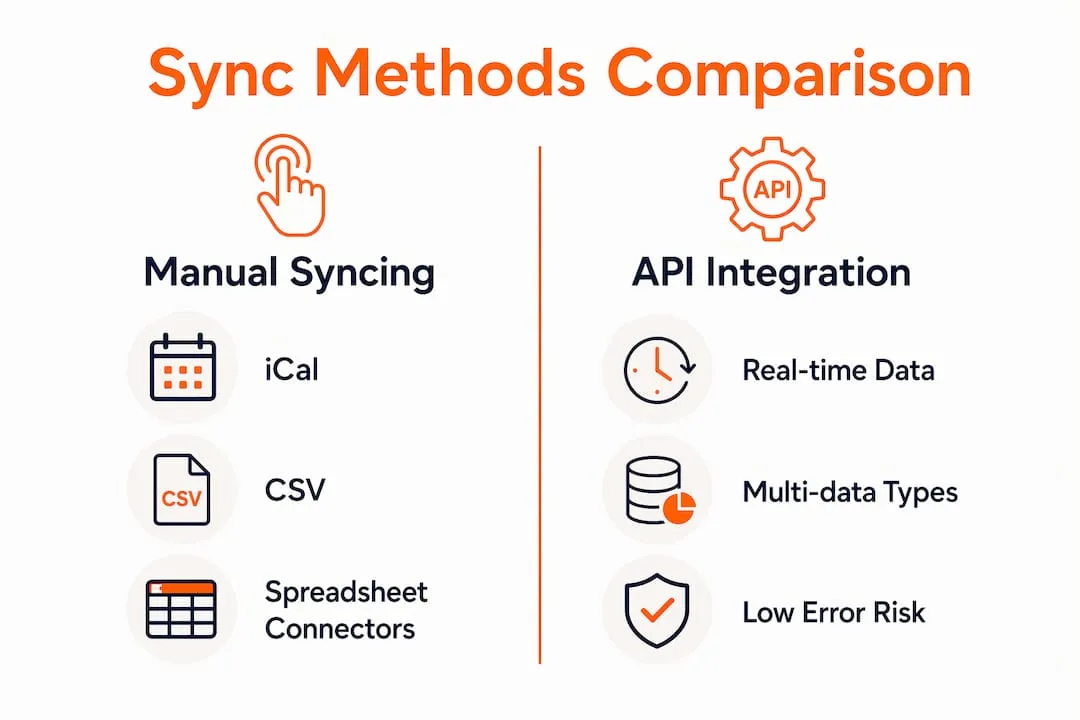
CSV exports are a step up but still manual. A manager exports a report, reformats it, and uploads it elsewhere. By the time the data lands, it is already outdated.
Real-time API integration is the standard for serious consolidation. APIs push reservation updates, rate changes, and financial transactions between systems the moment they occur. The difference in data freshness between iCal and API is the difference between yesterday’s weather report and a live radar.

| Sync Method | Data Types Supported | Update Speed | Error Risk |
|---|---|---|---|
| iCal | Availability only | Hours to days | High (double bookings) |
| CSV/Spreadsheet | Financial, reservations | Manual, delayed | Medium (human error) |
| API Integration | All data types | Real time | Low (automated) |
Spreadsheet connectors still make sense for small operators with two or three properties and low transaction volume. Once a portfolio exceeds ten properties or spans multiple platforms, manual methods become a liability, not a workflow.
How does data consolidation improve operational efficiency and decision-making?
The operational case for consolidation is direct. Organizations implementing data consolidation see 15 to 20% higher operational efficiency and reduce data engineering labor by four to five times. For a property manager spending ten hours a week on reporting, that is a meaningful recovery of time that goes back into guest experience and portfolio growth.
“A unified data environment cuts month-end close cycles from weeks to days and gives managers the financial clarity to make pricing decisions in hours, not after the fact.”
The specific benefits break down across three areas:
- Financial accuracy: Consolidated data eliminates the reconciliation gap between what channel managers report and what accounting software records. Month-end closes become faster and cleaner.
- Portfolio-level visibility: Instead of logging into five dashboards, managers see occupancy, revenue per available night, and maintenance costs across every property in one view. This is where multi-property reporting becomes genuinely useful rather than just a feature checklist.
- Owner relations: Owners who receive consistent, accurate monthly reports built from a single data source are less likely to question figures or request manual reconciliations. A single source of truth prevents the misalignment that damages owner trust.
- Real-time pricing decisions: When occupancy data, competitor rates, and booking pace all feed into one system, managers can adjust pricing with confidence rather than guesswork.
The strategic advantage is compounding. Managers who consolidate data early build the analytical foundation needed to scale. Those who delay find that adding properties multiplies their manual workload rather than their revenue.
What are the best practices for consolidating vacation rental data?
The most common mistake in vacation rental data integration is attempting to consolidate every system at once. A phased approach prevents overwhelm and dramatically improves adoption success across teams.
- Start with your highest-pain data source. For most managers, that is the gap between channel manager reservation data and accounting records. Solve that first before connecting pricing tools or communication platforms.
- Audit your data quality before connecting systems. Duplicate listings and inconsistent property attributes distort reporting accuracy. If your PMS has a property listed as “Beach House Unit 2” and your accounting software calls it “Property 14B,” consolidation will create two records instead of one clean entry.
- Establish data governance rules. Decide which system is the master record for each data type. Reservations live in the PMS. Financial records live in accounting software. Rates are owned by the channel manager. Document this and enforce it.
- Automate before you analyze. Manual data pulls should be replaced with automated API connections before you invest in analytics dashboards. Analyzing manually compiled data defeats the purpose of consolidation.
- Validate outputs against known benchmarks. After connecting systems, run your consolidated reports against your previous manual reports for the same period. Discrepancies reveal data mapping errors that need fixing before the system goes live.
Pro Tip: When cleaning data before consolidation, standardize property naming conventions across every platform first. This single step eliminates the majority of duplicate records and mapping errors that cause reporting failures downstream.
Data governance is not a one-time setup. It requires quarterly reviews as platforms update their APIs, change data field names, or introduce new booking categories. Assign one person on your team ownership of data quality. Without accountability, dirty data creeps back in within months.
What technical methods and tools support vacation rental data consolidation?
The technical architecture behind vacation rental data consolidation has shifted significantly toward ELT pipelines. Traditional ETL (Extract, Transform, Load) processes transformed data before loading it into storage, which created bottlenecks when source formats changed. ELT pipelines load raw data into a data warehouse first, then apply transformations. This means you can re-run transformations without re-fetching data from the source API, which is critical when Airbnb or Vrbo changes their data structure.
Data warehouses and cloud storage
Data warehouses unify diverse datasets into repositories optimized for reporting and high-volume analysis. Cloud-based options like Google BigQuery, Amazon Redshift, and Snowflake are common in enterprise vacation rental operations. For smaller operators, a well-configured PMS with strong API connectivity often serves as a functional equivalent without the infrastructure overhead.
Vacation rental APIs as the integration layer
APIs synchronize reservations, rates, and financials in real time across PMS, channel managers, accounting, and analytics tools. The key distinction is between one-directional APIs (which push data one way) and bidirectional APIs (which allow both systems to read and write). Bidirectional APIs are required for true consolidation because they keep all connected systems in sync simultaneously.
| Technical Method | Best For | Complexity | Cost Range |
|---|---|---|---|
| iCal / CSV | Solo operators, 1-5 properties | Low | Free to low |
| One-way API | Channel distribution | Medium | Moderate |
| Bidirectional API | Full data consolidation | High | Moderate to high |
| ELT + Data Warehouse | Enterprise portfolios | Very high | High |
Pro Tip: Before selecting a vacation rental analytics tool, verify that it offers bidirectional API connections to your existing PMS. One-way integrations create data gaps that require manual reconciliation, which eliminates the efficiency gains consolidation is supposed to deliver.
Automation is the payoff. Once API connections are live and data governance rules are in place, reporting that previously took a team member half a day runs automatically. Managers working with centralized rental data report reclaiming several hours per week that previously went to manual data pulls and report formatting.
Key takeaways
Vacation rental data consolidation delivers its full value only when built on real-time API connections, clean source data, and a phased implementation that prioritizes the highest-impact integrations first.
| Point | Details |
|---|---|
| Define your single source of truth | Assign one master system for each data type before connecting platforms. |
| Replace iCal with API connections | iCal cannot carry financial or guest data and causes lag in high-volume portfolios. |
| Start with the highest-pain gap | Consolidate the channel manager to accounting link first for immediate financial accuracy gains. |
| Clean data before connecting | Duplicate listings and inconsistent naming conventions corrupt consolidated reports from day one. |
| Use ELT for scalable architecture | ELT pipelines allow flexible re-transformation without re-fetching API data as platforms evolve. |
Why most managers underestimate what consolidation actually requires
I have worked with property managers who believed consolidation meant connecting their PMS to a reporting dashboard and calling it done. That misunderstanding is expensive. What they built was a prettier version of the same fragmented data problem, just with a nicer interface on top.
The real work in vacation rental data integration is not technical. It is organizational. Deciding which system owns which data type, getting your team to stop maintaining parallel spreadsheets, and convincing owners that the new report format is more accurate than the one they have been reading for three years. Those are the actual friction points.
The managers I have seen succeed with consolidation share one habit: they treat data quality as an ongoing operational responsibility, not a setup task. They review their data pipelines quarterly, flag anomalies in consolidated reports immediately, and update their governance rules when platforms change their APIs. The ones who treat it as a one-time project find themselves back to manual reconciliation within a year.
The other thing worth saying directly: you do not need enterprise infrastructure to consolidate effectively. A well-configured PMS with strong bidirectional API connections to your accounting software and channel manager covers 80% of what most managers actually need. The data-driven approach that scales portfolios is not about having the most sophisticated stack. It is about having a reliable one.
— Jose
How Realtevoos centralizes your vacation rental data

Realtevoos is built specifically for vacation rental property managers who need consolidated operational control without building a custom data stack. The platform connects directly to Airbnb, Vrbo, and leading PMS platforms, pulling reservation data, financial records, and performance metrics into a single dashboard that updates in real time. Property managers using Realtevoos report saving several hours each week previously spent on manual reporting and owner communication. If you manage multiple properties and want a unified operational platform that replaces fragmented dashboards with one source of verified data, Realtevoos is built for exactly that use case.
FAQ
What is vacation rental data consolidation?
Vacation rental data consolidation is the process of aggregating data from systems like PMS platforms, channel managers, and accounting software into one unified system. The goal is a single, accurate data source that supports real-time reporting and decision-making.
What is the difference between iCal sync and API integration?
iCal sync only transfers availability data and introduces delays of hours to days, while API integration transfers all data types including financials and guest records in real time. High-volume portfolios relying on iCal face double booking risks and pricing discrepancies.
How do I start consolidating vacation rental data?
Start by identifying your highest-pain data gap, typically the disconnect between channel manager reservations and accounting records, and connect those two systems via API first. Clean your data for duplicates and naming inconsistencies before connecting any systems.
What is an ELT pipeline and why does it matter for vacation rentals?
An ELT pipeline loads raw data into a warehouse before transforming it, which allows re-running transformations without re-fetching source data when platforms update their APIs. This makes consolidation more resilient as Airbnb, Vrbo, and other platforms evolve their data structures.
What are the main benefits of data consolidation for property managers?
The primary benefits include faster month-end financial closes, portfolio-level performance visibility, and consistent owner reporting from a single verified data source. Organizations that consolidate data see 15 to 20% higher operational efficiency compared to those relying on manual reporting methods.