Vacation rental intelligence: maximize revenue and efficiency
Discover what vacation rental intelligence is and how it can boost your revenue and efficiency. Transform data into actionable insights today!

Vacation rental intelligence: maximize revenue and efficiency
Most vacation rental operators believe their experience and gut instinct are enough to stay competitive. They’ve managed dozens of properties, they know their market, and they’ve built workflows that seem to work. But when revenue plateaus, occupancy dips unexpectedly, or a competitor pulls ahead without an obvious reason, intuition offers no real answers. Vacation rental intelligence changes that equation entirely. It replaces guesswork with a structured decision system built on real data, turning raw numbers from your properties and the broader market into actions you can take today.
Table of Contents
- Defining vacation rental intelligence
- Core methodologies: KPIs and revenue management
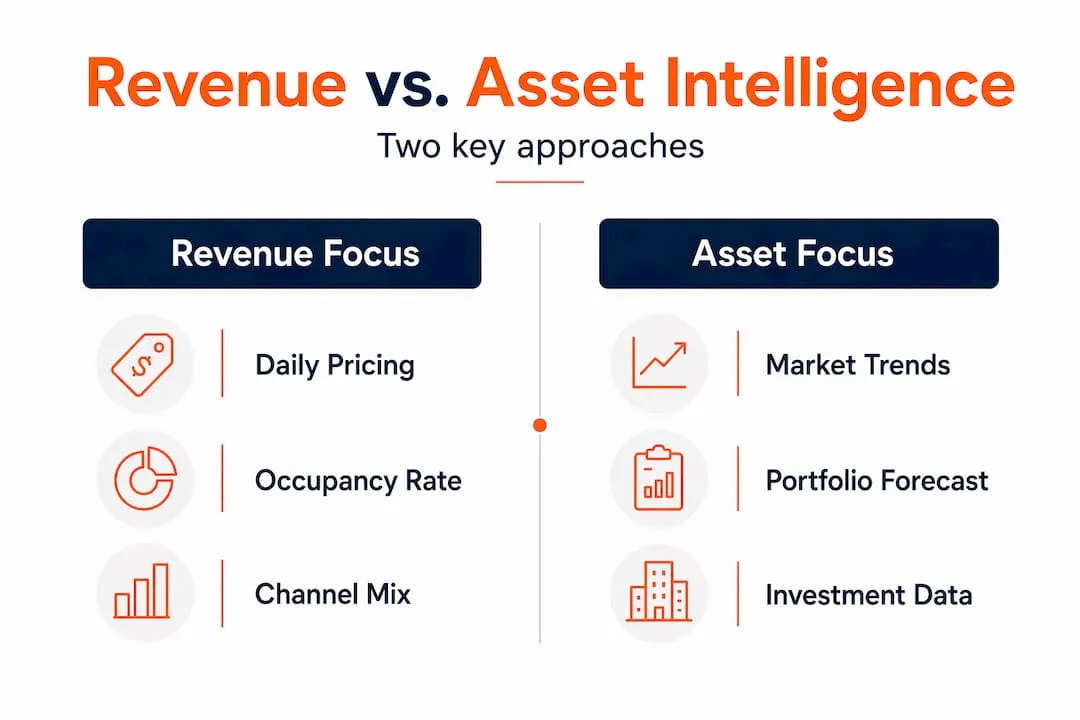
- Market and asset intelligence: Beyond day-to-day operations
- Nuances and challenges: Data calibration and benchmarking
- Our take: What most vacation rental operators overlook
- Next steps: Transform your operation with vacation rental intelligence
- Frequently asked questions
Key Takeaways
| Point | Details |
|---|---|
| Actionable decision system | Vacation rental intelligence turns data into real decisions on pricing, operations, and revenue. |
| Core KPIs drive results | Metrics like ADR, occupancy, and RevPAR are pillars of effective revenue management. |
| Calibration is critical | Platforms need time and quality inputs for benchmarking accuracy and pricing optimization. |
| Strategic asset forecasting | Intelligence tools forecast property performance to guide investment and portfolio growth. |
| Integration matters | The value of intelligence depends on fresh, integrated data from PMS and market sources. |
Defining vacation rental intelligence
Now that we’ve set the stage, let’s clarify what vacation rental intelligence actually means — because it is not just a fancier word for “analytics.”
Vacation rental business intelligence is defined as “the practice of collecting, integrating, and analyzing data about your properties and the competitive market to produce actionable insights for decisions like pricing, revenue management, distribution/channel strategy, and operational planning.” That definition matters. Notice the emphasis on actionable insights and decisions, not just charts or reports.
The distinction between a dashboard and a decision system is where most operators get confused. A dashboard shows you what happened. A decision system tells you what to do next. Both use data, but only one drives outcomes. Vacation rental intelligence sits firmly in the second category, and the gap between the two is wider than most people realize.
“A chart that shows last month’s occupancy rate is useful. A system that tells you to lower your minimum stay for a specific week because demand is softening in your comp set is powerful.”
Here are the core data sources that feed a true vacation rental intelligence system:
- Property management system (PMS) exports: reservation history, cancellation rates, length of stay patterns, and cleaning schedules
- Booking channel data: performance metrics from Airbnb, Vrbo, Booking.com, and direct booking channels, including conversion rates and visibility scores
- Guest communication data: response times, review sentiment, and repeat booking signals
- Market trend data: competitor pricing, local event calendars, search demand signals, and macroeconomic travel indicators
When these inputs are integrated and interpreted together, the outputs look very different from a simple monthly report. You get KPIs that move with the market, dashboards that flag anomalies before they become problems, and pricing signals that reflect real demand — not last year’s assumptions. Effective vacation rental decision systems connect all these inputs into a single operational view, making intelligence accessible across your entire portfolio.
For operators managing vacation rental property management at scale, the difference between basic analytics and a true intelligence system is often the difference between reactive management and proactive growth.
Core methodologies: KPIs and revenue management
With a definition in place, it’s time to look at the core methods that power vacation rental intelligence.
The foundation of any intelligence system is the right set of KPIs. The three most critical for vacation rental revenue management are:
- ADR (Average Daily Rate): the average revenue earned per booked night
- Occupancy rate: the percentage of available nights that are booked over a given period
- RevPAR (Revenue Per Available Room/night): ADR multiplied by occupancy rate, giving a single metric that captures both pricing power and booking volume
KPI-based revenue management combines these metrics with demand signals like pacing (how quickly future dates are filling up compared to the same period last year) and competitor or “comp set” comparisons to drive dynamic pricing decisions. Pacing is particularly powerful because it gives you a forward-looking view rather than a rearview mirror snapshot.
Here is a clear comparison between static snapshots and market-aware analytics:
| Feature | Static snapshot | Market-aware analytics |
|---|---|---|
| Data frequency | Monthly or weekly | Real-time or near real-time |
| Pricing signal | Fixed rate calendar | Dynamic, demand-adjusted rates |
| Comp visibility | Manual research | Automated comp set monitoring |
| Forecasting | Backward-looking | Forward-looking pacing curves |
| Decision speed | Days to act | Hours or automated |

The advantage of market-aware analytics becomes obvious when you look at real scenarios. Imagine a local festival is announced two months out. A static system won’t catch the demand spike until it’s already past. A market-aware intelligence platform flags the pacing acceleration immediately, allowing you to adjust minimum stays, raise rates, and capture that demand before your competitors do.
Here’s a sequential process for setting data-driven pricing using dynamic pricing strategies and advanced vacation rental KPIs:
- Establish your baseline KPIs using at least 12 months of historical PMS data, segmented by property type, season, and market.
- Define your comp set by identifying properties in your market with similar amenities, guest capacity, and location profiles.
- Set demand triggers for pacing thresholds that prompt automatic or manual rate adjustments.
- Implement a rate floor and ceiling to prevent algorithmic pricing from moving outside acceptable revenue bands.
- Review performance weekly, not monthly, comparing actual vs. expected occupancy at the property and portfolio level.
- Refine inputs quarterly based on new market data, competitor moves, and seasonal pattern shifts.
Pro Tip: Regularly calibrate your baseline inputs every 60 to 90 days. Markets shift faster than most operators expect, and stale inputs produce misleading signals that quietly erode your revenue performance.
Market and asset intelligence: Beyond day-to-day operations
While revenue management is the day-to-day focus, intelligence is essential for strategic asset decisions, too.
Vacation rental intelligence can also be delivered as market and asset intelligence for investment decisions, combining historical booking trends, seasonality, and comparable rental data to forecast property performance and generate underwriting outputs. This application is especially relevant for operators managing growing portfolios or evaluating new markets.
Think of a property manager considering adding five new units in a coastal market they have limited experience with. Without intelligence tools, that decision relies on hearsay, broker projections, or rough back-of-envelope estimates. With proper asset intelligence, they can model expected RevPAR by season, benchmark against comparable active listings, and stress-test occupancy scenarios before a single dollar is committed.
Here’s a sample forecasting table showing how asset intelligence might inform portfolio ROI projections:
| Metric | Conservative scenario | Base scenario | Optimistic scenario |
|---|---|---|---|
| Annual occupancy | 58% | 68% | 76% |
| ADR | $195 | $225 | $255 |
| RevPAR | $113 | $153 | $194 |
| Annual gross revenue | $41,245 | $55,845 | $70,810 |
| Estimated net ROI | 6.2% | 9.1% | 12.4% |
Forecasting benefits that come from applying intelligence to portfolio management include:
- Reduced underwriting risk by grounding projections in actual market data rather than optimistic assumptions
- Better capital allocation by identifying which markets or property types produce the strongest risk-adjusted returns
- Improved owner relations because data-backed performance projections build trust with property owners before contracts are signed
- Early exit signals when market saturation or regulatory changes begin to affect RevPAR trends in specific submarkets
- Competitive positioning by spotting gaps in comp set supply before other operators move in
Portfolio analytics tools that consolidate both operational and market-level data give property managers the visibility to act on these insights without building custom spreadsheet models for every decision.
Pro Tip: When evaluating a new market for expansion, pull at least three years of historical seasonal data and cross-reference it with forward-looking demand signals. Seasonality patterns in coastal markets can vary dramatically year over year, and single-season snapshots often overstate or understate annual performance.
Nuances and challenges: Data calibration and benchmarking
Strategic value aside, mastering vacation rental intelligence depends on overcoming real-world challenges that most vendors understate.
One of the most common mistakes operators make is evaluating a new intelligence tool or pricing algorithm too early. Pricing intelligence platforms often require data calibration and learning periods, and measuring their impact too early can understate the eventual lift because the algorithms need weeks of historical data to learn a property and its market. Evaluating performance at Day 30 and concluding “this doesn’t work” is a very common and very costly mistake.
The reality is that pricing algorithms are adaptive systems. They improve as they accumulate more reservation history, cancellation patterns, and comp set behavior. Operators who cut tools short during the calibration phase never see the full upside.
“Calibration is not a weakness of these systems — it is how they work. Giving an algorithm 60 to 90 days before a serious evaluation is not patience, it is good data practice.”
Benchmarking quality is the second major challenge. Not all benchmarking data is created equal, and benchmarking accuracy depends heavily on the data source. Platforms that rely on scraped listing data or single-channel visibility provide a narrower and often less accurate picture than those using co-op reservation data and deep PMS integrations. Scraped data captures what a listing asks for, not what it actually earns.
When evaluating the quality of any benchmarking data you rely on, consider these factors:
- Data source type: scraped listings vs. actual reservation data vs. PMS-integrated co-op networks
- Update frequency: daily refreshes vs. weekly aggregates vs. monthly reports
- Geographic granularity: market-level averages vs. neighborhood-level or submarket precision
- Forward-looking data: whether the platform includes pacing and future booking data, not just historical performance
- Sample size: the number of properties contributing data in your specific market or comp set
Understanding comparing property manager benchmarking methods helps you ask better questions when evaluating platforms. A vendor who can explain exactly where their benchmarks come from and how fresh the data is deserves more trust than one who leads with dashboard aesthetics.
The practical implication is significant. If your benchmarks are based on scraped listing prices rather than actual booked rates, you may be pricing against a fictitious market. Operators who have switched from listing-based to reservation-based benchmarking often discover their real comp set performs quite differently from what they assumed.
Our take: What most vacation rental operators overlook
Most conversations about vacation rental intelligence focus on pricing. That makes sense because pricing is where the revenue impact is most immediate and most visible. But that narrow focus causes operators to miss something more important.
Intelligence is not a pricing tool. It is a decision system, and the operators who treat it that way consistently outperform those who use it only for rate management. As noted in vacation rental business intelligence research, the real power is in “turning operational and market data into measurable actions — pricing, channel mix, and owner reporting — using dashboards and KPIs.” Channel mix and owner reporting. Those two outputs alone separate good operators from great ones.
Channel mix intelligence tells you which booking platforms are delivering the most profitable reservations, not just the most reservations. A high volume of short-stay bookings through one channel might be filling your calendar while crowding out longer, more profitable stays from another. You cannot see that pattern without integrated channel data.
Owner reporting, when powered by real intelligence, does more than update owners on occupancy. It positions you as a strategic partner, not just a caretaker. When you can show an owner that their property outperformed the market average by 12% last quarter, and here is exactly why, the conversation about fee structures changes entirely.
The operators who fail to see these secondary outputs are the ones who also struggle to retain property owners, expand their portfolios, and justify premium management fees. They have the data. They just haven’t built the system to act on it.
Integration quality is the variable that matters most and gets discussed least. Fresh, well-integrated data produces insights you can act on. Stale or siloed data produces reports that feel informative but don’t move the needle.
Pro Tip: When evaluating any intelligence platform, ask the vendor two specific questions: How often is the underlying data refreshed? And which specific actions does your dashboard enable, not just display? Vendors who can answer both questions clearly are building decision systems. Those who can’t are selling charts.
Next steps: Transform your operation with vacation rental intelligence
For operators ready to take the next step, here’s how you can turn intelligence into real results.
The concepts covered in this article — KPI management, dynamic pricing calibration, asset forecasting, and benchmark accuracy — are only actionable when your data is integrated, fresh, and connected to the workflows your team uses every day.

The RealtevoOS platform is built specifically for property managers who need more than a dashboard. It consolidates data across Airbnb, Vrbo, and other booking channels into a single operational view, automates guest communication and owner reporting, and surfaces the KPIs and demand signals that drive better pricing and portfolio decisions. Whether you are managing 20 properties or 200, the platform scales with your operation and replaces the manual work that slows most teams down. If vacation rental intelligence is the strategy, RealtevoOS is the system that executes it.
Frequently asked questions
What are the key data sources for vacation rental intelligence?
Vacation rental intelligence uses PMS exports, booking channel data, guest communication records, and market trend feeds to populate dashboards and generate actionable KPIs. The strongest systems integrate all these sources rather than relying on any single input.
How long does it take for pricing intelligence platforms to show results?
Results typically require 60 to 90 days because pricing algorithms need weeks to learn a property’s historical occupancy patterns and calibrate to local market dynamics before producing optimized rate recommendations.
What makes benchmarking more accurate in vacation rental analytics?
Benchmarking is most accurate when platforms draw from co-op reservation data and PMS integrations rather than scraped listing prices, because actual booked rates reflect real market conditions rather than asking prices that may never convert.
Can vacation rental intelligence help with investment and portfolio decisions?
Yes. By combining historical trends, seasonality, and comp data, intelligence platforms can model expected RevPAR across multiple scenarios, support underwriting decisions, and help operators evaluate new markets before committing capital.