Why Automate Reporting in Rentals: The Real Case
Discover why automate reporting in rentals boosts efficiency, retention, and revenue. Unlock the secrets to seamless reporting today!

Why Automate Reporting in Rentals: The Real Case
If you’re still generating owner reports by hand, you already know the problem. Manual spreadsheets, copied booking data, and formatted emails eat hours every month, and they still produce errors. Understanding why automate reporting in rentals matters is not just an efficiency question. It is a revenue and retention question. Property managers who automate owner reporting consistently retain more clients, receive fewer complaint calls, and make better decisions. This article breaks down exactly what automation changes, where the ROI shows up fastest, and how to implement it without the common pitfalls.
Table of Contents
- Key takeaways
- Why automate reporting in rentals: the core case
- Automated vs. manual reporting: a direct comparison
- How to implement automated reporting effectively
- Advanced features that support portfolio scaling
- My honest take on why teams resist this
- See how Realtevoos handles this for you
- FAQ
Key takeaways
| Point | Details |
|---|---|
| Automation drives retention | Owner retention reaches 94% with automated reporting versus 81% with manual processes. |
| Manual reporting costs more than time | Losing one multi-property owner costs $5,400 to $6,750 annually in lost management fees. |
| Inquiries drop significantly | Automated reporting cuts inbound owner inquiry calls by 34%, freeing your team for higher-value work. |
| Data quality is the foundation | Standardizing data across all systems before automating prevents errors from propagating at scale. |
| Scaling requires automation | Adding properties without automation means proportional staff increases. Automation breaks that equation. |
Why automate reporting in rentals: the core case
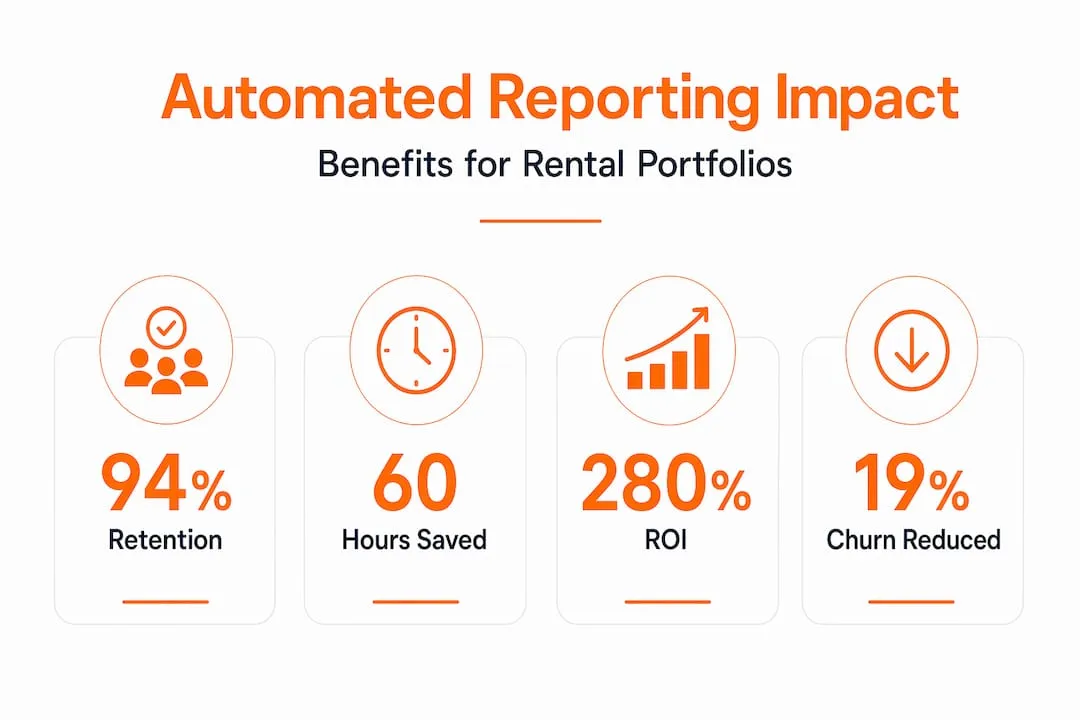
The most direct answer to why automate reporting in rentals is this: manual reporting cannot scale, and its failure is measured in lost owners. Poor communication and reporting gaps drive 19% annual owner churn. That number sounds abstract until you put a dollar figure on it. Losing a single owner with multiple properties costs $5,400 to $6,750 per year in lost management fees. Automation is not a tech upgrade. It is a financial defense mechanism.
Time savings that compound across a portfolio
Property management automation saves approximately 60 hours per month on scheduling and operational tasks. For reporting specifically, that time is recovered from data pulling, formatting, error-checking, and sending. When you multiply those hours across a portfolio of 50 or 100 properties, you are looking at weeks of recovered productivity per quarter.
The financial impact compounds further when you consider inquiry volume. Automated systems reduce inbound inquiry calls by 34% because owners can access their data without calling you. For companies managing 100 or more units, the automated reporting ROI reaches 280% in year one. That is not a forecast. It is a documented return based on inquiry reduction, error elimination, and churn prevention.
Accuracy and transparency as competitive advantages
Accuracy is where manual reporting breaks down the most. A formula error in one spreadsheet tab, a copy-paste mistake on a revenue line, or a missed expense entry creates owner distrust that is very hard to undo. Automated systems pull from a single source of truth, calculate consistently, and deliver the same format every time.
Rental owners prioritize communication speed and financial transparency, and they prefer low-frequency updates that are highly reliable over constant messages that are sometimes wrong. An owner portal that delivers accurate data on demand, 24 hours a day and 7 days a week, satisfies that preference completely. Owner portals reduce routine inquiry calls and build trust through consistent transparency. Owners stop wondering what is happening with their property because they can check anytime.
Pro Tip: Frame your owner portal as a benefit when onboarding new clients. Showing owners they can access real-time financial data at any hour, without needing to email you, is one of the most effective trust-builders in the first 90 days of the relationship.
Automated vs. manual reporting: a direct comparison
Most property managers who resist automation do so because the current process works well enough. That framing shifts when you look at the actual difference in outcomes side by side.
What manual reporting actually looks like
Manual reporting means someone on your team opens a spreadsheet, pulls booking data from your channel manager, cross-references maintenance records, calculates net owner payouts, formats the document, and emails it. That process takes time, requires concentration, and introduces multiple points of failure. One month a number is wrong. The next month a property is accidentally omitted. The month after that the report goes out four days late because the person who does it was out sick.

Owners notice all of this. They may not say anything the first time, but patterns accumulate. When a competitor offers them portal access and clean automated reports, the decision to switch is easy.
The documented performance gap
| Factor | Manual reporting | Automated reporting |
|---|---|---|
| Report generation time | 4 to 8 hours per cycle | Minutes per cycle |
| Error rate | High (human data entry) | Low (system-generated) |
| Owner access | On request or scheduled | 24/7 via portal |
| Decision speed | Delayed by report lag | Real-time data available |
| Owner retention rate | 81% | 94% |
| Inquiry call volume | High | Reduced by 34% |
The retention gap in that table is the most important number. Moving from 81% to 94% retention across a portfolio of 50 owners means keeping roughly 7 additional owners per year. At an average management fee base, that is a significant revenue difference that automation pays for many times over.
Pro Tip: If you manage a portfolio with 30 or more properties, calculate your current annual churn rate and multiply the average owner value by the percentage difference between 81% and 94%. That number is your automation business case. Present it to any stakeholder who questions the investment.
How to implement automated reporting effectively
Getting automation right requires more than buying software. The quality of your automated reports depends entirely on the quality of the data going into them. That is where most implementations fail.
Here is a practical sequence for rolling out automated reporting in a vacation rental operation:
- Audit your data sources. List every system that holds relevant data: your property management software, channel manager, maintenance tracking tool, and accounting platform. Identify where data conflicts exist between these sources.
- Standardize before automating. Standardizing data across maintenance, financial, and inspection systems before turning on automation is critical. Garbage in means garbage out, even with the most sophisticated reporting engine.
- Choose your reporting cadence. Monthly is the standard, but your owners may prefer weekly summaries during high season. Set the schedule deliberately rather than defaulting to whatever the software suggests.
- Configure your owner portal. Set up 24/7 access to financial statements, occupancy data, and maintenance records. Give owners a login during onboarding and walk them through what they will see.
- Build in review checkpoints. Automated systems require regular audits to avoid propagating errors from inconsistent inputs. Assign someone to spot-check data monthly for the first six months after launch.
- Communicate the change to owners. Tell them what is changing, why it benefits them, and what they can now access on their own. Owners who understand the portal use it. Owners who were never told about it call you anyway.
The biggest mistake managers make is treating automation as a one-time setup. Your channel integrations change. Your fee structures evolve. New maintenance categories get added. Each of those changes needs to be reflected in the automated reporting logic, or the reports become inaccurate over time.
Pro Tip: Schedule a quarterly review of your automated reporting outputs. Compare a sample of automated reports against raw source data to catch any drift between what your system reports and what actually happened.
Advanced features that support portfolio scaling
Once basic reporting automation is running, the next layer is where the real operational advantages appear. This is the difference between time-saving reporting solutions and actual management intelligence.
Modern vacation rental reporting platforms do far more than send monthly statements. Here is what the most useful advanced features look like in practice:
- Real-time performance dashboards displaying RevPAR (revenue per available rental), ADR (average daily rate), and occupancy rate across your entire portfolio, not just property by property. This lets you spot underperformers and make pricing decisions in hours rather than weeks.
- Automated financial alerts that notify you when a property’s revenue drops below a threshold or when a maintenance cost spike occurs. These alerts shift your team from reactive problem-solving to proactive management, which is where the strategic value of automation lives.
- Integrated booking and maintenance sync that ties operational data to financial reporting. When a maintenance ticket is resolved, that cost automatically appears in the owner’s statement for that period. No manual entry, no forgotten line items.
- Automated owner communication workflows that send scheduled reports, flag anomalies for manager review before delivery, and log every communication for audit purposes.
The scaling argument is straightforward. Adding 20 properties to a manual operation means adding staff time proportionally. Adding 20 properties to an automated operation means a few configuration changes and no meaningful increase in reporting workload. That is how property management companies grow their portfolios without their overhead growing at the same rate.
My honest take on why teams resist this
I’ve worked with property managers who have been doing monthly reports the same way for eight years, and every single one of them said the same thing when I first raised automation: “Our process works fine.” What I’ve learned is that this statement is almost always followed by some version of “except when it doesn’t.” The report that went out wrong last quarter. The owner who called three times in one month asking where their statement was. The spreadsheet that has a tab labeled “DO NOT TOUCH” because one formula holds the entire thing together.
What I’ve found is that resistance to automation is rarely about cost or technology. It is about familiarity and accountability. When a person builds a report manually, they feel ownership over it. When a system generates it, the question becomes: who checks the system? The answer, which I always give directly, is that you do. Automation does not remove human judgment. It removes human busywork and redirects your team toward relationships and strategy.
The financial case I find most underestimated is the owner churn argument. Most managers focus on the cost of acquiring new owners. Very few calculate what it costs to lose one. Once you run those numbers honestly, the conversation about automating reporting changes completely. The software cost becomes irrelevant compared to what you are protecting.
My advice is to start with your highest-value owners when piloting automation. Get the portal and reporting right for that segment first. If they respond well, the rest of the rollout becomes much easier to justify internally.
— Jose
See how Realtevoos handles this for you
Realtevoos was built specifically for property managers who are done choosing between growth and quality. The platform consolidates data from Airbnb, Vrbo, and every other channel into a single reporting engine, so your owner statements are accurate, on time, and automatically delivered without anyone on your team lifting a finger. The owner portal gives clients 24/7 access to financial data, maintenance history, and occupancy trends. If you manage 30 or more properties and want to see what automated owner reporting looks like in practice, Realtevoos is built for exactly that scale. Explore the platform and request a demo to see the ROI numbers applied to your actual portfolio.
FAQ
Why automate reporting in rentals specifically?
Vacation rental reporting involves multiple data sources, frequent booking changes, and owner relationships that depend on financial transparency. Automation handles the complexity at scale without the error rate of manual processes.
How much does manual reporting cost in owner churn?
Poor reporting drives 19% annual owner churn, and losing a single multi-property owner costs $5,400 to $6,750 annually. Automation brings retention rates up to 94%.
What is the ROI of automated reporting?
For portfolios managing 100 or more units, automated reporting delivers 280% ROI in year one, driven by inquiry reduction, error elimination, and improved owner retention.
Do owner portals really reduce inquiry calls?
Yes. Owner portals with 24/7 financial access reduce routine inquiry calls significantly because owners can check their own data without contacting your team.
What should I do before turning on automated reporting?
Standardize your data sources first. Unifying data across financial, maintenance, and booking systems before automating prevents errors from compounding in your reports.