AI Trends in Property Management 2026: Scale Smarter
Explore the latest AI trends in property management 2026. Discover how cutting-edge technology is reshaping workflows and boosting efficiency!

AI Trends in Property Management 2026: Scale Smarter
AI trends in property management 2026 are defined by a structural shift from isolated automation tools to embedded operational infrastructure that runs core workflows without human intervention. AI adoption among property management firms surged from 20% in 2025 to 58% in 2026, a pace that signals this is no longer optional for competitive operators. Platforms like AppFolio Realm-X, Buildium, and Guesty are no longer experimenting. They are deploying agentic AI and multi-agent systems that handle tenant communications, lease drafting, and maintenance triage at scale. For vacation rental managers, this means the gap between operators using AI and those who are not is widening fast.
Which key property management workflows are transformed by AI in 2026?
Agentic AI is the term the industry now uses for AI systems that take autonomous, multi-step actions within a defined workflow, rather than simply responding to a single prompt. This is the engine behind the most significant property management AI innovations reshaping operations this year.
Tenant and guest communication
AI agents now handle 24/7 multilingual guest communication across Airbnb, Vrbo, and direct booking channels. They resolve booking inquiries, process check-in instructions, and manage complaint escalation without a human in the loop for the majority of interactions. Transparent AI disclosure achieves over 70% guest acceptance rates, while hidden AI risks backlash and trust erosion. The practical lesson: tell guests they are interacting with an AI agent, and most will not object.

Automated lease and agreement drafting
AI tools now draft jurisdiction-specific rental agreements, flag regulatory conflicts, and apply redlines based on prior negotiation history. This removes a task that previously required a paralegal or experienced property manager for every new booking or lease renewal. The speed gain is real, but the accuracy depends entirely on how current your legal data sources are. Always keep a human review step for high-value or long-term agreements.
Maintenance triage and dispatch
AI classifies incoming maintenance requests by urgency, matches them to the right vendor, and dispatches work orders automatically. Agentic AI cuts per-unit operational hours by 25 to 40% and improves maintenance resolution times by over 30%. That is not a marginal gain. For a manager running 50 properties, a 30% faster resolution time translates directly into fewer negative reviews and higher repeat booking rates.
Pro Tip: Set your AI maintenance triage to flag any request involving water, electrical, or structural issues for immediate human review. These categories carry liability exposure that no AI system should handle without oversight.
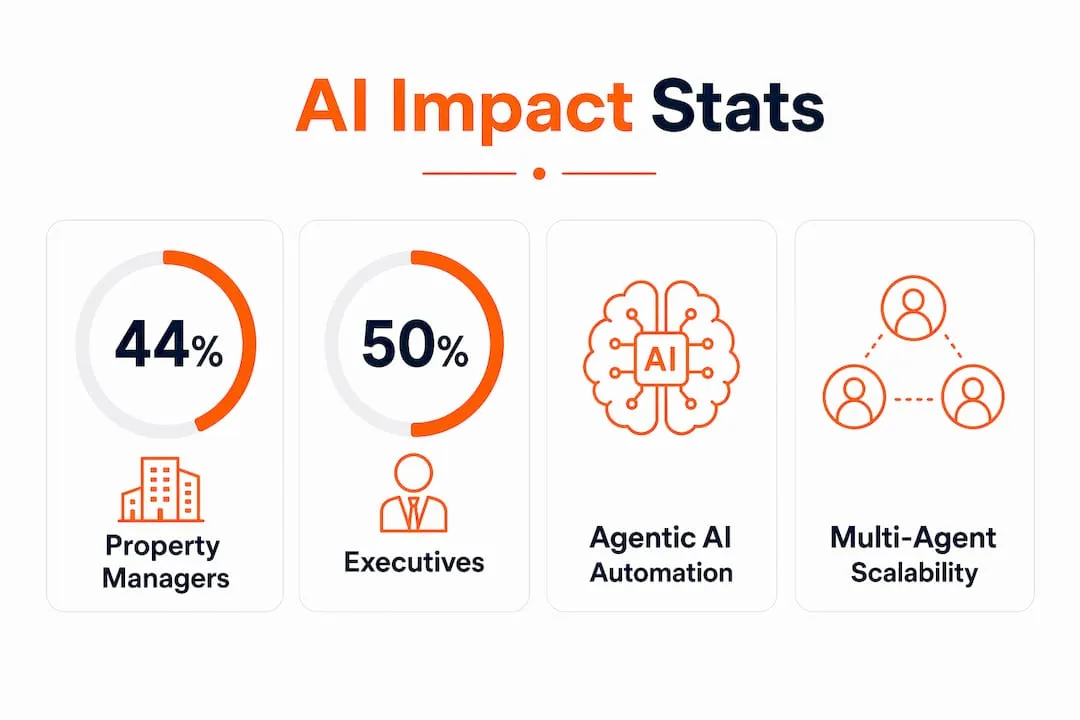
The combined effect of these workflow changes is that 44% of property managers and over 50% of executives have integrated AI into their core roles by mid-2026. The operators seeing the biggest gains are not using AI as a single chatbot. They are deploying it across multiple workflow layers simultaneously.
How are multi-agent AI architectures driving portfolio scalability?
Multi-agent AI is the architecture behind the most capable platforms in 2026. Instead of one general AI handling everything, specialized agents each own a distinct operational domain and share data with each other to coordinate decisions.
| Architecture type | How it works | Best for |
|---|---|---|
| Single AI assistant | One model handles all queries reactively | Small portfolios under 10 units |
| Workflow-specific agents | Separate agents for comms, maintenance, finance | Mid-size operators scaling to 50+ units |
| Coordinated multi-agent system | Agents share signals and inform each other’s actions | Large portfolios requiring portfolio-wide optimization |
Guesty’s agentic AI platform is built as a coordinated system of AI agents that handle finance, marketing, and operations simultaneously. Entrata takes a similar approach, with agents that surface cross-department signals to inform pricing and staffing decisions. The critical difference from older automation tools is coordination. When a maintenance agent flags a property as unavailable, the pricing agent adjusts rates and the guest communication agent updates availability messaging in real time, without any manual trigger.
This architecture is what makes scaling vacation rental portfolios without proportional headcount increases actually achievable. A team of five can manage 150 units when AI agents handle the high-volume, repetitive coordination work. The human team focuses on vendor relationships, guest escalations, and strategic decisions.
The honest limitation is that multi-agent systems still struggle with complex edge cases. A guest dispute involving a local ordinance, a vendor who goes out of business mid-job, or a booking conflict tied to a regulatory gray area all require human judgment. AI excels at routine bounded workflows but requires human oversight for complex regulatory or edge scenarios. Build your workflows with clear escalation paths.
Pro Tip: When evaluating multi-agent platforms, ask vendors specifically how their agents handle conflicts between domains. For example, what happens when the pricing agent wants to accept a booking that the maintenance agent has flagged as unavailable? The answer reveals how mature the coordination logic actually is.
What strategic considerations should vacation rental managers weigh when adopting AI?
Getting AI right in 2026 is less about choosing the flashiest platform and more about sequencing your adoption correctly. Here is a practical framework for vacation rental operators.
-
Audit your current workflows first. Identify the three tasks that consume the most staff hours per week. These are your highest-return automation targets. For most vacation rental managers, guest messaging, maintenance coordination, and reporting top the list.
-
Choose embedded AI over bolt-on tools. Embedded AI platforms outperform add-on tools in speed and data accuracy because they operate within a unified data environment rather than pulling from disconnected sources. A bolt-on AI chatbot that cannot see your maintenance calendar or booking history will give guests wrong information.
-
Follow a 90-day phased rollout. A structured rollout plan that runs discovery in days 1 to 14, a pilot in days 15 to 45, workflow expansion in days 46 to 75, and a decision gate at day 76 to 90 significantly improves integration success. Skipping the pilot phase is the most common and costly mistake.
-
Prioritize unified data environments. Consolidated data environments are what allow AI systems to analyze cross-department signals and deliver portfolio-wide insights. If your booking data, maintenance records, and financial reports live in separate systems, your AI will produce fragmented outputs. Data consolidation is not a technical detail. It is the foundation.
-
Avoid closed black-box systems. Mid-size vacation rental managers should prefer platforms with open data layers and integration flexibility. Closed systems lock your operational data inside a vendor’s ecosystem, which limits your ability to switch tools or build custom workflows as your portfolio grows.
The build-versus-buy decision is straightforward for most operators at this stage. Building custom AI requires data science resources and ongoing model maintenance that most property management teams do not have. Buying a purpose-built platform with open integration layers gives you speed to value without the technical debt.
What emerging AI innovations are shaping vacation rental management?
The next wave of 2026 property management technology goes beyond workflow automation into predictive and structural intelligence.
-
Digital twins create structured data models of individual properties, capturing layout, appliance age, maintenance history, and usage patterns. This gives AI systems the context to make accurate predictions about repair needs and guest experience risks before they become problems.
-
Predictive maintenance uses sensor data and historical patterns to flag issues before they cause service disruptions. AI-driven predictive maintenance reduces repair costs and improves uptime across vacation rental portfolios. A water heater flagged three weeks before it fails is a maintenance ticket. One that fails during a guest stay is a refund, a negative review, and a rebooking headache.
-
AI-powered vendor networks match properties to service providers based on performance history, response time, and pricing. This removes the manual vendor management burden and improves service consistency across large portfolios.
-
End-to-end AI property management platforms are the most ambitious development. Fully AI-managed platforms can reduce coordination costs by approximately 85%, bringing per-property management costs down to around $37 per month compared to traditional human-managed coordination. That figure is not yet realistic for complex, high-touch vacation rental portfolios, but it signals where the cost curve is heading.
The honest filter for evaluating these innovations is to ask whether the AI is embedded in the workflow or sitting on top of it. Tools that require manual data export and import to function are not true AI integrations. They are reporting dashboards with a marketing rebrand.
Key takeaways
AI trends in property management 2026 are defined by agentic and multi-agent systems that automate high-volume workflows, enable portfolio scaling without proportional staffing increases, and deliver measurable reductions in operational costs for vacation rental operators.
| Point | Details |
|---|---|
| Adoption has crossed the majority threshold | AI use among property management firms jumped from 20% to 58% in a single year. |
| Agentic AI cuts labor hours significantly | Per-unit operational hours drop 25 to 40% with agentic AI deployment across core workflows. |
| Multi-agent coordination enables true scaling | Coordinated AI agents across finance, operations, and communications allow small teams to manage large portfolios. |
| Unified data is the foundation | AI systems without consolidated data produce fragmented outputs that reduce accuracy and trust. |
| Phased rollout reduces implementation risk | A structured 90-day adoption plan with clear decision gates improves integration success rates. |
Why I think most vacation rental managers are still underestimating AI in 2026
I have spent considerable time evaluating how AI is actually being used across vacation rental portfolios, not just how vendors describe it in demos. The gap between the two is significant.
The operators getting the most value from AI are not the ones who bought the most expensive platform. They are the ones who mapped their workflows before they bought anything. They knew exactly which tasks were eating hours, which ones carried the highest error rate, and which ones guests cared about most. That clarity made their AI adoption fast and measurable.
The common pitfall I see is purchasing a multi-agent platform and then running it on fragmented data. The AI produces confident-sounding outputs that are wrong because it is working from incomplete information. This is not an AI failure. It is a data architecture failure that gets blamed on the technology.
I am also cautious about vendors who cannot explain how their AI makes decisions. Transparent AI is not just an ethical preference. It is a practical requirement. When a guest asks why their booking was flagged or why a rate changed, your team needs to be able to answer that question. Black-box systems make that impossible and erode the trust you have built with guests over years.
The future I find genuinely exciting is AI handling the coordination layer entirely, freeing property managers to focus on the work that actually requires human judgment: building vendor relationships, designing guest experiences, and making strategic portfolio decisions. That is not a threat to the profession. It is an upgrade.
— Jose
How Realtevoos helps vacation rental managers scale with AI in 2026

Realtevoos is built specifically for vacation rental operators who need AI embedded in their core workflows, not bolted on as an afterthought. The platform consolidates booking data from Airbnb and Vrbo, automates guest communications, and surfaces real-time portfolio insights through a single dashboard. Property managers using Realtevoos report saving several hours per week on manual reporting alone, with measurable improvements in guest satisfaction scores. If you are managing multiple properties and want to scale your portfolio without scaling your headcount, Realtevoos gives you the operational infrastructure to do it. Explore the platform and see how AI-driven automation translates into higher NOI and fewer operational fires.
FAQ
What are the biggest AI trends in property management for 2026?
The dominant trends are agentic AI for autonomous workflow execution, multi-agent systems that coordinate across operational domains, and predictive maintenance powered by sensor data. AI adoption among property management firms reached 58% in 2026, up from 20% the prior year.
How does AI reduce operational hours for vacation rental managers?
Agentic AI handles guest communications, maintenance triage, and lease drafting autonomously, cutting per-unit operational hours by 25 to 40%. The largest time savings come from eliminating repetitive coordination tasks that previously required manual input at every step.
Is AI ready to fully replace property managers?
No. AI excels at routine, bounded workflows but requires human judgment for complex regulatory scenarios, vendor disputes, and high-stakes guest situations. The most effective model in 2026 is AI handling coordination and volume while humans focus on judgment-intensive decisions.
What should I look for when choosing an AI platform for vacation rentals?
Prioritize platforms with embedded AI, open data layers, and integration flexibility with Airbnb and Vrbo. Avoid closed systems that lock your operational data inside a single vendor’s ecosystem, as these limit your ability to adapt as your portfolio grows.
How much can AI reduce property management costs?
End-to-end AI platforms can reduce coordination costs by approximately 85%, though this figure applies more to standardized long-term rental portfolios than complex vacation rental operations. For vacation rental managers, the most reliable savings come from reduced labor hours and faster maintenance resolution.
Recommended
- The Role of Data in Property Management in 2026 — Realtevo Blog
- Rental Operations Scaling Process: A 2026 Guide — Realtevo Blog
- Enterprise property management: Data-driven success for vacation rentals — Realtevo Blog
- Rental management intelligence systems: What they do and why they matter — Realtevo Blog