Under 200 Properties? Skip Airbnb API Access and Use a Channel Manager
See who really qualifies for Airbnb API access, why most managers should use a channel manager or iCal, and practical alternatives including RealtevoOS.

Under 200 Properties? Skip Airbnb API Access and Use a Channel Manager
Airbnb’s API is restricted to approved partners, not open to individual developers or hosts who want to build a side project. If you run a handful of properties, the practical move is a channel manager or iCal sync. If you manage a growing portfolio, your best path is either the formal partner application (with security review and a real support team behind it) or a platform like RealtevoOS that already carries the integration weight for you.
TL;DR:
- Airbnb’s API is limited to approved partners managing significant property inventory, typically requiring thousands of listings for approval.
- The Homes API only allows supply-side management of your own listings, not for searching or accessing market-wide data at scale.
- Most property managers and small startups cannot meet Airbnb’s strict scale, security, support, and strategic criteria for direct API access.
- Alternatives like channel managers, iCal synchronization, and third-party market data APIs fully address most operational needs without API partnership burdens.
- Platforms like RealtevoOS provide plug-and-play integration, automating calendar sync, reservations, and messaging without requiring technical build or security reviews.
Table of Contents
- What Does Airbnb’s Official API Actually Let You Do?
- Who Actually Gets Approved for Airbnb API Access?
- How Does the Airbnb Partner Application Process Work?
- What Obligations Come With Airbnb API Access?
- What Are the Best Alternatives If You Can’t Get Airbnb API Access?
- How Do Property Managers Actually Integrate Airbnb Data Day to Day?
- What Should Developers Know Before Building an Airbnb Integration?
- Where to Go From Here
- Why Partner Access Isn’t the Goal for Most Operators
- Skip the Partner Application: How RealtevoOS Handles Airbnb Integration for You
- Sources
What Does Airbnb’s Official API Actually Let You Do?
Airbnb built its developer platform for one purpose: helping approved partners run their own supply, not for outsiders to search or scrape the marketplace. The Airbnb API documentation breaks the offering into three pieces, and understanding what each one covers explains why so many developers hit a wall when they assume Airbnb operates like a typical public API.
The Homes API is the core of the partner platform. It lets an approved property management system push and pull data tied to listings a partner already controls: calendar availability, reservation details, pricing rules, photos, and house descriptions. A channel manager using the Homes API can update your nightly rate on Airbnb the instant you change it in your own system, or block dates automatically when a guest books through another channel. That is the entire design intent. It manages your inventory. It does not hand you a window into everyone else’s.
The Activities API extends the same logic to Airbnb’s experiences marketplace. Tour operators and experience hosts who partner with Airbnb can manage bookings, availability, and pricing for guided activities the same way Homes API partners manage lodging. It is a smaller surface than Homes, but it follows an identical supply-side pattern.
Webhooks round out the system by pushing events to partners in near real time instead of forcing constant polling. Rather than querying Airbnb every few minutes to check for a new reservation, a partner subscribes to events and gets notified when something changes. Typical webhook categories include:
- New reservation created or a reservation modified
- Cancellation events
- Messaging events between host and guest
- Calendar or availability updates
- Listing status changes
This is where the confusion usually starts. Developers researching how to get Airbnb API access often assume there is a companion endpoint for searching listings, comparing prices across a market, or pulling review data at scale. There isn’t one, at least not from Airbnb directly. Independent technical profiles like the api-evangelist Airbnb repository confirm this pattern: the documented endpoints revolve around managing a partner’s own supply, never a general-purpose read API for the broader catalog. Airbnb has strong commercial reasons to keep marketplace search proprietary. Handing that out to any developer with an API key would let competitors rebuild Airbnb’s search experience on top of Airbnb’s own data, which is precisely the outcome its terms are written to prevent.
Who Actually Gets Approved for Airbnb API Access?
Airbnb doesn’t run an open sign-up form. Getting Airbnb API access starts with Airbnb deciding whether your organization is worth the integration effort on its side, and that filter eliminates the vast majority of applicants before they ever see a contract. Four factors tend to decide the outcome.
- Supply scale. Airbnb wants partners who bring meaningful inventory or transaction volume to the table. A property manager with three listings represents negligible leverage; a PMS or channel manager serving thousands of properties across multiple operators is a different conversation entirely.
- Technical maturity. Applicants need demonstrable security practices, uptime monitoring, and an engineering team capable of maintaining a production integration over years, not months. Airbnb is effectively asking, “If we hand you write access to guest and reservation data, will your infrastructure hold up?”
- Support capacity. Partner integrations create shared customers. When something breaks, Airbnb expects the partner to have a real support operation, not a single founder answering emails from a phone.
- Strategic fit. Airbnb evaluates whether the integration adds something to its ecosystem, whether that’s expanded supply, better distribution, or a workflow guests and hosts genuinely need improved.
This is why most individual hosts and small startups never make it past the first filter. A host building a personal automation tool for their own two units has no supply story Airbnb cares about, and no support team to speak of. A three-person startup with a clever idea for a review aggregator faces the same problem from the other direction: interesting concept, no scale, no track record. Practitioner guidance on Airbnb’s ecosystem consistently points the same direction: property management businesses fare far better integrating through an already-approved software partner than attempting to become a direct Airbnb partner without the scale to justify it. Airbnb partner applications aren’t self-serve forms. Applicants are effectively vetted for whether the relationship is worth Airbnb’s engineering and support investment, and that vetting bar sits far higher than most solo developers or small management companies expect going in.
How Does the Airbnb Partner Application Process Work?
If your organization clears the eligibility bar, the path to Airbnb API integration follows a predictable sequence, though the timeline stretches longer than most teams plan for.
Start on Airbnb’s developer platform, where the partner intake process is documented alongside general information about the Homes, Activities, and Webhooks APIs. Your initial application should lay out your business model, current supply or transaction volume, the specific use case you want the integration to serve, and your technical team’s capacity to support a long-term partnership. Vague pitches get filtered out quickly. Specific ones, backed by real numbers, get a second look.
Once Airbnb expresses interest, expect a security review before any credentials get issued. This typically involves:
- A questionnaire covering data handling, encryption, and access controls
- An NDA covering the technical specifications you’ll receive
- Verification of your engineering team’s ability to meet Airbnb’s integration standards
- A review of how you’ll store and secure guest personal information
After the security review clears, onboarding generally moves through a sandbox environment first, where your team builds and tests against mock data without touching live listings. Integration testing follows, where you connect real (often limited) supply and validate behavior against Airbnb’s expected responses. A validation phase checks that your webhook handling, calendar sync, and reservation flows behave correctly under realistic conditions before Airbnb greenlights a full go-live.
Pro Tip: Budget for this process to take several months from first contact to production access, not weeks. Teams that stall usually underestimate the security documentation requirements or apply before they have the support infrastructure to back their pitch.
The most common reasons applications get rejected or stall indefinitely: insufficient supply scale, unclear differentiation from existing partners, incomplete security documentation, or a support model that doesn’t convince Airbnb the partnership will hold up under real guest volume. If you’re evaluating whether to pursue Airbnb API integration directly versus routing through an existing partner, the honest answer for most property management operations under a certain size is that direct partnership rarely pencils out against the engineering and legal cost.
What Obligations Come With Airbnb API Access?
Getting approved is only the beginning. Airbnb’s API Terms of Service load partner organizations with contractual obligations that carry real engineering and legal weight, and teams that skim the terms before signing often discover the cost later.
The API Terms of Service published in Airbnb’s Help Center spell out several hard constraints:
- No building a database of Airbnb listings, prices, or availability for purposes beyond managing your own connected supply.
- No retaining static copies of Airbnb data outside what’s needed for active operations.
- No developing a product that competes directly with Airbnb’s core marketplace.
- No using API access to power scraping-adjacent features under a different label.
Beyond prohibitions, the terms include mandatory feature implementation clauses. When Airbnb updates its API or introduces new required functionality, partners must implement those changes within a timely manner or risk losing access entirely. This creates a real engineering liability: your product roadmap partially becomes Airbnb’s roadmap, whether or not the timing suits your business. Practitioners who’ve worked inside these partnerships describe this dynamic as one of the most underappreciated costs of API access, since a mandatory implementation deadline can pull an engineering team off planned work with little notice.
Security obligations extend well past the initial review. Partners are typically expected to support periodic audits, maintain incident response procedures, and in some cases undergo penetration testing on a recurring basis. The OWASP Top Ten is a common baseline auditors reference when evaluating whether a partner’s security posture meets the bar Airbnb expects for handling guest and reservation data.
Operationally, partners also carry support service level agreements for shared customers, ongoing monitoring requirements, and compliance exposure if a breach or misuse of data occurs on their end. None of this is unusual for enterprise-grade API partnerships generally, but it means the true cost of API access includes a standing legal and security function, not just a one-time integration build.
What Are the Best Alternatives If You Can’t Get Airbnb API Access?
Most property managers reading this will not get direct API credentials, and that’s fine, because working alternatives cover nearly every real-world need without the partnership overhead.
Channel managers and PMS integrations are the default answer for good reason. Established channel managers already hold Airbnb partner status, so connecting your properties through one gives you calendar sync, reservation pushes, and rate updates without you ever touching a security review or an NDA; you can also list your property to tap into regional vacation rental marketplaces easily. This is the route most practitioner guides recommend for hosts and small management companies, and it’s worth understanding how rental channel integration actually works before choosing a provider, since not all channel managers cover the same feature depth.
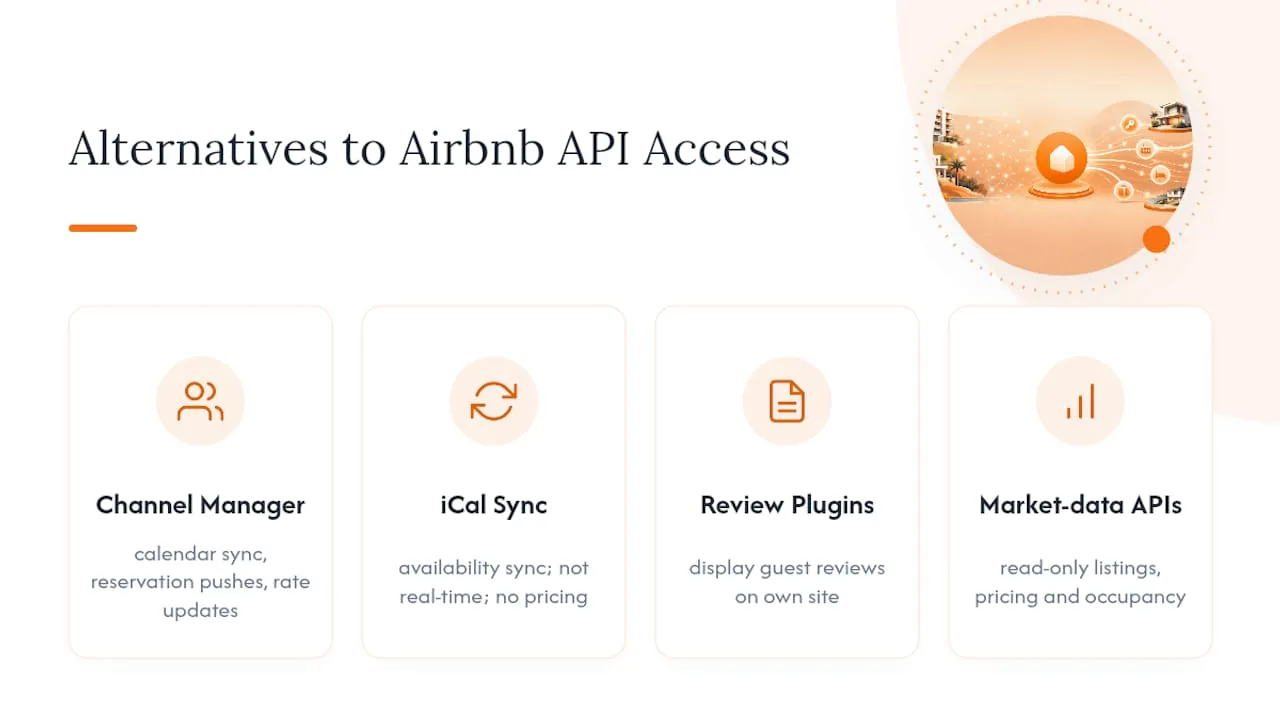
iCal export and import handles the simplest case: keeping availability calendars aligned across platforms so you never get double-booked. It’s not real-time and it won’t push pricing changes or guest messages, but for a host running two or three units who just needs to stop juggling spreadsheets, iCal remains the lowest-friction option available. Pairing iCal sync with a broader multi-channel booking management approach closes most of the gap for smaller operations.
WordPress review plugins and widgets solve a narrower but common request: displaying guest reviews on your own website without needing API access at all. These tools typically pull publicly displayed review content through supported integrations rather than direct Airbnb data access, which keeps you clear of the terms-of-service issues that come with unauthorized scraping.
Third-party market-data APIs fill a different need entirely: research and analytics rather than listing management. Providers like RealtyAPI and Apify’s Airbnb API product offer read-only access to marketplace listings, pricing trends, and occupancy signals for developers building comparison tools, pricing research, or investment analysis. This is a fundamentally different category from Airbnb’s partner APIs. You’re not managing your own supply through these services; you’re pulling aggregated market data under that provider’s own usage terms, which typically restrict resale and impose rate limits. If your use case is competitive pricing research rather than operating listings, this is often the right tool, but read the provider’s terms carefully since usage limits and data freshness vary widely between vendors.
The pattern across all four alternatives is the same: none require you to become an Airbnb partner, none carry the security review or mandatory feature implementation burden, and all of them solve a real, common problem that direct API access would otherwise be the only answer to.
How Do Property Managers Actually Integrate Airbnb Data Day to Day?
Most professional property managers never touch the Homes API directly, and that’s by design, not by compromise. The realistic pattern across multi-property operations looks less like custom engineering and more like adopting a platform that has already absorbed the integration complexity on the operator’s behalf.
A typical RealtevoOS integration pattern centers on a single dashboard pulling live data from Airbnb and Vrbo simultaneously, so a manager isn’t logging into three separate host portals to check on ten properties. Calendar and revenue data sync automatically, which eliminates the double-booking risk that plagues managers still juggling manual spreadsheets across channels. Guest messaging gets automated based on trigger events (a new booking, an upcoming check-in, a post-stay review request), and the platform reacts to reservation and cancellation events the same way a webhook-driven partner integration would, just without the manager having to build or maintain that infrastructure themselves.
The build-versus-buy decision usually comes down to three variables:
| Factor | Build in-house / apply as partner | Adopt a SaaS platform |
|---|---|---|
| Portfolio scale | Justifiable above roughly 200+ units or when you’re building software to resell | Cost-effective from a handful of units up through large portfolios |
| Engineering resources | Requires a dedicated team for ongoing maintenance and mandatory feature updates | No engineering team required on your end |
| Support burden | You own security reviews, audits, and Airbnb’s implementation deadlines | The platform absorbs partner obligations |
For most operators, the math is straightforward once you weigh the support and compliance load against a monthly subscription. Managers who’ve made the switch tend to report saving several hours a week that used to go into manual cross-platform reconciliation, along with fewer double bookings and noticeably faster turnaround on guest communication.
Pro Tip: If you’re still deciding between building a custom integration and adopting a platform, run the calculation on engineering hours alone. A single mandatory feature implementation deadline from Airbnb can eat more developer time than a year of SaaS subscription fees.
For a deeper look at how the build-versus-buy decision plays out across different portfolio sizes, the guide to integrating Airbnb and Vrbo data walks through the calculation in more detail.
What Should Developers Know Before Building an Airbnb Integration?
If your team does get approved for partner access, the technical execution has a few sharp edges that trip up developers who assume Airbnb’s API behaves like a generic REST service.
- Authentication runs on OAuth, and Airbnb issues scoped tokens tied to specific permission levels. Requesting broader scopes than you need slows down security review, since Airbnb’s team evaluates exactly what data access each scope grants before approving your application.
- Token handling needs production-grade discipline. Refresh tokens, expiration windows, and secure storage aren’t optional extras; they’re part of what the security review is checking for in the first place.
- Webhook processing must be idempotent. Airbnb, like most event-driven platforms, can deliver the same webhook event more than once. If your system processes a reservation-created event twice without a deduplication check, you risk double-charging, duplicate notifications, or corrupted booking records.
- Retry logic and signature verification aren’t optional. Verify webhook signatures against the secret Airbnb provides so you’re not processing spoofed events, and build retry handling that doesn’t create duplicate side effects if a delivery attempt times out.
- Sandbox testing has real limits. The sandbox environment approximates production behavior but won’t perfectly replicate every edge case, particularly around calendar sync race conditions when two systems try to update availability for the same dates simultaneously.
The single most common technical misconception involves pricing queries. Developers new to the platform often assume they can request a listing’s price without specifying dates, the same way you might request a product’s price from a retail API. That’s not how Airbnb’s pricing model works. Price is a composite calculation built from calendar rules, seasonal adjustments, fees, and guest count. Asking for a price without check-in and check-out dates is a request the system has no way to answer, because there’s no such thing as a single static price for a listing. Every pricing endpoint, whether on Airbnb’s partner API or a third-party market-data service, is date-bound for that reason.
Where to Go From Here
Your next move depends entirely on which category you fall into. Airbnb’s developer documentation and API Terms of Service are the two documents worth reading in full if you’re seriously considering the partner path, since both spell out obligations that are easy to underestimate from a summary alone.
- Running one to three properties? Set up iCal sync between platforms today. It solves the calendar-conflict problem immediately with zero application process.
- Managing a growing portfolio? Evaluate channel managers or PMS integrations before you consider a direct partner application. Most of what you need already exists off the shelf.
- Building a research or analytics product? Look at third-party market-data APIs rather than pursuing Airbnb partner access, since your use case doesn’t require write access to listings anyway.
- Running a management company at meaningful scale? Prepare your security documentation now if you’re serious about applying, or evaluate whether a platform built for multi-property operators solves the same problem without the partnership overhead.
For operators leaning toward the platform route, the Realtevo blog covers channel integration and multi-channel booking management in more depth, and the RealtevoOS team can walk you through what a demo or trial looks like for your specific portfolio size.
Why Partner Access Isn’t the Goal for Most Operators
The pattern I keep coming back to when I look at how partner obligations actually play out: the Airbnb partnership model rewards organizations that were already going to build serious infrastructure anyway. It doesn’t reward ambition or a good idea. It rewards existing scale, existing security teams, and existing support operations. That’s a rational filter for Airbnb to run, but it means most teams chasing direct API access are solving the wrong problem.
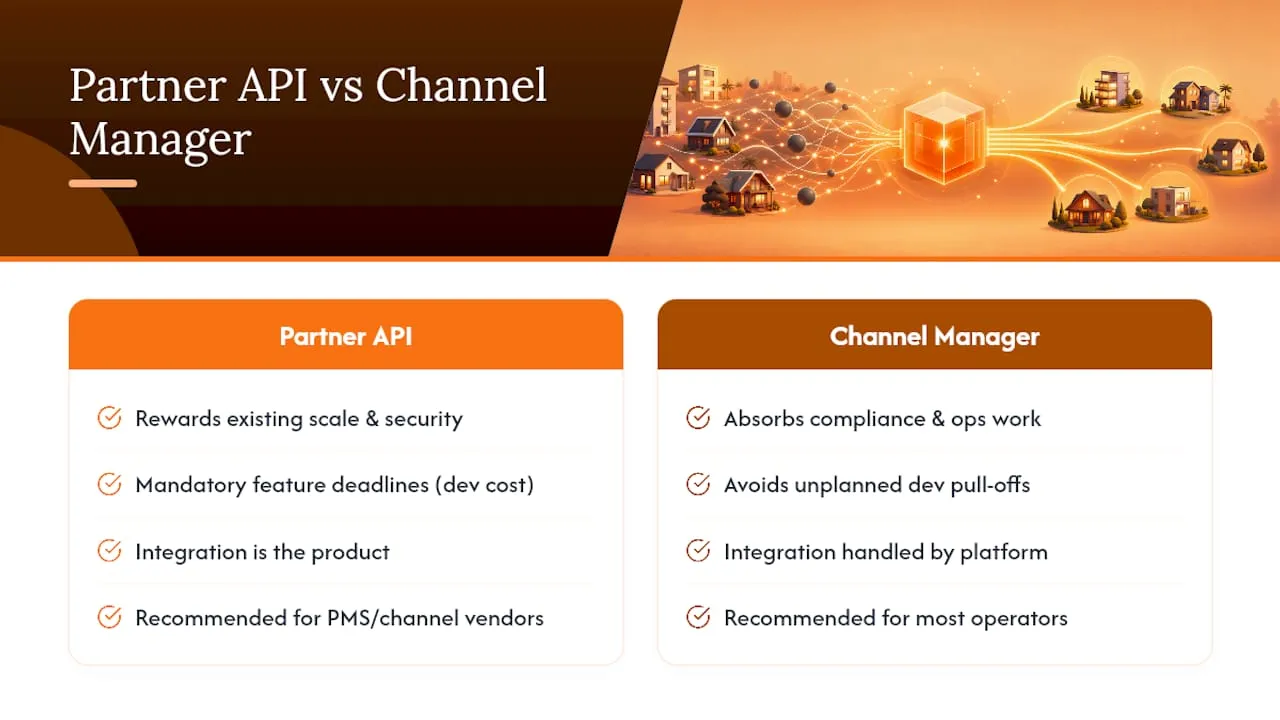
Here’s what gets underestimated: the mandatory feature implementation clause. Teams read it as boilerplate before signing, then discover a year later that an unplanned deadline from Airbnb has pulled two engineers off their actual roadmap for a month. That’s not a hypothetical risk. It’s a structural feature of how partner APIs stay maintained across a platform with Airbnb’s scale, and it’s precisely the kind of cost a consolidated platform absorbs on a manager’s behalf instead of passing it downstream.
I’d only recommend the custom, direct-partner route for organizations where the integration itself is the product, a channel manager or PMS vendor building on top of the API for resale. For everyone else managing their own portfolio, even a large one, the operational math favors adopting a platform that’s already carrying the compliance weight. That’s not a compromise. It’s the correct trade for anyone whose actual business is running great vacation rentals, not maintaining an API integration.
— Jose Villeda
Skip the Partner Application: How RealtevoOS Handles Airbnb Integration for You
Realtevoos is the practical alternative to applying for direct Airbnb partner status yourself, and the difference shows up immediately: no security review, no NDA, no mandatory feature implementation deadlines landing on your engineering team, because RealtevoOS has already absorbed that overhead on behalf of every property manager on the platform.

The platform connects your Airbnb and Vrbo listings into a single dashboard, syncing calendars and reservations automatically so double bookings stop being a recurring headache. Guest messaging runs on automation triggered by real booking events, and revenue and occupancy data surface in real-time analytics instead of scattered spreadsheets across three host portals. Property managers using RealtevoOS benefit from automated cross-platform reconciliation, reducing time spent on manual tasks and allowing more focus on portfolio growth.
Getting started doesn’t require a technical integration project on your end. You can start a free trial and connect your existing listings within your onboarding session, or explore the full feature set to see how the dashboard handles multi-property operations at your specific scale.