Automate Guest Onboarding Process: 2026 Guide
Learn how to automate guest onboarding process to streamline operations. Cut errors, save time, and enhance guest experience with our 2026 guide.

Automate Guest Onboarding Process: 2026 Guide
Automating the guest onboarding process is defined as using technology to collect guest information, handle compliance tasks, and deliver arrival communications without manual intervention. For vacation rental property managers, this practice directly cuts administrative labor, reduces data entry errors, and produces a consistent guest experience across every booking. Automation replaces manual tasks like ID verification and agreement signing with digital workflows, saving time and reducing errors at scale. Platforms like Realtevoos apply AI-driven automation to consolidate these workflows across multiple properties, giving managers a single dashboard instead of a pile of manual tasks.
How to automate guest onboarding process: what you need first
Before you build any automation workflow, you need to audit what you already do manually. Auditing current manual onboarding processes identifies where automation will have the greatest impact. Manual data entry points and document collection are the most common bottlenecks, and fixing those first produces the fastest gains.
The technology stack for onboarding automation has three core layers. First, a property management system (PMS) acts as the central record for bookings, guest data, and task assignments. Second, a digital document tool handles e-signatures, ID verification, and rental agreements. Third, a communication platform sends scheduled messages for arrival instructions, house rules, and FAQs. Smart locks or keypad systems connect to this stack so access codes are delivered automatically after compliance steps are complete.

Compliance data is the most urgent element to automate. ID verification, signed rental agreements, and payment authorizations must be collected before arrival, not at the door. Skipping this step creates last-minute friction and legal exposure. The table below maps the core technology components to their roles in a fully automated onboarding system.
| Technology component | Role in onboarding automation |
|---|---|
| Property management system (PMS) | Central hub for booking data, task triggers, and guest records |
| Digital document platform | Collects e-signatures, IDs, and signed agreements before arrival |
| Automated messaging tool | Sends scheduled arrival instructions, FAQs, and check-in codes |
| Smart lock or keypad system | Delivers access codes automatically after compliance is confirmed |
| Centralized dashboard | Gives managers real-time visibility across all properties and tasks |
Pro Tip: Audit your last 20 guest bookings and count every manual step you took. That list is your automation priority queue.
Step-by-step guide to setting up automated guest onboarding
The most effective sequence starts immediately after a booking is confirmed and ends when the guest walks through the door with zero manual follow-up required from your team.
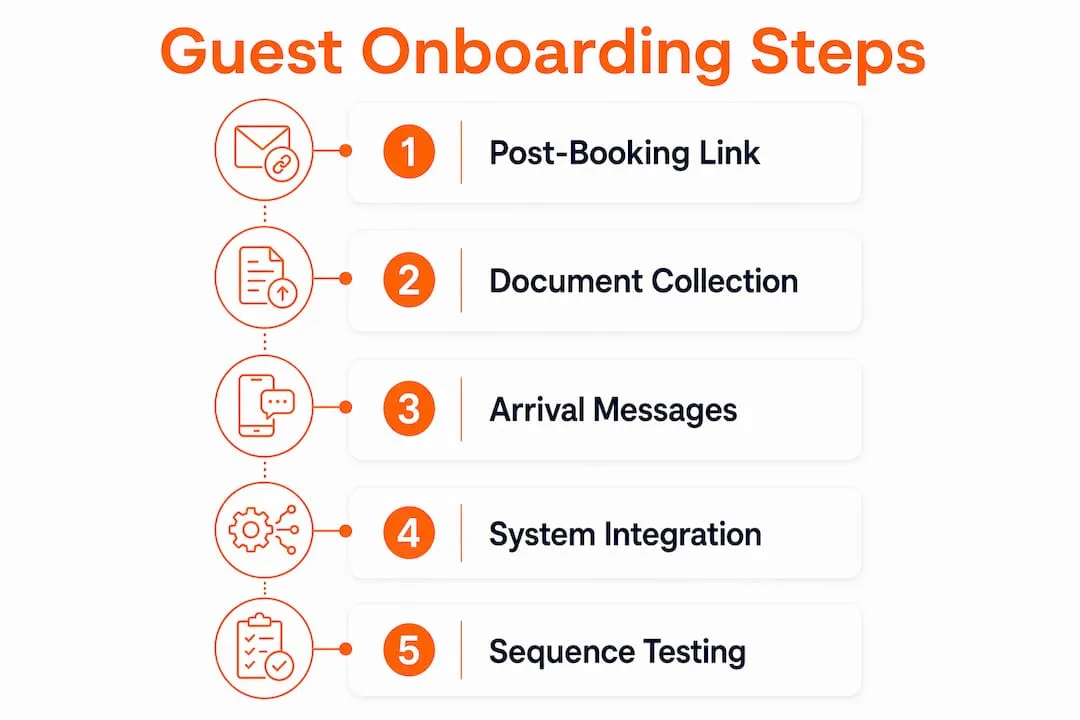
1. Send a post-booking onboarding link
The single highest-impact automation step is sending a post-booking onboarding link that collects compliance data before arrival. This link should go out within minutes of booking confirmation, not hours. It reduces guest questions and late communications by getting paperwork done early. The link should collect verified ID, a signed rental agreement, arrival time, and payment authorization in one branded flow.
2. Automate document collection and e-signatures
Your digital document platform should trigger automatically once the onboarding link is opened. Set the system to send a reminder after 24 hours if the guest has not completed the form. Do not wait for guests to remember. Automated reminders recover the majority of incomplete submissions without any manual follow-up.
3. Schedule arrival communications
Once documents are confirmed, your messaging tool should fire a sequence of scheduled messages. A confirmation message goes out immediately. An arrival instructions message goes out 48 hours before check-in. A final message with the access code goes out 2 hours before the check-in window opens. This sequence covers the most common guest questions before they are even asked.
4. Connect your PMS, messaging tool, and smart devices
Integration is where most property managers lose time. Your PMS should trigger your messaging tool and your smart lock system from a single booking event. If these systems do not connect natively, use an automation platform like Zapier or Make to build the bridge. Onboarding automation workflows improve operational coordination by automating document collection, task assignments, and scheduled communication without manual follow-up.
5. Test the full sequence before going live
Run a test booking through your entire workflow before applying it to real guests. Check that every trigger fires at the right time, every message contains accurate property-specific details, and every access code delivers correctly. A broken automation at 11 PM on a Friday is far worse than no automation at all.
Pro Tip: Build your onboarding sequence in a staging environment first. Use a personal email address as the test guest so you experience exactly what your guests will see.
The hotel check-in process workflow used by hospitality businesses offers a useful reference model for sequencing these steps, particularly for managers running properties with multiple room types or access points.
How to troubleshoot common automation pitfalls in guest onboarding
Automation fails most often because of incomplete data, not broken technology. When a guest record is missing a phone number or email address, the entire communication sequence stalls. Build data validation into your booking intake form so no record enters your system without the required fields.
Common pitfalls include trying to automate complex guest communications before standardizing basic administrative tasks. This leads to automation failures that frustrate guests and create more manual work than you started with. Fix the foundation first: ID collection, agreements, and arrival details. Add personalized or AI-assisted messaging only after those workflows run reliably.
Human oversight remains non-negotiable for exceptions. Automation systems should maintain human oversight for complex cases to protect guest satisfaction. A guest with a disability requiring special access, a booking with a dispute, or a last-minute property issue all need a real person to respond. Build a clear escalation path so your team knows exactly when to step in.
Use this checklist to monitor your automation health on a monthly basis:
- Review failed message deliveries and identify missing contact data
- Check document completion rates and follow up on any gaps
- Confirm that access codes are generating and delivering correctly
- Test at least one full onboarding sequence end-to-end each month
- Review guest feedback for complaints that point to automation gaps
Pro Tip: Set a weekly 15-minute calendar block to review your automation logs. Catching a broken trigger early costs minutes. Catching it after 10 guest complaints costs hours.
Best practices to sustain and scale your automated onboarding system
Scaling property managers treat automation as essential to maintaining service quality across multiple properties, not just a convenience for small portfolios. Without automation, consistency degrades with scale, increasing operational friction and guest complaints. The practices below keep your system performing as your portfolio grows.
- Audit workflows quarterly. Identify any step that has started requiring manual intervention again. Workflows drift over time as platforms update and booking patterns change.
- Add AI-assisted communication incrementally. Automation should be layered incrementally, starting from the most manual processes and adding AI-assisted guest interactions only after foundational workflows are stable.
- Centralize your data and task visibility. Centralizing onboarding resources and data dashboards increases visibility and control for managers, enabling faster resolution of onboarding delays and data inconsistencies. A unified dashboard is not optional at scale.
- Use guest feedback to refine flows. If multiple guests ask the same question after receiving your automated arrival instructions, that message needs rewriting. Feedback is your quality signal.
- Build property-specific variations. Effective onboarding automation includes conditional workflows tailored to different guest types and locations. A mountain cabin and a city apartment need different arrival instructions, even if the compliance steps are identical.
The role of automation in scaling rentals is well documented for managers expanding beyond five properties, where manual processes become genuinely unsustainable.
Key Takeaways
Automating the guest onboarding process requires a layered technology stack, a compliance-first sequencing approach, and consistent human oversight for exceptions to maintain quality at scale.
| Point | Details |
|---|---|
| Audit before automating | Map every manual step in your current workflow before building any automation. |
| Start with compliance data | Automate ID verification, agreements, and arrival info before adding communication layers. |
| Send the post-booking link first | A branded onboarding link sent immediately after booking is the highest-impact single step. |
| Maintain human oversight | Build escalation paths for exceptions so automation never leaves a guest without support. |
| Scale with conditional workflows | Use property-specific and guest-type variations to maintain consistency as your portfolio grows. |
What I’ve learned from watching automation go wrong
By Jose Villeda
Property managers who struggle with automation almost always make the same mistake: they try to automate the experience before they automate the paperwork. They build beautiful welcome message sequences and AI-powered FAQ bots, but their ID verification still runs through email threads and their rental agreements still require manual follow-up. The guest gets a polished first impression and then a chaotic check-in.
The operators who get this right treat automation as a compliance tool first and a hospitality tool second. They lock down the administrative layer, make sure every guest has submitted verified ID and a signed agreement before the access code is ever generated, and only then do they layer in the personalized touches.
The other thing I’ve noticed is that managers underestimate how much automation breaks silently. A messaging trigger stops firing after a platform update. An integration drops a field. Nobody notices for three weeks because no guest complained loudly enough. Monthly log reviews are not optional. They are the maintenance schedule for a system that runs your business while you sleep.
The future of guest onboarding automation points toward AI-assisted personalization at the property level, where the system adapts messaging based on guest history and booking type. That is genuinely exciting. But it only works on top of a clean, stable foundation. Build the foundation first.
— Jose Villeda
Realtevoos: a command center for onboarding automation
Property managers who want to put these steps into practice without stitching together five separate tools have a direct path forward with Realtevoos.
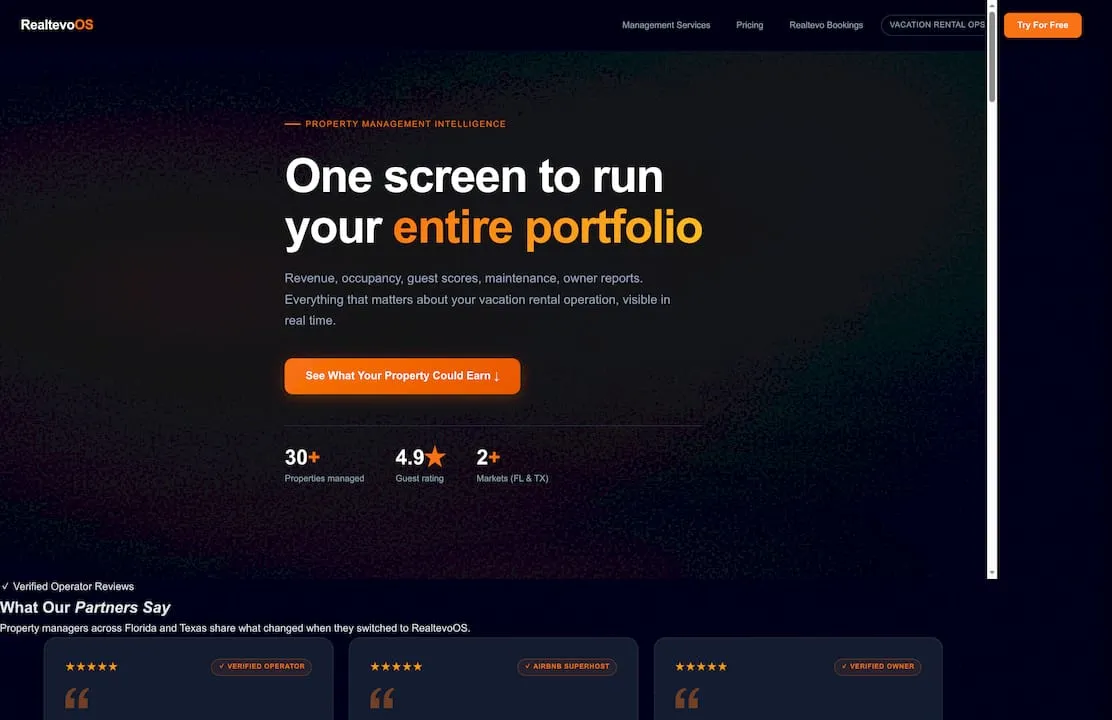
Realtevoos consolidates PMS data, automated communications, and real-time property insights from platforms like Airbnb and Vrbo into a single dashboard. Property managers report saving several hours each week after switching from manual workflows to the platform’s AI-driven automation. The management deck gives you a centralized command center where onboarding workflows, task assignments, and guest communications run without manual follow-up. For managers ready to scale their portfolio without scaling their workload, Realtevoos is built for exactly that.
FAQ
What is onboarding automation for vacation rentals?
Onboarding automation is the use of technology to collect guest information, handle compliance tasks, and deliver arrival communications without manual steps. It replaces email threads and manual follow-up with triggered digital workflows.
Why automate onboarding processes instead of handling them manually?
Automation can eliminate over 1,200 hours annually in administrative work by replacing document collection, data entry, and communication tasks with integrated workflows. Manual processes also introduce errors that automation prevents by design.
What is the first step to automate guest onboarding?
The first step is sending a branded post-booking onboarding link that collects verified ID, a signed rental agreement, and arrival details automatically. This single step prevents the majority of last-minute compliance issues.
How do I avoid over-automating guest communication?
Standardize your administrative workflows first, including ID collection, agreements, and arrival instructions, before adding AI-assisted or personalized messaging. Automating complex communications before the foundation is stable causes failures that frustrate guests.
Does automation replace the need for human staff in guest onboarding?
Automation handles routine tasks but requires human oversight for exceptions, disputes, and complex guest needs. Build a clear escalation path so your team steps in when the automated system reaches its limits.