How to Convert a Long-Term Rental to a Vacation Rental
Transform your long-term rental into a successful vacation rental with essential steps, from market checks to dynamic pricing strategies.

How to Convert a Long-Term Rental to a Vacation Rental
Converting a long-term rental into a vacation rental requires five things done in the right order: regulatory clearance, physical property prep, operations systems (cleaning, turnover, guest communications), dynamic pricing, and multi-channel distribution. Your immediate next step is a market and regulatory feasibility check — confirm local short-term rental rules, estimate average daily rate (ADR) and seasonal occupancy for your market, and verify HOA or lease constraints before spending a dollar on furnishings.
The managers who scale fastest don’t start with pricing hacks. They start with systems. A repeatable turnover SOP, automated guest messaging, and synced channel calendars are what separate a profitable short-term rental conversion from a chaotic one.
Professional managers who run dynamic pricing, multi-channel distribution, and daily operations consistently outperform those who treat the switch as a simple re-listing. Platforms like Realtevoos are built specifically to consolidate those workflows across multiple properties from day one.
Key Takeaways
Converting a long-term rental into a vacation rental succeeds when you build operations systems first and treat pricing as a downstream output of reliable turnovers and strong reviews.
| Point | Details |
|---|---|
| Regulatory check is non-negotiable | Confirm STR permits, HOA rules, and lease status before spending on furnishings. |
| Operations before pricing | Turnover SOPs and automated messaging protect ratings more than rate adjustments. |
| Budget for recurring costs | Cleaning, consumables, and utilities run higher monthly expenses per unit; model breakeven nights first. |
| Launch pricing builds reviews | Price 10–15% below target for the first 10 bookings to accelerate review velocity. |
| Realtevoos consolidates the stack | Automated messaging, channel sync, and owner reporting in one platform saves hours per property per week. |
Table of Contents
- What does it take to convert a long-term rental to a vacation rental?
- Your 0–8 week launch plan for a short-term rental conversion
- How do you set up a property that commands vacation rental rates?
- How do you create listings that actually convert?
- What pricing strategy works for a newly converted vacation rental?
- How do you build turnover and guest communication workflows that scale?
- Which tech capabilities should your PMS or operations hub cover?
- How Realtevoos accelerates the conversion process
- How do you scale from one converted unit to a multi-property portfolio?
- What does a realistic budget and ROI look like for this conversion?
- Ready-to-use templates for your conversion
- What most managers get wrong about STR conversions
- Realtevoos: your operations hub for vacation rental conversions
- Sources
What does it take to convert a long-term rental to a vacation rental?
Before you touch a single piece of furniture, run through this checklist. It covers every go/no-go decision point.
Regulatory & legal:
- Confirm your city or county requires a short-term rental permit or business license
- Check HOA CC&Rs for minimum-stay restrictions or outright STR bans
- Verify lease status: unit must be vacant or tenant exit must be lawful before listing
- Review local STR rules and building policies to avoid fines or forced closure
Safety & insurance:
- Install or test smoke detectors, CO detectors, and a fire extinguisher
- Switch to an STR-specific landlord or commercial short-term rental insurance policy
- Post emergency contact info and evacuation routes inside the unit
Property readiness:
- Furnish all sleeping areas, equip the kitchen with essentials, and add quality linens
- Install a smart lock or keypad for self check-in
- Create a dedicated owner-storage closet for supplies and spare inventory
Operations essentials:
- Identify and onboard a cleaning partner with a written turnover SOP
- Set up a property management system (PMS) with Airbnb and Vrbo channel sync
- Configure dynamic pricing with minimum-stay rules and a launch-rate strategy
Your 0–8 week launch plan for a short-term rental conversion
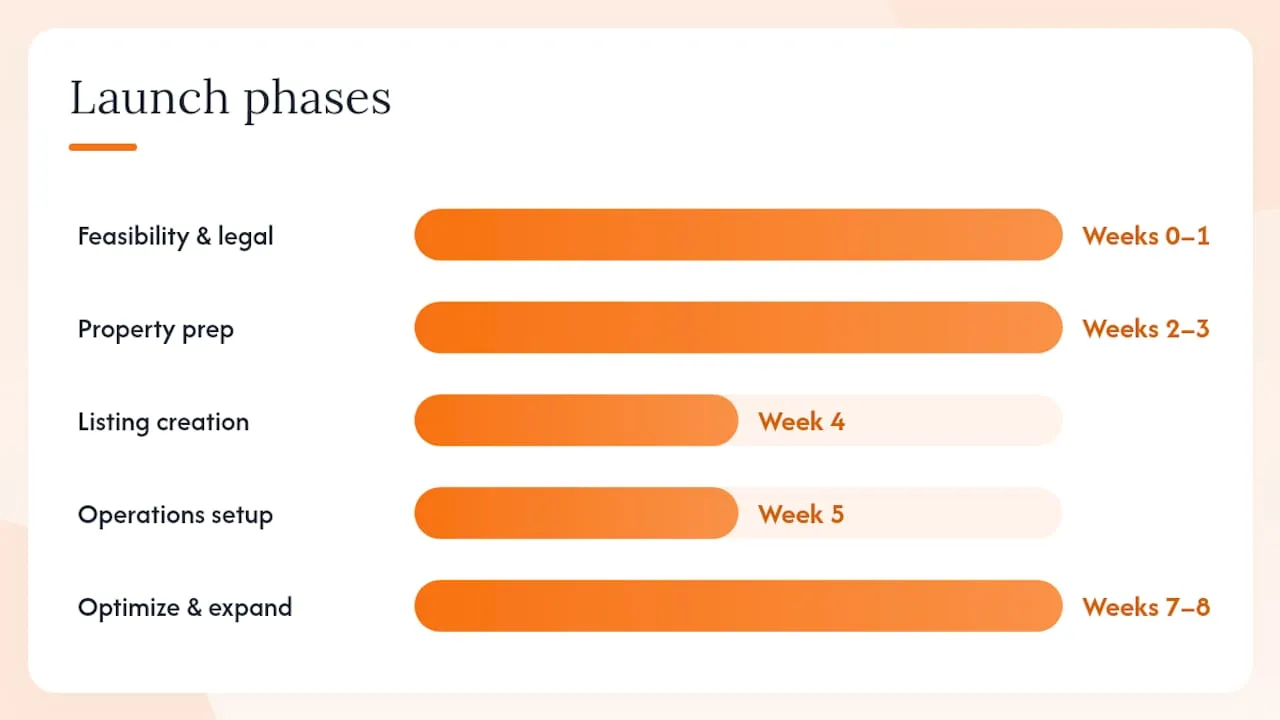
A phased launch checklist prevents the two most common failure modes: compliance surprises and operational gaps that tank early reviews. Here is a week-by-week plan.
| Week | Milestone | Key Actions |
|---|---|---|
| 0–1 | Feasibility & legal | Pull STR permit requirements, check HOA docs, confirm tenant exit timeline |
| 2–3 | Property prep | Furnish unit, install smart lock, stock consumables, complete safety checklist |
| 4 | Listing creation | Professional photography, write listing copy, configure platform settings |
| 5 | Operations setup | Finalize cleaning SOP, onboard cleaner, test turnover, set up PMS/channel sync |
| 6 | Soft launch | Go live on one OTA at a competitive launch rate, test messaging automation |
| 7–8 | Optimize & expand | Adjust pricing from early data, add second OTA, activate dynamic pricing rules |
Startup cost categories to budget:
Furnishing a one-bedroom unit typically requires several thousand dollars depending on quality tier. Smart locks add a moderate cost per door. Professional photography and initial supplies are additional expenses to budget. Recurring costs — cleaning per turnover, utilities, and consumables — are meaningfully higher than long-term rental expenses, so model your breakeven occupancy before committing.
Five-star reviews in the first 30 days compound into higher search placement and justify rate increases that more than recover the early discount.*
How do you set up a property that commands vacation rental rates?
The physical unit has to earn the nightly rate. Guests compare your listing to dozens of others in seconds, and the gap between a $120 night and a $180 night usually comes down to three things: linens, Wi-Fi, and self check-in.
Furnishing priorities for high-turnover use:
- Invest in commercial-grade mattresses and durable upholstery that clean easily
- Provide blackout curtains, quality pillows, and at least two full linen sets per bed
- Equip the kitchen with a coffee maker, basic cookware, and labeled essentials
- Add a dedicated workspace (desk, good chair, monitor-level surface) for longer stays
Amenities that move ADR:
- Gigabit Wi-Fi with the password displayed prominently
- Smart TV with streaming apps pre-configured
- Self check-in via smart lock with a digital welcome guide
- A printed or digital house manual covering appliances, parking, and local recommendations
Safety requirements (platforms + most jurisdictions):
- Smoke detector in every bedroom and common area
- CO detector on every floor
- Fire extinguisher in the kitchen
- First-aid kit and posted emergency contacts
Keep a dedicated owner-storage closet stocked with backup linens, cleaning supplies, and spare hardware. It cuts turnover time and eliminates the “we ran out of towels” support ticket.
How do you create listings that actually convert?
Photography is the single highest-ROI investment in your listing. Professional photos and clear listing copy drive click-through before a guest reads a single word of your description.
Photo checklist: wide-angle hero shot of the living area, bedroom shots showing linens and natural light, kitchen showing appliances and counter space, bathroom showing cleanliness, outdoor space if applicable, and a neighborhood/location context shot.
Listing copy structure: lead with a benefit headline (“Bright downtown loft, fast Wi-Fi, walkable to everything”), follow with sleeping layout and guest capacity, then top amenities, then logistics (parking, check-in, house rules). Keep it scannable.
Channel distribution: start on Airbnb and Vrbo. Once you have 10+ reviews and a stable SOP, add direct booking capability. Learning how to list on vacation rental sites and diversify beyond OTAs is a growth lever, not a day-one priority.
Platform settings to configure before going live: minimum-stay rules (2–3 nights minimum reduces single-night turnover costs), cleaning fee that covers your actual cost, house rules that match your insurance policy, and a cancellation policy that balances booking volume with revenue protection.
What pricing strategy works for a newly converted vacation rental?
Dynamic pricing is the standard for professional vacation rental management. Static rates leave money on the table during peak weekends and produce empty calendars during slow seasons.
Core pricing rules to implement:
- Set a base rate using comparable listings in your market (filter by bedroom count, amenities, and proximity)
- Apply a weekend premium of 15–25% above your weekday base
- Add event overrides for local festivals, sports events, and holidays
- Offer length-of-stay discounts (7+ nights, 28+ nights) to fill shoulder seasons
- Review and adjust rates weekly using occupancy data from your PMS
KPIs to track weekly:
- ADR (average daily rate)
- Occupancy rate
- RevPAR (revenue per available room = ADR × occupancy)
- Cleaning cost per turnover as a percentage of nightly rate
- Breakeven nights per month (total fixed + variable costs ÷ average nightly rate)
Monitoring occupancy rates weekly gives you the signal to raise rates when demand is strong and drop minimums when the calendar goes soft.
How do you build turnover and guest communication workflows that scale?
Reliable turnovers protect your ratings. A missed clean or a late check-in message costs you a five-star review that takes weeks to recover.
Turnover SOP (core steps):
- Cleaner receives automated task notification at checkout confirmation
- Cleaner completes room-by-room checklist (linen swap, surfaces, floors, restock)
- Photo inspection submitted via app before checkout window closes
- PMS auto-updates availability only after inspection approval
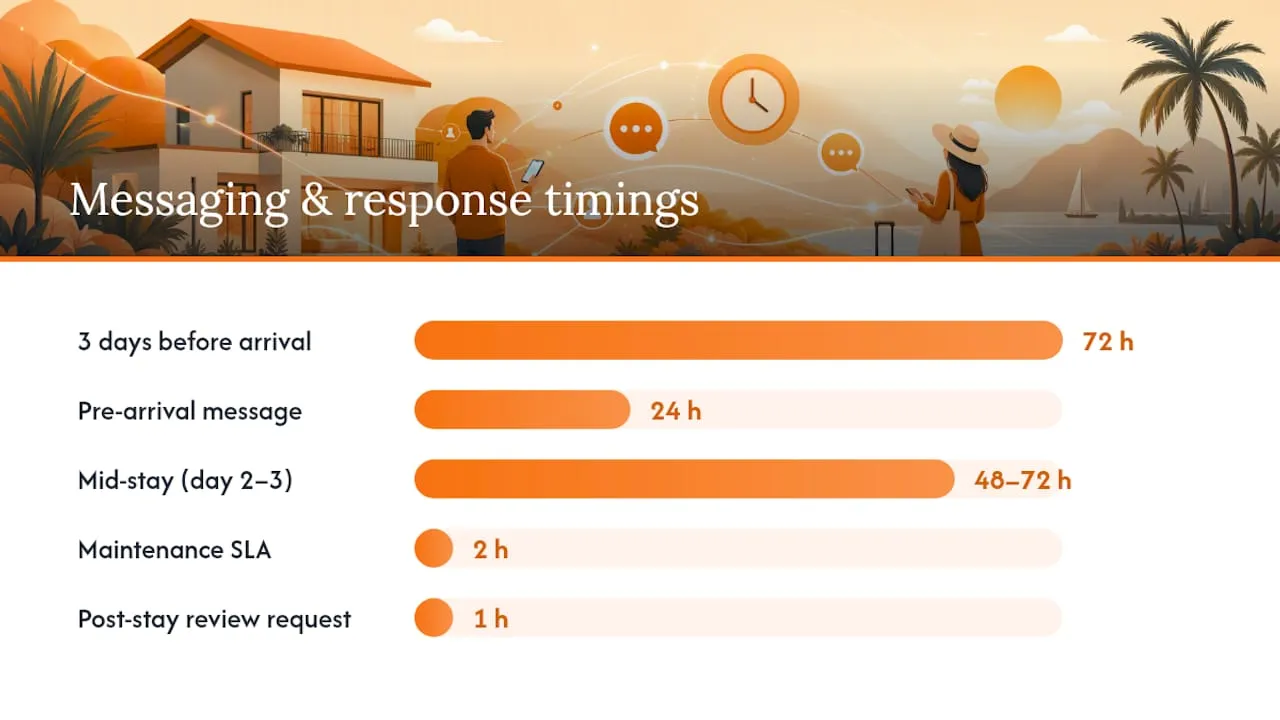
- Pre-arrival message triggers automatically 24 hours before next guest check-in
Guest messaging cadence:
- Booking confirmation: property details, house rules, check-in instructions
- 3 days before arrival: reminder with door code and parking info
- Check-in day: welcome message with Wi-Fi password and local tips
- Mid-stay (day 2 or 3 for longer stays): check-in question to catch issues early
- Checkout reminder: 10 PM the night before with instructions
- Post-stay review request: within 1 hour of checkout
Pro Tip: During your first month, stagger bookings to leave a buffer day between stays. It gives your cleaning team margin to handle surprises without impacting the next guest’s check-in.
Maintenance tickets should route to a dedicated channel (text, app, or PMS task) with a 2-hour response SLA for guest-impacting issues. Predictive maintenance workflows reduce the emergency calls that disrupt turnovers.
Which tech capabilities should your PMS or operations hub cover?
Your tech stack is the backbone of a scalable short-term rental conversion. Prioritize these capabilities when evaluating a PMS or operations hub:
- Calendar and channel sync with Airbnb and Vrbo (two-way, real-time to prevent double-bookings)
- Automated guest messaging with customizable templates and trigger-based scheduling
- Housekeeping task management that auto-assigns cleaners at booking confirmation
- Owner reporting dashboard with earnings, occupancy, fees, and maintenance summaries
- Dynamic pricing integration or a native pricing engine
- Expense and invoice capture to track per-property costs accurately
- Smart lock integration for automated door code generation per booking
Centralizing your OTA and PMS data in one dashboard eliminates the reporting gaps that frustrate owners and slow decision-making.
Implementation tip: connect your PMS to one OTA first, run a full test booking cycle, then add the second channel. Cutting over all channels simultaneously risks double-bookings and missed automation triggers during setup.
How Realtevoos accelerates the conversion process
Property managers using Realtevoos report saving several hours per property per week once messaging automation and automated turnover tasking are live. The workflow runs like this: property onboarding captures all unit details via structured intake forms, automated messaging handles the full guest communication sequence, and the owner dashboard delivers earnings and occupancy data without manual report-building.
| Workflow Stage | Manual Approach | With Realtevoos |
|---|---|---|
| Property onboarding | Spreadsheets, email chains | Structured intake forms, centralized data |
| Guest messaging | Manual send per booking | Automated sequences, trigger-based |
| Turnover coordination | Phone/text to cleaners | Auto-assigned tasks at booking confirmation |
| Owner reporting | Monthly manual export | Real-time dashboard, automated summaries |
Structured onboarding forms that capture appliance details, access instructions, and amenity specifics from owners and cleaners reduce future support tickets and speed up every subsequent turnover.
How do you scale from one converted unit to a multi-property portfolio?
Scaling requires org design, not just more properties. Here is the team structure that works at 5–20 properties:
- Operations lead — owns SOPs, vendor relationships, and escalation decisions
- Onboarding specialist — manages new property intake, listing setup, and owner communication
- Cleaning coordinator — schedules turnovers, manages cleaner capacity, and handles supply logistics
- Maintenance manager — owns the vendor network, ticket routing, and preventive maintenance calendar
Hiring triggers:
- Hire a dedicated cleaning coordinator when you exceed 8 active properties or 15+ turnovers per week
- Add an onboarding specialist when you’re converting more than 2 new properties per month
- Bring on a regional ops lead when properties span more than one metro area
Codify failure modes in your SOPs — missed turnovers, guest no-shows, maintenance escalations — and assign RACI ownership for each. That single step cuts time-to-fix and protects your ratings as volume grows.
What does a realistic budget and ROI look like for this conversion?
Sample breakeven calculation: a one-bedroom unit with $5,000 in startup costs and $600/month in recurring expenses at an ADR of $120 needs roughly 5 booked nights per month to cover recurring costs.
Ready-to-use templates for your conversion
Turnover SOP checklist (copyable):
- Strip and replace all linens (beds, bathrooms)
- Wipe all surfaces, appliances, and fixtures
- Restock toiletries, coffee, and paper goods to standard par levels
- Check and report any damage via photo before leaving
- Confirm smart lock code reset for next guest
Messaging templates:
Booking confirmation: “Hi [Guest Name], your stay at [Property Name] is confirmed for [Dates]. Check-in is at [Time] using code [Code]. House rules and full details are attached. We’re here if you need anything.”
Post-stay review request: “Hi [Guest Name], thank you for staying at [Property Name]. If you enjoyed your stay, a quick review helps future guests and means a lot to us. We’d love to host you again.”
Owner report template elements: gross revenue, management fee, net payout, cleaning costs, maintenance expenses, occupancy rate, ADR, and open maintenance items. Operational reporting guides can help you build a dashboard owners actually read.
What most managers get wrong about STR conversions
The conventional wisdom says pricing is the lever. Get the rate right, and everything else follows. That’s backwards. The managers who struggle after converting a long-term rental aren’t losing on price — they’re losing on operations. A guest who can’t get into the unit, finds it half-cleaned, or waits 4 hours for a response to a maintenance question leaves a one-star review that no pricing strategy recovers from.
The second mistake is treating the conversion as a one-time project. A short-term rental is a hospitality operation. It needs weekly KPI reviews, monthly SOP audits, and a cleaning coordinator who has capacity headroom — not just enough cleaners to cover current bookings. Build the system first, then scale the portfolio.
The third mistake is skipping the regulatory check. Local STR rules change frequently, and the fine for operating without a permit in some markets exceeds a full month’s revenue. That’s a risk no manager should carry.
Realtevoos: your operations hub for vacation rental conversions
Converting properties at scale means you can’t afford to rebuild the same workflows from scratch for every new unit. Realtevoos gives property managers a single command center that handles onboarding, automated guest messaging, channel sync with Airbnb and Vrbo, dynamic pricing coordination, and owner reporting — all in one dashboard.

Managers using Realtevoos report saving several hours per property per week once automation is live. That’s time back for owner acquisition, portfolio growth, and the work that actually moves revenue. The platform integrates with Guesty, Hostaway, DocuSign, and major OTAs, so it fits into your existing stack rather than replacing it.
See the Realtevoos management deck and request a demo to see how the conversion playbook maps to your current portfolio.
Sources
- Vacation Rental Management: The Complete Owner’s Guide for 2026
- The STR Launch Checklist: 47 Steps from Property to First Booking