Enterprise property management: Data-driven success for vacation rentals
Discover what is enterprise property management and how data-driven strategies can elevate your vacation rental success with streamlined operations.

Enterprise property management: Data-driven success for vacation rentals
Most vacation rental owners still think great property management means fast cleanings, quick check-ins, and answering guest messages promptly. Those things matter, but they barely scratch the surface of what separates average operators from the ones consistently hitting 85%+ occupancy and growing their portfolios year after year. Today, the gap between good and great comes down to how well you collect, interpret, and act on data across every property you manage.
Table of Contents
- What is enterprise property management?
- Key performance indicators that drive enterprise results
- How technology transforms operations
- Is enterprise property management right for your portfolio?
- What most guides miss about enterprise property management
- Next steps: Empower your vacation rental portfolio
- Frequently asked questions
Key Takeaways
| Point | Details |
|---|---|
| Enterprise defined | Enterprise property management uses tech and teams to efficiently run large property portfolios. |
| Data-driven success | Tracking KPIs like occupancy and revenue is essential for making smart business decisions. |
| Technology is vital | Automation, unified dashboards, and analytics platforms separate enterprise operations from the rest. |
| Scalability and fit | Enterprise systems work best for portfolios facing complexity, growth, or high service expectations. |
What is enterprise property management?
Enterprise property management is the large-scale, technology-enabled oversight of property portfolios through unified systems, centralized workflows, and real-time data analytics. It is not just property management at a bigger size. It is a fundamentally different operating model.
Where traditional management relies on spreadsheets, phone calls, and gut instinct, enterprise management runs on dashboards, automated workflows, and performance benchmarks. A single manager might handle a handful of properties the old way. An enterprise operation supports teams managing dozens or even hundreds of rentals across multiple markets, all from a single control point.
The core attributes that define enterprise property management include:
- Centralized visibility: Every property’s performance, revenue, and maintenance status is visible in one place
- Team-based workflows: Tasks are assigned, tracked, and escalated across multiple staff members automatically
- Proactive maintenance management: Issues are flagged and resolved before they affect guest experience or revenue
- Financial optimization: Pricing adjusts dynamically based on demand, seasonality, and competitor positioning
- Multi-channel integration: Data flows in from Airbnb, Vrbo, direct booking sites, and other platforms without manual entry
Enterprise KPI benchmarks include occupancy, vacancy, collections, maintenance turn times, and rely on dashboards and analytics for every major decision. That is a major departure from checking a booking calendar each morning and hoping for the best.
A good property management platform overview shows how these layers connect. Think of enterprise management as the operating system for your rental business, and traditional management as a basic spreadsheet sitting on top of it.
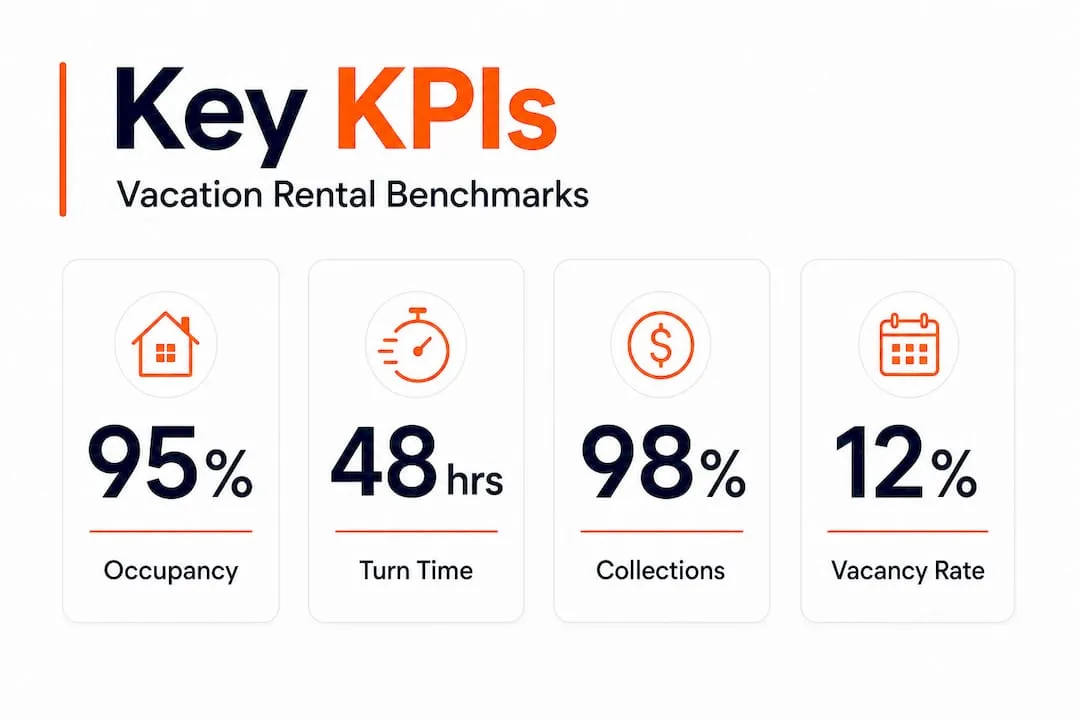
Traditional vs. enterprise property management
| Feature | Traditional management | Enterprise management |
|---|---|---|
| Portfolio size | 1 to 10 properties | 10 to 500+ properties |
| Data visibility | Manual reports, delayed | Real-time dashboards |
| Guest communication | Manual, reactive | Automated, proactive |
| Maintenance tracking | Phone/email requests | Ticketing system with escalation |
| Pricing strategy | Flat rate or simple seasonality | Dynamic pricing with analytics |
| Reporting | Monthly summaries | Live KPI monitoring |
| Team coordination | Informal, ad hoc | Structured workflows |
| Channel management | Manual updates | Integrated reservation management tools |
The shift from one model to the other is not just about adding software. It requires rethinking how your entire operation functions.
Key performance indicators that drive enterprise results
Once you understand what enterprise property management is, the next question is: what are you actually measuring? KPIs, or key performance indicators, are the specific numbers that tell you whether your operation is healthy or heading for trouble.
The most important KPIs in vacation rental portfolio management include:
- Occupancy rate: The percentage of available nights that are booked. Industry top performers often target 75% to 90% depending on market
- Average daily rate (ADR): What you earn per occupied night. This number, combined with occupancy, drives your overall revenue
- Revenue per available room (RevPAR): ADR multiplied by occupancy. This is the single best snapshot of overall financial performance
- Vacancy rate: Nights that went unbooked. High vacancy often signals a pricing or listing quality problem
- Net operating income (NOI): Total revenue minus all operating expenses. This is what actually lands in your pocket
- Maintenance response time: How quickly your team resolves reported issues. Slow response destroys guest reviews and owner trust
- Guest satisfaction score: Average ratings across platforms. Even a 0.2-point drop in your Airbnb rating can significantly impact booking volume
Meaningful KPIs require local benchmarks and directly affect pricing, staffing, and maintenance decisions. You cannot just compare your occupancy to a national average. A beach property in Florida in July and a mountain cabin in Colorado in January operate in completely different demand environments.
Sample KPI benchmarks for vacation rentals
| KPI | Below average | Average | Top performer |
|---|---|---|---|
| Occupancy rate | Under 60% | 60% to 74% | 75% and above |
| ADR growth year over year | Flat or declining | 1% to 3% | 5% and above |
| Maintenance response time | Over 48 hours | 24 to 48 hours | Under 12 hours |
| Guest satisfaction score | Below 4.5 | 4.5 to 4.7 | 4.8 and above |
| NOI margin | Under 30% | 30% to 45% | 45% and above |
Properties that actively monitor vacation rental analytics and benchmark against local comps consistently outperform those that manage by instinct alone. The data is not just a report card. It is an early warning system and a decision-making engine.
Properties that track and act on performance data regularly see measurably stronger occupancy and revenue outcomes compared to those relying on manual tracking alone.
The real power of KPI tracking comes from the cadence. Reviewing numbers monthly is better than never. Reviewing them weekly is far better than monthly. Real-time access, which enterprise platforms provide, means you can catch a pricing issue on a Tuesday and fix it before the weekend rush. That kind of agility is simply not possible with traditional management tools.
How technology transforms operations
Understanding the metrics is just one part. How managers act on them through technology is the real game-changer.
Technology in enterprise property management is not about using more apps. It is about building an integrated stack where each tool feeds data into a central brain. Here is how that typically breaks down across key operational categories:
- Reservation management: Connect all your booking channels into one system. Changes to availability, pricing, or house rules sync automatically so you never deal with double bookings or outdated listings
- Dynamic pricing automation: Algorithms monitor demand, local events, competitor rates, and historical patterns to adjust your nightly rates without manual intervention. This alone can lift revenue by 10% to 25%
- Centralized guest communication: AI-driven messaging handles pre-arrival instructions, check-in reminders, mid-stay check-ins, and review requests. Your team focuses on exceptions, not routine messages
- Maintenance ticketing and escalation: When a guest reports a broken appliance or a cleaning issue, the platform creates a ticket, assigns it to the right vendor, tracks resolution, and notifies the owner automatically
- Owner reporting and transparency: Owners receive automated performance reports with occupancy, revenue, expenses, and maintenance history. This builds trust and reduces back-and-forth communication
- Analytics and forecasting: Dashboards surface patterns in booking lead times, seasonal demand, and channel performance so you can make smarter decisions about pricing and marketing spend
Operational dashboards and analytics support pricing, staffing, and maintenance decisions at a level of precision that manual processes simply cannot match. The data tells you not just what happened, but what is likely to happen next.
Pro Tip: Resist the urge to bolt on every available tool one by one. A portfolio running on six disconnected apps creates more data chaos than clarity. Look for advanced property management tools that unify operations in a single platform before adding specialized integrations.
Modern online reservation systems have matured significantly, and the best ones now handle far more than just booking confirmations. They serve as the entry point for a guest’s entire journey, from discovery through post-stay review requests.
Consider a real-world scenario: a vacation rental company managing 60 properties across three markets previously relied on a mix of manual scheduling, email chains with cleaners, and a shared Google calendar for reservations. After migrating to an integrated platform, they automated 80% of guest communications, reduced maintenance response time from 36 hours to under 10, and saw their average guest score climb from 4.6 to 4.9 within two quarters. Revenue increased not because they raised rates dramatically, but because fewer gaps, faster responses, and better reviews drove more bookings.

Is enterprise property management right for your portfolio?
So, when does it make sense to move from traditional management to an enterprise solution?
The honest answer is: earlier than most people think. Here are the clear signs that your operation is ready for an enterprise approach:
- You manage five or more properties and spend more than two hours daily on coordination tasks
- Your team uses multiple disconnected tools and still relies on text messages or phone calls to coordinate work
- You cannot tell at a glance what your occupancy rate is across your full portfolio right now
- Maintenance issues are discovered by guests rather than flagged proactively by your team
- Owner reporting takes more than 30 minutes per property per month to prepare manually
- You want to grow but feel like adding more properties would just add more chaos
Enterprise property managers use benchmarks to optimize portfolio outcomes at scale, and the structure they build makes growth manageable rather than overwhelming.
The pros and cons are worth thinking through honestly. Centralized control means faster decisions, consistent standards, and clear accountability. The tradeoff is that enterprise systems require upfront investment in both money and training time. Smaller operators may find the feature set exceeds their current needs. But if your goal is to grow, building enterprise habits now is far cheaper than retrofitting them later when you have 50 properties in chaos.
Pro Tip: Start by documenting your current KPIs, even imperfectly. Calculate your occupancy rate, your average response time to maintenance requests, and your NOI for the last quarter. Those three numbers alone will tell you whether you are operating at enterprise standards or managing by feel. Many operators are surprised to find their numbers worse than they assumed. That gap is exactly what enterprise systems are designed to close.
The guest experience improvements that enterprise management enables go well beyond faster check-ins. Guests notice when communication is consistent, when properties are perfectly prepared, and when issues get resolved without drama. Those experiences generate the reviews and repeat bookings that compound revenue over time.
What most guides miss about enterprise property management
Most guides treat enterprise property management as a technology selection problem. They list software categories, recommend features to look for, and suggest you pick the right platform and everything falls into place. That framing misses the most important truth.
Enterprise property management is fundamentally a cultural and operational challenge, not a software challenge. The best platform in the world fails if your team does not trust the data it produces, does not know how to interpret what they are seeing, or defaults to old habits when the system flags something unexpected.
We have seen this pattern repeatedly. An operator invests in a sophisticated platform, imports all their properties, sets up dashboards, and then three months later, their team is still texting each other about maintenance tasks because “it’s faster.” The software is running. The operation is not.
The real work is training people to act on data rather than instinct, to trust automated workflows rather than working around them, and to treat dashboard alerts as a management priority rather than background noise. That requires leadership commitment, not just a software subscription.
The other overlooked pitfall is automation running ahead of judgment. Just because a pricing algorithm can update rates every hour does not mean every property should have that turned on at maximum sensitivity. Dynamic pricing with no human review can create wild rate swings that confuse guests or undercut your positioning. Automation works best when it handles volume and speed, and humans handle nuance and exceptions.
The enterprise platform insights that separate high-performing operators from average ones come from building the right operational culture around the tools, not just deploying the tools themselves. The technology amplifies whatever is already in your process. Strong process plus great technology creates exceptional results. Weak process plus great technology creates expensive chaos.
Next steps: Empower your vacation rental portfolio
Ready to bring high-performance management to your properties? Here’s how to start.
The gap between where your operation is today and where enterprise management can take it is closer than you think. The frameworks, KPIs, and automation capabilities described in this article are not reserved for large corporate operators.
Realtevoos brings all of it together in one place: real-time analytics, AI-powered guest communications, automated maintenance workflows, and owner reporting built for scale. Whether you manage 5 properties or 500, the enterprise command center gives you the visibility and control to make faster, smarter decisions while reducing the manual labor that limits growth. Book a demo and see how your current operation benchmarks against top performers in your market.
Frequently asked questions
What types of properties benefit most from enterprise property management?
Large portfolios, multi-unit vacation rentals, and investors seeking efficiency and data insight gain the most from enterprise management. As enterprise KPI benchmarking shows, scale amplifies every operational advantage.
How does enterprise property management boost profitability?
By tracking data-driven KPIs and optimizing pricing, staffing, and maintenance, operators can reduce costs and maximize revenue. Dashboards and analytics translate performance data directly into smarter business decisions.
Is specialized software necessary for enterprise property management?
Yes, integrated platforms enable automation, reporting, and centralized control necessary for scale and operational efficiency. Enterprise management systems are built on data-driven analytics and tech integration that manual processes cannot replicate.
Can smaller property owners use enterprise management solutions?
Smaller operations can benefit significantly if they plan to scale or want advanced features. Even small portfolios gain from benchmarking and analytics when growth is the goal, though very limited portfolios may find some features exceed their immediate needs.