Property Maintenance Tips for Managers in 2026
Discover essential property maintenance tips for managers in 2026. Learn effective strategies to boost efficiency and keep your rentals thriving.

Property Maintenance Tips for Managers in 2026
Vacation rental properties operate on tight turnaround windows. A guest checks out at 11 a.m. and another arrives at 3 p.m., which leaves almost no margin for discovering a leaking faucet or a malfunctioning HVAC unit mid-changeover. The property maintenance tips for managers covered here go beyond basic to-do lists. They address the operational frameworks, inspection cadences, and digital tools that separate properties with glowing reviews from those hemorrhaging costly repair calls and one-star complaints. If you manage multiple vacation rentals and want a maintenance program that actually holds up under pressure, this is built for you.
Table of Contents
- Key takeaways
- 1. Property maintenance tips for managers: the criteria that actually matter
- 2. The five inspection zones every vacation rental manager needs
- 3. Building an effective maintenance checklist for managers
- 4. Manual coordination vs. digital work order systems
- 5. Preventive maintenance scheduling that actually prevents things
- What I’ve learned about vacation rental maintenance the hard way
- How Realtevoos helps you run a tighter maintenance operation
- FAQ
Key takeaways
| Point | Details |
|---|---|
| Structured inspection cadences matter | Turnover, monthly, and seasonal inspections each serve a distinct purpose and must all run consistently. |
| Checklist zones drive accountability | Organize inspections by zone: bathrooms, HVAC, exterior, appliances, and safety equipment. |
| Digital work orders close the loop | CMMS platforms convert informal repair requests into trackable, documented tasks with assigned ownership. |
| Multi-trigger PM outperforms calendars | Preventive maintenance tied to usage and condition data cuts unplanned failures by 30 to 40 percent. |
| KPIs must reflect reliability, not compliance | Track outcome-based metrics like mean time between failures, not just whether tasks got checked off. |
1. Property maintenance tips for managers: the criteria that actually matter
Before you build or overhaul any maintenance program, you need clear criteria for what “good” looks like. In vacation rental facilities management, that starts with three non-negotiables: inspection cadence, lifecycle management, and accountability.
Inspection cadence means having a defined schedule at every level. Turnover inspections, monthly safety checks, and seasonal tasks like HVAC servicing and gutter clearing are not interchangeable. Each targets a different failure window. A structured cadence for multi-property managers includes monthly work order reviews, quarterly vendor assessments, semi-annual building inspections, and annual capital planning audits.
Lifecycle management means every repair request travels a defined path from submission to verified completion. Gaps in ownership at each lifecycle step are the leading cause of lost work orders and unresolved issues. You cannot rely on a text thread to confirm a job is actually done.
Accountability comes from documentation. Assigned tasks, timestamped records, and photo confirmation give you audit-ready data and protect you if a guest files a damage or injury claim.
- Define who submits maintenance requests and through what channel
- Set response time targets by priority level (urgent, routine, planned)
- Require photo documentation at task open and close
- Review open work orders weekly at minimum
Pro Tip: Build your criteria before selecting any software. A tool is only as good as the process it supports.
2. The five inspection zones every vacation rental manager needs
Think of every turnover inspection as a diagnostic sweep, not a visual scan. Turnover inspections must be checklist-enforced to catch problems before the next guest checks in. A quick walk-through misses the slow drain, the tripped GFCI, and the smoke detector with a dying battery.
Here are the five zones that generate the most guest complaints and the highest repair costs when neglected:
-
Bathrooms and plumbing. Check drain flow, toilet flush, faucet seals, and water pressure at every turnover. Monthly, look for signs of slow leaks under sinks and around toilet bases. Water damage compounds fast in occupied rentals.
-
HVAC and electrical. HVAC, electrical, and mechanical failures generate a disproportionate share of negative reviews and emergency costs. Replace filters on a defined schedule, not when someone remembers. Test GFCI outlets monthly.
-
Exterior and structure. Seasonal tasks here include clearing gutters, inspecting the roof after storm season, checking walkways for trip hazards, and treating for pests. These are easy to defer and expensive when deferred too long.
-
Appliances. Run every appliance at turnover. A dishwasher that fails on night one of a week-long booking is a one-star review in the making. Check seals, burners, ice makers, and washer/dryer cycles.
-
Safety equipment. Smoke detectors, carbon monoxide detectors, fire extinguishers, and emergency lighting fall under non-negotiables. Test them monthly, document the result, and replace batteries on a fixed interval rather than waiting for alerts.
Pro Tip: Create a laminated zone checklist for each property and require photo uploads for each zone before closing the turnover work order. This takes two extra minutes and saves hours of dispute resolution.
3. Building an effective maintenance checklist for managers
A maintenance checklist for managers only works if it matches the frequency and complexity of the work being done. Generic templates often collapse everything into a single monthly list, which buries urgent tasks under routine ones.
Structure your checklists by frequency:
At every turnover. Zone sweep across all five areas above. Document condition with photos. Flag any issue for a scheduled repair or urgent response before check-in.
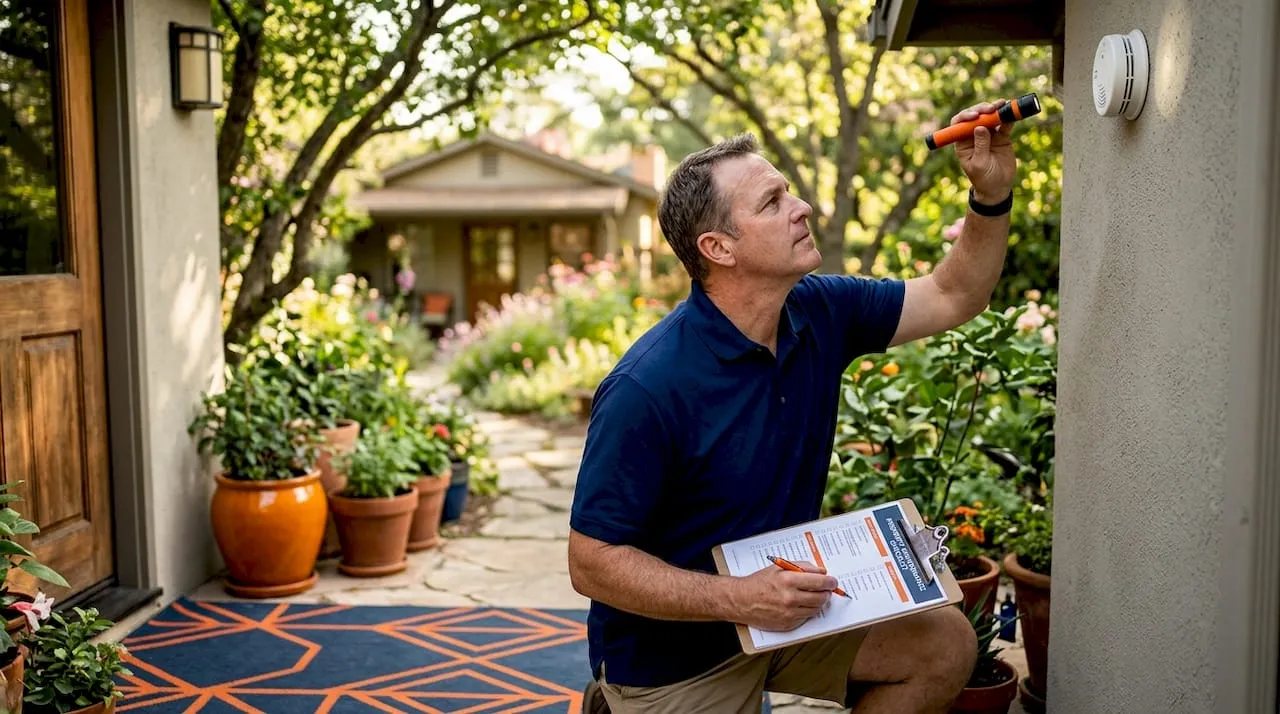
Monthly. Test all safety equipment. Inspect GFCI outlets. Check under-sink plumbing. Review open work orders and close any that have stalled. A monthly inspection cadence aligned with operational needs also includes vendor performance reviews to catch contractors who are underperforming before they cost you a guest relationship.
Seasonally. Service HVAC before peak use periods. Clear gutters in fall and spring. Schedule pest control before warm months. Inspect exterior paint, caulking, and weatherstripping annually. These tasks are time-sensitive. Scheduling them in a seasonal property maintenance guide format with calendar alerts prevents the “we meant to do that” deferrals that pile up into capital repair bills.
The goal is a checklist system where every task has a defined frequency, an owner, and a completion record. Anything less is a wish list.
4. Manual coordination vs. digital work order systems
This is where many vacation rental managers get stuck. The informal approach, sending texts and emails to vendors and cleaners, feels fast. It rarely is.
| Factor | Manual (text/email) | CMMS-enabled digital |
|---|---|---|
| Work order creation | Ad hoc, often undocumented | Auto-generated in under 60 seconds |
| Task assignment | Verbal or text-based | Digital with skill-based routing |
| Completion verification | Assumed or followed up manually | Photo confirmation with timestamp |
| Repeat repair tracking | Not visible | Logged and flagged automatically |
| Audit readiness | Poor | Full documentation trail |
Manual text-based coordination leads to unassigned and unverified repairs at a rate that surprises most managers when they first see the data. One missed confirmation, and a guest arrives to find nothing was actually fixed.
A properly configured CMMS converts every request into a classified, prioritized work order. CMMS systems create work orders in under 60 seconds, with assignment, documentation, and escalation built in. For managers running five or more properties remotely, this shift alone changes the guest experience measurably.
The secondary benefit is data. Digital systems surface patterns. If a specific property generates three plumbing work orders per quarter, you have the evidence to justify a capital repair rather than another band-aid fix.
5. Preventive maintenance scheduling that actually prevents things
Most preventive maintenance programs fail for one reason: they are built around calendar dates and compliance counts rather than asset behavior. Checking a box that says “HVAC serviced in April” does not tell you whether the unit is likely to fail in July.
Effective PM scheduling uses multi-trigger methods that combine time intervals, usage hours, and condition data. This approach achieves PM compliance above 90 percent and reduces unplanned failures by 30 to 40 percent compared to calendar-only programs.
Here is what a well-configured preventive maintenance program looks like in practice:
- Asset inventory first. You cannot schedule maintenance for assets you haven’t cataloged. Every HVAC unit, appliance, water heater, and smoke detector needs a record.
- Criticality ranking. Not all assets carry equal risk. HVAC failure in August at a beach rental is a critical guest impact. A loose cabinet hinge is not. Matching PM strategy to asset criticality prevents over-scheduling low-risk items while under-protecting high-risk ones.
- Multi-trigger configuration. Set PM tasks to trigger on time, usage, or condition signals. A water heater that runs 12 months a year needs different scheduling than a pool heater used only in summer.
- Outcome-based KPIs. Optimizing for compliance counts instead of reliability is one of the most common PM pitfalls. Track mean time between failures and use it to retire PM tasks that are not reducing failure rates.
- Technician training. Technician training depth directly affects PM outcomes. A technician who cannot identify early signs of wear during a PM task defeats the purpose of the schedule.
- Annual review. Every PM program needs a yearly audit to add, modify, or retire tasks based on actual failure data.
| PM task type | Trigger method | Best use case |
|---|---|---|
| Time-based | Fixed calendar interval | Smoke detector battery replacement |
| Usage-based | Occupancy hours or cycles | Appliance servicing after X bookings |
| Condition-based | Sensor or inspection signal | HVAC filter replacement by airflow reading |
Pro Tip: When you set up a PM task in your CMMS, write the acceptance criteria in the task itself. “Filter replaced and unit cycling normally” is a completion standard. “HVAC serviced” is not.
Explore how predictive maintenance for vacation rentals extends these PM principles further using condition monitoring and data-driven scheduling.
What I’ve learned about vacation rental maintenance the hard way
I’ve reviewed a lot of vacation rental maintenance programs, and the pattern is almost always the same. Managers who struggle are not lazy or uninformed. They’re just running on informal systems that worked fine at two properties and fell apart at six.
The biggest misconception I see is treating turnover inspections as a housekeeping add-on. Cleaners notice obvious problems. They are not trained to diagnose a failing water heater or test electrical outlets. Turnover inspections need to be a separate, checklist-driven process with a dedicated owner. When they aren’t, the deferred issues compound quietly until a guest surfaces them in a review.
The second thing I’ve learned is that seasonal maintenance deferrals have a tax. Skipping gutter clearing or HVAC pre-season servicing feels like a cost saving in the moment. It rarely is. The emergency call in peak season costs three times the planned service, plus you’re dealing with it while your inbox is full of guest requests.
What I’ve found genuinely changes outcomes is giving managers portfolio-wide maintenance visibility through centralized reporting. When you can see all open work orders, overdue PM tasks, and vendor response times in one place, you stop managing by memory and start managing by data.
The inspection cadence piece matters more than most managers expect. Over-inspection burns out your team and trains them to rush through checklists. Under-inspection lets hidden backlogs grow. The right frequency depends on property age, occupancy rate, and asset condition, not a generic template.
— Jose
How Realtevoos helps you run a tighter maintenance operation

Realtevoos was built specifically for vacation rental operators who need more than a spreadsheet to manage maintenance across a portfolio. The platform centralizes work order creation, tracks open and overdue tasks in real time, and automates PM scheduling so nothing falls through the cracks between bookings.
You can assign turnover inspections to specific team members with zone-level checklists, require photo documentation before a task closes, and get escalation alerts when a seasonal task approaches its deadline. For managers running properties on Airbnb and Vrbo, Realtevoos pulls booking data to trigger usage-based PM tasks automatically.
The result is fewer repeat repairs, faster resolution times, and guest experiences that hold up under scrutiny. See how Realtevoos supports your operation from inspection to invoice.
FAQ
What are the most important property maintenance tips for managers?
Focus on three fundamentals: structured inspection cadences at turnover, monthly, and seasonal intervals; digital work order management with photo verification; and preventive maintenance scheduling tied to asset criticality rather than calendar dates alone.
How often should vacation rental properties be inspected?
Vacation rentals require a turnover inspection at every checkout, monthly safety checks covering detectors and electrical outlets, and seasonal inspections addressing HVAC, gutters, and pest control.
What is a CMMS and why does it matter for vacation rental managers?
A CMMS (computerized maintenance management system) converts informal repair requests into tracked, assigned, and documented work orders. It prevents the lost and unverified repairs that manual text coordination routinely produces.
How do I build a maintenance checklist for managers of multiple properties?
Organize checklists by frequency and zone rather than by property. Use a consistent five-zone structure covering plumbing, HVAC and electrical, exterior, appliances, and safety equipment, and assign a clear owner and completion standard to every task.
What KPIs should vacation rental managers track for maintenance performance?
Track mean time between failures, work order completion rate by priority level, and repeat repair frequency. Outcome-based KPIs reveal whether your PM program is actually reducing failures, not just generating completed tasks.