Handling Owner Disputes Step by Step: A Manager's Playbook
Master the essential steps in handling owner disputes effectively, minimizing risks while ensuring smooth operations within 24 hours.

Handling Owner Disputes Step by Step: A Manager’s Playbook
The first 24 hours decide whether an owner dispute stays a minor operational hiccup or turns into a contract termination; understanding the hotel check-in process workflow can offer operational best practices to reduce guest-related disputes. Acknowledge the complaint in writing within 24 hours, pause any unilateral action that could make the situation worse (don’t authorize a repair, adjust a payout, or change a listing without sign-off), and open an evidence log the moment the complaint lands. That’s the entire triage move. Everything else in handling owner disputes step by step builds on getting those three actions right in the first day.
Here’s the checklist your on-duty staff should be able to copy straight into a ticket:
- Acknowledge: Send a written response within 24 hours confirming you’ve received the concern and are looking into it.
- Pause: Freeze any pending charges, repairs, or listing changes tied to the dispute until you understand the full picture.
- Document: Open a dedicated file or ticket and start logging every message, timestamp, and document related to the issue.
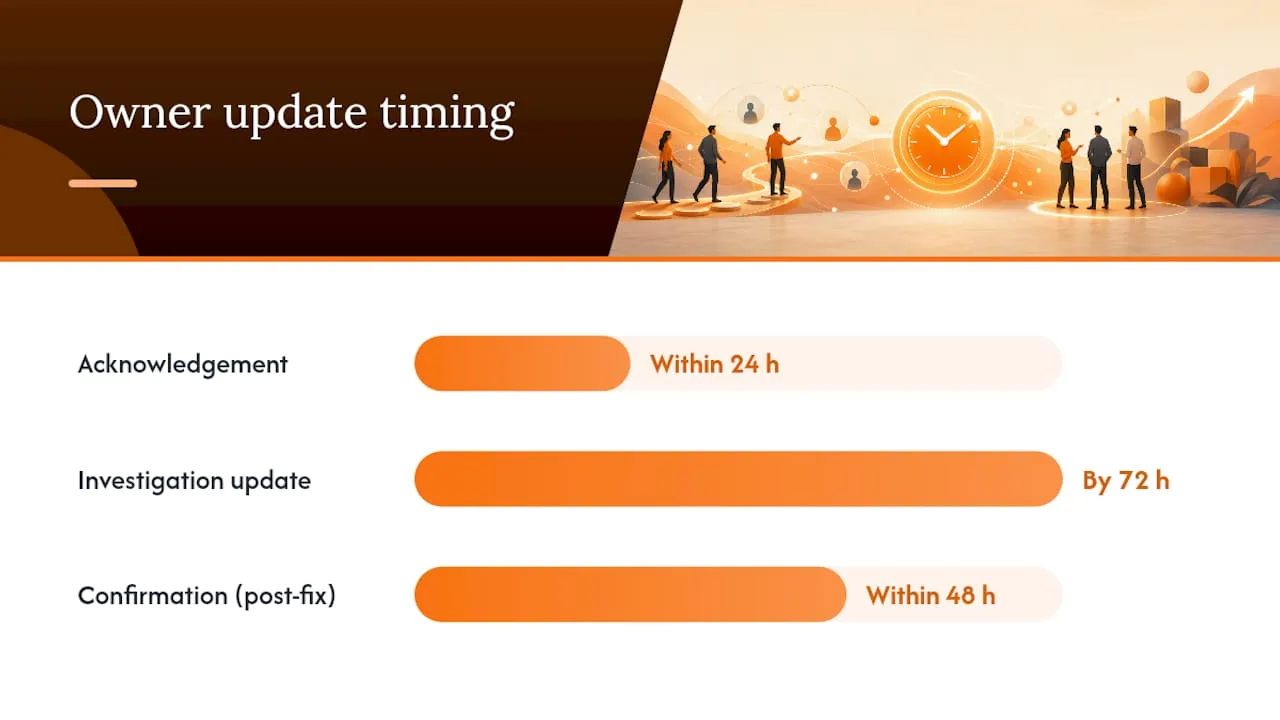
Set the timeline out loud, in writing, to the owner: initial response within 24 hours, an investigation status update by 72 hours, and a target resolution window after that. Industry data backs up why this speed matters: a large majority of property managers rank owner retention as their top priority, and most owner-manager breakups trace back to misaligned expectations, not actual performance failures. A fast, structured response is often the difference between a resolved complaint and a lost contract.
Table of Contents
- Step-By-Step Workflow: From First Contact To Closure
- What Evidence Should You Gather And How Long Should You Keep It?
- How Do You Match A Remedy To What The Owner Actually Wants?
- Communication Templates That Keep Owners Calm
- Contract Language And Onboarding Fixes That Stop Repeat Disputes
- When Should You Escalate Beyond Internal Resolution?
- How Dashboards And Automation Close The Transparency Gap
- How Do You De-Escalate An Angry Or Emotional Owner?
- What Happens After The Dispute Is Resolved?
- How Should You Train Staff To Handle Owner Disputes?
- What Mistakes Make Owner Disputes Worse?
- Why Dispute Handling Is Really Owner-Retention Work
- See How RealtevoOS Handles The Hard Parts For You
- Sources
Step-By-Step Workflow: From First Contact To Closure
Handling owner disputes step by step means running the same six-stage process every time, regardless of whether the complaint is about a $40 cleaning fee or a $4,000 damage claim.
- Triage — Acknowledge, pause, and log within 24 hours.
- Investigate — Pull records, interview staff, and confirm what actually happened (target: 48 to 72 hours).
- Propose a solution — Draft a remedy that fits the facts and the owner’s priorities.
- Implement — Execute the fix once the owner signs off.
- Verify — Confirm the owner and, if relevant, the guest agree the issue is closed.
- Close — File the dispute packet and update your onboarding notes if a pattern emerges.
Branching points come up constantly. If a guest damage claim exceeds the security deposit, you’re deciding between filing an insurance claim or covering the gap from a maintenance reserve. If an owner disputes a commission calculation, you’re pulling payout ledgers before you say a word. If two owners in the same building clash over guest noise or shared amenities, you’re mediating rather than fixing anything unilaterally.
| Task | Owner | Approval Threshold |
|---|---|---|
| Initial acknowledgement | Operations/guest services | None; send within 24 hours |
| Investigation and evidence pull | Maintenance lead or ops manager | None; complete within 72 hours |
| Repair or refund decision | Revenue manager | Owner sign-off required above $250–$500 |
| Contract or legal question | Owner relations/legal | Required before any settlement offer |
Most operational disputes (fee disagreements, minor maintenance delays, communication breakdowns) resolve in a typical resolution timeframe for operational disputes once investigation is complete once you’ve completed the investigation. Disputes touching contract interpretation or an insurance claim usually run closer to a typical resolution timeframe, due to waiting on third parties.
What Evidence Should You Gather And How Long Should You Keep It?
A dispute without documentation is just two people arguing about who remembers correctly. Build a single “dispute packet” the moment a complaint comes in, because assembling records before mediation materially reduces resolution time.
- Booking records and reservation history
- Guest and owner message threads, exported with timestamps
- Maintenance invoices and repair receipts
- Photos and video from before, during, and after the incident
- Smart lock or access logs, if the property has them
- Payout ledgers and bank or trust-account statements
| Document Type | Where To Store It | Minimum Retention |
|---|---|---|
| Message exports | Cloud folder + ticket entry | a recommended minimum retention period for message exports |
| Maintenance invoices | Cloud folder + accounting system | 3 to a retention period aligned with typical regulatory expectations for trust and escrow account statements (check local rules) |
| Trust/escrow statements | Restricted-access cloud folder | a retention period aligned with typical regulatory expectations for trust and escrow account statements |
| Photos/video evidence | Cloud folder linked to ticket | Duration of ownership relationship |
Keep everything in one source of truth, whether that’s a cloud folder tied to a ticket number or a property management platform that exports a PDF automatically. Restrict owner-sensitive files (bank statements, trust-account records) to whoever actually needs them for legal or accounting reasons. When you assemble evidence this way from day one, producing a dispute packet for mediation or insurance takes minutes, not a frantic afternoon of digging through email.
How Do You Match A Remedy To What The Owner Actually Wants?
Not every owner wants the same thing when something goes wrong, and offering the wrong remedy can turn a minor issue into a trust problem. This is where an Owner Mindset Matrix earns its keep: it maps owner priorities so your proposed fix actually lands.
Two dimensions matter most. First, is the owner an investor (focused on net yield and predictable returns) or a lifestyle owner (focused on the property’s condition and how it’s treated)? Second, does the owner prioritize high rate or high occupancy? Cross those, and you get four rough archetypes.
| Owner Archetype | What They Value | Remedy That Lands |
|---|---|---|
| Investor, high-occupancy | Consistent booking flow | Fee credit toward next booking cycle, no gaps in calendar |
| Investor, high-rate | Net revenue per stay | Direct refund or commission adjustment, transparent accounting |
| Lifestyle, high-occupancy | Property condition, guest care | Repair with before/after photos, personal update call |
| Lifestyle, high-rate | Property reputation and premium positioning | Detailed incident report plus proof of preventive fix |
An investor archetype usually wants a clean number: “Here’s the adjusted payout, and here’s the ledger showing why.” A lifestyle owner wants reassurance the property is being cared for: “Here’s what happened, here’s the repair, and here are photos confirming it’s fixed.” Matching your language to the archetype, not just the facts, is often what separates a five-minute phone call from a three-week email chain.
Communication Templates That Keep Owners Calm
Owners get anxious in the silence, not in the problem itself. A predictable cadence of short updates does more to prevent an owner dispute from escalating than any single perfectly worded message.
Acknowledgement (within 24 hours): “We’ve received your message about [issue] and have started looking into it. You’ll have a status update by [date, 72 hours out].”
Investigation status (72 hours): “Here’s what we’ve found so far: [summary]. We expect to have a proposed resolution by [date].”
Proposed remedy: “Based on our review, we’re proposing [specific fix]. Here’s the documentation supporting this decision: [link or attachment].”
Confirmation of resolution: “This issue is now resolved. Here’s a summary of what was done and when. Let us know if anything is unclear.”
| Checkpoint | Timing | Action |
|---|---|---|
| Initial acknowledgement | Within 24 hours | Confirm receipt, set next update date |
| Investigation update | By 72 hours | Share findings and proposed next step |
| Implementation | a typical resolution timeframe for operational disputes once investigation is complete | Execute agreed fix, notify owner |
| Confirmation | Within 48 hours of fix | Close the loop in writing |
Preempt the questions owners always ask: who pays for what, whether the dispute delays their payout, and where they can see the supporting evidence. Answering those three questions inside your first message cuts follow-up volume significantly.
Contract Language And Onboarding Fixes That Stop Repeat Disputes
Every recurring dispute usually traces back to a clause that was never written down clearly. A well-drafted management agreement defines scope, fees, listing ownership, and dispute-resolution steps before anyone needs them.
- Set a specific repair approval threshold in dollars (commonly a recommended repair approval threshold requiring owner sign-off for higher-cost repairs) above which the owner must sign off before work starts.
- State listing ownership explicitly. If the manager owns the Airbnb or Vrbo listing, say so in writing, including what happens to it at termination.
- Define commission calculation with an example, not just a percentage.
- Spell out who pays for guest-caused damage beyond the security deposit and how insurance claims get filed.
- Include a dispute-resolution clause naming mediation or arbitration as the first step before litigation.
- Set termination notice windows (a set notice window for termination, typically ranging from a month to several months) and what happens to bookings already on the calendar.
Onboarding checklist for new owners:
- Walk through expectations for reporting cadence and communication frequency.
- Collect proof of insurance and confirm coverage limits.
- Confirm who legally owns the listing on each platform.
- Record the owner’s priorities using the Owner Mindset Matrix so future remedies match their expectations from day one.
- Have both parties sign an amendment log for any changes made after the original contract.
Pro Tip: Keep an amendment sign-off template on hand so verbal agreements (“sure, go ahead and replace the mattress”) become written records instead of he-said-she-said arguments six months later.
When Should You Escalate Beyond Internal Resolution?
Some disputes can’t be solved with a phone call and a fee credit. Escalate when you see any of these:
- A material accounting discrepancy that internal review can’t explain.
- Any hint of fiduciary breach or commingled trust funds, since regulators and civil claims often follow trust-accounting problems.
- Guest-caused damage that exceeds the security deposit and the owner’s insurance won’t cover.
- An owner who refuses every reasonable remedy you’ve offered.
- An insurer denying a claim you believed was covered.
Rough expectations: mediation typically resolves in a few weeks and costs far less than litigation. Small claims court adds weeks to months depending on your local docket. Full litigation can stretch past a year and costs scale with complexity and how much discovery is involved. Time and cost both climb fast once lawyers are billing by the hour.
Before you escalate, assemble:
- A final demand letter stating exactly what you’re asking for and by when.
- The complete dispute packet: messages, invoices, photos, ledgers, timeline.
- Documented proof of your resolution attempts, including timestamps.
- Internal legal review sign-off confirming the case is ready to proceed.
How Dashboards And Automation Close The Transparency Gap
Most owner disputes start with a gap between what the owner believes is happening and what the operational data actually shows. Owners who can’t see real-time bookings, maintenance logs, or payout math tend to assume the worst, and assumptions escalate faster than facts do.
An owner-facing dashboard closes that gap by giving owners the same numbers you’re looking at. RealtevoOS supports this directly through:
- Owner-accessible dashboards showing occupancy, revenue, and maintenance status in real time.
- Automated maintenance logs that timestamp every repair and approval.
- Payout reconciliations owners can review without emailing to ask.
- One-click dispute packet exports pulling messages, invoices, and photos into a single file.
- Approval workflows that route repair requests above threshold to the owner automatically.
Pro Tip: Before dashboards, a $600 repair dispute could take two weeks of back-and-forth email to resolve. With real-time access to the same maintenance log and photos the manager sees, the same dispute often closes within a single call, because there’s nothing left to argue about.
Printable Checklist For The First 72 Hours
Paste this into your ticketing system for any new dispute:
- Hour 0 to 24: Acknowledge in writing, pause pending actions, open the evidence file.
- Hour 24 to 72: Pull records, interview involved staff, draft an investigation summary.
- Hour 72: Send status update to owner with findings and next steps.
- Day 7 to 14: Implement agreed remedy, confirm resolution in writing.
- Decision rule: Repairs above $250–$500 require owner sign-off before work begins.
- Decision rule: Pause payouts only when accounting discrepancies are unresolved, never as a default response.
How Do You De-Escalate An Angry Or Emotional Owner?
Owners who are yelling or firing off all-caps emails aren’t usually irrational. They’re scared about money or property condition, and fear reads as anger. Start every call by naming the concern back to them plainly: “You’re worried the damage wasn’t handled properly and you’re not sure what you’re paying for. Is that right?” Getting the owner to say “yes” resets the conversation from confrontation to collaboration.
Slow down your own responses. A rushed reply signals you’re trying to make the problem go away rather than actually solve it, and owners notice the difference. Stick to facts and documents rather than opinions: “Here’s the timestamp on the maintenance log” lands better than “I promise we handled this correctly.” When an owner is especially heated, move the conversation from text or email to a phone call. Tone carries information that a message thread can’t.
Never match the owner’s emotional register. If they raise their voice, lower yours. Silence after a hard question is fine. It gives the owner room to finish their thought instead of escalating to fill the gap.
What Happens After The Dispute Is Resolved?
Closing a dispute isn’t the same as closing the relationship. Send a written confirmation summarizing what was decided, when it was implemented, and where the owner can find the supporting documents if they want to double-check anything later.
Follow up again at the next reporting cycle, not just at closure. A quick line in the monthly owner report (“Following up on last month’s maintenance issue: everything’s been resolved and the unit has had no repeat problems”) shows the owner you’re still paying attention, not just relieved the complaint went away.
File the dispute in your internal system tagged by category (accounting, maintenance, guest damage, communication) so patterns become visible over time. If the same owner raises three maintenance concerns in six months, that’s not three disputes. That’s one operating-model mismatch worth a direct conversation.
How Should You Train Staff To Handle Owner Disputes?
Frontline staff need a script, not just good intentions. Build a short internal reference document covering the acknowledgement template, escalation thresholds, and approval limits so new hires aren’t guessing during their first real dispute.
Run quarterly role-play sessions using real (anonymized) past disputes. Staff who’ve practiced the de-escalation conversation out loud handle the real version far better than staff who’ve only read about it. Pair newer team members with a senior ops lead for their first few disputes, and require every closed dispute to get a five-minute debrief: what worked, what didn’t, and whether the contract or onboarding process needs a fix.
What Mistakes Make Owner Disputes Worse?
The single biggest mistake is silence. An owner who doesn’t hear from you for four days will assume you’re ignoring them, even if you’re actively working the case.
Other recurring pitfalls:
- Making a unilateral decision on refunds or repairs before the owner has weighed in, even when you’re confident you’re right.
- Verbal-only agreements. If it’s not in writing, it didn’t happen, and you’ll be relitigating it in six months.
- Treating every owner the same way. An investor archetype doesn’t want the same explanation a lifestyle owner does.
- Skipping the evidence log because the issue “seems minor,” then scrambling when it isn’t.
- Missing your own stated deadlines. A blown 72-hour update commitment damages trust more than the original issue did.
- Escalating too fast or too slow. Jumping to legal threats over a $50 fee dispute burns the relationship; sitting on a trust-accounting discrepancy for weeks invites regulatory attention.
Why Dispute Handling Is Really Owner-Retention Work
Most management companies file dispute resolution under customer service. That’s a mistake. Every dispute you handle well or badly gets weighed against every other property manager the owner has talked to, and against the mental math of just selling the property or self-managing.
The data backs this up: a large majority of property managers name owner retention as their top priority, and the relationships that fail usually fail on fit, not on any single mistake. A dispute is rarely the actual problem. It’s a symptom that expectations, reporting, or contract terms drifted out of alignment somewhere earlier.
That reframes what “resolution” should mean. Closing the ticket isn’t the finish line. The real question is whether this dispute reveals a gap in your onboarding process, your reporting cadence, or your contract language that will produce the same complaint from a different owner next quarter. Companies that treat disputes as diagnostic information, not just fires to put out, tend to see fewer emergency escalations over time and stronger owner retention, because they’re fixing root causes instead of individual symptoms.
The managers who handle disputes best aren’t the ones with the smoothest scripts. They’re the ones who go back and change something structural after every serious complaint.
See How RealtevoOS Handles The Hard Parts For You
Building a defensible evidence trail by hand, drafting owner updates from scratch, and chasing down payout ledgers eats hours you don’t have during an active dispute. RealtevoOS was built to remove that manual work entirely.

The platform gives owners a real-time dashboard so they see the same occupancy, maintenance, and payout data you do, which closes the transparency gap before it ever turns into a complaint. Automated maintenance logs timestamp every repair and approval automatically. Payout reconciliations update without a spreadsheet. And when a dispute does happen, one click exports a complete dispute packet, messages, invoices, photos, and ledgers, ready for the owner or a mediator to review. If you’re ready to see how that works with your own portfolio, check out the RealtevoOS command center and walk through a live demo.
Key Takeaways
Resolving owner disputes well requires fast acknowledgement, disciplined evidence collection, a remedy matched to the owner’s mindset, and contract fixes that stop the same complaint from recurring.
| Point | Details |
|---|---|
| Acknowledge within 24 hours | Respond in writing immediately and commit to a 72-hour investigation update. |
| Build a dispute packet from day one | Log messages, invoices, photos, and ledgers as the issue unfolds, not after. |
| Match remedies to owner archetype | Investors want clean numbers; lifestyle owners want proof the property is cared for. |
| Fix contracts and onboarding | Set repair thresholds, listing ownership, and dispute-resolution clauses up front. |
| Escalate on clear thresholds | Trust-account issues, uncooperative owners, or insurer denials warrant mediation or legal review. |
| Use dashboards to prevent repeats | RealtevoOS gives owners real-time access to the same data managers use, cutting disputes at the source. |
Sources
- Why So Many STR Owner-Property Manager Relationships Fall Apart
- Revenue management strategies for homeowners
- Sample Vacation Rental Property Management Agreement Template - LegalClarity
- Sandbridge Vacation Rental Disputes: Property Manager, HOA, and Insurance Fights - Shin Law Office