Maintenance Request Automation for Vacation Rentals
Discover what is maintenance request automation and how it streamlines property management, saves time, and enhances guest satisfaction.

Maintenance Request Automation for Vacation Rentals
Maintenance request automation is the process of using software-powered workflows to automatically manage property maintenance tasks from submission to completion, eliminating manual coordination at every step. For vacation rental property managers, this means no more phone tag with vendors, no more lost work orders, and no more guests waiting days for a response. The system handles intake, triage, routing, notifications, and closure without a staff member touching each step. Property managers report saving several hours each week once automated workflows replace manual processes. If you manage more than a handful of properties, understanding what is maintenance request automation is no longer optional. It is the difference between a portfolio that runs and one that grows.
What is maintenance request automation and how does it work?

Maintenance request automation is a rule-based workflow engine that replaces manual coordination with software-driven task management. The industry term for the broader category is computerized maintenance management, though most vacation rental operators encounter it through property management platforms with built-in automation modules. The core idea is simple: every maintenance event follows a defined path from submission to resolution, and software handles each handoff automatically.
The workflow moves through six distinct stages.
-
Intake. Guests or tenants submit requests through a portal, SMS, or email. The system parses the message, extracts the issue type and location, and creates a work order instantly. Automated portal submissions prevent duplicate requests and prefill work orders with all necessary details, removing the need for follow-up calls.
-
Triage. The system categorizes the request by urgency and type. A leaking pipe triggers an emergency flag. A burned-out lightbulb gets a routine label. This categorization happens in seconds, not after a coordinator reviews a voicemail.
-
Routing. Rule-based logic assigns the work order to the right vendor or technician based on skill, availability, and proximity. Automated routing cuts assignment time from 45–90 minutes down to under 3 minutes.
-
Communication. The system sends the guest or tenant an acknowledgment, then follows up with technician ETAs and status updates at each milestone. No staff member writes these messages manually.
-
Escalation. If a request goes overdue or an emergency is flagged, the system automatically notifies supervisors and reassigns the task. Escalation logic improves SLA compliance from 70% to over 95%.
-
Closure. Once the work is marked complete, the system sends a satisfaction survey, closes the work order, and logs the full audit trail.
Pro Tip: Set your escalation timer for emergency requests at 15 minutes, not 1 hour. Guests in a vacation rental with no hot water will leave a review before your coordinator checks email.
What are the key benefits of maintenance request automation?
The financial case for automated maintenance solutions is direct and measurable.
- Labor reduction. Maintenance coordination consumes 35–45% of property management staff time. Automated workflows cut that to under 12 minutes per request, a 74% reduction. Staff save 6–10 hours weekly per portfolio.
- Cost per request. Manual administrative overhead costs $75–$150 per maintenance request before any repair work begins, due to phone calls and data re-entry. Automation eliminates most of that overhead.
- Response time. Automated systems improve tenant-reported response times by up to 62%. Faster acknowledgment alone changes how guests perceive service quality.
- Satisfaction scores. The same data shows tenant satisfaction scores rise by 25–35% through automatic status updates. Guests feel informed, not ignored.
- Compliance and liability. Automation enforces standardized workflows with a tamper-proof audit trail. Every action is logged, timestamped, and retrievable for dispute resolution.
- Strategic focus. Automation shifts property managers from administrative firefighting to oversight, exception handling, and process refinement.
The last point is the one most managers underestimate. When your team stops manually dispatching every work order, they start noticing patterns: which vendor consistently runs late, which property generates the most HVAC calls, which season spikes emergency requests. That visibility is only possible when the routine work runs itself.
How to automate maintenance requests: implementation layers and best practices
A practical maintenance request system is built in layers, not deployed all at once. Seven layers make up a complete automated workflow: intake, triage, routing, communication, escalation, billing, and satisfaction. Not all of them deliver equal value at the start.
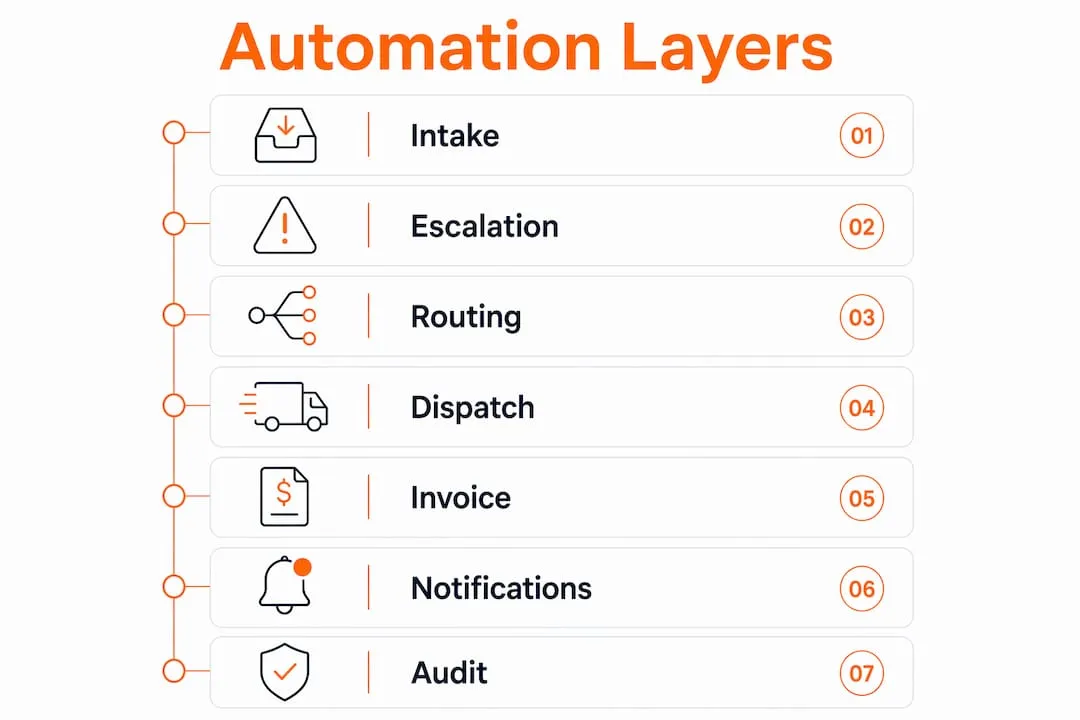
Prioritizing intake, emergency escalation, and tenant notifications yields the fastest return on investment. Here is how each layer stacks up in terms of implementation priority and impact.
| Automation layer | Priority | Primary benefit |
|---|---|---|
| Intake (portal, SMS, email parsing) | High | Eliminates manual data entry and duplicate requests |
| Emergency escalation | High | Reduces risk and SLA failures on urgent issues |
| Tenant milestone notifications | High | Drives satisfaction scores without staff effort |
| Rule-based routing | Medium | Cuts assignment time from hours to minutes |
| Triage and categorization | Medium | Ensures right urgency level reaches right team |
| Billing and invoice matching | Medium | Closes the vendor payment loop automatically |
| Satisfaction surveys | Lower | Captures feedback for continuous improvement |
Start with intake automation. Every other layer depends on clean, structured work order data arriving in the system. A request submitted through a portal with photos, location, and issue type gives the triage engine everything it needs. A request logged manually from a phone call introduces errors at every downstream step.
Vendor dispatch and invoice reconciliation work best as a closed-loop system. When a work order closes, the system matches the vendor invoice automatically, flags discrepancies, and queues payment. Treating maintenance and billing as one process removes an entire category of administrative work.
Pro Tip: Audit your routing rules every 90 days. Vendor availability changes, and a rule that assigned HVAC calls to your best contractor six months ago may now route to someone who is overbooked.
How does automation improve guest experience and reduce turnover?
Guest retention in vacation rentals depends more on communication quality during maintenance than on repair speed. That finding runs counter to what most property managers assume. Guests tolerate delays when they receive clear, timely updates. They leave negative reviews when they feel ignored.
Automated milestone notifications solve this directly. The system sends a confirmation when the request is received, an update when a technician is assigned, an ETA when the vendor is en route, and a follow-up when the job is complete. No staff member writes any of these messages. The guest experiences attentive service regardless of how busy your team is.
Transparent, frequent communication is the primary driver of guest satisfaction during maintenance events. Automation delivers that communication consistently, at scale, without adding headcount.
The financial stakes are real. Tenant turnover costs $3,000–$5,000+ per occurrence in a traditional rental context. In vacation rentals, the equivalent is a lost repeat booking, a one-star review, and a damaged listing ranking. Preventing even a handful of those outcomes per year more than covers the cost of an automated maintenance request system.
For property managers running vacation rentals on platforms like Airbnb and Vrbo, guest communication transparency directly affects review scores. A guest who receives three proactive updates during a minor repair is far more likely to leave a five-star review than one who had to call twice to find out what was happening.
- Real-time status updates reduce repeat calls and messages from guests.
- Automated ETAs set accurate expectations before guests ask.
- Satisfaction surveys after closure capture feedback while the experience is fresh.
- Consistent communication across all properties removes the variability that comes from relying on individual staff members.
Key Takeaways
Maintenance request automation delivers the highest return when intake, emergency escalation, and tenant communication are automated first, before billing or satisfaction layers.
| Point | Details |
|---|---|
| Automation cuts labor by 74% | Workflows reduce time per request from 47 minutes to under 12 minutes. |
| Response time improves by 62% | Automated acknowledgments and updates drive this gain, not faster repairs. |
| Tenant communication prevents turnover | Milestone notifications reduce costly guest churn more than repair speed does. |
| Compliance is built in | Tamper-proof audit trails protect managers in disputes and liability claims. |
| Start with intake and escalation | These two layers deliver the fastest ROI and enable every downstream automation. |
What I have learned managing maintenance at scale
The biggest mistake I see property managers make is treating automation as a digital version of what they already do manually. They replace a phone call with an email trigger and call it automated. Real automation means the system makes decisions, not just sends messages.
Scaling manual maintenance coordination breaks beyond roughly 150 units. I have watched portfolios hit that wall: requests get lost, dispatchers get overwhelmed, and response times collapse. The managers who avoid that collapse are the ones who built rule-based routing and escalation logic before they needed it, not after.
The other thing I have learned is that automation requires governance, not just setup. You cannot install a workflow engine and walk away. Vendor pools change. Urgency rules need tuning. A routing rule that worked perfectly for a 30-unit portfolio creates bottlenecks at 80 units. The managers who get the most from predictive and automated maintenance treat their workflow rules as living documents, reviewed quarterly.
Start with intake and emergency escalation. Get those two layers working cleanly before you touch billing or satisfaction surveys. The temptation to automate everything at once is real, but a partially automated workflow with gaps is worse than a manual one. At least with manual, you know where the handoffs are.
— Jose Villeda
How Realtevoos supports vacation rental maintenance automation
Realtevoos is built specifically for vacation rental property managers who need more than a generic work order system.
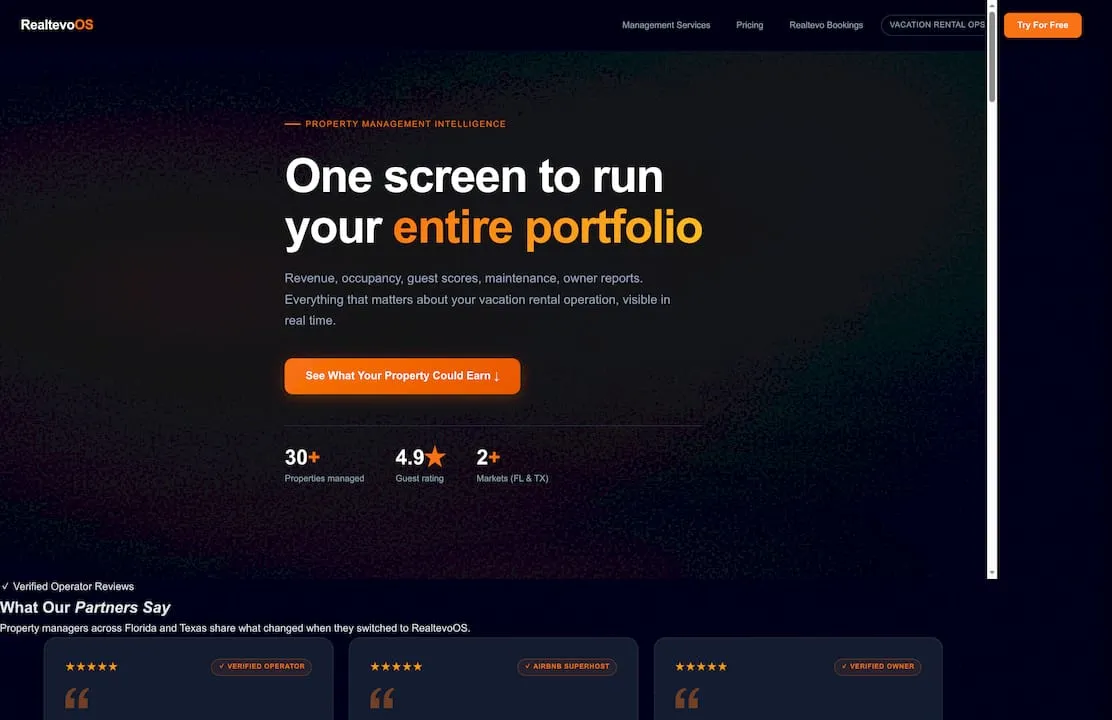
The Realtevoos Command Center consolidates automated intake, AI-powered routing, milestone notifications, and a centralized dashboard into one platform. It integrates directly with Airbnb and Vrbo data, so your maintenance workflows connect to your booking calendar and guest communication in real time. Property managers using Realtevoos report saving several hours each week while maintaining higher guest satisfaction scores across their portfolios. As your portfolio grows, the platform scales with it, applying the same governed workflow rules across every property without adding coordination overhead.
FAQ
What is maintenance request automation in simple terms?
Maintenance request automation is software that handles property maintenance tasks automatically, from the moment a guest submits a request through vendor assignment, status updates, and work order closure, without manual staff intervention at each step.
Why automate maintenance requests instead of managing them manually?
Manual coordination consumes 35–45% of property management staff time and costs $75–$150 per request in administrative overhead before any repair begins. Automation cuts that to under 12 minutes per request and reduces cost significantly.
How long does it take to see results from a maintenance request system?
Property managers who prioritize intake automation and emergency escalation first typically see measurable labor savings and improved guest satisfaction scores within 90 days of implementation.
Does automation help with compliance and liability?
Automated workflows enforce standardized procedures and generate a tamper-proof audit trail for every maintenance event, which protects property managers in disputes and liability claims.
Can automation work for small vacation rental portfolios?
Automation delivers value at any portfolio size, but the ROI accelerates as the portfolio grows. Even managers with 10–20 properties benefit from automated guest notifications and emergency escalation rules.