Property Managers: Automate Mid-Stay Cleaning for 14+ Night Stays
Automate mid-stay cleans with PMS triggers, route-aware scheduling, guest scripts, and copy-ready checklists to manage 14+ night bookings.
Property Managers: Automate Mid-Stay Cleaning for 14+ Night Stays
Offer a light mid-stay clean for stays of 5–7 nights, and automate recurring mid-stay cleans for stays of 14+ nights or luxury listings. That single threshold balances guest experience against crew workload: shorter stays rarely justify the disruption, while longer stays accumulate wear that hurts your reviews. The templates, scripts, and scheduling workflows below show you exactly how to build that rule into your operation.
TL;DR:
- Mid-stay cleans are most effective for stays of 7 days or longer, especially in humid climates or premium listings where maintenance impacts reviews.
- Recommendations suggest offering mid-stay cleanings proactively for stays of 7 to 13 nights, and scheduling recurring visits every 7 to 14 days for stays over 14 nights.
- Pricing should reflect actual crew time and travel, with flat fees for light refreshes and scaled rates for partial or full cleanings; bundling free cleans for longer stays can justify higher rates.
- Communicate visits with at least 24 hours’ notice, using specific time windows and clear instructions to minimize guest disruption and privacy concerns.
- Automating trigger-based scheduling and messaging through a property management system reduces manual effort and improves consistency across multiple units.
Table of Contents
- What Counts As a Mid-Stay Cleaning?
- Do the Benefits Outweigh the Hassle?
- How Often Should You Schedule Mid-Stay Cleans?
- What Should You Charge for a Mid-Stay Clean?
- How Do You Communicate Mid-Stay Visits Without Feeling Intrusive?
- How Do You Build This Into Your Scheduling Workflow?
- Your Copy-Ready Mid-Stay Checklist and Scripts
- Why Standardizing This Actually Changes Your Week
- Ready to Automate Your Mid-Stay Cleaning Schedule?
- Sources
What Counts As a Mid-Stay Cleaning?
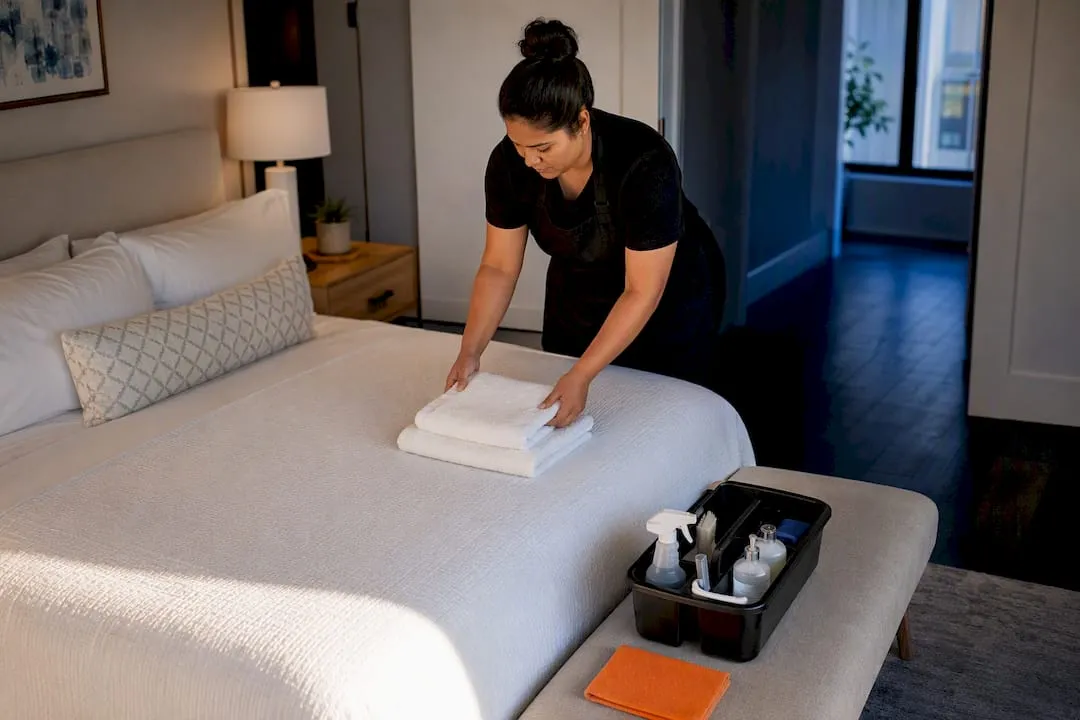
A mid-stay cleaning is a partial refresh performed while a guest is still in residence, not the full reset you run between reservations. It’s built around convenience, not deep sanitation, and Turno recommends hosts spell out the scope in writing so guests and cleaners share the same expectations.
A typical mid-stay visit runs 45 to 90 minutes with one cleaner, depending on square footage. What’s usually included:
- Fresh towels and linen swap
- Kitchen wipe-down and trash removal
- Bathroom refresh and restocking amenities
- Vacuuming high-traffic areas
What’s typically excluded: deep grout cleaning, oven interiors, closets, luggage areas, and anything requiring the guest to fully vacate for hours.
Do the Benefits Outweigh the Hassle?
Mid-stay cleans pay off in review scores, but they add real scheduling weight to your week. Guests on longer trips consistently rate stays higher when the property feels maintained rather than static, and a mid-week visit often catches a clogged drain or dying air filter before it becomes a maintenance ticket during checkout. Nearly 24% of cleaning tasks performed in 2025 were mid-stay cleanings rather than traditional turnovers, a sign this is now standard operating practice, not a niche perk.
The downsides are just as real:
- Extra crew hours and travel time per property
- Scheduling conflicts with your turnover calendar
- Guest privacy concerns if timing feels intrusive
- Harder to justify on short bookings where the math doesn’t work
Mid-stays deliver the most value on stays over a week, in hot or humid climates where towels and linens wear faster, and on premium listings where guests expect hotel-level upkeep.
Pro Tip: Track which properties generate the most mid-stay requests over a season. That pattern tells you where to build cleaning fees into your base rate instead of upselling it every time.
How Often Should You Schedule Mid-Stay Cleans?
Stay length should drive your cadence, not guesswork. Here’s a workable policy you can encode directly into your booking rules:
- 5–7 nights: Make it optional. Send an opt-in message around day 3 and let the guest decide.
- 7–13 nights: Recommend it proactively. Suggest a visit between day 3 and day 5, since tiered scripting by stay length tends to convert better when the offer lands early rather than as an afterthought.
- 14+ nights: Build it into the booking as recurring, scheduled every 7 to 14 days depending on property size and guest count.
Adjust the cadence for context. A studio with one occupant needs less frequent attention than a five-bedroom villa hosting a family of eight. Coastal or high-humidity climates justify tighter intervals because linens and bath areas grind through faster than they do in dry regions.
What Should You Charge for a Mid-Stay Clean?
Pricing needs to reflect actual crew time and travel, not a flat number pulled from a competitor’s listing. Three scopes work well for most portfolios:
- Tidy and linen refresh: the lightest tier, usually 30 to 45 minutes, priced as a flat add-on fee
- Partial refresh: covers kitchen and bath plus linens, priced per bedroom to scale with property size
- Near-turnover refresh: a fuller clean short of a true turnover, often bundled free into premium or multi-week stays as a retention perk
Set your price around real crew hours, drive time between properties, and the cost of restocking amenities, not around what feels competitive. If you’re still building your base fee structure, a cleaning fee strategy built around actual costs keeps mid-stay pricing from eating your margin. Many operators use the mid-stay clean itself as an upsell lever, bundling it free for stays over two weeks to justify a higher nightly rate.
How Do You Communicate Mid-Stay Visits Without Feeling Intrusive?
Notice matters more than almost anything else in this process. Give guests at least 24 hours’ notice before any scheduled visit, and specify an exact window rather than a vague “sometime Tuesday.” Airbnb’s own host guidance echoes the same point: clarity about your cleaning process prevents the awkward surprise of a stranger unlocking the door.
A simple four-message sequence covers most stays:
- Opt-in message (day 2 or 3): offer the clean and ask for a preferred window
- Included confirmation (for 14+ night bookings): confirm the date without asking permission, since it’s part of the stay
- Day-before reminder: restate the time window and any access instructions
- Reschedule message: triggered automatically if the guest requests a change
Set firm boundaries on what cleaners won’t touch: personal belongings, locked rooms, pets left alone in the unit, and anything resembling a photo of the guest’s items. Offering a two-hour window instead of a fixed hour measurably reduces complaints, since guests feel they retain some control over their day.
Pro Tip: Never schedule the first mid-stay message for the same day as check-in. Wait until day 2 so the guest has settled in before you ask them to plan around a cleaner.
How Do You Build This Into Your Scheduling Workflow?
Manual mid-stay scheduling collapses fast once you’re managing more than a handful of units. The fix is encoding your rules directly into your property management system or a dedicated cleaning app so the trigger fires automatically instead of relying on someone remembering to check a calendar.
- Set length-of-stay triggers. Configure day-of-stay rules (day 3 for a 7-night booking, day 7 for a 14-night booking) that fire the opt-in or confirmation message without manual review.
- Attach recurring task templates. Every mid-stay job should pull from a saved checklist and time estimate rather than getting built from scratch, which is how tasks get missed.
- Use route-aware scheduling. Platforms built for cleaning business scheduling apply travel-time buffers and conflict detection so a crew member isn’t double-booked across two properties fifteen minutes apart.
- Give crews a mobile app with GPS clock-in. This confirms arrival times against the promised window and gives you a paper trail if a guest disputes access.
- Support single-occurrence overrides. A guest requesting to skip or reschedule one visit shouldn’t force you to rebuild the entire recurring series, a detail that trips up managers using spreadsheet-based schedules.
The trade-off between guest slot picks and host-assigned windows comes down to control versus flexibility. Letting guests pick from two or three preset windows keeps satisfaction high without opening your calendar to unlimited requests. If you’re coordinating this across multiple properties, structured team coordination prevents the same cleaner from getting assigned to conflicting routes on the same afternoon.
Hospitality operations outside vacation rentals face a similar coordination problem at check-in, and the workflow principles in hotel check-in process design translate directly: clear windows, predictable triggers, and a single source of truth for staff.
Your Copy-Ready Mid-Stay Checklist and Scripts
Room-by-room checklist with time estimates for a standard two-bedroom unit:
- Kitchen (10 minutes): wipe counters, empty trash, reload dish soap
- Bathrooms (15 minutes per bath): restock toiletries, swap towels, wipe surfaces
- Bedrooms (10 minutes each): swap linens if requested, tidy surfaces
- Common areas (10 minutes): vacuum high-traffic zones, straighten furniture
Crew briefing notes: never open closets, drawers, or luggage; never move personal items to clean under them; skip any room with a “do not disturb” sign regardless of the schedule.
Four messaging templates to build into your automation:
- Opt-in (5–7 nights): “Would you like a mid-stay tidy on [date]? It takes about an hour and includes fresh towels and a kitchen refresh.”
- Included confirmation (14+ nights): “Your mid-stay clean is scheduled for [date] between [window]. Let us know if you’d like to adjust the time.”
- Day-before reminder: “Reminder: our team will stop by tomorrow between [window] for your scheduled refresh.”
- Reschedule: “No problem, we’ve moved your clean to [new date]. Your next visit stays on the original schedule.”
Attach each template to its trigger inside your PMS so the message fires without you touching a keyboard, and link the checklist to your cleaning vendor onboarding so every new hire starts from the same standard.
Why Standardizing This Actually Changes Your Week
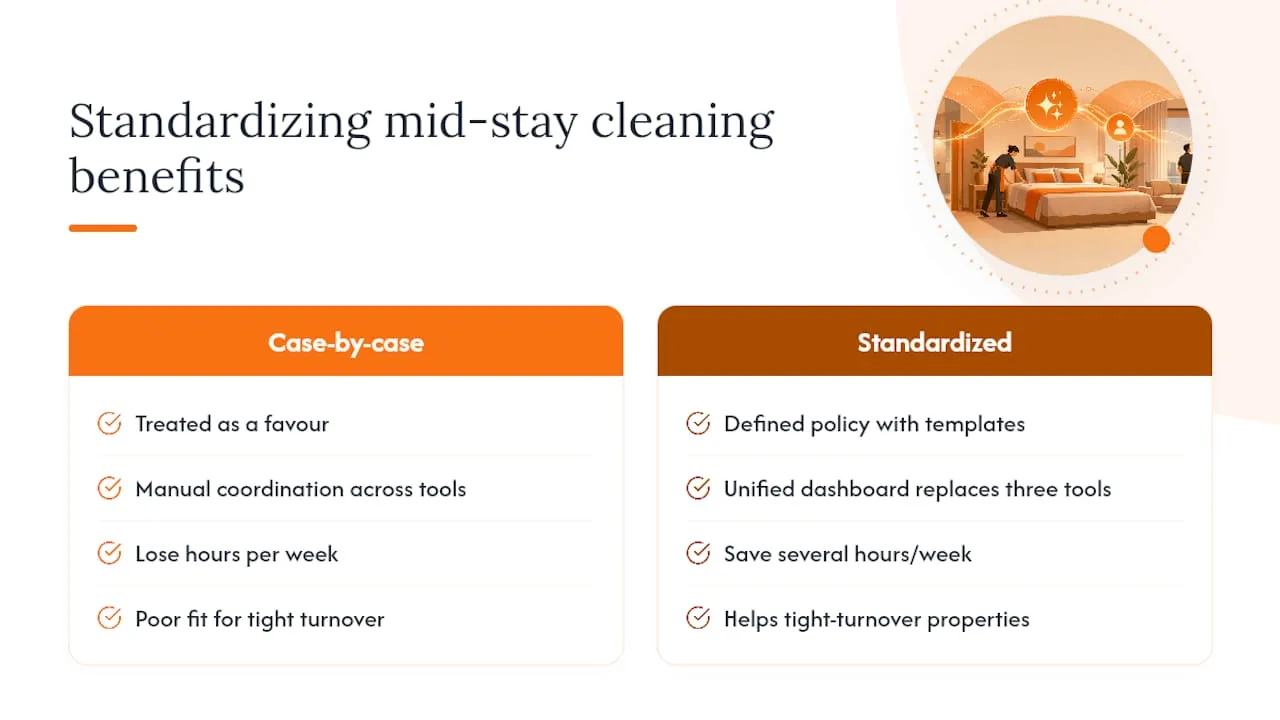
Most managers treat mid-stay cleaning as a case-by-case favor instead of a policy, and that’s the real inefficiency. I’ve watched operators lose hours every week re-negotiating the same conversation with every guest because nothing was templated. Jose Villeda, who covers vacation rental operations, points out that the properties benefiting most from mid-stay automation tend to be the ones already running tight turnover schedules, since the same routing and messaging logic simply extends outward.
Property managers using integrated platforms like RealtevoOS’s command center report saving several hours a week once guest messaging, task assignment, and booking-platform data sit in one dashboard instead of three separate tools. That’s not a marketing number, it’s the direct result of removing manual coordination from a repeatable process.
— Jose Villeda
Ready to Automate Your Mid-Stay Cleaning Schedule?
A modern platform can turn length-of-stay rules into automatic triggers, so a 14-night booking generates its cleaning tasks and guest messages without manual input.

Some platforms pull real-time booking data from Airbnb and Vrbo, then apply recurring task templates and messaging scripts automatically, from the opt-in message on day 3 to the day-before reminder. Cleaning crews receive assignments through a connected task view instead of a forwarded text chain, and exceptions, like a guest rescheduling one visit, don’t break the rest of the recurring pattern. If you’re managing more than a few units and still building this manually, start exploring RealtevoOS to see how the scheduling and messaging pieces connect to the rest of your operation.
Sources
- Should you offer mid-stay cleans at your short-term rental?
- Should You Schedule Mid-Stay Cleanings? (Turno)
- Scheduling Software for Cleaning Business | CleanerHQ
- Airbnb Mid-Stay Cleans: Scripts, Pricing, and Privacy That Guests Love | STR Specialist
- How to tell your guests about your cleaning process (Airbnb resources)