Operational Efficiency for Rentals: 2026 Guide
Discover what is operational efficiency for rentals in our 2026 guide. Learn to enhance profits, boost guest satisfaction, and streamline operations!

Operational Efficiency for Rentals: 2026 Guide
Operational efficiency for vacation rentals is defined as the practice of managing properties to reduce costs, minimize wasted time, and deliver consistent guest experiences across every booking cycle. Property managers who master this discipline do not just cut expenses. They build portfolios that outperform competitors on reviews, occupancy, and long-term revenue. Automated retention workflows can lift retention rates 10–15 percentage points within 90 days, which shows how directly operational management for rentals translates into measurable financial gains. Whether you manage three properties or three hundred, the principles are the same: control your inputs, measure your outputs, and remove friction at every step.
What is operational efficiency for rentals?
Operational efficiency for rentals is the industry’s shorthand for what property management professionals call operational excellence: the disciplined alignment of people, processes, and technology to produce the best possible outcome at the lowest sustainable cost. For vacation rental managers, that means every dollar spent on maintenance, every hour a unit sits vacant, and every guest communication either adds value or drains it.
The concept matters because vacation rental management is operationally dense. A single property requires cleaning coordination, maintenance tracking, dynamic pricing, guest messaging, and review management, often running in parallel. Multiply that across 20 or 50 units and the complexity compounds fast. Operational reporting platforms help managers identify bottlenecks and measure the impact of improvements in real time. Without that visibility, you are managing by instinct rather than data.

The financial stakes are real. Turnover costs per unit run $2,000–$5,000 when you factor in lost rent, cleaning, repairs, and re-booking fees. Reducing that number by even 20% across a 30-unit portfolio adds tens of thousands of dollars back to your bottom line annually.
What are the core components of rental operational efficiency?
Improving rental operations requires focusing on five interconnected areas. Neglect any one of them and the others degrade faster than you expect.
- Expense control. Proactive maintenance prevents the expensive emergencies that destroy margins. A $150 HVAC tune-up can prevent a $3,000 emergency replacement. That math is not complicated, but it requires scheduling discipline.
- Turnover management. The speed and quality of unit turns directly affect your occupancy rate. Standardizing renovation materials and scheduling cleaning crews in shifts produces faster, more predictable turns and cuts vacancy loss.
- Guest retention workflows. Automated renewal and re-engagement communications sent 90 days before a guest’s typical return window convert repeat visitors at a significantly higher rate than last-minute outreach.
- Technology integration. Smart devices, AI-driven task coordination, and property management platforms reduce manual labor and response times. Smart thermostats are identified as the single highest-ROI upgrade for multifamily energy efficiency, often qualifying for tax credits.
- Standardization and KPIs. Processes without standards drift. KPIs without processes are just numbers. You need both working together to sustain efficiency gains over time.
Pro Tip: Build a simple operations checklist for every unit turn: pre-arrival inspection, supply restock, appliance check, and photo documentation. Standardizing this one workflow alone reduces guest complaints by catching problems before check-in.
How can you measure operational efficiency in vacation rentals?
Revenue metrics like Average Daily Rate (ADR) and Revenue Per Available Room (RevPAR) tell you what happened. Operational KPIs tell you why. For portfolios beyond 50 units, revenue KPIs alone are insufficient as leading indicators of portfolio health.
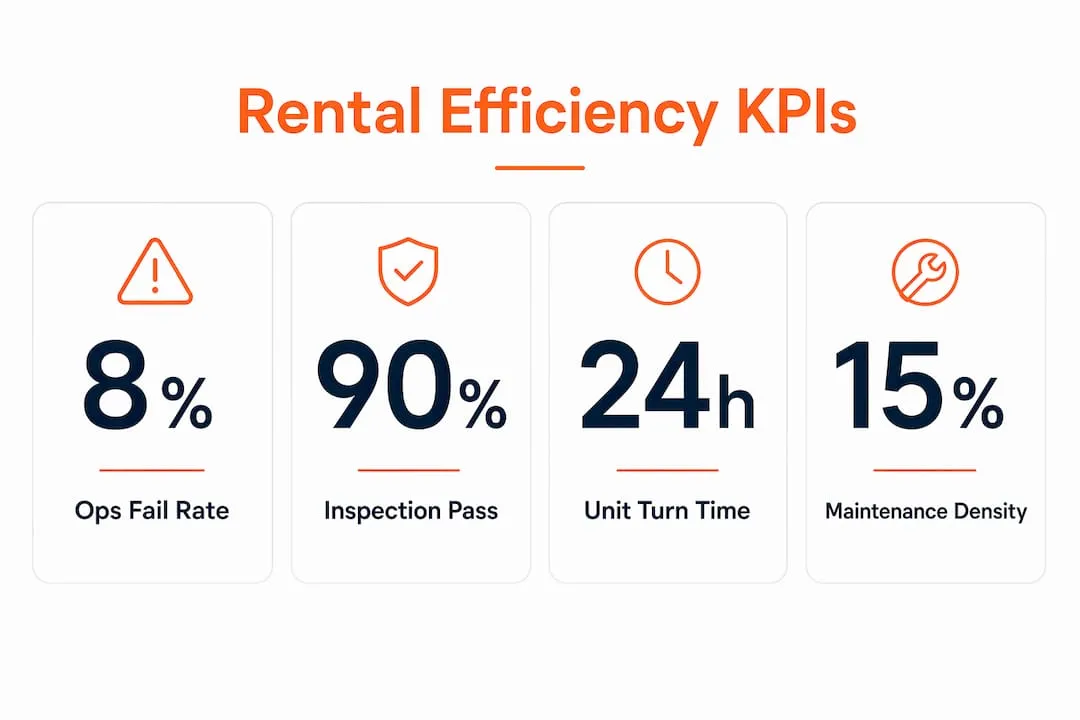
The metrics that actually predict performance are operational. Here are the ones worth tracking:
| KPI | What It Measures | Target Benchmark |
|---|---|---|
| Ops Failure Rate | Frequency of operational breakdowns per booking | Below 5% of stays |
| Inspection Pass Rate | Units passing pre-arrival inspection on first check | Above 90% |
| Unit Turn Time | Hours from guest checkout to next check-in ready | Under 4 hours |
| Maintenance Ticket Density | Open tickets per unit per month | Below 1.5 per unit |
| Guest Response Time | Average time to reply to guest inquiries | Under 1 hour |
The Ops Failure Rate deserves special attention. Building a failure taxonomy, meaning a categorized log of what went wrong and when, lets you spot patterns instead of just reacting to individual incidents. A 0.2-star rating drop linked to operational failures correlates with a 5–10% reduction in listing page views. Fewer page views means fewer bookings, which means lower revenue, all from a problem that started with a missed maintenance ticket.
Pro Tip: Review your Ops Failure Rate weekly, not monthly. Operational problems compound quickly in vacation rentals. Catching a pattern in week two prevents a bad month of reviews.
Execution metrics like unit turn time and inspection pass rate predict long-term financial health better than pricing KPIs alone. Price optimization cannot rescue a property with a 70% inspection pass rate and a 6-hour average turn time.
What strategies increase operational efficiency for vacation rental managers?
Rental efficiency strategies work best when they address the highest-cost friction points first. Here is a prioritized approach proven to move the needle on both costs and guest satisfaction.
-
Automate guest retention and re-engagement. Automated workflows that engage prospects within 2 hours convert at 3–4 times the rate of responses delayed by 24 or more hours. Apply the same logic to returning guests: automated re-engagement sequences sent before peak booking windows fill calendars before you need to discount.
-
Deploy smart property technology. Integrating smart thermostats and occupancy sensors can reduce HVAC runtime by up to 45%, directly lowering operating costs. Pair smart locks with automated check-in messaging to eliminate key handoff delays and reduce front-desk labor.
-
Standardize maintenance and turn procedures. Pre-kit supply closets with standard quantities of consumables for each unit size. Schedule cleaning crews in overlapping shifts so a delayed checkout does not cascade into a missed check-in. Operators who standardize materials report faster turns and fewer re-cleans.
-
Bring maintenance coordination in-house. In-house maintenance coordination provides tighter cost control and eliminates the unpredictable delays common in fully outsourced models. You do not need a full maintenance staff to benefit. Even a single in-house coordinator managing vendor relationships reduces scheduling slips and cost overruns.
-
Use micro-location data for pricing. Properties within the same market often have 15–30% price variance based on proximity to attractions, parking, or waterfront access. Data-driven pricing tools that incorporate micro-location premiums capture revenue that flat-rate or basic dynamic pricing leaves behind.
-
Automate late-fee and payment escalation. Automated escalation workflows for late-fee collection recover fees at an 85–95% rate, compared to 55–70% collected manually. That gap represents real revenue on every portfolio.
For a deeper look at how these strategies connect to revenue outcomes, the vacation rental revenue tips from the Realtevoos blog offer practical frameworks tied directly to operational execution.
What pitfalls undermine rental operations?
Even experienced managers fall into patterns that quietly erode efficiency. These are the most common blind spots in operational management for rentals.
- Tracking only revenue KPIs. ADR and occupancy rates are lagging indicators. By the time they drop, the operational problem has already been hurting you for weeks. Add Ops Failure Rate and Inspection Pass Rate to your dashboard now, not after a bad quarter.
- Slow maintenance response. Guests notice a broken appliance within hours. A delayed response turns a minor issue into a one-star review. Set automated alerts for maintenance tickets that go unacknowledged beyond two hours.
- Over-reliance on third-party vendors. Outsourcing every function creates dependency on vendor schedules and pricing. Avoiding unpredictable vendor pricing and scheduling slips is one of the clearest arguments for bringing at least some coordination in-house.
- Poorly timed guest communications. Sending re-engagement messages too late, or not at all, forces you to compete on price instead of loyalty. Operators like Stepaway Vacation Rentals in northern Wisconsin demonstrate that consistent, well-timed communication builds the repeat guest base that stabilizes occupancy through shoulder seasons.
- Ignoring small inefficiencies. A 10-minute delay per unit turn across 20 properties adds up to over 3 hours of lost productivity per turnover cycle. Small inefficiencies compound into significant vacancy loss and staff burnout over a full season.
Predictive maintenance practices address the compounding problem directly by catching equipment failures before they become emergency repairs and guest-facing problems.
Key takeaways
Operational efficiency for vacation rentals depends on measuring execution metrics, not just revenue, and acting on them before problems reach guests.
| Point | Details |
|---|---|
| Define efficiency correctly | Operational efficiency covers cost, time, and guest experience, not revenue alone. |
| Track operational KPIs | Ops Failure Rate and Inspection Pass Rate predict financial health better than ADR or RevPAR. |
| Automate high-friction workflows | Automated retention and payment workflows recover revenue that manual processes consistently miss. |
| Standardize every unit turn | Pre-kitted supplies and shift-scheduled crews reduce turn time and re-clean rates. |
| Bring coordination in-house | In-house maintenance oversight reduces vendor delays and gives you direct cost control. |
Where most managers get this wrong
I have worked with property managers who run tight ships on pricing and still watch their portfolios underperform. The pattern is almost always the same: they optimize what is easy to see, like nightly rates and occupancy percentages, and ignore what is harder to quantify, like turn quality and maintenance response time.
The uncomfortable truth is that operational excellence transforms a portfolio’s competitive position more than acquisition price or location alone. A well-run property in a secondary market will outperform a poorly run property in a prime location over a full year. I have seen it repeatedly.
What I find most managers resist is the discipline of tracking operational KPIs weekly. It feels like overhead. It is actually the opposite. Thirty minutes reviewing your Ops Failure Rate and turn times each week prevents the kind of cascading problems that cost you days of recovery time and dozens of negative reviews. The managers who build this habit early scale faster and with less chaos than those who add systems only after something breaks.
Technology helps, but it does not replace judgment. The best operators I know use automation to handle the repetitive work and reserve their attention for the decisions that actually require human context. That balance is what separates a portfolio that grows from one that just survives.
— Jose
How Realtevoos supports your operational efficiency goals
Running a vacation rental portfolio efficiently requires more than good intentions. It requires a system that connects your data, your workflows, and your team in one place.

Realtevoos is built specifically for vacation rental operators who need that kind of command center. The platform consolidates operational workflows across multiple properties, integrates real-time data from Airbnb and Vrbo, and uses AI-driven automation to replace the manual reporting and fragmented communication that slow most managers down. Property managers using Realtevoos report saving several hours each week on tasks that previously required manual effort. Explore what Realtevoos can do for your portfolio and see how the platform’s rental management intelligence tools translate operational data into decisions you can act on today.
FAQ
What is operational efficiency for rentals in simple terms?
Operational efficiency for rentals is the practice of managing vacation properties so that costs, time, and resources are used as effectively as possible to maximize guest satisfaction and profitability. It covers everything from unit turn speed to maintenance response time and automated guest communications.
Which kpis best measure rental operational efficiency?
The most predictive KPIs are Ops Failure Rate, Inspection Pass Rate, Unit Turn Time, and Maintenance Ticket Density. Revenue metrics like ADR and RevPAR are useful but lag behind operational indicators when diagnosing portfolio problems.
How does automation improve rental efficiency?
Automated workflows that engage prospects within 2 hours convert at 3–4 times the rate of delayed responses. Automation also handles late-fee collection, guest re-engagement, and maintenance alerts, reducing manual labor and response gaps.
What is the biggest mistake rental managers make operationally?
Tracking only revenue KPIs while ignoring execution metrics is the most common and costly mistake. By the time ADR or occupancy drops, the underlying operational problem has already been affecting guest reviews and bookings for weeks.
How much can smart technology reduce vacation rental operating costs?
Smart thermostats and occupancy sensors can reduce HVAC runtime by up to 45%, which directly lowers utility costs. These devices often qualify for tax credits and grants, making the upfront investment recover quickly across a multi-property portfolio.