Templates & Tracking for Owner Referral Programs in Vacation Rentals
How owner referral programs work for vacation rental owners and managers: real payout examples ($500, $1,000), reproducible templates, and tracking tips.

Templates & Tracking for Owner Referral Programs in Vacation Rentals
An owner referral program pays you when a property owner you refer becomes a customer, typically after their listing goes live or the first rent gets collected. Rewards run from cash and gift cards to management-fee credits, typically amounting to several hundred dollars. If you already know owners looking to switch managers or list a new property, joining one is close to free money for a warm introduction.
TL;DR:
- Referral payouts are typically delayed until a property becomes actively rented or listed publicly, not at the initial referral contact.
- Rewards vary widely, from cash and gift cards to management fee credits, often based on activation milestones like a live listing or first rent payment.
- Submission must happen early and with full contact details, preferably through a warm email with owner permission, to ensure credit.
- Programs often include verification steps such as a qualification call and strict eligibility rules, to prevent fraud and fake sign-ups.
- Using centralized tracking tools like RealtevoOS can simplify management, especially at scale, by attaching referral data directly to owner records and automating alerts.
Table of Contents
- How Does an Owner Referral Program Work?
- What Do Owner Referral Rewards Typically Pay, and When?
- How Do You Submit a Referral That Actually Gets Credited?
- What Do Real Referral Program Templates Look Like?
- How Do You Design an Owner Referral Program From Scratch?
- How Can RealtevoOS Simplify Referral Tracking for Managers?
- When Is an Owner Referral Program Actually Worth Your Time?
- A Quick Note on Automating Referral Tracking
- Where to Verify Program Terms and Rewards
- Sources
How Does an Owner Referral Program Work?
Most programs follow the same lifecycle from introduction to payday, even though the specific dollar figures and windows vary by company. Understanding the sequence matters because payouts almost never happen at the moment you make the introduction.
- Submission. You send the lead through a form, a unique referral link, or an owner portal, depending on how the company built its program.
- Qualification. The company’s sales or onboarding team contacts the referred owner to confirm they are a genuine prospect, not someone already in the pipeline.
- Onboarding. If the owner signs on, they move into standard onboarding: contract, listing setup, and property photos or inspection.
- Activation. The reward doesn’t unlock until a defined milestone, like a live listing or a first rent payment, rather than at signature.
- Payout. Once activation criteria are met, the referrer (and often the referred owner) receives the reward, usually within a set window after that trigger.
Warm introductions convert at a noticeably higher rate than passive sharing, mainly because a personal email connect or a direct phone call gives the sales team permission to follow up immediately instead of chasing a cold lead. A referral link dropped in a Facebook group rarely performs as well as a two-line email that says, “I told her you’d reach out.” The company’s team handles everything after the handoff. You are not expected to manage a CRM record or chase paperwork. Your job ends at the introduction; theirs begins there.
What Do Owner Referral Rewards Typically Pay, and When?
Reward amounts and payout timing vary more than most owners expect, and the differences usually come down to what the company is trying to protect against: fake sign-ups, churn, or slow-moving listings.
Common structures include:
- Flat cash or credit rewards. Owner.com’s referral page advertises a $1,000 reward, paid after the referred business goes live, following a form submission and qualification call.
- Management-fee credits tied to rent, not signature. GPS Renting’s owner referral program offers a $500 credit against management fees, but only after the referred property is rented and the tenant pays the first month’s rent.
- Activation-based windows. Evolve’s referral program requires the referred listing to stay live for a set period, often around 60 days, before either party gets paid.
- Platform-level commission savings. Booking.com’s Property Referral Program applies eligibility rules and reward timing directly through partner accounts rather than a standalone payout.
Delaying payment until activation is deliberate, not stingy. It filters out sign-ups that never turn into real revenue, which protects both the reward budget and the referrer’s time. Eligibility rules also tend to require that the referral be a genuine third party, someone outside the company’s existing pipeline, with limits on how many referrals one person can submit in a given period. Some programs split the reward between the referrer and the new owner, which lowers friction because the person joining sees immediate value instead of feeling like they’re doing the company a favor for free.
How Do You Submit a Referral That Actually Gets Credited?
Getting credit hinges on capturing the referral correctly at the first point of contact. Programs commonly reject late claims where the owner already reached out on their own before your submission landed.
- Submit before the introduction goes cold. File the form or link the moment you have permission to share the owner’s contact details, not after they’ve already emailed the company directly.
- Include full contact information. Name, phone number, email, property location, and a note on why they’re considering a switch.
- Get explicit permission first. A warm intro means the owner knows you’re connecting them, which protects your claim if a dispute comes up later.
- Follow up once, politely. Give the company’s team one to two weeks before checking in on status; most qualification calls happen within that window.
Watch for the usual disqualifiers: referring yourself, referring someone already in an active sales conversation, or submitting a lead with no verifiable contact information.
Pro Tip: Send the warm-intro email yourself with the company CC’d, rather than just submitting a form. It shows the owner you vouched for them personally, and it gives the sales team a paper trail proving the referral came from you first.
What Do Real Referral Program Templates Look Like?
Every program dresses up the same basic flow differently, but the wording tends to rhyme across the industry. A referral form asks for contact details, a qualification call confirms intent, onboarding handles the paperwork, and payout lands after activation.
Reward tiers also vary by property type and platform:
- Gift-card tiers scaled to property size, as seen in Wonder Vacation Homes’ Homeowner Referral Program
- Matched cash rewards where both referrer and new owner receive equal amounts
- Management-fee credits applied as credits against future invoices instead of direct cash payments
- Community-oriented framing, like Pacaso’s owner referral page, which positions the reward as a shared benefit rather than a transactional payout
A warm-intro email template that works well follows this structure:
Subject: Quick intro, thought of you for [Company]
Hi [Owner name], I’ve been really happy with how [Company] handles my listing, especially the reporting and communication. I mentioned your property and they’d love to connect. Would it be okay if I passed along your email so their team can reach out directly?
A quick-share version for texting or messaging apps can be as short as: “Hey, have you thought about switching managers? I’ve had a good experience with [Company] and can connect you if you’re interested.” Short, specific, and permission-based messages consistently outperform generic link drops, mainly because they read like an actual recommendation instead of marketing.
How Do You Design an Owner Referral Program From Scratch?
If you manage properties and want to build a program rather than just join one, treat it like any other operational system: define the rules before you launch, not after the first dispute.
- Set the objective and reward structure first. Decide whether you’re optimizing for volume of leads or quality of long-term owners, since that changes whether cash, credits, or tiered gift cards make more sense.
- Define activation criteria clearly. Tie the payout to something measurable, like a listing live for 30 to 60 days or a first rental payment received, and publish the exact verification steps so owners don’t have to guess.
- Choose a tracking method. Unique referral links, a dedicated form, or CRM flags all work, but pick one and stick with it so you’re not reconciling data from three sources.
- Set a payout schedule and fraud safeguards. Require third-party referrals only, cap the number of submissions per person, and hold payment until activation to prevent gaming the system.
- Write plain-language terms and conditions. Vague rules generate more support tickets than any other part of a referral program.
Pro Tip: Review referral conversion once a quarter, not once a year. Slow leaks in tracking or unclear terms compound fast when you’re running multiple properties across different owners.
How Can RealtevoOS Simplify Referral Tracking for Managers?
Running a referral program by spreadsheet works fine until you’re managing more than a handful of owners, and then it falls apart fast. RealtevoOS’s Command Center centralizes owner data and referral notes in one dashboard, so a warm intro doesn’t get lost between an inbox and a sticky note.
- Referral notes and owner contact history stay attached to each property record, not scattered across email threads
- Automated triggers flag onboarding tasks and payout alerts the moment a referral hits its activation milestone
- users report saving several hours a week on manual reporting once owner data and communications run through one system
- Templates from the owner reporting checklist on the Realtevo blog give you a starting point for referral program terms and owner-facing copy
When Is an Owner Referral Program Actually Worth Your Time?
Referral programs pay off most for owners who already talk shop with other owners, at investor meetups, in Facebook groups, or just at the property next door. If that’s not you, chasing referrals for a few hundred dollars probably isn’t worth the effort.
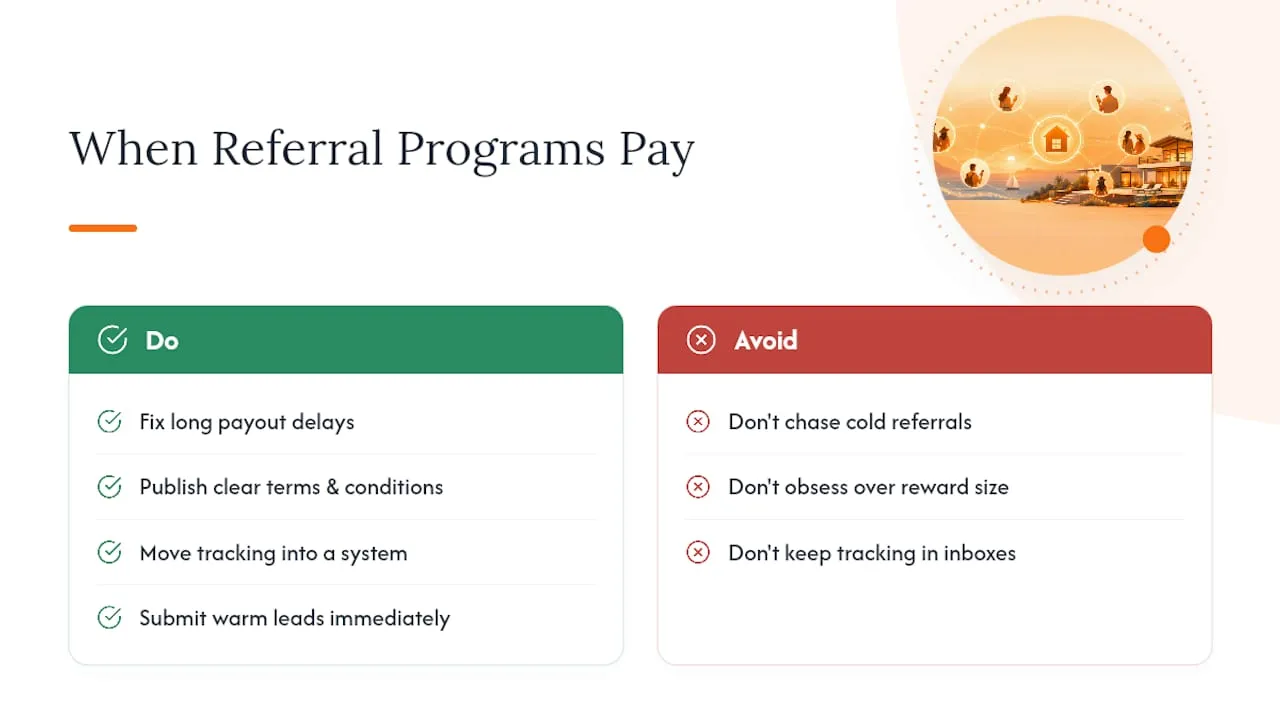
For managers building a program, the pitfalls are predictable: payouts that drag on for months, terms and conditions nobody reads until there’s a dispute, and tracking that lives in someone’s inbox instead of a system. Fix those three things before you worry about reward size.
If you’re an owner with a warm lead, submit it today rather than waiting for the perfect moment, following guidelines on how to make a qualifying referral.
— Jose Villeda
A Quick Note on Automating Referral Tracking
Referral programs generate a lot of small, easy-to-lose details: who referred whom, what stage they’re in, and when a payout is actually due. The platform is built to keep that information attached to the owner record instead of buried in email, so nothing slips through when you’re juggling referrals across a growing portfolio.

The Command Center gives you one dashboard for owner communications, automated payout alerts tied to activation milestones, and reporting templates you can adapt for your own referral terms. If you’re already running multiple properties and thinking about launching a referral program instead of just joining one, it’s worth seeing how the automation handles the tracking side before you write your own terms and conditions. You can start a free trial and connect your first properties in under an hour.
Where to Verify Program Terms and Rewards
The examples throughout this article come from published program pages, and terms change more often than most owners expect, so verify current details before you submit a referral or promise a reward to anyone.
- Owner for form-based submission and payout-after-activation wording
- Booking.com’s Property Referral Program for platform-level eligibility rules
- Evolve’s referral program for activation windows and listing-live requirements
- GPS Renting’s owner referral program for rent-triggered credit payouts
Always check for state-specific restrictions and referral caps before assuming a program applies to your situation.
Sources
- Owner
- Our Property Referral Program explained - Booking.com
- Referral | Evolve
- Owner Referral Program | GPS Renting