Rental Operations Scaling Process: A 2026 Guide
Master the rental operations scaling process in 2026. Learn key systems, automation, and team strategies to effortlessly grow your portfolio!
Rental Operations Scaling Process: A 2026 Guide
Growing a vacation rental portfolio sounds straightforward until you’re fielding six guest messages at midnight, chasing a vendor who hasn’t shown up, and realizing your new property still doesn’t have a cleaning checklist. The rental operations scaling process breaks down for most managers not because they lack ambition, but because they add units before adding systems. This guide walks you through the preparation, execution, automation, and verification steps that separate operators who burn out at five properties from those who run 50 with a lean, high-performing team.
Table of Contents
- Key takeaways
- The rental operations scaling process starts with your foundation
- Automation and technology for growing rental operations
- Step-by-step scaling from 1 property to 10 or more units
- Common pitfalls when scaling rental operations
- Measuring success after you scale
- My honest take on scaling rental operations
- How Realtevoos powers your rental operations growth
- FAQ
Key takeaways
| Point | Details |
|---|---|
| Systems before properties | Document workflows for guest communication, maintenance, and compliance before acquiring each new unit. |
| Automate the repetitive | Rent collection and maintenance routing are the fastest wins and should be automated within the first 30 days. |
| Layer your team support | Combine daytime decision teams with after-hours triage and remote support to handle volume without burning out staff. |
| Measure automation success | Track weekly dashboards targeting a greater than 95% automation success rate and optimize monthly. |
| Use a single source of truth | Centralize SOPs, templates, and property data to maintain quality across every unit you manage. |
The rental operations scaling process starts with your foundation
Most property managers hit a wall around properties four or five. Response times slip, maintenance falls through the cracks, and the owner calls you instead of the other way around. The problem is almost never the number of properties. It’s the absence of documented, repeatable processes.
Scalable operators document guest communication workflows, maintenance intake procedures, and compliance processes before adding new units, separating high-value work from repetitive tasks and layering 24/7 coverage to reduce team stress. That separation matters more than most managers realize. You should not be the one answering check-in questions at 10 p.m. That task belongs in a documented, templated workflow that anyone on your team can execute.
Separating high-value from repetitive work
Think of your daily tasks in two buckets. High-value work includes owner communication, pricing strategy, and vendor relationship management. Repetitive work includes FAQ responses, booking confirmations, and maintenance ticket creation. Once you label them honestly, it becomes clear which tasks need a human decision and which need a documented process or automated trigger.
A centralized operations manual with standardized onboarding and quality control analytics helps scale short-term rental operations without sacrificing guest experience. Build that manual before you need it. Store your SOPs, photo libraries, house rules, and vendor contacts in one shared location that your entire team, including remote staff, can access and update.
Pro Tip: Create a standardized property intake form for every new unit you onboard. Capture parking details, WiFi credentials, access instructions, appliance quirks, and local amenity recommendations. This single document feeds your guest messaging templates and prevents generic, inaccurate replies.
A layered 24/7 support model works best when you define escalation rules clearly. Tier one handles common guest questions using templates. Tier two handles property-specific issues or complaints. Tier three, which is you or a senior manager, handles emergencies, owner concerns, and anything that deviates from standard protocol.
Automation and technology for growing rental operations
Once your foundation is documented, automation becomes a force multiplier rather than a band-aid. Without documented workflows, automation just speeds up chaos. With them, it frees your team to focus on the work that actually grows the business.
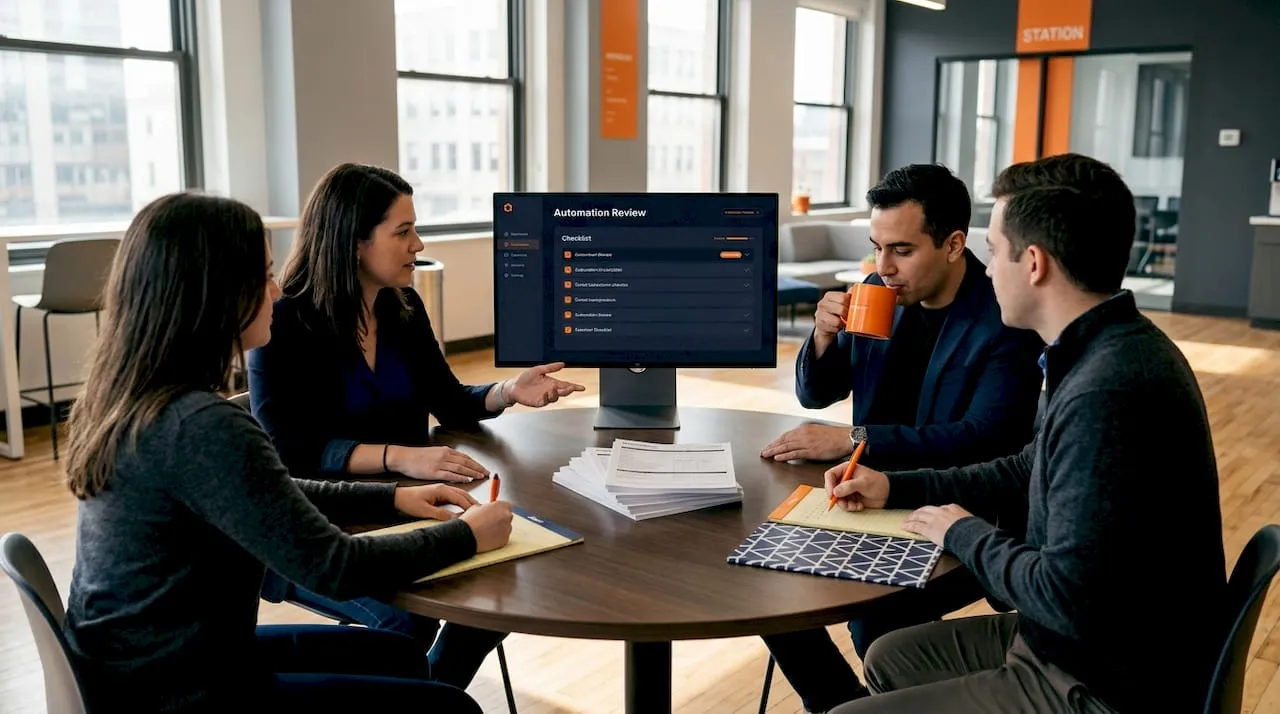
Start with an audit. Walk through every recurring manual task your team performs and flag the ones that happen frequently, follow a predictable pattern, and don’t require judgment. You will likely find 15 to 25 tasks that qualify. Rent collection automation reduces time spent on reminders and late notices, while maintenance routing automates vendor notifications based on issue type and urgency, substantially reducing response times. These two are your quickest wins.
A staged rollout that actually works
Rushing automation implementation is one of the most common reasons it fails. A staged approach gives you time to measure, adjust, and build team confidence before rolling out more complex workflows.
- Weeks 1 to 4: Deploy rent collection automation and basic maintenance request routing. Set up your dashboard to track success rates daily.
- Weeks 5 to 8: Add automated guest messaging for pre-arrival, check-in, and check-out sequences. Integrate with your property management system as the central data source.
- Weeks 9 to 12: Layer in AI-assisted messaging for mid-stay inquiries, dynamic pricing triggers, and predictive maintenance alerts. Human review stays in place for all outbound guest communication.
| Automation type | Implementation timeline | Target success rate |
|---|---|---|
| Rent collection | Weeks 1 to 2 | Greater than 98% |
| Maintenance routing | Weeks 2 to 4 | Greater than 95% |
| Guest messaging sequences | Weeks 5 to 8 | Greater than 95% |
| AI-assisted guest replies | Weeks 9 to 12 | Greater than 90% with human review |
Quick-win automations like rent collection and maintenance routing can go live in 2 to 4 weeks, with full Level 3 automation completed in 60 to 90 days, monitored via weekly dashboards targeting greater than 95% success rates and monthly optimizations for lower rates.
For guest messaging specifically, teams centralize messages in a unified inbox and add AI drafting tools at 10 or more properties, using standardized property intake forms capturing details like parking, access, and house rules to feed AI drafts that are approved or edited before sending. That human review layer is not optional. It is what keeps your response quality consistent as volume grows.
Pro Tip: Never activate AI-assisted guest messaging without a property-specific knowledge base loaded into the system. Generic AI replies are worse than a delayed human response. Guests notice immediately when a message doesn’t match the actual property.
Step-by-step scaling from 1 property to 10 or more units
This is where the rental operations scaling process becomes concrete. Follow these steps sequentially rather than in parallel. Skipping steps creates the exact operational chaos you are trying to avoid.
-
Max out your first property. Before acquiring property two, your first unit should be hitting occupancy targets, generating clean owner reports, and running with documented SOPs for every operational touchpoint. If you can’t run one property efficiently, you can’t run ten.
-
Standardize your intake process. Build a property onboarding form that captures every operational variable: parking logistics, access method, appliance brands and quirks, emergency contacts, vendor preferences, and listing photo requirements. Every new property gets the same form before it goes live.
-
Add listings only after your foundation is stable. This means your unified inbox is live, your maintenance routing is automated, your cleaning team has a standardized turnover checklist, and your owner reporting is templated. Adding a property before these are in place means you will manually manage every exception.
-
Extend your team with remote operational support. Layered guest communication includes daytime decision teams and after-hours triage, while remote operational support can manage guest inboxes, maintenance coordination, and back-office tasks, enabling internal teams to focus on growth. Remote support is not a compromise. It is how you scale communication coverage without adding full-time local hires for every market you enter.
-
Deploy automation strategically at each growth stage. Don’t automate everything at once. Add automation layers as your portfolio grows, so each layer is tested and validated before the next one is added.
-
Monitor KPIs weekly without exception. Track guest response SLA compliance, maintenance ticket resolution times, rent collection rates, and automation success rates. These numbers tell you where your system is breaking before guests or owners do.
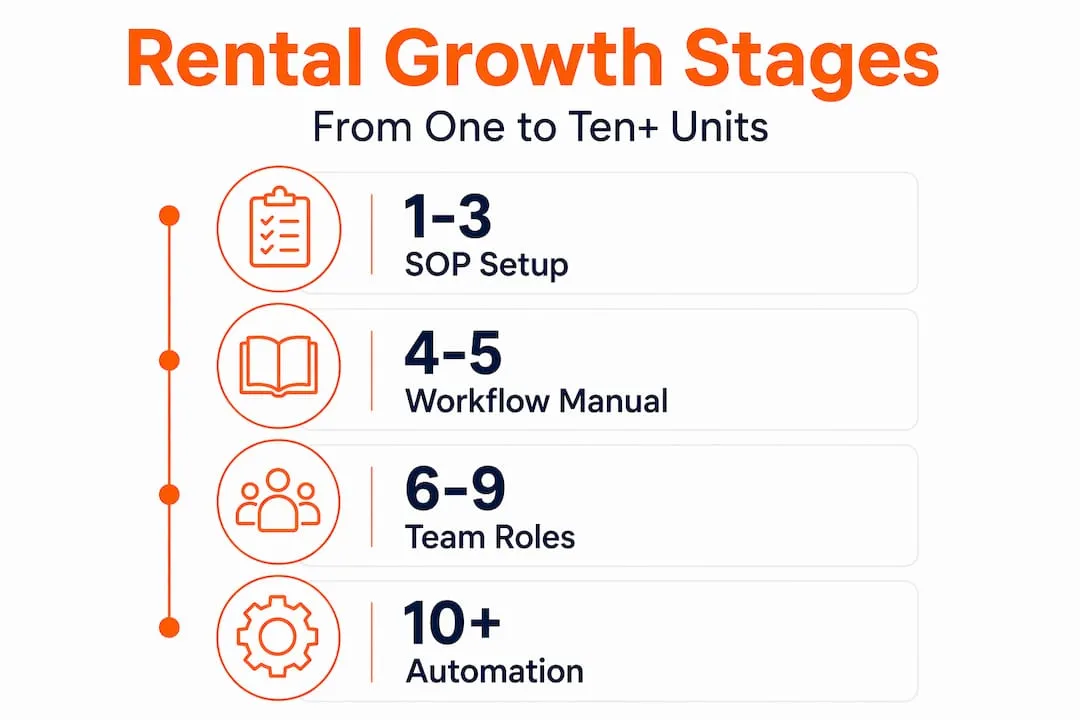
| Growth stage | Key focus area | Primary KPI |
|---|---|---|
| 1 to 3 properties | SOPs and documentation | Response time under 1 hour |
| 4 to 6 properties | Automation layer 1 (collection, routing) | Automation success rate greater than 95% |
| 7 to 10 properties | Unified inbox and remote team integration | Ticket resolution under 4 hours |
| 10 or more properties | AI messaging and dynamic pricing | Occupancy rate and owner retention |
Common pitfalls when scaling rental operations
Even well-intentioned managers make the same mistakes when they start to grow. Knowing these in advance is the difference between a rough quarter and a full operational breakdown.
The most expensive mistake is confusing adding staff with scaling operations. Scaling is not about simply adding more staff but about systematizing operations and strategically extending teams with automation and remote support. Hiring a third coordinator when your intake process is broken just means three people are confused instead of two.
Other pitfalls that consistently derail growing operators:
- Duplicative inboxes. When messages from Airbnb, Vrbo, and direct bookings land in separate places, response consistency collapses. A unified inbox is not a nice-to-have at five or more properties. It is a requirement.
- Unmeasured automation. Deploying a tool and assuming it works is not a strategy. Technology ROI greatly improves when automation success is constantly measured and workflows optimized accordingly.
- Neglected quality control. Centralized SOPs don’t enforce themselves. You need regular audits of turnover quality, guest messaging accuracy, and maintenance resolution times to catch drift before it becomes a guest complaint or owner churn.
- No escalation path for after-hours issues. Guests expect rapid responses around the clock. Without a documented escalation protocol, your team improvises, and improvisation at scale leads to inconsistent guest experiences.
- Ignoring owner communication standards. As your portfolio grows, owner reporting and communication become as important as guest experience. Owners who feel uninformed leave, and replacing properties is far more costly than retaining them.
Scaling without systems doesn’t scale. It just spreads the same chaos across more properties.
Measuring success after you scale
Reaching 10 or 20 properties is not the finish line. It is the point where operational drift becomes your biggest risk. The properties you added six months ago may no longer meet the same standards as your original units if you haven’t built a review cycle into your process.
| KPI | Target threshold | Review frequency |
|---|---|---|
| Automation success rate | Greater than 95% | Weekly |
| Guest response SLA compliance | Greater than 98% within 1 hour | Weekly |
| Maintenance resolution time | Under 4 hours for urgent, 24 hours for standard | Weekly |
| Rent collection rate | Greater than 99% on-time | Monthly |
| Guest satisfaction score | Greater than 4.7 out of 5 | Monthly |
Microsoft’s Dynamics 365 ERP will deliver workflow orchestration from quoting to billing, enabling a single view of reservations, asset availability, and maintenance to enhance planning and limit avoidable downtime. The principle applies directly to vacation rental platforms. A single system of record eliminates the reconciliation overhead that kills efficiency at scale.
Monthly workflow reviews should go beyond looking at numbers. Read guest reviews for operational clues. A pattern of “the keypad was confusing” is a process problem. A pattern of “no one responded for two hours” is an SLA failure. Both are fixable, but only if you are looking for them.
Pro Tip: Set a monthly calendar block specifically for automation review. Pull your weekly dashboard data, identify any workflow with a success rate below 90%, and fix it before it compounds. An hour a month here saves dozens of hours in guest recovery later.
My honest take on scaling rental operations
I’ve watched operators with strong instincts and genuine hospitality talent completely fall apart at eight or ten properties. Not because they weren’t good at their jobs, but because they kept solving operational problems with more effort instead of better systems.
The most persistent myth I encounter is that technology alone will fix the scaling problem. It won’t. I’ve seen operators deploy expensive property management platforms and still manage everything manually because their underlying workflows were never documented. The platform just became another inbox to check.
What actually works is deceptively simple. Fix the foundation before you grow. Document every recurring task. Automate what is predictable. Layer human oversight on top of automation, not instead of it. Higher automation maturity correlates with an average ROI of 312% over three years with 4 to 7 months payback for portfolios above 50 units, primarily by reducing staff time and vacancy. That kind of return doesn’t come from buying software. It comes from using software inside a well-structured operational system.
The other thing I’d push back on is the idea that you need to hire locally for every new market. Remote operational support, when paired with local vendor relationships and documented SOPs, handles the majority of what a full-time local hire would do, at a fraction of the cost and with better consistency.
— Jose
How Realtevoos powers your rental operations growth
If you’re ready to put this framework into practice, Realtevoos was built for exactly this kind of growth. The platform acts as a centralized command center for your entire portfolio, connecting Airbnb, Vrbo, and direct booking channels into a unified management dashboard where guest messaging, maintenance routing, owner reporting, and operational KPIs all live in one place.
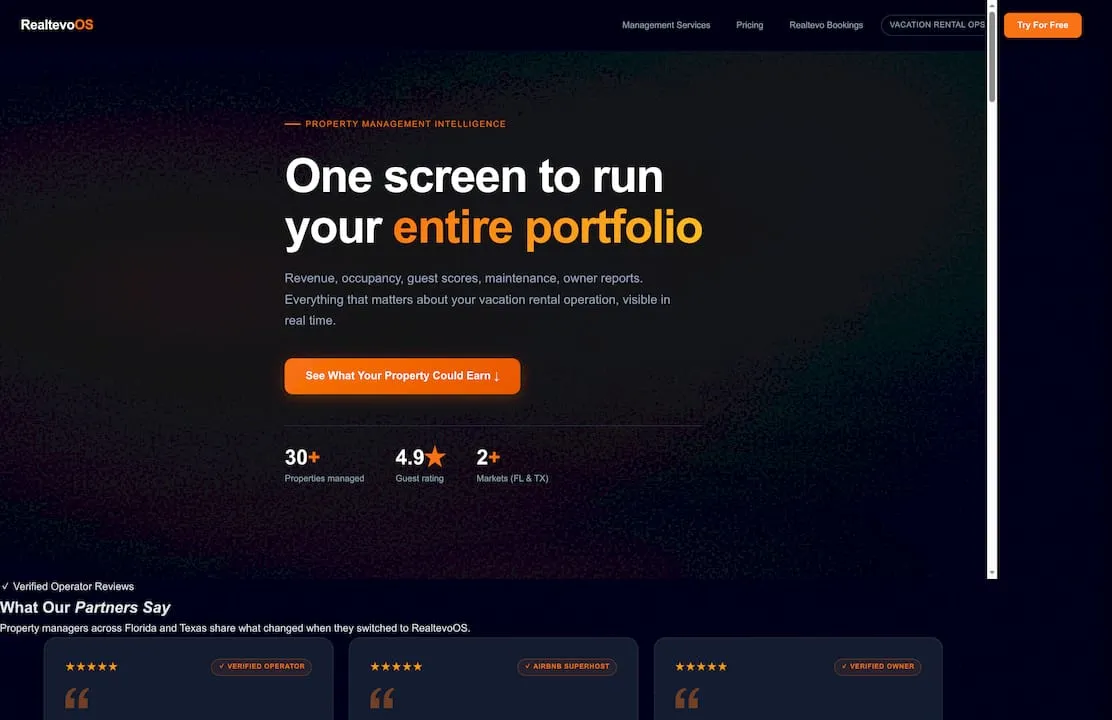
Realtevoos handles AI-assisted guest communication with property-specific knowledge bases and human approval workflows built in, so your response quality stays consistent as your volume grows. Automated maintenance escalation, rent collection tracking, and new property onboarding workflows mean your team spends time on decisions, not data entry. If you manage more than five vacation rental properties and want to grow without adding proportional overhead, Realtevoos gives you the operational infrastructure to do it.
FAQ
What is the rental operations scaling process?
The rental operations scaling process is a structured approach to growing a rental portfolio by standardizing workflows, deploying automation, and layering team support before adding new properties. It focuses on building systems that maintain service quality as volume increases.
How many tasks can be automated in rental management?
Most property managers can identify 15 to 25 recurring manual tasks suitable for automation, with rent collection and maintenance routing delivering the fastest returns and typically going live within two to four weeks.
What metrics should I track when scaling rental operations?
Track automation success rate, guest response SLA compliance, maintenance resolution times, rent collection rates, and guest satisfaction scores on a weekly and monthly basis to catch operational drift before it affects guests or owners.
When should I add new properties to my portfolio?
Add new properties only after your existing units run with documented SOPs, a unified inbox, automated maintenance routing, and templated owner reporting. Adding units before these systems are in place multiplies management complexity rather than scaling it.
How does AI-assisted guest messaging work at scale?
AI-assisted guest messaging requires a property-specific intake data layer and a human review step before messages are sent. This combination maintains accuracy and prevents the generic replies that damage guest trust and review scores.