Rental Channel Integration: What Every Vacation Rental Manager Must Know
Discover the definition of rental channel integration and how it prevents double bookings while simplifying your vacation rental management.

Rental Channel Integration: What Every Vacation Rental Manager Must Know
Rental channel integration is the automated connection between your property management system (PMS) and booking platforms like Airbnb, Vrbo, and Booking.com, so that availability, rates, and reservations stay synchronized across every channel without manual updates. For vacation rental managers, this single capability prevents double bookings, centralizes rate control, and turns a fragmented multi-platform operation into one coordinated system. This article covers the core technical types (API, iCal, webhooks), the data fields that sync, the real benefits and risks, and a step-by-step implementation checklist you can act on today.
Table of Contents
- What does rental channel integration actually mean for your business?
- How does channel integration actually work under the hood?
- What data fields does channel integration sync?
- Which integration model fits your portfolio size?
- What are the real benefits and risks of channel integration?
- How do you read a connectivity matrix and verify API depth?
- How do you choose the right channel manager?
- How do you implement a channel connection safely?
- What do real-world scenarios look like?
- What has changed in channel management by 2026?
- Key Takeaways
- The part most managers skip
- Realtevoos handles the complexity so you can focus on growth
- Useful sources
What does rental channel integration actually mean for your business?
The technical definition is clean. The operational reality is where it gets interesting. When your channels are properly integrated, every booking made on Airbnb instantly blocks that date on Vrbo and Booking.com. Your nightly rate update in the PMS pushes out to all platforms within seconds, not hours. Guest details flow back automatically into your reservation log. You stop living in spreadsheets.
Here is what that translates to in daily operations:
- No more manual calendar updates. One source of truth drives every platform’s availability.
- Fewer pricing errors. Rate changes apply across channels simultaneously, reducing the risk of rate parity violations.
- Faster reservation processing. Bookings from any OTA land in your PMS automatically, triggering confirmations and task workflows.
- Cleaner reporting. Revenue and occupancy data consolidates in one place instead of being scattered across five dashboards.
- Wider distribution without extra labor. Adding a new channel takes configuration time, not ongoing manual effort.
Your rental channel strategy also connects directly to revenue tasks. Rate parity and channel-specific markup management become manageable when a single pricing engine pushes to all OTAs. Distributing across at least four major channels reduces income risk from any single platform’s algorithm changes or policy shifts.
Pro Tip: If you manage even two properties on two platforms, you already need channel integration. The math on manual updates breaks down fast: two properties × three platforms × daily rate checks = a part-time job.
Portfolio size shapes how urgently you need it. A single owner with one or two listings can survive on iCal for a while. A mid-size manager running 4–20 properties needs real-time API sync to stay competitive. A scaling operator above 20 properties who lacks full integration is actively leaving revenue on the table and absorbing preventable operational risk.
How does channel integration actually work under the hood?
Three technical mechanisms power rental channel integration, and they are not interchangeable.

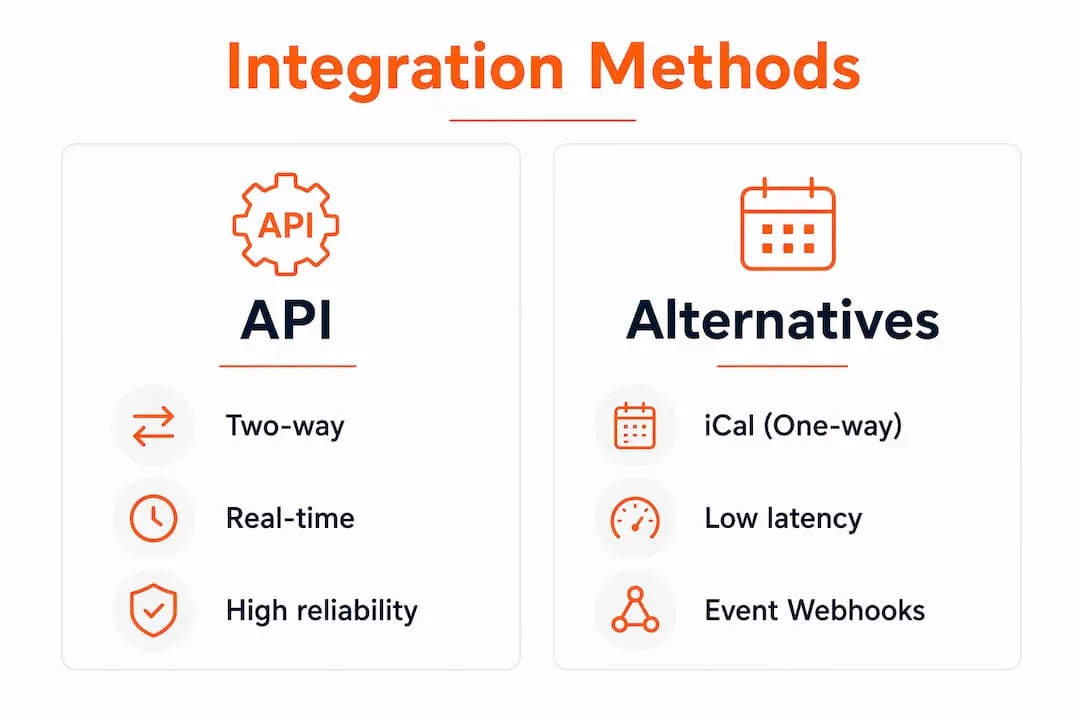
API (Application Programming Interface) is the gold standard. A two-way API connection lets your PMS push rate and availability updates to an OTA and pull confirmed reservations back, all in near real time. Most major platforms, including Airbnb, Vrbo, and Booking.com, offer API connectivity to certified channel managers. APIs provide two-way, near-real-time sync for rates, availability, and reservations, making them the most reliable option for active portfolios.
iCal is a calendar-sharing protocol that exports a read-only feed of blocked dates. It is one-directional, updates on a polling schedule (typically every 15–60 minutes), and carries no rate or guest data. It is a fallback, not a strategy.
Webhooks are event-driven notifications. Instead of your system polling an OTA every few minutes to check for new bookings, the OTA pushes a notification the moment a booking occurs. Webhooks reduce latency significantly and are increasingly common in modern API integrations as a complement to standard REST calls.
| Sync method | Typical latency | Data types supported | Reliability / risk |
|---|---|---|---|
| Two-way API | Seconds to 2 minutes | Availability, rates, reservations, guest details, content | High reliability; requires certified connectivity |
| iCal | 15–60 minutes | Availability (blocked dates) only | Moderate to high overlap risk; no rate sync |
| Webhooks | Near-instant (event-driven) | Booking events, cancellations, modifications | High reliability; depends on OTA support |
The data flow works like this: your PMS holds the master record. The channel manager sits between the PMS and the OTAs, translating your data into each platform’s required format and pushing updates outward. When a guest books on Booking.com, the reservation travels back through the channel manager into your PMS, which then triggers your automated workflows (cleaning schedules, guest messaging, accounting entries).
Latency matters more than most managers realize. A 30-minute iCal delay during a high-demand weekend is long enough for a double booking to occur. For data integration in rental management, real-time API sync is not a premium feature. It is the baseline requirement for any portfolio with consistent booking volume.
What data fields does channel integration sync?
Not everything syncs equally across all platforms. Here is what a well-configured channel manager typically handles, and where the limits appear.
| Data field | Typically synced | Common platform limits |
|---|---|---|
| Availability / calendar | Yes, all major OTAs | iCal syncs dates only; no rate data |
| Nightly rates | Yes via API | Some OTAs require rate plans set natively |
| Minimum stay restrictions | Yes | Platform minimums may override your settings |
| Fees (cleaning, pet, etc.) | Partial | Airbnb and Vrbo handle fees differently; some fee types must be set in the OTA dashboard |
| Taxes | Partial | Many OTAs collect and remit taxes independently; verify per market |
| Reservations / guest details | Yes via API | Guest contact info often masked by OTA until check-in |
| Listing content (photos, descriptions) | Yes, initial push | Character limits vary; Airbnb caps descriptions differently than Booking.com |
| Policies (cancellation, house rules) | Partial | Some policy fields are OTA-controlled and cannot be overridden via API |
| Guest messaging | Partial | Automated templates sync; full thread history often stays within the OTA inbox |
Guest messaging is worth a specific note. Most channel managers can trigger automated messages (check-in instructions, welcome notes) via the OTA’s messaging API, but the full conversation thread typically lives inside the OTA’s platform. You get automation, not full portability.
Which integration model fits your portfolio size?
The right approach depends on where you are today and where you are going.
1–3 properties: A PMS with a built-in channel manager is usually sufficient. Tools like Guesty offer entry-level plans that handle the major OTAs without requiring a separate channel management layer. iCal is acceptable as a temporary bridge for niche platforms not yet on your PMS’s API list, but treat it as a short-term workaround.
4–20 properties: This is where a dedicated channel manager earns its cost. Built-in channel managers inside PMS solutions are often sufficient for portfolios under roughly 200 units, but mid-size operators benefit from the broader channel coverage and deeper API connectivity that standalone tools like Rentals United provide. The key advantage: access to specialty channels (extended stay, luxury, metasearch) that a basic PMS integration may not cover.
20+ properties: At this scale, the channel manager becomes a revenue infrastructure decision, not just a convenience. You need:
- Full two-way API connectivity to all active channels
- Rate parity monitoring and channel-specific markup capability
- Audit logs and conflict resolution tools
- Support SLAs with defined response times
Pros and cons by model:
- PMS-native channel manager: Lower cost, fewer vendor relationships, simpler setup. Cons: limited channel list, less flexibility for specialty OTAs.
- Standalone channel manager (e.g., Rentals United): Broader connectivity, deeper API depth, revenue tools. Cons: additional subscription cost, one more integration to maintain.
- Direct OTA API integrations: Maximum control and data fidelity. Cons: requires developer resources, each OTA’s certification process takes time.
- iCal fallback: Zero cost, easy setup. Cons: high overlap risk, no rate sync, unsuitable for active portfolios.
Vendor lock-in is a real consideration. Before committing to any platform, confirm you can export your property data and reservation history if you switch.
What are the real benefits and risks of channel integration?
The benefits of a well-executed rental channel strategy are concrete. Time savings come first: managers running multi-channel booking management without automation report spending hours each week on manual calendar and rate updates. Proper integration reclaims that time. Distribution breadth follows: listing on at least four major channels increases booking volume without proportionally increasing workload, because the channel manager handles the synchronization. Revenue optimization is the third lever. Channel-specific markups let you test profitability across platforms, and applying channel markups within your pricing engine is a standard practice among experienced operators.

The risks are equally real, and ignoring them is expensive.
Sync delays remain the most common failure point. Even API connections experience occasional latency spikes. A booking that takes two minutes to propagate during peak season can collide with a second booking on another channel. Monitor your sync logs daily during high-demand periods.
Incorrect property mapping causes silent errors. If your PMS property ID does not correctly map to the OTA listing ID, updates may push to the wrong listing or fail silently. Run a mapping verification test before going live on any new channel.
Rate parity penalties are an OTA-enforced risk. If your rates on a direct booking site undercut your OTA rates, platforms like Booking.com can suppress your listing or remove it. Understand each platform’s rate parity clause before setting channel-specific pricing.
Delisting risk is the most severe outcome. Repeated double bookings or policy violations can trigger automatic delisting from Airbnb or Vrbo. A single preventable double booking from a misconfigured sync is enough to damage your standing on a platform that drives significant revenue.
Pro Tip: Before activating any new channel connection, block a test date in your PMS and confirm within two minutes that the block appears on every connected OTA. This 60-second check catches mapping errors before a real guest does.
How do you read a connectivity matrix and verify API depth?
A connectivity matrix is a vendor’s published table showing which channels they connect to and at what level of integration. Reading it correctly separates real coverage from marketing claims.
API depth refers to how many data fields a connection actually supports, not just whether a connection exists. A vendor might list Booking.com as a supported channel, but the connection may only sync availability, not rates or content. Ask specifically: which fields are read-only, which are write-enabled, and which require manual entry in the OTA dashboard?
“Real-time” in vendor marketing often means “within our polling cycle,” which could be 5 minutes or 30 minutes. Ask for the actual sync frequency in seconds or minutes, not a marketing label.
Here is a simplified connectivity matrix to use during vendor evaluation:
| Channel | Availability sync | Rate sync | Reservation pull | Content push | Sync frequency |
|---|---|---|---|---|---|
| Airbnb | API (two-way) | API (two-way) | API (two-way) | API (one-way) | Near real-time |
| Vrbo | API (two-way) | API (two-way) | API (two-way) | API (one-way) | Near real-time |
| Booking.com | API (two-way) | API (two-way) | API (two-way) | API (one-way) | Near real-time |
| Niche OTA (example) | iCal | Manual | Email notification | Manual | 15–60 min |
Verification steps to run during any vendor demo:
- Map test: Confirm your PMS property ID maps correctly to each OTA listing ID.
- Live booking test: Make a test reservation on one channel and verify it blocks in the PMS and on all other channels within the vendor’s stated latency window.
- Rate update test: Change a rate in the PMS and time how long it takes to appear on each OTA.
- Error log review: Ask to see the error log interface. A vendor with no visible error logging has no way to alert you when a sync fails.
How do you choose the right channel manager?
Start with non-negotiables, then evaluate the rest.
Must-haves before anything else:
- Two-way API connectivity to your top three revenue channels (Airbnb, Vrbo, Booking.com at minimum)
- Accurate property mapping with a visible audit trail
- Real-time or near-real-time sync (under 5 minutes for availability)
- Error alerting and a queryable sync log
- Support with defined response-time commitments
Questions to ask during demos:
- How does your system handle a conflict when two bookings arrive simultaneously on different channels?
- What is your escalation path when a sync failure causes a double booking?
- How often do you release API updates when Airbnb or Vrbo changes their endpoints?
- What are your support hours, and is phone support included or a paid add-on?
Pricing considerations: Channel managers typically charge per property per month, as a percentage of booking revenue, or a hybrid. Per-unit pricing is easier to forecast; percentage-based pricing scales with your revenue but can become expensive at high occupancy. Always calculate total cost of ownership including setup fees, per-channel activation fees, and the cost of adding channels as you grow. A low base price with high per-channel fees can exceed a higher flat rate within months.
How do you implement a channel connection safely?
Follow this sequence to minimize risk during any new channel integration.
- Audit your PMS data. Confirm that property details, rates, restrictions, and photos are complete and accurate in the PMS before connecting any channel. Garbage in, garbage out.
- Set up your channel manager account and complete the provider’s onboarding steps: connect your API credentials, enter your OTA account details, and verify your property IDs.
- Map each property to its OTA listing. Double-check every ID match. A single transposed character in a property ID causes silent sync failures.
- Configure fees, taxes, and policies per channel. Reconcile these as separate steps, since OTAs handle fee structures differently.
- Run a sandbox or test booking. Make a reservation on one OTA using a test account and confirm it appears in your PMS within the vendor’s stated latency window.
- Block a test date in the PMS and verify the block propagates to all connected channels within two minutes.
- Soft launch with one channel before activating all connections simultaneously. This isolates any mapping errors to a single platform.
- Activate remaining channels one at a time, running the rate update test and booking test for each.
- Set up monitoring alerts. Configure your channel manager to notify you of sync errors via email or SMS. Check the error log daily for the first two weeks.
Testing checklist before going fully live:
- Single-night booking test on each channel
- Blocked-date propagation test (PMS → all OTAs)
- Rate update test (PMS → all OTAs, timed)
- Cancellation flow test (cancel on OTA, verify PMS updates)
- Guest details receipt test (confirm reservation data lands in PMS correctly)
If a sync error occurs post-launch, your first call is to your channel manager’s support team, not the OTA. The channel manager owns the connection; they have the tools to diagnose it.
What do real-world scenarios look like?
Scenario 1: Single owner, 2 properties. A host managing two beach cottages on Airbnb and Vrbo manually updates calendars today. A PMS with a built-in channel manager (Guesty’s starter tier, for example) handles both platforms via API for a predictable monthly fee. The immediate win: no more Sunday-night calendar reconciliation. The trigger to revisit: adding a third platform or a third property.
Scenario 2: Mid-size manager, 12 properties. A property manager running a dozen urban apartments across Airbnb, Vrbo, Booking.com, and a direct booking site needs rate parity monitoring and channel-specific markup tools. A standalone channel manager like Rentals United, connected to an existing PMS, provides the broader channel list and revenue tools a basic PMS integration lacks. The trigger to revisit: crossing 20 properties or adding extended-stay channels.
Scenario 3: Scaling operator, 35+ properties. At this scale, the channel manager is mission-critical infrastructure. The operator needs:
- Full API depth on all active channels
- Automated conflict resolution with a clear audit trail
- Support SLAs and a dedicated account contact
- Integration with a multi-market management strategy across different cities or regions
The trigger to revisit: any acquisition that adds a new property type (long-stay, luxury) requiring specialty channel coverage.
Across all three scenarios, direct bookings deserve protection. Channels fill demand, but direct bookings preserve margin and guest relationships. A healthy channel mix includes OTAs for volume and a direct booking site for retention.
What has changed in channel management by 2026?
Channel management has shifted from preventing double bookings to acting as a revenue engine using data-driven distribution and dynamic pricing. The basic sync problem is largely solved. The competitive edge now lives in how intelligently you distribute.
The channel manager market has grown substantially, reflecting how central this infrastructure has become to professional vacation rental operations. Modern platforms now provide revenue coaching, demand forecasting, and distribution planning tools alongside the core sync function.
One shift that separates high-performing operators from the rest: platform-specific content optimization. Copying the same listing description across every OTA is a visibility penalty. Airbnb’s algorithm rewards experiential, story-driven descriptions. Booking.com’s conversion signals favor amenity lists and price clarity. The operators winning on both platforms write for each one separately. AI-driven tools in travel booking are accelerating this trend, making personalized content at scale increasingly achievable for mid-size managers.
Pro Tip: Audit your top three OTA listings right now. If the description is identical across Airbnb, Vrbo, and Booking.com, you are leaving ranking points on the table. Rewrite each one to match the platform’s conversion signals, and watch your click-through rate respond within 30 days.
Key Takeaways
Rental channel integration is the single most impactful operational decision a vacation rental manager can make: it prevents double bookings, centralizes rate control, and turns multi-platform distribution from a manual burden into an automated revenue system.
| Point | Details |
|---|---|
| API sync is non-negotiable | Two-way API connections update availability and rates in seconds; iCal introduces 15–60 minute delays and double-booking risk. |
| Map before you launch | Verify every PMS-to-OTA property ID match before activating any channel connection. |
| Diversify your channel mix | Listing across at least four major channels reduces income risk from any single OTA’s policy changes. |
| Optimize content per platform | Airbnb rewards experiential descriptions; Booking.com converts on amenity and price clarity. Identical copy hurts ranking on both. |
| Realtevoos centralizes the operation | Realtevoos consolidates multi-channel data, AI-driven automation, and real-time dashboards into one command center for vacation rental managers. |
The part most managers skip
Most of the conversation around rental channel integration focuses on setup: which tool, which channels, which API. That is the right starting point. What gets skipped is the ongoing discipline of treating your channel manager as a live system that needs monitoring, not a set-it-and-forget-it installation.
The operators who get the most out of channel integration are the ones who check their sync logs weekly, run a rate propagation test after every pricing change, and audit their OTA listing content quarterly. The technology does the heavy lifting, but it rewards the managers who stay engaged with it.
One practical habit worth building: set a recurring calendar reminder every 90 days to review your channel mix, your mapping configuration, and your per-platform content. OTAs update their algorithms and API requirements regularly. A configuration that worked perfectly in January may need a small adjustment by April. Staying ahead of those changes is the difference between a channel manager that pays for itself and one that quietly creates problems you discover only after a guest complaint.
The vacation rental revenue tips that consistently outperform are not exotic. They are the basics, executed with consistency: real-time sync, accurate mapping, platform-specific content, and a direct booking channel running alongside your OTA mix.
Realtevoos handles the complexity so you can focus on growth
Managing channel integration across Airbnb, Vrbo, Booking.com, and your direct booking site means keeping a lot of moving parts synchronized. Realtevoos is built specifically for vacation rental managers who need that coordination handled automatically, without hiring a dedicated operations team to babysit it.
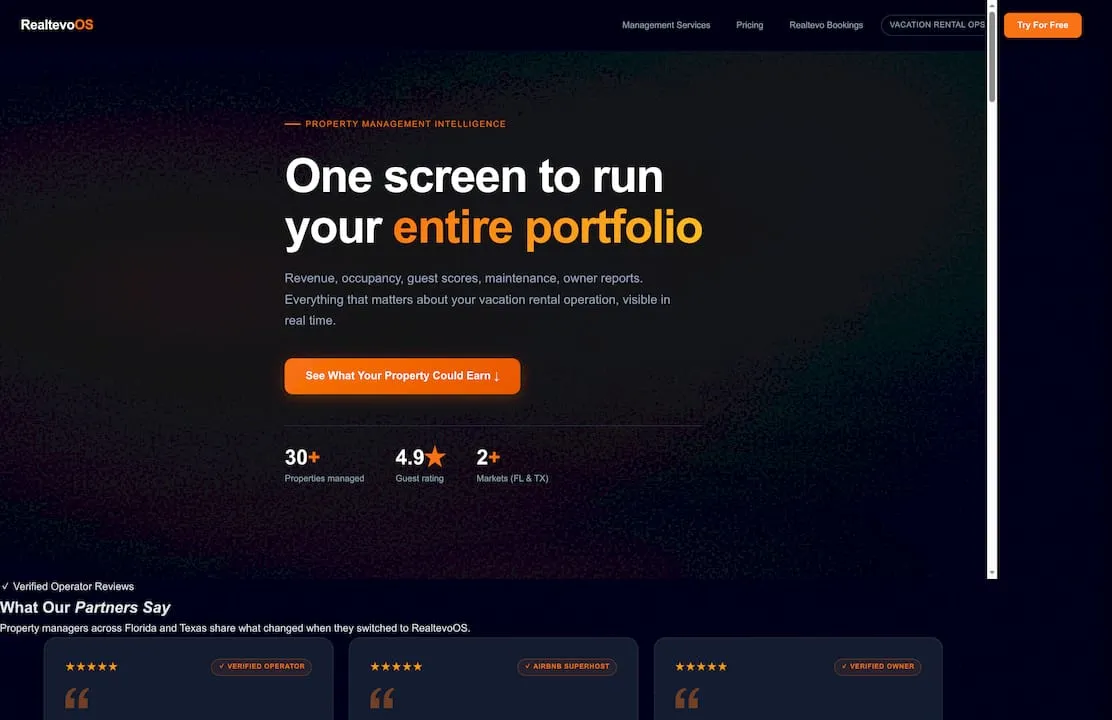
The Realtevoos management command center consolidates real-time data from all your connected channels into a single dashboard, so you see occupancy, rates, and reservation status across every property at a glance. AI-driven automation handles the routine tasks: rate adjustments, guest communications, and reporting that would otherwise eat hours each week. Property managers using Realtevoos report recovering several hours of manual labor per week, time that goes back into growing the portfolio rather than maintaining it.
Whether you manage 3 properties or 30, Realtevoos scales with your operation. Book a demo to see the mapping tools, sync monitoring, and AI automation in action for your specific channel setup.
Useful sources
- Rentals United: The 2025 Playbook for Short-Term Rental Distribution Growth — Revenue-first distribution strategy, platform-specific content optimization, and channel management evolution.
- Hostaway: How to Succeed with Multi-Channel Distribution — Practical onboarding steps, channel markup strategies, and diversification guidance.
- SendSquared: Vacation Rental Channel Manager — What It Does — Functional definition of a channel manager, API vs iCal trade-offs, and tech stack role clarity.
- Global Vacation Rentals: Channel Manager Definition — Market size context and accessible definition for operators new to channel management.
- Rentals United: The Ultimate Guide to Vacation Rental Distribution 2026 — Comprehensive channel type breakdown including OTAs, metasearch, specialty channels, and direct booking strategy.
- VRMA (Vacation Rental Management Association) — Industry standards, professional development, and operator resources for U.S. vacation rental managers.