AI Benefits for Rental Managers: 2026 Guide
Discover the AI benefits for rental managers in 2026. Save time, boost bookings, and enhance guest returns with smart automation.

AI Benefits for Rental Managers: 2026 Guide
AI in vacation rental management is defined as the use of machine learning and automation to handle screening, maintenance, communications, and pricing without manual intervention. The AI adoption rate among property management companies jumped from 20% to 58% in a single year, with firms reporting an average ROI of 312% over three years. For vacation rental property managers juggling multiple properties across platforms like Airbnb and Vrbo, the AI benefits for rental managers are no longer theoretical. They show up in hours saved, faster bookings, and guests who actually come back.
1. AI benefits for rental managers start with faster tenant screening
AI reduces application turnaround from 4–7 days to 24–48 hours, which means rental units fill 5.2 days faster on average. That speed directly cuts vacancy loss, which compounds quickly across a multi-property portfolio. For vacation rental managers, faster screening also means less time manually chasing documents and more time focused on guest experience.
Automation handles the repetitive parts of leasing workflows: collecting applications, verifying documents, scoring applicants against preset criteria, and sending status updates. Property managers who previously spent hours per applicant now review a ranked shortlist instead. The result is a higher application-to-lease conversion rate with less staff time per booking.
- AI scores applicants against custom criteria automatically
- Document requests and reminders go out without manual follow-up
- Managers receive ranked shortlists instead of raw application stacks
- Lead nurturing sequences keep prospective guests engaged during review
Pro Tip: Set your AI screening criteria to flag incomplete applications immediately rather than waiting for a human review cycle. Catching gaps on day one keeps your 24-hour turnaround target realistic.
2. Maintenance triage gets faster and smarter with AI
AI classifies maintenance requests by urgency the moment they arrive, routing work orders to the right vendor within minutes instead of hours. Response times drop from 48 hours to under 6 hours. That shift matters enormously in vacation rentals, where a broken air conditioner on a Friday night can trigger a one-star review before your on-call staff even sees the message.

The classification logic separates emergency requests (flooding, no heat, electrical faults) from routine ones (light bulb replacements, minor cosmetic issues) and dispatches accordingly. Vendors receive structured work orders with property details, access instructions, and photos attached. Managers get a status update without making a single phone call.
| Request type | Traditional response time | AI-assisted response time |
|---|---|---|
| Emergency (flooding, no heat) | 12–48 hours | Under 2 hours |
| Urgent (appliance failure) | 24–48 hours | 2–6 hours |
| Routine (cosmetic, minor) | 3–7 days | Same day scheduling |
Predictive maintenance adds another layer. AI flags patterns in request history, such as an HVAC unit that generates three service calls per season, and schedules preventive work before the next failure. That proactive approach reduces the total number of emergency requests over time.
Pro Tip: Connect your maintenance AI to your guest messaging system so guests receive an automatic update when a vendor is dispatched. That single message eliminates most follow-up calls.
3. Lease renewals and guest retention improve with AI insights
AI-driven renewal cadences speed up decisions by 30 days and push renewal rates roughly 7% higher. For a 250-unit property, that translates to approximately $55,000 in annual savings from reduced vacancy loss. In vacation rentals, the equivalent is repeat bookings: guests who rebook directly rather than returning to a listing platform.
The mechanism is early identification of at-risk guests. AI monitors booking patterns, review sentiment, and communication history to flag guests who are likely to churn before they actually do. Managers can then send a personalized offer or check-in message at exactly the right moment.
- Sentiment analysis on guest reviews surfaces dissatisfaction before it becomes a public complaint
- Automated renewal prompts go out at the optimal window, not whenever a manager remembers
- Personalized messaging replaces generic blast emails
- Booking history data identifies guests worth prioritizing for loyalty offers
The deeper advantage is what the industry calls “resident intent capture.” AI reads two-way conversations to understand what a guest actually wants, not just what they explicitly requested. That intelligence feeds proactive retention strategies that generic broadcast messaging cannot replicate. Managers who use AI for guest retention consistently outperform those relying on manual follow-up alone.
4. Automated communication cuts workload without cutting quality
Automated communication eliminates 31% of inbound “did you get my request?” messages and saves small teams up to 50 hours per month. Those hours represent real capacity: time that goes back into property improvements, guest relationship building, or simply managing more properties without adding headcount.
The automation covers the full guest communication cycle. Check-in instructions go out automatically at the right time. Maintenance status updates fire when a vendor is assigned. Post-stay review requests land within the optimal window after checkout. Every touchpoint happens on schedule, regardless of how busy the management team is that day.
- Automated check-in and checkout messaging with property-specific details
- Maintenance status updates sent directly to guests without manager involvement
- FAQ responses handled by AI assistants for common questions (Wi-Fi passwords, parking, trash pickup)
- Review request sequences timed to maximize response rates
Consistency is the underrated benefit here. A human team sends great messages on good days and slower, less complete messages when things get hectic. AI sends the same quality message every time. Guests notice that reliability, even if they cannot articulate why the experience felt polished. Explore how automation in property management translates directly into guest satisfaction scores.
5. AI tools for landlords work best when integrated across systems
Cross-system automation connecting your property management system, CRM, communication tools, and accounting software is what separates scalable AI from a collection of disconnected features. Siloed AI deployments create new inefficiencies: data lives in separate places, staff manually transfer information between tools, and the promised time savings never fully materialize.
The practical fix is integration. When a guest submits a maintenance request, the AI should log it in the PMS, dispatch a vendor, update the guest, and record the cost in accounting, all without a human touching the workflow. That chain only works when the systems talk to each other.
Successful AI deployment sequences follow a specific order: start with screening, then add maintenance triage, then layer in renewal automation. Each stage delivers measurable results before the next one begins. Attempting to automate everything at once causes data overload and erodes staff confidence in the tools.
The rollout sequence matters because each stage builds on the last. Screening automation creates clean applicant data. That data feeds better maintenance routing. Maintenance history informs renewal conversations. The whole system compounds in value as it matures.
6. Predictive analytics give rental managers a market edge
AI-driven rental market insights shift decision-making from reactive to forward-looking. Pricing models that adjust rates based on local demand, competitor occupancy, and seasonal patterns consistently outperform static pricing. Managers who rely on last year’s rates leave revenue on the table during peak windows and overprice during slow periods.
Predictive analytics also apply to staffing and supply planning. AI can forecast high-demand weekends based on local event calendars and booking velocity, giving managers time to schedule cleaning crews and restock supplies before the rush. That preparation shows up in guest reviews as “the property was spotless and fully stocked.”
The data advantage compounds over time. The longer an AI system runs on your property portfolio, the more accurate its predictions become. Early adopters who started building that data history in 2025 now have a meaningful edge over managers who are starting from scratch. For a deeper look at where this is heading, the AI trends shaping 2026 are worth understanding before your competitors do.
7. AI handles scale that human teams cannot
The core promise of AI solutions for property managers is the ability to grow a portfolio without growing headcount at the same rate. A manager running 10 properties manually hits a ceiling quickly. The same manager with AI handling screening, communications, and maintenance triage can realistically manage 30 or 40 properties with the same team size.
That scale comes from removing the tasks that consume disproportionate time relative to their complexity. Answering the same check-in question 15 times a week is not a skilled task. Manually copying applicant data from an email into a spreadsheet is not a skilled task. AI absorbs those tasks and frees the human team for work that actually requires judgment: handling a difficult guest situation, negotiating with a vendor, or deciding whether to add a new property to the portfolio.
Human oversight remains critical for sensitive decisions. AI classifies, drafts, and routes. A human approves anything involving legal exposure, significant financial decisions, or complex guest disputes. That division of labor is what makes AI a force multiplier rather than a liability.
Key takeaways
AI delivers the strongest results in vacation rental management when it handles high-volume, repeatable tasks while humans retain oversight of sensitive decisions.
| Point | Details |
|---|---|
| Faster screening pays off immediately | AI cuts turnaround from days to hours, filling units 5.2 days faster on average. |
| Maintenance triage reduces guest complaints | Response times drop from 48 hours to under 6 hours with automated routing. |
| Renewal automation protects revenue | AI-driven cadences boost renewal rates by roughly 7% and save $55K annually per 250-unit property. |
| Integration unlocks compounding value | Connecting PMS, CRM, and accounting tools turns isolated features into a full operational system. |
| Sequence your rollout | Start with screening, then maintenance, then renewals to avoid operational overload. |
What I’ve learned about deploying AI in vacation rental operations
The managers I see get the most out of AI are not the ones who automate the most. They are the ones who automate the right things first. Screening is always the right starting point. It is high volume, low risk, and the time savings are immediately visible. That early win builds team confidence and gives you clean data to feed the next stage.
The mistake I see repeatedly is treating AI as a replacement for human judgment on complex situations. A guest who is upset about a noise complaint at 11 PM needs a human response, not an automated template. AI handles bounded tasks well: classifying requests, drafting standard replies, routing work orders. The moment a situation requires reading emotional context or making a judgment call with legal implications, a human needs to be in the loop.
The insight that changed how I think about this is the concept of resident intent capture. The real value of AI is not just automating tasks. It is understanding what your guests actually want before they leave. That requires two-way conversation tools, not just outbound automation. Managers who build that capability now will have retention rates that are genuinely difficult for competitors to match.
Start small, measure everything, and expand only after each stage delivers clear results. That discipline separates the managers who build durable advantages from the ones who buy tools and wonder why nothing changed.
— Jose
Realtevoos: a command center built for vacation rental managers
Vacation rental managers who want AI benefits without stitching together a dozen separate tools have a direct path forward with Realtevoos.
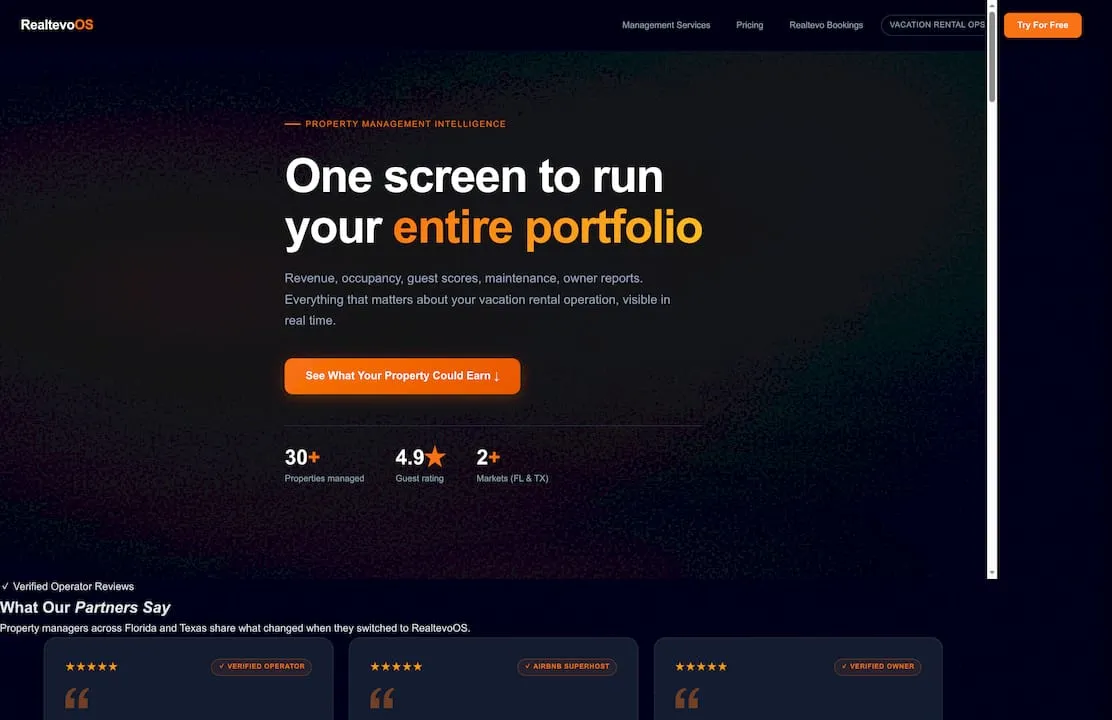
Realtevoos consolidates screening, maintenance, guest communications, and real-time data from Airbnb and Vrbo into a single dashboard. Property managers using the platform report saving several hours each week on manual tasks, with guest satisfaction improving through consistent automated communications. The platform is built to grow with your portfolio, so adding properties does not mean adding proportional workload. If you are ready to see what AI-driven rental management looks like in practice, Realtevoos is where that conversation starts.
FAQ
What are the main AI benefits for rental managers?
AI reduces screening time, automates guest communications, and routes maintenance requests faster. Property management firms report an average ROI of 312% over three years after adopting AI tools.
How does AI improve maintenance response times?
AI classifies maintenance requests by urgency and dispatches vendors automatically, cutting response times from 48 hours to under 6 hours. That speed directly reduces guest complaints and negative reviews.
Can AI replace property managers entirely?
AI handles repeatable, bounded tasks well but cannot replace human judgment on sensitive or legal decisions. Successful deployments keep humans in the loop for final approval on complex situations.
How should rental managers start with AI?
Start with screening automation first, then add maintenance triage, then layer in renewal cadences. Attempting to automate all workflows at once causes operational overload and reduces the measurable benefit of each stage.
Does AI work for small vacation rental portfolios?
AI delivers measurable benefits starting at 50+ units, but the communication and maintenance automation tools provide value even at smaller scales by saving staff hours on repetitive tasks.